日本語

David Sandler's Leadership Style: The Submarine System That Rewrote How B2B Sales Works

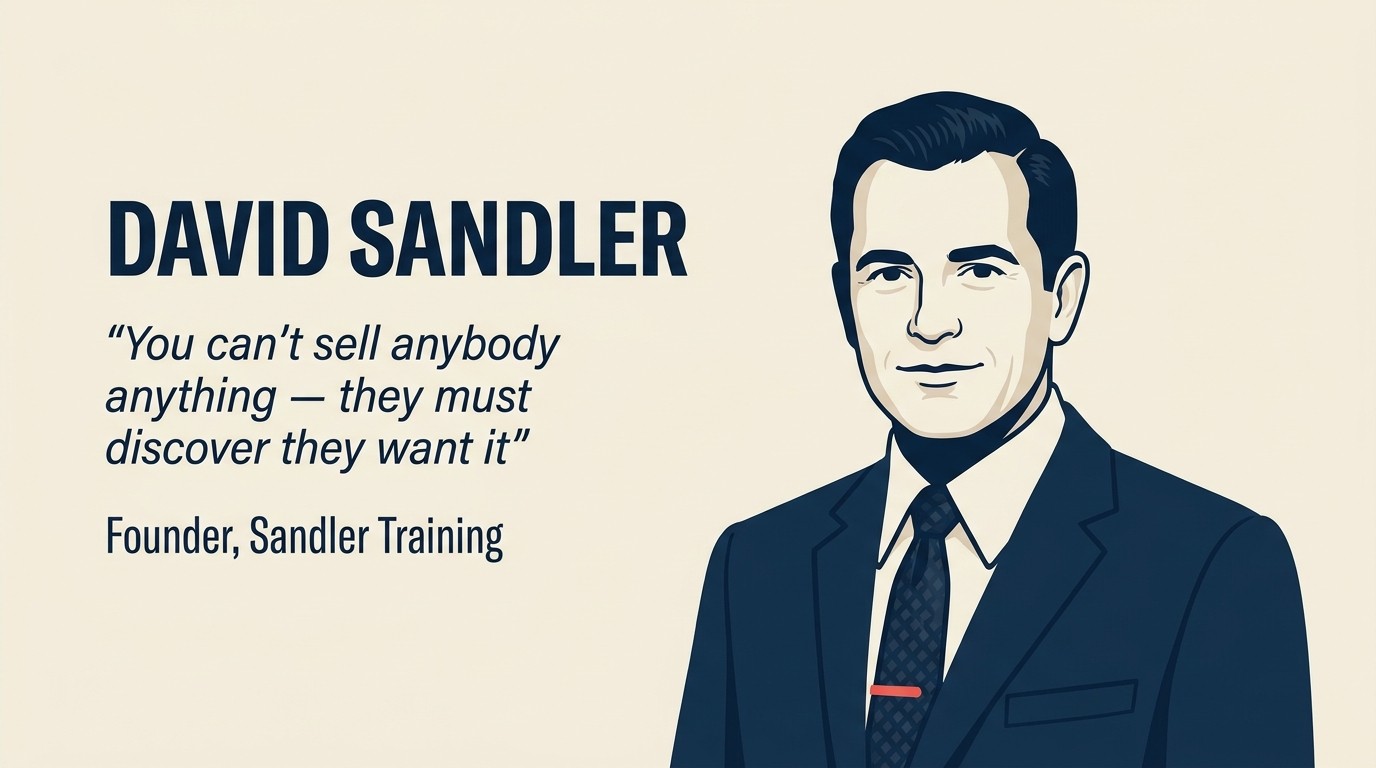
David Sandler Leadership Profile

Key Facts: David Sandler (1930-1995) founded Sandler Training in Baltimore in 1967 and developed the "Sandler Selling System," anchored by his "Submarine" method of sequenced qualification. The franchise he built now operates through 250+ offices worldwide. His book You Can't Teach a Kid to Ride a Bike at a Seminar (1995) codified his reinforcement training model — the idea that selling skills require ongoing coaching, not one-time workshops.

The Submarine Sales System (The Sandler Selling Method)

The Submarine Sales System is David Sandler's seven-compartment sales methodology that treats each stage of a deal — bonding, up-front contract, pain, budget, decision, fulfillment, and post-sell — as a sealed compartment that must be completed before advancing. The seller qualifies as aggressively as the buyer evaluates, and the presentation is deliberately delayed until pain, budget, and decision authority are established.

David Sandler spent years in home building and then insurance sales before he hit a wall. He was good at his job by most measures. But he was tired of the feeling that every sales interaction started with him in a one-down position, the buyer holding all the power, the seller trying to convince, flatter, and close their way to a yes. He started reading everything he could find on sales training and found it mostly confirmed the dynamic he hated: seller pursues, buyer decides.

In 1967, he founded Sandler Training in Baltimore, built around a system he'd developed as a reaction to that dynamic. The core idea: the seller should qualify as aggressively as the buyer evaluates. Pain, budget, and decision authority should all be established early, through direct questioning, before the seller invests time in a full presentation. The seller who postpones those conversations doesn't avoid awkwardness. They just delay the rejection.

Sandler died in 1995, but the franchise he designed kept growing. Sandler Training now operates through more than 250 franchise offices in over 30 countries, making it one of the largest sales training organizations in the world. That growth is a structural argument for the franchise model he built, which turned out to be as durable as the selling system it delivers.

Leadership Style Breakdown

Style Weight How it showed up
Systems Thinker 60% Sandler's contribution wasn't a collection of techniques — it was an architecture. The Submarine's seven compartments are designed to be completed in sequence because each compartment sets up the next one. You can't skip to budget qualification before you've established pain because the buyer doesn't have a compelling reason to be honest with you yet. Sandler was explicit about the sequencing logic: the system fails if you treat it as a menu. He thought in flows, not tactics.
Counter-Intuitive Challenger 40% The challenger dimension is what made Sandler's work genuinely original. His techniques — negative reverse selling, the dummy curve, up-front contracts, budget discussion early in the sales cycle — ran against every conventional selling instinct of his era. The standard advice was to build rapport, avoid friction, and save the difficult questions for late in the process. Sandler argued that approach inverted the actual logic of trust-building: buyers trust sellers who are willing to have uncomfortable conversations directly, not sellers who avoid them.

The 60/40 split reflects a real design choice in how Sandler taught. The systems orientation ensured the methodology had organizational integrity: you couldn't cherry-pick the comfortable parts and ignore the rest. The challenger orientation ensured it produced differentiated results, because techniques that feel natural are easy to copy and techniques that feel counterintuitive require deliberate practice that most sellers don't do.

Key Leadership Traits

Trait Rating What it means in practice
Up-Front Contract Very High The up-front contract is the most transferable individual technique in Sandler's system. Before any sales call or meeting, you establish mutual agreement on three things: what the seller needs (specific information or a decision), what the buyer can expect (what the seller will cover and won't), and what happens at the end (a specific next step, not "I'll follow up"). This eliminates the two most common end-of-call failures: the buyer who thought it was just an intro call, and the seller who leaves without a clear next commitment. It takes 90 seconds to set and saves hours of wasted follow-up.
Pain Qualification Very High Sandler's three-level pain model is one of the most useful diagnostic frameworks in B2B sales. Level 1 is surface pain (the symptom the buyer describes). Level 2 is business pain (the operational consequence of that symptom — what it costs in time, money, or risk). Level 3 is personal pain (what happens to the individual buyer if the problem isn't solved — their professional reputation, their annual review, their job security). Most sellers stop at Level 1, which means they're selling to a symptom rather than a cause. Buyers who can articulate Level 3 pain are qualified to buy. Buyers who can only articulate Level 1 are shopping.
Budget Qualification High Sandler's insistence on discussing budget early — in the second conversation, not the fifth — was and remains controversial. Most sellers delay budget conversations because they're uncomfortable. Sandler's argument: the discomfort isn't in raising the question. The discomfort is in discovering late that the buyer can't afford the solution you've spent six weeks presenting. Harvard Business Review's work on consultative selling confirms that reps who qualify budget and authority early spend significantly more time on deals that actually close. Early budget qualification respects both parties' time. The practical technique is to anchor budget as a range using reference points: "Most of the organizations we work with in your situation invest between X and Y to solve this. Does that range work for you?"
Negative Reverse Selling Strong This is Sandler's most counterintuitive technique and the one most often mis-applied. Negative reverse is used when a buyer signals hesitation or withdrawal — instead of pushing back toward the deal, the seller moves in the same direction as the buyer. "It sounds like you might be thinking this isn't the right solution for you" is a negative reverse. The goal isn't to give up the deal. It's to expose the real objection, which the buyer won't state while they're being pushed. When the pressure reverses, the authentic concern surfaces. That's what you actually need to address.

The 3 Frameworks That Defined David Sandler

1. The Sandler Submarine: Seven Compartments, One Sequence

The submarine metaphor is specific. A submarine has watertight compartments. If one compartment floods, you seal it and the rest of the vessel stays afloat. Sandler's point: each stage of the selling process is a containment zone. If a stage fails, you should be able to diagnose it, address it, and recover without losing the whole deal.

The seven compartments: (1) Bonding and Rapport — establishing a real human connection, not a performance of friendliness; (2) Up-Front Contract — establishing mutual expectations for the current conversation; (3) Pain — qualifying whether the buyer has a problem worth solving and understanding it at all three levels; (4) Budget — establishing whether the buyer has the financial authority and resources to act; (5) Decision — mapping who actually decides, what the process looks like, and what criteria they'll use; (6) Fulfillment — presenting the solution, but only after Compartments 1-5 are complete; (7) Post-Sell — confirming the decision and preventing buyer's remorse.

The sequencing logic is critical. Sandler deliberately delayed the presentation (Compartment 6) until five conversations have established that the buyer has real pain, real budget, and real decision authority. Traditional selling leads with the presentation and hopes qualification happens naturally during and after. Sandler's reversal is the source of most of his framework's power and most of its resistance from sellers who find it feels slow.

For enterprise B2B, where deals die most often because of unqualified pain, invisible decision makers, or phantom budget: the submarine's explicit qualification stages would have caught the disqualifying conditions before you spent four months on a deal that was never going to close.

2. The Dummy Curve: Appearing to Know Less Than You Do

The dummy curve is one of Sandler's most intellectually interesting techniques and one of the least-taught outside of Sandler-specific training.

The concept: sellers tend to demonstrate expertise by showing how much they know. Buyers respond to expertise by shortening their disclosures. They assume the expert has the answers and stop explaining the depth of the problem. Sandler's observation was that the opposite works better. When a seller asks genuinely naive questions — "I'm not sure I fully understand how that affects your team, can you walk me through it?" — buyers fill the gap with detailed information they wouldn't have shared with an apparent expert.

This isn't dishonesty. It's a discovery methodology. You're not pretending to be ignorant about your domain. You're asking questions in a way that invites the buyer to explain their world in their own terms rather than mapping to the framework you've arrived with.

The operational application: in discovery calls, resist the instinct to demonstrate pattern-matching. Instead of "oh, we see that a lot, it's usually caused by X," try "that's interesting — what have you tried before?" The second question gives you more useful information and makes the buyer feel more heard. Both outcomes improve your deal.

3. The Franchise Architecture: Building for Longevity Beyond the Founder

Sandler died in 1995. His methodology has grown significantly since then. That's not an accident. It's the result of a deliberate architectural decision he made in the design of Sandler Training from the beginning.

He built the methodology to be deliverable by others. The Sandler system is documented, structured, and teachable without requiring Sandler's specific personality or presence. He trained trainers who trained other trainers. He franchised the delivery, which gave him both the quality control of an ownable system and the distribution reach of an independent operator network.

Most consultants and trainers build their practice around their personal brand. They're the product. When they stop working, the practice stops. Sandler built a system that was the product, and he made himself replaceable early enough to build the infrastructure before he needed it. Mark Roberge applied the same systems logic to scaling a modern revenue organization at HubSpot — treating sales as an engineering problem with measurable inputs and predictable outputs, a frame that owes something to Sandler's methodology even where it updates the tooling.

For leaders thinking about organizational design: the question of whether your company depends on specific people or on documented systems is a direct analog. The Sandler franchise model is an argument for systematization. The methodology survived because Sandler documented it with enough specificity that someone who had never met him could deliver it with fidelity 30 years later.

What David Sandler Would Do in Your Role

If you're a CEO, Sandler would tell you that your sales team's late-stage deal failures are almost certainly caused by problems from the early stages of those deals. The budget you didn't discuss in the second meeting. The champion who turned out not to be the decision maker. The pain that was articulated at Level 1 but never qualified at Level 3. Your CRM shows you where deals died. Sandler's framework tells you why they died much earlier. The diagnostic is to look at your last 20 lost deals and identify the compartment where the real disqualification happened, not where the contract fell apart.

If you're a COO building a sales process, the up-front contract technique deserves specific adoption. Write it into your meeting prep standard: every internal and external meeting that requires a decision should begin with a 90-second establishment of what the meeting needs to produce, what both parties will cover, and what the specific next step is. Not "we'll follow up," but a specific action with a specific owner and a specific date. You'll eliminate 40% of your meeting overhead within a month.

If you're in product running customer discovery, Sandler's three-level pain model is one of the most underused discovery frameworks in product management. You're probably asking Level 1 questions: "What's the problem?" and "How does that affect your workflow?" You're probably not asking Level 3 questions: "If this problem isn't solved in the next 12 months, what happens to you personally?" The Level 3 answer tells you whether you're building for a nice-to-have or a must-solve, and those two things get funded differently.

If you're in sales or marketing, the budget qualification timing is the most immediately actionable change you can make. Move budget qualification from late in the process to the second meaningful conversation. Your initial objection rate will go up. Your close rate on qualified opportunities will go up more. The deals you lose by qualifying budget early are deals you would have lost anyway. You just find out faster.

How Sandler's Method Maps to Modern SaaS and Rework CRM

Discovery-first selling and up-front contracts translate directly into modern SaaS pipeline design. Most B2B SaaS teams still lead with demos because the product is easy to show. Sandler's reversal applies: the demo is worth more after pain, budget, and decision authority are qualified, not before. Teams that gate the demo behind Compartments 1-5 close at higher rates with far less wasted implementation time.

This is where CRM qualification stages earn their place. Rework's CRM lets revenue teams encode the Submarine's compartments as required stages on every deal — a deal can't move from "discovery" to "proposal" until pain has been captured at Level 3, budget is a numeric range, and the decision map names the economic buyer. Up-front contracts become a templated field on each meeting record: stated purpose, agreed coverage, confirmed next step with owner and date. The result is a pipeline that reports Sandler-qualified deals distinctly from hopeful ones, which is the metric forecast accuracy actually depends on. Rework CRM starts at $12/user/month and is built for teams running structured qualification frameworks, not opportunistic selling.

Notable Quotes and Lessons Beyond the Boardroom

"You can't lose what you don't have."

This is Sandler's most important reframe for salespeople who avoid difficult conversations because they're afraid of losing the deal. His point: the deal you're protecting by not asking about budget or decision authority isn't a deal yet. It's a prospect. You can't lose what you don't have. But you can waste eight weeks pretending you have it.

"Don't spill your candy in the lobby."

Sandler's warning against premature disclosure of your full solution. The tendency is to demonstrate value early by revealing everything your product does. The cost: you give the buyer enough information to evaluate you without investing in a real conversation, and you spend your differentiation before you've established what the buyer actually needs. Save the candy for the room.

"No mutual mystification."

The operating principle behind up-front contracts. Sandler believed that most sales failure was caused by both parties operating from different assumptions about what was happening in the relationship. The seller thought they had a champion; the buyer thought they were still browsing. The seller thought budget was approved; the buyer thought they were doing due diligence. Up-front contracts eliminate mystification by making both parties' assumptions explicit at the start of each conversation.

Sandler's own story carries a lesson that operators sometimes miss. He built his system specifically as a reaction to feeling manipulated by traditional sales training. He didn't just see a market gap. He felt a professional indignity and built a response to it. The methodology has integrity because it came from genuine frustration, not from market analysis. That origin is why the system feels different from most sales training: it's designed to restore dignity to the sales process, not just to improve close rates.

Where This Style Breaks

Sandler's framework was designed for 1960s-80s B2B selling, and some of the friction shows in modern enterprise contexts.

The buyer-centric movement of the 2010s-2020s has produced buyers who expect to control the sales process, arrive pre-educated from analyst reports and peer reviews, and resist frameworks that feel like they're being managed. Sandler's explicit structure ("we're going to talk about budget, decision authority, and pain before I show you anything") works well when the buyer trusts you. It can feel clinical or controlling with buyers who've read procurement training materials.

Where Sandler's framework focuses on qualifying the deal before investing in the presentation, Jill Konrath addresses what happens once you're in that meeting with a distracted, time-constrained buyer — her SNAP framework is in many ways the logical continuation of Sandler's qualification work, covering the conversation that happens after you've confirmed the buyer is worth engaging.

The franchise network quality also varies significantly. A Sandler trainer who deeply understands the philosophy produces different results than one who delivers the compartments as a script. Negative reverse selling in particular fails badly when applied mechanically. It reads as manipulative when it's not delivered with genuine curiosity about the buyer's actual position.

And the counterintuitive techniques, while genuinely effective when executed well, require more practice to implement than most sales training programs budget for. The investment in actually learning the dummy curve or negative reverse to the point where it's natural is higher than the investment in learning a standard objection-handling script.

Frequently Asked Questions about David Sandler's Sales System

Who was David Sandler?

David Sandler (1930-1995) was an American sales trainer who founded Sandler Training in Baltimore in 1967. He developed the Sandler Selling System after years in home building and insurance sales, designing a methodology that flipped the traditional seller-pursues-buyer dynamic by requiring the seller to qualify as aggressively as the buyer evaluates.

What is the Sandler Selling System?

The Sandler Selling System is a seven-stage B2B sales methodology built around sequenced qualification. Pain, budget, and decision authority are established through direct questioning early in the process, before the seller invests time in a full presentation. It's delivered through Sandler Training's 250+ franchise offices in more than 30 countries.

What is the 'Submarine' in Sandler's method?

The Submarine is Sandler's metaphor for his seven-compartment sales process: bonding and rapport, up-front contract, pain, budget, decision, fulfillment, and post-sell. Like a submarine's watertight compartments, each stage is self-contained — if one floods, you diagnose and recover without sinking the whole deal — and the compartments must be completed in sequence.

What is an upfront contract per Sandler?

An up-front contract is a 90-second agreement set at the start of any sales conversation covering three things: what the seller needs from the meeting, what the buyer can expect the seller to cover, and what specific next step happens at the end. Sandler argued it eliminates "mutual mystification" — the mismatch where each party leaves a meeting with different assumptions about what happened.

Why does Sandler say 'you can't teach a kid to ride a bike at a seminar'?

It's the title of his 1995 book and the core argument for his reinforcement training model. Sandler believed sales skills cannot be installed in a one-time workshop because they require repeated practice, coaching, and feedback in real selling situations. His franchise network was designed to deliver ongoing reinforcement rather than one-off seminars, which is why clients engage Sandler trainers for years, not days.

What can modern salespeople learn from Sandler?

The most transferable techniques are the up-front contract (eliminates vague meeting outcomes), three-level pain qualification (surface, business, personal), and early budget discussion (second conversation, not fifth). Modern SaaS teams applying these techniques close at higher rates because they disqualify bad-fit deals faster and stop burning demo and implementation hours on prospects who were never going to buy.

Learn More