Project Cost Estimation: Techniques and Examples
Turn this article into takeaways for your work.


Each assistant summarizes the article only for you and suggests best practices for your work.
Project cost estimation is the process of forecasting how much money a project will require to complete its defined scope. Get it right and you protect your margins, earn stakeholder trust, and keep your team focused. Get it wrong and you face uncomfortable renegotiations, scope cuts, or outright project cancellation.
This guide covers the five main estimation techniques, the cost types you need to account for, typical accuracy ranges, and a worked example you can adapt for your next project.
What Is Project Cost Estimation?
Project cost estimation is the practice of predicting the financial resources needed to execute a project from initiation through closeout, based on available scope information, historical data, and expert knowledge. It is one of the core outputs of cost management planning, and it feeds directly into the project budget baseline.
Estimates are not guesses. A structured estimate carries a stated accuracy range and documents the assumptions behind each number. As the project moves from concept to detailed design, estimates are progressively elaborated: early rough figures give way to tighter, better-supported numbers.
Key Facts
- Roughly 85% of large government IT projects exceed their original cost estimate, according to the McKinsey Global Institute analysis of major infrastructure programs.
- The Project Management Institute's "Pulse of the Profession" report found that organizations waste an average of $97 million for every $1 billion invested, largely due to poor scope definition and underestimation.
- Oxford professor Bent Flyvbjerg's research across 16,000 projects found that cost overruns occur in 9 out of 10 projects, with an average overrun of 30%.
Project Cost Estimation Techniques
Five techniques cover the vast majority of real-world situations. Choosing the right one depends on how much scope detail you have and how much time you can invest in the estimate.

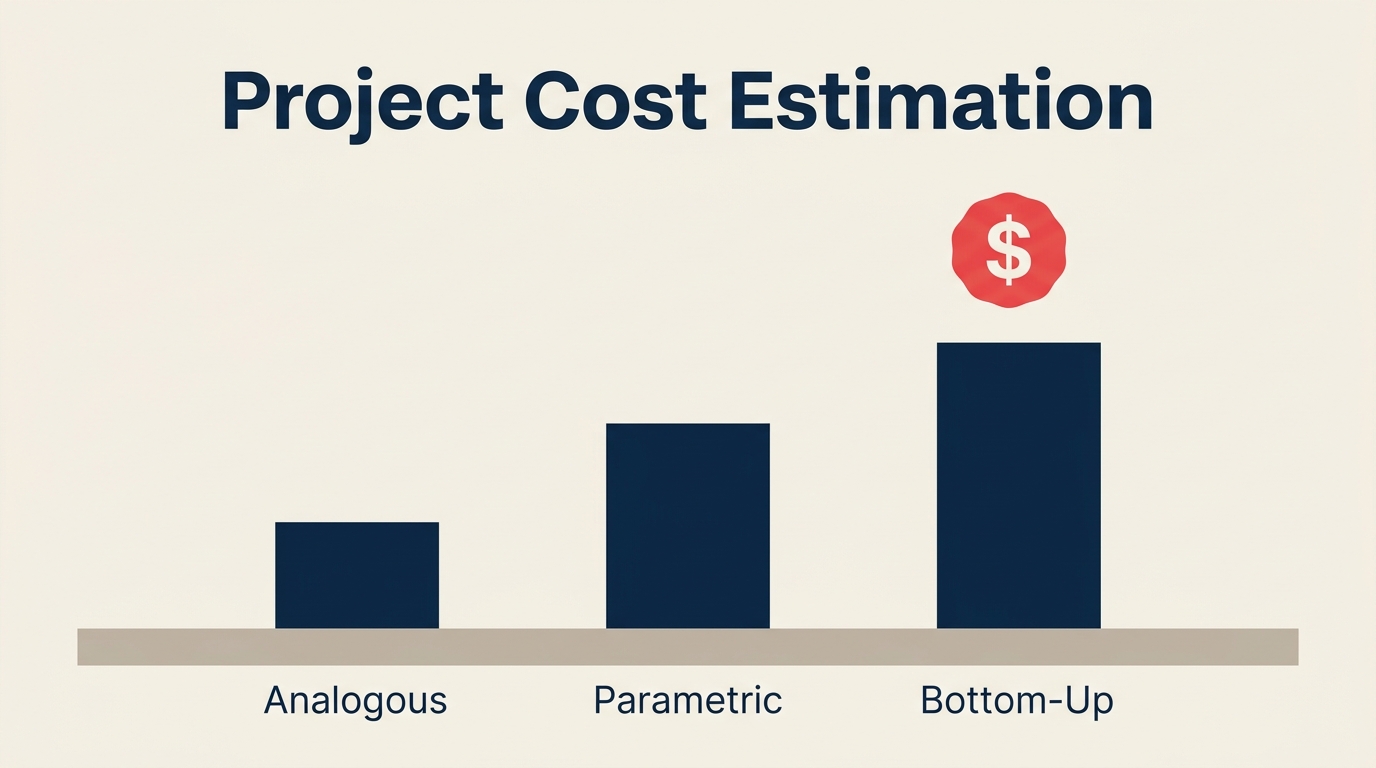
| Technique | How It Works | Typical Accuracy | When to Use |
|---|---|---|---|
| Analogous | Uses actual costs from a similar past project, adjusted for size or complexity | -25% to +75% (ROM) | Early feasibility; limited scope detail |
| Parametric | Multiplies a unit cost by a measurable quantity (e.g., cost per story point, per square meter) | -10% to +25% | When you have reliable unit-cost data and a measurable driver |
| Bottom-Up | Estimates each work package in the Work Breakdown Structure individually, then rolls up | -5% to +10% | Detailed planning phase; highest effort and highest accuracy |
| Three-Point | Averages optimistic (O), most likely (M), and pessimistic (P) scenarios using PERT: (O + 4M + P) / 6 | Depends on inputs; reduces single-point bias | Uncertain or novel work; pairs well with Monte Carlo simulation |
| Expert Judgment | Subject-matter experts provide estimates based on experience | Wide range | New technology or domain; used to cross-check other methods |
Techniques are not mutually exclusive. Most professional project managers combine two or more: use analogous estimation to get a quick sanity check during the proposal stage, then refine with bottom-up once the WBS is complete.
See three-point estimation for a deeper walkthrough of the PERT formula and when it outperforms simple averaging.
Types of Project Costs
Before you can estimate accurately, you need a shared vocabulary for the cost categories you're working with.

Direct costs are expenses tied specifically to the project: labor hours from named team members, purchased materials, software licenses, contractor fees, and travel directly related to deliverables.
Indirect costs (overhead) are shared across multiple projects or the organization: office rent, utilities, HR functions, and the portion of IT infrastructure allocated to the project.
Fixed costs do not change with project scope or duration: a software license fee, a server purchase, or a one-time setup charge.
Variable costs scale with activity: consultant day rates, cloud compute billed per hour, or printing costs per document.
Contingency reserves cover identified risks that may or may not occur. They sit inside the cost baseline and are released when a risk event fires. A typical reserve is 5% to 15% of the base estimate, depending on risk exposure identified during project risk management.
Management reserves cover unknown unknowns. They sit outside the cost baseline, require formal authorization to access, and are not part of the earned value baseline. See Earned Value Management (EVM) for how reserves interact with cost performance measurement.
Common Mistakes in Project Cost Estimation
Even experienced PMs fall into predictable traps.
Anchoring to the first number. Once a sponsor hears a ballpark figure, it becomes the target. Protect early estimates with explicit accuracy labels (see Accuracy Ranges below) so stakeholders understand the range, not just the midpoint.
Omitting indirect costs. Teams often estimate only direct labor and materials, then get surprised by overhead allocations at billing time.
Forgetting integration and testing. These phases routinely consume 25% to 40% of total effort but get squeezed out of early estimates because they feel abstract during planning.
Single-point optimism. Estimating only the "most likely" scenario ignores the asymmetry of project uncertainty: delays and scope additions are common; early delivery and scope reductions are rare. Three-point estimation and Monte Carlo simulation address this directly.
Ignoring the triple constraint. Cost, scope, and schedule are linked. An estimate built without a clear scope baseline will drift as soon as scope conversations resume.
No change buffer. Requirements change. Allocate a formal contingency reserve rather than absorbing changes silently, which hides true costs and distorts reporting.
How to Estimate Project Costs
Step 1: Confirm the scope baseline
You can't estimate what you haven't defined. Start with the project charter and scope statement, then build or review the Work Breakdown Structure. Every work package needs a clear description of what "done" looks like before you put a dollar figure on it.

Step 2: Identify all cost categories
List every cost type the project will incur: internal labor (by role and rate), external contractors, software and hardware, facilities, travel, training, and overhead allocations. Missing a category at this stage is harder to recover from than an inaccurate estimate within a category.
Step 3: Choose your estimation technique
Match the technique to the information you have. In the concept phase, analogous or parametric estimates are appropriate. Once the WBS is complete, bottom-up is the standard. For high-uncertainty work packages, apply three-point estimation.
Step 4: Estimate each work package
For bottom-up estimation, assign a cost to each WBS work package. Include labor (hours multiplied by blended rate), materials, and any direct expenses. Document assumptions for every estimate: "assumes senior developer at $150/hour for 40 hours" is traceable; "development: $6,000" is not.
Step 5: Add contingency reserves
Review identified risks from the risk register (see project risk management). For each significant risk, estimate the cost impact and probability. Sum the expected values and add them as a contingency reserve line. Add management reserve as a separate line outside the baseline.
Step 6: Aggregate and validate
Sum the work package estimates plus contingency to form the cost baseline. Then cross-check using a top-down technique: does your bottom-up total feel proportionate to similar past projects? If the numbers diverge significantly, investigate before presenting.
Step 7: Document assumptions and get sign-off
An estimate without documented assumptions is just a number. Record what was included, what was excluded, what rates were used, and what accuracy range applies. Present to stakeholders for formal approval so the baseline becomes a shared commitment, not a wish.
Step 8: Monitor with earned value
Once the project starts, track actual spend against the baseline using Earned Value Management (EVM). If Cost Performance Index (CPI) drops below 0.9 early, re-estimate to completion rather than hoping for a recovery that rarely comes. If the schedule is also slipping, consider Fast Tracking vs Crashing and model the cost impact of each approach before committing.
Project Cost Estimation Example
A software team is building a customer portal. Here is a simplified bottom-up estimate for the first release phase.

| Work Package | Effort (hours) | Rate ($/hr) | Labor Cost | Materials / Other | Total |
|---|---|---|---|---|---|
| Requirements and design | 80 | $120 | $9,600 | $0 | $9,600 |
| Backend API development | 200 | $150 | $30,000 | $500 (cloud sandbox) | $30,500 |
| Frontend development | 160 | $130 | $20,800 | $200 (UI kit license) | $21,000 |
| QA and testing | 120 | $110 | $13,200 | $300 (test tooling) | $13,500 |
| Deployment and DevOps | 40 | $140 | $5,600 | $800 (first-year hosting) | $6,400 |
| Project management | 60 | $120 | $7,200 | $0 | $7,200 |
| Subtotal (base estimate) | 660 | $86,400 | $1,800 | $88,200 | |
| Contingency reserve (10%) | $8,820 | ||||
| Management reserve (5%) | $4,410 | ||||
| Total project budget | $101,430 |
Key assumptions: senior developer rates; 40-hour work weeks; no infrastructure migration required; scope frozen after sprint 0. Accuracy range: minus 10% to plus 15% (definitive estimate based on completed WBS).
If the scope or timeline changed, you'd go back to Step 1 and re-estimate the affected work packages rather than adjusting the total by feel.
Best Practices for Project Cost Estimation
Use historical data systematically. Build an internal rate card and maintain a lessons-learned repository that captures actual versus estimated costs by project type. Each completed project makes the next estimate more accurate.
Separate estimation from negotiation. The estimate should reflect reality. If the budget approved by leadership is lower, that is a negotiation outcome, not a reason to shave the estimate. Document the gap and the risks it introduces.
Label accuracy ranges explicitly. A Rough Order of Magnitude (ROM) estimate carries a -25% to +75% range. A budget estimate is -10% to +25%. A definitive estimate is -5% to +10%. Use these labels so stakeholders calibrate their expectations correctly.
Revisit the estimate at phase gates. As scope detail increases, re-estimate. Don't let an early ROM figure harden into a binding commitment without a formal rebaselining.
Include the full team. The people doing the work have the best feel for complexity and risk. Planning poker-style sessions (see the Agile approach in planning poker if your team works iteratively) surface disagreements early, before they become cost surprises.
Track cost performance weekly. A CPI below 1.0 means you're spending more than the work is worth. Catching it in week 2 leaves room to act; catching it in week 12 usually means damage control.
Wrapping Up
Project cost estimation is part science and part judgment. The science comes from choosing the right technique for your current level of scope detail, accounting for all cost types, and building a defensible contingency. The judgment comes from knowing your team's pace, your organization's overhead structure, and where past estimates have been optimistic.
Start with a clear scope baseline, document every assumption, label your accuracy range honestly, and revisit the estimate at every phase gate. That discipline, applied consistently, is what separates teams that deliver within budget from those that spend half the project explaining overruns.
Related Reading

Senior Operations & Growth Strategist
On this page
- What Is Project Cost Estimation?
- Project Cost Estimation Techniques
- Types of Project Costs
- Common Mistakes in Project Cost Estimation
- How to Estimate Project Costs
- Step 1: Confirm the scope baseline
- Step 2: Identify all cost categories
- Step 3: Choose your estimation technique
- Step 4: Estimate each work package
- Step 5: Add contingency reserves
- Step 6: Aggregate and validate
- Step 7: Document assumptions and get sign-off
- Step 8: Monitor with earned value
- Project Cost Estimation Example
- Best Practices for Project Cost Estimation
- Wrapping Up
- Related Reading