McClelland's Theory of Needs Explained
Turn this article into takeaways for your work.


Each assistant summarizes the article only for you and suggests best practices for your work.
McClelland's needs theory is one of the most actionable motivation frameworks available to managers. It moves past generic incentives and asks a sharper question: what specifically drives this person?
The answer, according to psychologist David McClelland, comes down to three learned needs. Once you know which one dominates on your team, you can design work, feedback, and incentives that actually land.
What is McClelland's theory of needs?
McClelland's theory of needs (also called the acquired needs theory or three needs theory) was introduced by David McClelland in his 1961 book The Achieving Society. The core claim: human behavior at work is driven primarily by three learned motivational needs, not by innate drives or physiological requirements.
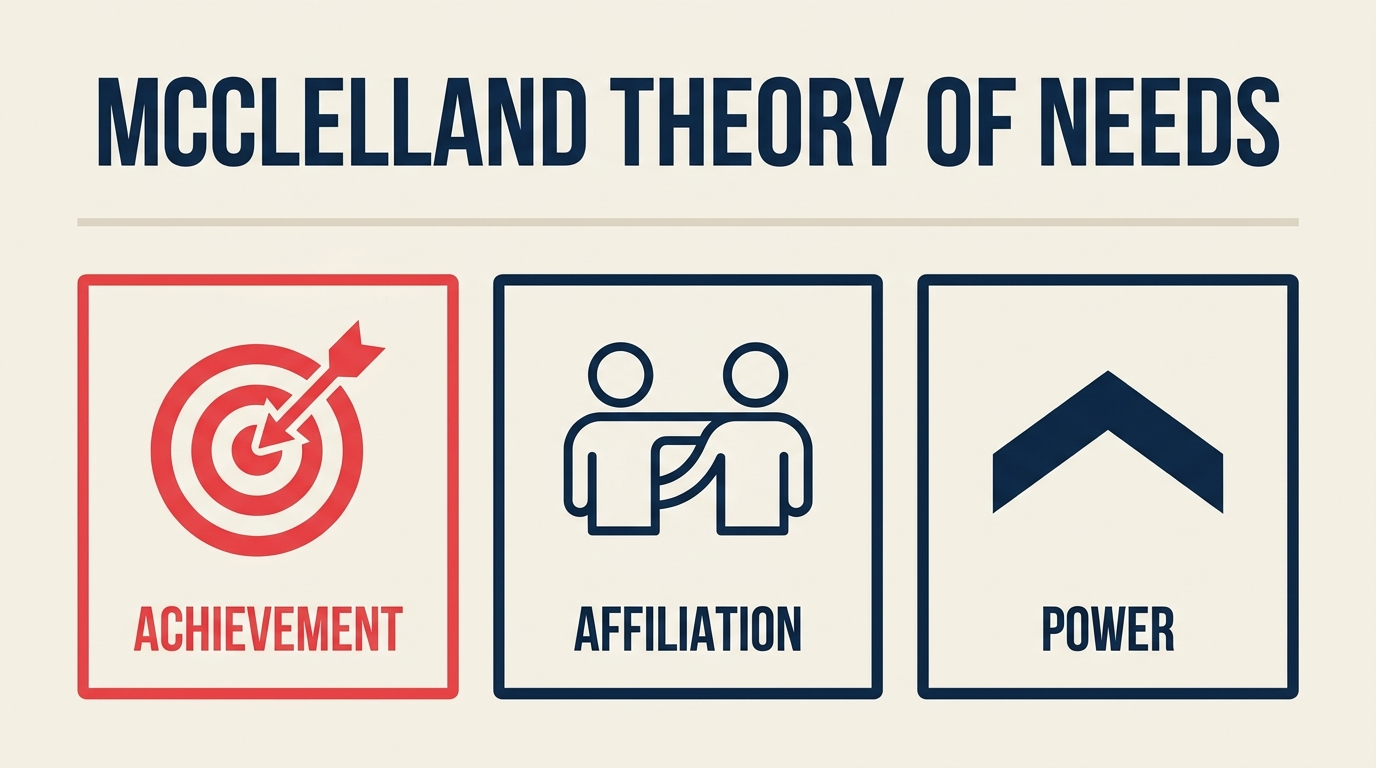
Those three needs are:
- nAch (need for achievement), the drive to excel, solve challenging problems, and reach measurable goals
- nAff (need for affiliation), the drive to build close relationships, belong, and be liked
- nPow (need for power), the drive to influence others and control outcomes, either personally or for the benefit of the organization
Unlike Maslow's hierarchy of needs, which treats motivation as a universal ladder everyone climbs, McClelland argued that people learn these needs through culture, upbringing, and experience. That means needs vary significantly from person to person, and they can shift over time.
Key insight from McClelland: "The desire to do something better than it has been done before" is the hallmark of the high achiever, and it's a learnable trait, not a fixed personality type.
Key Facts
- David McClelland first published the three needs framework in The Achieving Society (1961) and refined it through decades of research at Harvard.
- McClelland's research found that high-nAch individuals prefer tasks of moderate difficulty, not too easy (no satisfaction) and not too hard (no realistic chance of success). This preference for calculated risk distinguishes them from gamblers or risk-avoiders.
- In later work (1988), McClelland distinguished between socialized power (using influence to benefit a group) and personalized power (using influence for self-gain), finding that the best leaders skew heavily toward socialized power.
- The theory underpins widely-used managerial tools including the Thematic Apperception Test (TAT), behavioral interviewing, and individual development planning.
The three needs
Each need shapes how a person prefers to work, what they find rewarding, and how they respond to management.

| Need | What motivates this person | How to manage them effectively |
|---|---|---|
| Achievement (nAch) | Challenging goals, personal mastery, measurable progress, feedback on results | Set clear, stretch targets with quantifiable outcomes. Assign ownership. Give frequent, specific feedback. Avoid micromanagement. |
| Affiliation (nAff) | Belonging, harmony, collaborative projects, being valued by colleagues | Build team cohesion. Avoid isolating them with solo work. Address conflict quickly, it's deeply uncomfortable for them. Recognize their relational contributions. |
| Power (nPow) | Influence, status, leading others, winning, shaping decisions | Give leadership roles and responsibility. Involve them in decisions. Channel their drive toward team goals (socialized power). Watch for domineering behavior under stress. |
One need is usually dominant in a given person, but the other two are still present. A high-nAch salesperson might still value the team's approval (nAff) and want input on strategy (nPow). The dominant need just determines where the energy goes when trade-offs arise.
How to identify which need dominates
McClelland originally used the Thematic Apperception Test (TAT), a projective assessment where people describe ambiguous images and their responses reveal unconscious motivational themes. It's valid and well-researched, but it requires a trained administrator.

For most managers, these practical signals are faster and close enough for day-to-day decisions:
Listen for what they talk about unprompted. High-nAch people mention goals, personal bests, and what they're trying to improve. High-nAff people mention team dynamics, relationships, and whether everyone's getting along. High-nPow people bring up influence, competition, and who's in charge.
Watch what they volunteer for. nAch employees gravitate toward clearly scoped projects with measurable outcomes. nAff employees lean into cross-functional collaboration and mentoring. nPow employees put their hands up for team leads, spokesperson roles, and high-visibility assignments.
Notice what frustrates them. nAch people get frustrated by vague goals or lack of feedback. nAff people get unsettled by conflict, isolation, or feeling excluded. nPow people chafe at being left out of decisions or having their authority undermined.
Use behavioral interview questions. Ask "Tell me about a time you had to work independently toward a challenging goal" vs. "Tell me about a time you built a relationship that mattered to a project." The stories they choose and how they tell them are more revealing than the content alone.
For leaders who want a more structured approach, consider pairing this with self-determination theory, which maps the three basic psychological needs (autonomy, competence, relatedness) onto similar motivational terrain and offers complementary diagnostic questions.
Benefits and limitations of McClelland's theory
Benefits
The theory is genuinely practical. Unlike frameworks that describe motivation in abstract terms, McClelland's model gives managers a specific variable to assess and act on. You don't need a PhD to use it, the behavioral observation techniques above are learnable in an afternoon.
It also explains why one-size-fits-all motivation fails. Giving the same bonus structure to a high-nAch individual (who wants meaningful challenge) and a high-nAff individual (who wants team recognition) will motivate one and puzzle the other.
The distinction between socialized and personalized power is especially useful in leadership development. It helps organizations identify high-nPow candidates who are likely to use authority constructively, and flag those who might not.
Limitations
The TAT assessment, while valid, is resource-intensive and rarely used outside clinical or research settings. Most managers rely on informal observation, which introduces bias.
The model also has less to say about extrinsic motivators like pay and job security. For workers whose basic needs aren't met, the three learned needs may be less predictive than Herzberg's two-factor theory would suggest, hygiene factors (salary, safety, working conditions) have to be satisfied first before motivator-level differences between nAch, nAff, and nPow become visible.
Finally, the theory describes what people are drawn to, but it doesn't fully account for situational constraints. A high-nPow employee still needs institutional permission to lead. A high-nAch employee still needs an environment that allows calculated risk. Context shapes whether a dominant need can actually be satisfied.
How to apply McClelland's needs theory (step by step)
Step 1: Assess each person's dominant need
Don't guess from personality type or job title. Observe over two to three weeks. Look for the patterns described in the identification section above. For a new hire, structured onboarding conversations work well: ask them what they found most energizing in their last role and what made them choose this team.

Step 2: Match tasks and incentives to the dominant need
For high-nAch: assign ownership of a measurable project with a clear outcome and a moderate difficulty curve. Add milestone checkpoints where they can see their progress.
For high-nAff: structure collaborative assignments. Pair them with a respected team member they can build a relationship with. Use peer recognition programs, not just manager-to-employee feedback.
For high-nPow: give real decision-making authority. Assign mentoring responsibilities. Channel their competitive drive outward (team vs. benchmark, not team member vs. team member).
Step 3: Tailor feedback and recognition
High-nAch employees want honest, specific, data-backed feedback, and they want it frequently. Vague praise bores them.
High-nAff employees respond to feedback that acknowledges the relational dimension of their work. "Your ability to bring this team together during a difficult sprint mattered" hits differently for them than "project delivered on time."
High-nPow employees want their influence recognized. Acknowledge when their direction shaped an outcome, and be precise about the scope of their authority so they're not constantly testing boundaries.
Step 4: Design teams with need diversity in mind
The strongest teams often combine all three profiles. High-nAch members push performance. High-nAff members keep the team cohesive and retain institutional knowledge. High-nPow members drive direction and protect resources.
Problems arise when teams skew too heavily in one direction: all-nAch teams can become competitive and siloed; all-nAff teams can avoid the hard conversations that drive improvement; all-nPow teams can fracture into internal power struggles.
Use need profiles during team design, especially when building project pods or restructuring departments. The RACI framework and equity theory both pair well here for clarifying roles and fairness perceptions once teams are formed.
Step 5: Develop the achievement drive
McClelland's most optimistic finding: nAch isn't fixed. Organizations can build achievement motivation through deliberate development. His research showed that training programs focused on goal-setting, personal responsibility, and calculated risk-taking meaningfully increased nAch scores in participants, including managers who had shown low initial levels.
Practically, this means: stretch assignments, coaching on how to set goals (not just what goals to set), and psychological safety to fail on moderate-risk bets without career damage. McGregor's Theory X and Theory Y is directly relevant here, a Theory Y environment is the precondition for developing nAch in your team.
McClelland's needs theory examples
Real-world patterns tend to follow predictable shapes once you know what to look for.
| Profile | Typical behavior | Management approach |
|---|---|---|
| High-nAch salesperson | Tracks personal quota daily, asks for harder accounts, gets frustrated when CRM data is unreliable | Assign an ambitious but achievable target. Give weekly performance data. Let them own their pipeline methodology. |
| High-nAff support lead | Prioritizes team morale, dreads escalations that involve blaming a colleague, stays late to help a struggling peer | Involve them in team-building decisions. Protect their time from back-to-back solo tasks. Recognize their retention impact explicitly. |
| High-nPow operations manager | Proactively expands team scope, advocates strongly in cross-functional meetings, struggles to delegate final decisions | Define their domain clearly and give genuine authority within it. Coach on socialized vs. personalized power. Rotate them into cross-departmental leadership projects. |
These aren't stereotypes, they're starting points for a conversation. The goal isn't to label people but to understand them well enough to remove friction between what they need and what the work offers.
McClelland vs Maslow vs Herzberg
All three theories try to explain workplace motivation, but they ask different questions and give different answers.

Maslow's hierarchy is a universal sequence: people move up through physiological, safety, social, esteem, and self-actualization needs as lower levels are satisfied. It's intuitive but hard to operationalize, managers can't always know which level someone is on.
Herzberg's two-factor theory splits motivators (achievement, recognition, growth) from hygiene factors (pay, conditions, job security). Hygiene factors prevent dissatisfaction; only motivators drive genuine engagement. It explains why a raise doesn't produce lasting motivation, but doesn't tell you which motivators matter most for a specific person.
McClelland's theory answers that last gap. It doesn't claim a universal sequence, and it doesn't split hygiene from motivators. Instead, it says: find out which of these three learned needs is dominant, and design the work accordingly.
Used together, they form a layered toolkit. Maslow helps assess whether someone's baseline needs are met. Herzberg helps design the environment. McClelland helps personalize the challenge. See also expectancy theory for a complementary model focused on effort-to-outcome belief chains.
Frequently Asked Questions about McClelland's Theory of Needs Explained
What are the three needs in McClelland's theory?
The three needs are achievement (nAch), affiliation (nAff), and power (nPow). Achievement is the drive to excel and reach measurable goals. Affiliation is the drive to build close relationships and belong. Power is the drive to influence others and shape outcomes. Everyone has all three to some degree, but one typically dominates.
What is nAch?
nAch stands for "need for achievement." People high in nAch are motivated by challenging but realistic goals, take personal responsibility for outcomes, seek feedback on their performance, and prefer moderate risk over long shots or certainties. McClelland's research found nAch is learnable, organizations can cultivate it through deliberate development practices.
How does McClelland's theory differ from Maslow's?
Maslow's hierarchy describes a fixed sequence of universal needs that everyone progresses through. McClelland's theory describes three learned needs that vary by individual and don't follow a universal order. Maslow is more useful for assessing whether foundational conditions are in place; McClelland is more useful for personalizing how you motivate a specific person once those conditions exist.
Can dominant needs change over time?
Yes. McClelland explicitly framed these as acquired needs, shaped by experience, culture, and environment. A person who develops strong leadership skills may find their nPow increases over time. Someone who goes through a difficult period of conflict may temporarily shift their nAff upward. The dominant need isn't fixed, which is both a challenge (assessments go stale) and an opportunity (organizations can actively develop the needs that serve team performance).
Is McClelland's theory still used today?
Yes, though the original TAT assessment has largely been replaced by behavioral interviewing, 360-degree feedback, and structured observation in organizational settings. The underlying framework remains influential in leadership development, team design, and individual coaching. Its core distinction between socialized and personalized power is a staple of executive assessment work.
Related reading
- Maslow's Hierarchy of Needs
- Herzberg's Two-Factor Theory
- Expectancy Theory
- Equity Theory
- McGregor's Theory X and Theory Y
- Self-Determination Theory
- Transformational vs. Transactional Leadership
The most effective managers don't pick one motivation theory and apply it everywhere. They use frameworks like McClelland's as diagnostic tools, a way to ask better questions, notice what they might be missing, and adapt before small engagement gaps become retention problems.

Senior Operations & Growth Strategist
On this page
- What is McClelland's theory of needs?
- Key Facts
- The three needs
- How to identify which need dominates
- Benefits and limitations of McClelland's theory
- How to apply McClelland's needs theory (step by step)
- Step 1: Assess each person's dominant need
- Step 2: Match tasks and incentives to the dominant need
- Step 3: Tailor feedback and recognition
- Step 4: Design teams with need diversity in mind
- Step 5: Develop the achievement drive
- McClelland's needs theory examples
- McClelland vs Maslow vs Herzberg
- Related reading