The Five Practices of Exemplary Leadership (Kouzes and Posner)
Turn this article into takeaways for your work.


Each assistant summarizes the article only for you and suggests best practices for your work.
The five practices of exemplary leadership are a framework for what leaders actually do when they're at their personal best. Not personality traits you're born with, and not a style you perform. A set of observable, learnable behaviors that show up consistently in leaders who produce extraordinary results with and through other people.
Jim Kouzes and Barry Posner developed these practices after analyzing thousands of personal best leadership stories from managers and executives across industries and continents. What they found surprised many people at the time: great leadership isn't about the leader. It's about what the leader enables in others.
What are the five practices of exemplary leadership?
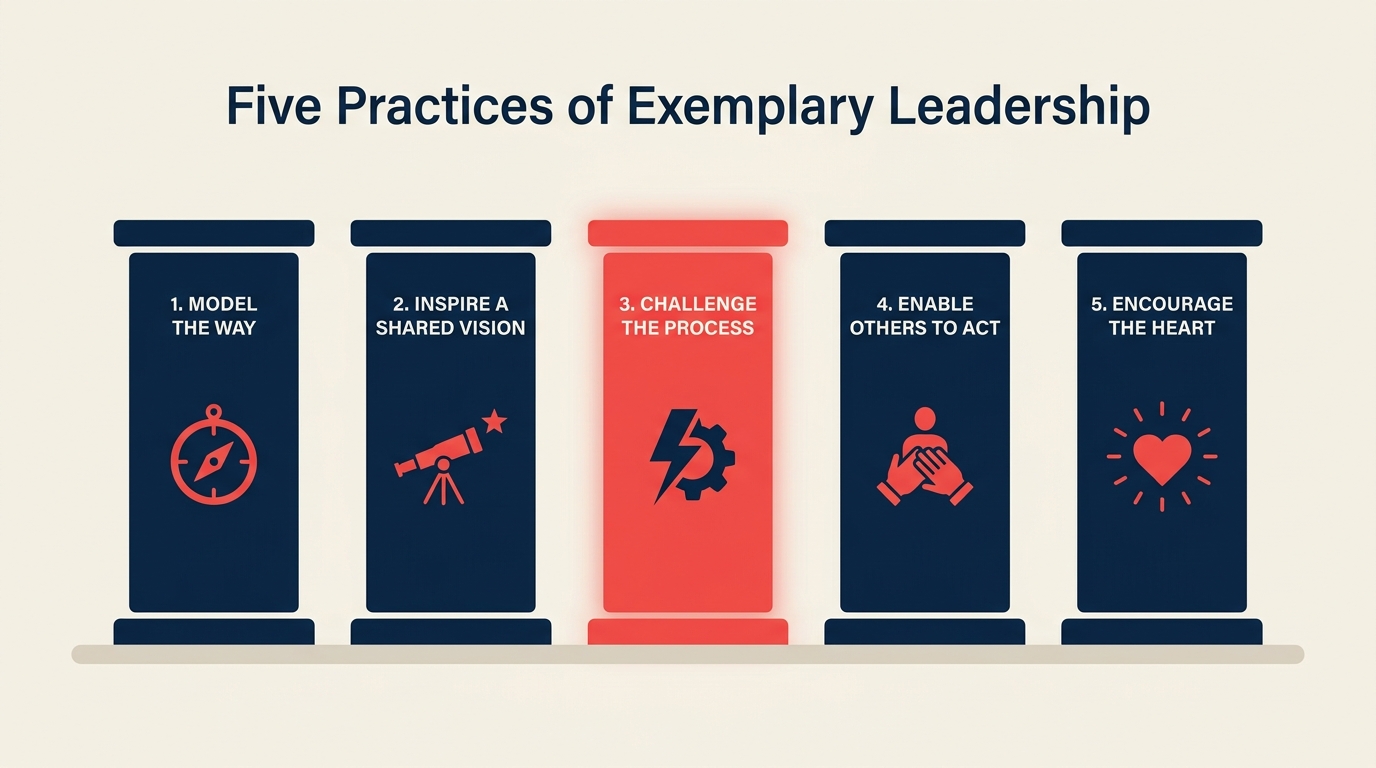
The five practices of exemplary leadership is a research-based leadership model developed by Jim Kouzes and Barry Posner, first published in their 1987 book The Leadership Challenge. The model identifies five core behavioral practices that distinguish leaders who produce extraordinary results from those who produce ordinary ones: Model the Way, Inspire a Shared Vision, Challenge the Process, Enable Others to Act, and Encourage the Heart.
The model is grounded in empirical research, not theory alone. Kouzes and Posner collected over 70,000 personal best leadership cases between 1983 and the early 2000s, and the five practices emerged as a consistent pattern across every industry, organizational level, and cultural context they studied.
Key Facts
- Kouzes and Posner collected data from more than 70,000 leaders across 45 countries over two decades of research supporting The Leadership Challenge (Kouzes and Posner, 2012, 5th edition).
- Their Leadership Practices Inventory (LPI) has been used by more than 5 million leaders worldwide, making it one of the most widely deployed leadership assessment instruments in existence (Kouzes and Posner, 2023).
- Their research consistently finds that the behavior leaders model most strongly is the single best predictor of team commitment, according to surveys of tens of thousands of direct reports across multiple editions of the study.
Each practice comes with two commitments, which are the specific behaviors that bring the practice to life. Understanding the commitments is what makes the model actionable rather than aspirational.
The 5 practices explained
Model the Way
Model the Way is the foundational practice. Before a leader can ask others to commit to a direction, they need to clarify their own values and then align their behavior with those values consistently. Credibility comes from the gap, or rather the absence of a gap, between what you say and what you do.

The two commitments:
- Clarify values by finding your voice and affirming shared ideals
- Set the example by aligning actions with shared values
In practice, this means a leader who says "we treat everyone with respect here" has to model that in every meeting, especially the stressful ones. A finance director who announces that teams need to cut travel costs but flies business class to a conference undermines this practice completely. The team notices.
A concrete example: a regional VP at a logistics company decides to personally audit one shipment per week alongside frontline staff to demonstrate commitment to quality standards she'd set for the team. She's not there to check up on anyone. She's there to show that the standard matters to her, not just in memos, but in how she spends her time. Within three months, quality incident rates in her region dropped by 18%.
Inspire a Shared Vision
Leaders who perform at their best don't just set goals. They paint a picture of a future that others want to be part of. The key word is "shared." A vision that only the leader cares about is a plan. A vision that the team owns is a movement.
The two commitments:
- Envision the future by imagining exciting and ennobling possibilities
- Enlist others by appealing to shared aspirations
This practice requires genuine listening. You can't appeal to shared aspirations if you don't know what the people around you actually aspire to. Leaders who skip the listening step end up with compelling visions that only compel themselves.
Consider a product manager running a team of twelve developers. Instead of presenting a product roadmap with features and timelines, she opens a quarterly planning session by asking: "What's the version of this product that you'd be genuinely proud to have built?" The conversation that follows surfaces ideas she hadn't thought of, and the team's investment in the roadmap they co-created is noticeably higher than on previous cycles. Transformational leadership theory builds on this same insight: vision-driven leaders unlock discretionary effort that directive ones never reach.
Challenge the Process
Exemplary leaders don't accept the status quo as permanent. They search for opportunities to innovate, experiment, and improve, and they treat setbacks as information rather than verdicts. But it's worth noting that Kouzes and Posner distinguish between reckless disruption and purposeful experimentation. The best leaders create conditions where small risks are safe to take.
The two commitments:
- Search for opportunities by seizing initiative and looking outward for innovative ways to improve
- Experiment and take risks by constantly generating small wins and learning from experience
The "small wins" piece is deliberate. Breaking a big change into smaller experiments reduces the cost of being wrong, generates faster learning, and builds momentum. A single dramatic pivot that fails can derail a team for a year. A series of small tests that each teach you something keeps the team moving forward even when individual experiments don't pan out.
An operations lead at a consulting firm who stops asking for budget approval on new process tools under $500, delegating that decision to team leads instead, is practicing this. She's challenging the process (the approval bottleneck) through a small, reversible change that either proves or disproves whether her team leads are ready for more autonomy.
Enable Others to Act
This is the practice that separates leaders who create followers from those who create leaders. Enabling others to act means actively building the capacity, confidence, and authority of the people around you. It's the opposite of managing by holding information tightly and making every decision yourself.
The two commitments:
- Foster collaboration by building trust and facilitating relationships
- Strengthen others by increasing self-determination and developing competence
Kouzes and Posner found that this practice has the strongest correlation with team commitment of all five. When people feel genuinely enabled, they don't just do the task. They take ownership of the outcome.
In leadership terms, this connects directly to what servant leadership describes as inverting the hierarchy: the leader's job is to remove barriers, provide resources, and create the conditions where others can succeed. A senior engineer who blocks junior developers from presenting directly to clients "to maintain quality control" is doing the opposite of enabling. She's building dependency.
The leadership pipeline model maps out how enabling others becomes increasingly central as leaders move from managing themselves to managing managers. At each transition, the leader's leverage shifts from personal execution to collective capacity.
Encourage the Heart
High performance requires sustained effort over time, and sustained effort requires recognition. Not lavish praise for mediocre work, but genuine acknowledgment of specific contributions and a visible celebration of progress toward shared goals.
The two commitments:
- Recognize contributions by showing appreciation for individual excellence
- Celebrate the values and victories by creating a spirit of community
The research behind this practice is consistent: people do more when their contributions are noticed and named. A generic "good job" does almost nothing. A specific "I noticed how you handled the client pushback in that meeting, especially the way you reframed the timeline issue as a scope question" does a great deal.
This practice also has a team dimension. Leaders who only recognize individual performance miss the chance to build collective identity. Celebrating a team milestone, sharing a specific story about what the team achieved together, reinforces the shared vision and makes future effort feel worthwhile. Authentic leadership adds the critical caveat here: recognition has to be genuine. People can tell the difference between a leader who means it and one who's running through a checklist.
The five practices at a glance
| Practice | Core Idea | Behaviors |
|---|---|---|
| Model the Way | Earn credibility by living your values | Clarify personal values, align daily actions with stated principles, hold yourself to the same standards you hold others |
| Inspire a Shared Vision | Create a future others want to build | Listen to what the team aspires to, paint a concrete picture of a possible future, connect individual roles to the larger purpose |
| Challenge the Process | Seek better ways and learn from setbacks | Look for innovation opportunities, run small experiments, treat failures as data points rather than defeats |
| Enable Others to Act | Build the capacity and confidence of the people around you | Share information openly, delegate real authority, invest in skill development, remove blockers |
| Encourage the Heart | Sustain effort through genuine recognition | Acknowledge specific contributions, celebrate team wins publicly, reinforce shared values through stories |
How to apply the five practices
Step 1: Start with a personal best audit
Before trying to change anything, recall a time when you were at your leadership best. What were you doing? What was the team doing? Which of the five practices were most present in that period? Kouzes and Posner's research shows that leaders already have evidence of all five practices in their own history. The goal isn't to learn something foreign. It's to make the practices more consistent and intentional.

Step 2: Identify your current weak practice
Most leaders default to two or three practices they're naturally comfortable with and underuse the others. Use the Leadership Practices Inventory (LPI) as a formal diagnostic, or do a rough self-assessment by rating yourself on each practice on a scale of one to ten. The practice with the lowest score is where to start.
Step 3: Build one commitment into your weekly routine
Each practice has two commitments. Pick the commitment under your weakest practice that feels most actionable right now. Turn it into a specific behavior with a time and a place. "I'll have a one-on-one with each team member on the first Tuesday of the month specifically to ask what's blocking them" is actionable. "I'll enable others more" is not. The four I's of transformational leadership maps related behaviors if you want a parallel structure for comparing approaches.
Step 4: Collect feedback from the people you lead
The LPI's 360-degree version asks direct reports, peers, and managers to rate the leader on observable behaviors across all five practices. That outside view is often more accurate than self-assessment, because leaders consistently overestimate how visible their values and recognition behaviors are to their teams. Run a shorter informal version if the full instrument isn't available: ask three people "what do you think I do less well as a leader?" and listen without defending.
Step 5: Connect the practices to a real project
Abstract skill development rarely sticks. Find a current project or team challenge and consciously apply all five practices to it. Define a clear shared vision for the project with input from the team. Challenge the process by experimenting with one thing you've never tried on this type of project. Recognize contributions publicly at the midpoint, not just at the end.
Step 6: Revisit and adjust every quarter
Effective application of the five practices isn't a one-time exercise. Leaders who use the framework most effectively treat it as a recurring diagnostic. At the start of each quarter, ask: which practice did I most neglect last quarter? What's one commitment I can build into this quarter's routine? This kind of structured reflection keeps the model active rather than letting it slide back into theory. The 5 levels of leadership describes how this kind of deliberate self-development is what separates Level 3 leaders from Level 4 and 5.
The LPI (Leadership Practices Inventory)
The Leadership Practices Inventory (LPI) is the psychometric instrument Kouzes and Posner developed to measure leadership behavior across the five practices. It works as a 30-item questionnaire with six items per practice, answered on a ten-point frequency scale ranging from "Almost Never" to "Almost Always."

The LPI is designed as a 360-degree tool. Leaders complete a self-assessment, and the same questionnaire is completed by observers: direct reports, peers, and managers. The gap between self-ratings and observer ratings is often the most valuable data. Leaders who rate themselves much higher than their observers on Encourage the Heart, for example, are often unaware of how infrequently their recognition behaviors are actually visible to the team.
The LPI has been validated across dozens of countries and organizational types. Its reliability coefficients are consistently strong, and it has been tested for cross-cultural validity in contexts ranging from US corporations to Asian public sector organizations to European NGOs. This makes it one of the more robust leadership instruments available, not just one of the most widely used.
Common mistakes
Treating the five practices as sequential. Some managers read the model as a pipeline: first you model the way, then you inspire a vision, and so on. But the five practices are concurrent, not sequential. You can't wait until you've perfected Model the Way before starting to enable others. All five are active at any given time, in different proportions depending on the situation.

Confusing modeling with perfectionism. Model the Way doesn't mean performing flawlessness. It means being visible about your own values and showing that you hold yourself to the same standards you hold others. Leaders who wait until they've "figured it out" before modeling their values never start.
Inspiring a vision without listening first. The word "shared" in Inspire a Shared Vision is load-bearing. A leader who drafts an inspiring vision in isolation and then presents it to the team has completed roughly half the practice. The other half is understanding what the team cares about so the vision actually resonates.
Using Encourage the Heart as an event rather than a habit. One big annual recognition ceremony is far less effective than consistent, specific, real-time acknowledgment woven into ordinary work. When recognition only happens at performance review time, it loses the immediacy that makes it meaningful.
Skipping the Challenge the Process practice because things are going well. This is when the practice matters most. Teams that only challenge the process when things break miss the growth that happens through proactive experimentation. The best leaders search for better ways even when current results are acceptable.
Best practices
- Make values explicit. Don't assume the team knows what you stand for. State it clearly, and revisit it when decisions arise that test those values.
- Frame experiments as learning, not failing. When a small test doesn't work, debrief it explicitly as useful data. That signals that experimentation is safe.
- Build recognition into the rhythm of work, not just milestone events. A two-minute acknowledgment in a weekly standup is more powerful than a trophy at a quarterly all-hands.
- Use 360-degree LPI data before you assume you know your weak practice. Self-assessment of leadership behavior is notoriously unreliable. Observer data is where the real signal lives.
- Pair Enabling Others with genuine authority transfer. Saying "I trust you to make this call" and then second-guessing every decision undoes the practice. Real enablement means accepting that the person will sometimes make a call differently than you would.
- Connect Inspire a Shared Vision to current team concerns. The most effective visions aren't abstract futures. They're concrete answers to frustrations the team already has. If the team is frustrated by slow decision cycles, a vision of a more agile, autonomous team structure lands far better than a vision of industry leadership.
Related reading
- 5 Levels of Leadership
- What Is Transformational Leadership Theory
- Servant Leadership
- Authentic Leadership
- Transformational vs. Transactional Leadership
- The Four I's of Transformational Leadership
- Leadership Pipeline Model
What makes the five practices enduring is the same thing that made them original in the 1980s: they describe leadership as a set of things you do, not a personality you have. That distinction matters more now than it did then, because the research keeps confirming that organizations develop the leaders they need when they invest in behavior change rather than waiting to hire the right people.

Senior Operations & Growth Strategist
On this page
- What are the five practices of exemplary leadership?
- The 5 practices explained
- Model the Way
- Inspire a Shared Vision
- Challenge the Process
- Enable Others to Act
- Encourage the Heart
- The five practices at a glance
- How to apply the five practices
- Step 1: Start with a personal best audit
- Step 2: Identify your current weak practice
- Step 3: Build one commitment into your weekly routine
- Step 4: Collect feedback from the people you lead
- Step 5: Connect the practices to a real project
- Step 6: Revisit and adjust every quarter
- The LPI (Leadership Practices Inventory)
- Common mistakes
- Best practices
- Related reading