Democratic Leadership: Definition, Examples, Pros and Cons
Turn this article into takeaways for your work.


Each assistant summarizes the article only for you and suggests best practices for your work.
Democratic leadership is the style that turns the people doing the work into the people shaping the decisions. It's one of the most studied approaches in leadership research, and for most knowledge-work teams, it consistently outperforms both autocratic direction and passive laissez-faire management.
What is democratic leadership?
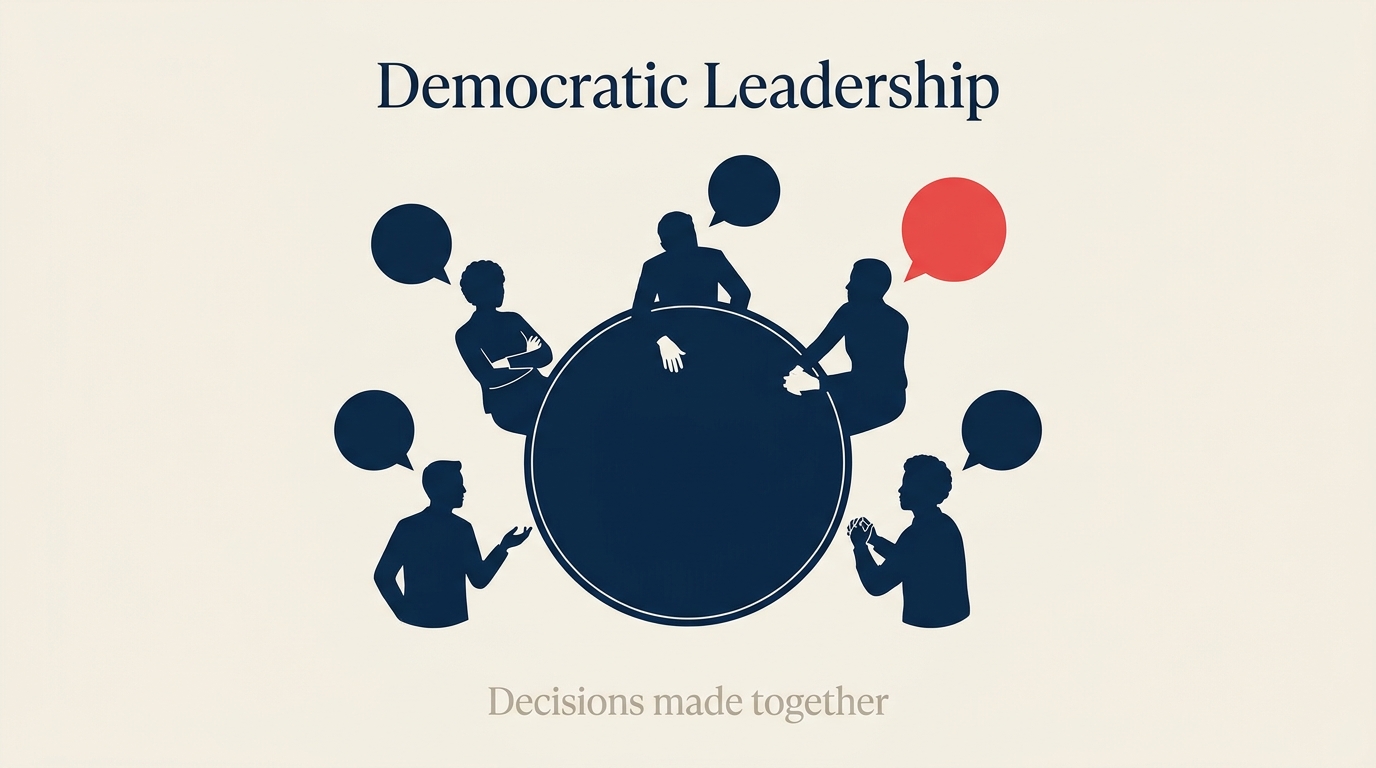
Democratic leadership (also called participative leadership) is a leadership style where the leader actively involves team members in the decision-making process before making a final call. The leader retains ultimate authority but uses input, discussion, and shared deliberation to reach better decisions and build genuine commitment to the outcome.
The term comes directly from Kurt Lewin, Ronald Lippitt, and Ralph White's landmark 1939 University of Iowa study. The researchers divided groups of boys into three conditions: autocratic (leader decides alone), democratic (leader invites input, then decides), and laissez-faire (leader provides minimal guidance). The democratic groups produced higher-quality work, showed stronger group cohesion, and maintained performance even when the leader left the room. That study became one of the most-cited foundations of modern leadership theories.
In practice, democratic leadership means creating deliberate space for team input before decisions are made. It does not mean every decision goes to a vote, and it does not mean the leader abdicates responsibility for the outcome. The leader still decides. But they decide with, not instead of, the people who will carry the work forward.
Key Facts
- Lewin, Lippitt, and White (1939) found that groups under democratic leadership produced higher-quality work than autocratic groups and maintained performance when the leader stepped away, an outcome that did not occur under autocratic or laissez-faire conditions.
- Gallup's State of the Global Workplace 2023 found only 23% of employees worldwide are actively engaged at work. Organizations that practice participative decision-making consistently score 10 to 20 percentage points higher on engagement than high-control environments.
- A meta-analysis by Sauer (2011) published in The Leadership Quarterly found that participative leadership has a significant positive effect on group performance, particularly in tasks requiring creativity and complex problem-solving.
Democratic leadership vs autocratic vs laissez-faire
These three styles from Lewin's original study differ most sharply in where decision authority lives and how much team input shapes outcomes. Understanding the difference helps you recognize which context calls for which approach, a point developed further in situational leadership frameworks.

| Style | Who decides | Speed | Best for | Key risk |
|---|---|---|---|---|
| Democratic | Leader, after team input | Moderate | Knowledge work, strategic planning, experienced teams | Analysis paralysis, slower execution |
| Autocratic | Leader alone | Fast | Crisis, safety-critical, unskilled teams, urgent execution | Low morale, low innovation, dependency |
| Laissez-faire | Individual team members | Variable | Expert researchers, autonomous professionals | Confusion, inconsistency, lack of direction |
Autocratic leadership works when speed matters more than buy-in and the leader holds all the relevant information. Laissez-faire works when the team members are experts who need freedom, not guidance. Democratic leadership works in the wide middle: when the team has knowledge the leader needs, and when commitment to the decision will determine whether it succeeds.
Core principles of democratic leadership
Democratic leaders don't just ask questions. They build specific habits and structures that make shared decision-making real and repeatable.

- Shared decision-making. The leader brings meaningful decisions to the team before the call is made, not just for show. Input actually shapes the outcome.
- Transparent communication. The reasoning behind decisions is shared openly, including why certain team suggestions were incorporated and why others weren't.
- Psychological safety. Team members can disagree, challenge assumptions, and raise concerns without fear of retaliation or exclusion. Without this, the other principles don't work.
- Distributed ownership. People feel accountable for decisions they helped shape. Commitment is higher because involvement is real, not performative.
- Structured process. Democratic leaders use rituals, retrospectives, and recurring forums to create consistent space for input rather than relying on ad hoc conversations.
- Clear final authority. Everyone understands who makes the final call. Democratic leadership isn't a committee system where no one is accountable. The leader decides, with the team's input.
How democratic leadership works (the 4-step decision process)
Democratic leadership isn't informal. The leaders who do it well follow a clear, repeatable process that makes input meaningful without creating endless debate.

Step 1: Gather input
Before making a decision, the leader creates explicit opportunity for team members to share their knowledge, concerns, and ideas. This can take many forms: async written input, a structured meeting, one-on-one conversations with key stakeholders, or a simple "what am I missing?" prompt before a call. The goal is to surface what the leader doesn't know yet.
Step 2: Deliberate
The leader (and often the team together) works through the input. Competing options get evaluated. Trade-offs get named. The leader asks questions to test assumptions and push the thinking further. Good democratic deliberation is productive, not circular. It has a time boundary, a clear question to answer, and a facilitator keeping the discussion on track.
Step 3: Decide
The leader makes the call. Not the committee. Not the majority vote. The leader, with full information from Steps 1 and 2. This is the step that distinguishes democratic leadership from consensus management. Consensus requires everyone to agree before moving. Democratic leadership requires the leader to decide, informed by everyone's perspective.
Step 4: Communicate
The decision goes out with its reasoning: what input was considered, what alternatives were weighed, and why this path was chosen. This step closes the loop for team members whose ideas weren't incorporated and builds credibility for the next time the leader asks for input. Skipping it turns democratic process into theater.
Pros and cons of democratic leadership
Pros:

| Benefit | Why it matters |
|---|---|
| Higher decision quality | Team input surfaces information the leader doesn't have, especially in knowledge-work roles where expertise is distributed |
| Stronger commitment | People support decisions they helped shape; implementation goes faster with less resistance |
| Better employee engagement | Being asked for input is a signal of respect; Gallup research consistently links voice to engagement |
| Reduced attrition risk | Experienced professionals who feel heard stay longer than those who feel directed |
| Greater innovation | Psychological safety and shared deliberation create the conditions for new ideas to reach the surface |
Cons:
| Drawback | When it matters most |
|---|---|
| Slower in time pressure | The input-gathering and deliberation steps take time; they don't compress well under genuine deadlines |
| Risk of analysis paralysis | Too many voices without a clear process creates circular debate instead of forward movement |
| Requires capable team members | If the team lacks relevant experience or knowledge, their input may not improve the decision |
| Can frustrate junior teams | People new to a role sometimes need direction first; open-ended input requests can feel overwhelming |
| Leader must hold the tension | Gathering input and then making a call that disappoints some people requires courage and good communication |
Real examples of democratic leaders
These examples show democratic leadership in high-stakes environments where participation shaped both trust and execution.
Indra Nooyi at PepsiCo
As CEO of PepsiCo from 2006 to 2018, Indra Nooyi consistently cited her practice of including senior leaders, scientists, and operational teams in major strategic decisions, including the "Performance with Purpose" repositioning that shifted PepsiCo toward healthier products. She was known for her listening tours, her habit of visiting the families of her direct reports, and her insistence on gathering diverse perspectives before committing to direction. Under her tenure, PepsiCo's revenue grew by 80%, and she is frequently cited in research on participative leadership in Fortune 500 contexts.
Jacinda Ardern
New Zealand's Prime Minister from 2017 to 2023, Ardern became a widely studied example of democratic leadership in government. Her response to the 2019 Christchurch mosque shootings and the COVID-19 pandemic both involved rapid, transparent communication and deliberate inclusion of community stakeholders in shaping the response. She maintained unusually high approval ratings through sustained crises, which researchers attributed in part to her practice of explaining decisions publicly and acknowledging uncertainty rather than projecting false confidence.
Tim Cook at Apple
Where Steve Jobs famously operated in an autocratic mode, Tim Cook shifted Apple toward a more participative style after becoming CEO in 2011. Cook built Apple's decision-making around collaborative review processes, empowering division leaders to drive strategy within their domains. He has publicly stated that he actively seeks disagreement from his team before major calls. Apple's revenue grew from roughly $108 billion in his first year as CEO to over $380 billion by 2023, suggesting that democratic process and strong organizational performance are not in conflict.
Satya Nadella at Microsoft
When Nadella became CEO of Microsoft in 2014, the company had a deeply competitive, stack-ranked culture that suppressed internal collaboration. He introduced "growth mindset" as a cultural framework and shifted decision-making to include broader input from product teams, engineering, and frontline leaders. The culture shift produced measurable results: Microsoft's market capitalization grew from approximately $300 billion in 2014 to over $2 trillion by 2023. Nadella frequently references listening as a core leadership practice, and his approach is cited in servant leadership literature alongside democratic leadership research.
When to use (and when NOT to use) democratic leadership
| Use democratic leadership when... | Avoid democratic leadership when... |
|---|---|
| Your team has relevant knowledge or expertise | Speed is genuinely critical and input won't change the outcome |
| Commitment to the decision will determine success | The decision requires confidential information that can't be shared |
| You're working through strategy, product direction, or complex trade-offs | The team lacks the experience to provide useful input on the specific question |
| You need to develop your team's judgment over time | A crisis requires one person to make a fast call and explain later |
| Morale or engagement has been declining | A regulatory or compliance requirement removes discretion entirely |
| You're planning change that requires behavioral adoption | A junior team member needs direction, not open-ended input requests |
The leadership vs management distinction matters here. Democratic leadership is most valuable in leadership decisions: setting direction, allocating priorities, shaping strategy, building culture. It's less relevant in pure management tasks like scheduling, resource allocation within a defined budget, or enforcing an already-agreed policy.
How to develop a democratic leadership style
If you're used to making decisions alone, shifting to democratic leadership takes deliberate practice. These five habits build the muscle.

Build a standing input ritual. Create a recurring forum where your team expects to weigh in on real decisions. A weekly async question, a monthly team retrospective, or a standing pre-decision brief. The ritual signals that input is genuine, not occasional theater.
Ask better questions. The quality of input you receive depends directly on the quality of the question you ask. "What do you think?" gets vague answers. "What assumption in my plan are you least confident about?" gets the information you actually need. Practice asking the question that surfaces your blind spot, not the one that confirms your instinct.
Train your facilitation skills. Good democratic leaders can run a productive discussion: keep it bounded, surface minority perspectives, prevent dominant voices from crowding out quieter ones, and land at a clear decision point. These are learnable skills. Facilitation training, retrospective practice, and structured meeting formats all help. See also the 5 levels of leadership framework for how facilitation fits into broader leadership development.
Close every loop. After gathering input and deciding, tell the team what you heard, what you chose, and why. This is the step most leaders skip when they're busy. Skipping it breaks trust in the process because people don't know if their input mattered. Closing the loop takes five minutes and pays off for every future conversation.
Practice deciding, not just consulting. Democratic leadership requires courage. You gather input, you deliberate, and then you make a call that some people won't agree with. Getting comfortable making a decision after hearing dissent, and owning it cleanly, is the hardest part of the style. The leaders who do it well make their reasoning transparent and hold the decision steady under social pressure.
Frequently Asked Questions about Democratic Leadership
Is democratic leadership the same as participative leadership?
Largely yes. The two terms describe the same core practice: involving team members in decision-making before the final call is made. "Democratic leadership" comes from Lewin's 1939 classification system and is the term most commonly used in academic research. "Participative leadership" is more common in organizational behavior and management literature and sometimes implies a slightly broader range of involvement styles, from consultation to full collaboration. In practice, the terms are used interchangeably.
When does democratic leadership fail?
Democratic leadership tends to fail in four situations. First, when there's no real decision boundary and the process becomes a loop with no end point. Second, when input is gathered but leaders make pre-decided calls regardless, which destroys trust faster than never asking in the first place. Third, when the team lacks the expertise or context to give useful input on the specific question being decided. And fourth, when the leader lacks the communication skill to explain why some input was incorporated and some wasn't, leaving people feeling ignored after a participative-looking process.
What's the difference between democratic and laissez-faire leadership?
The key difference is whether the leader stays accountable for the final decision. In democratic leadership, the leader gathers input from the team and then makes the call, with full accountability for the outcome. In laissez-faire leadership, the leader largely steps back and lets individuals or the group decide independently, with minimal direction. Democratic leadership creates structured, facilitated participation. Laissez-faire creates autonomy. Democratic leadership works best with capable teams that still benefit from direction and coordination. Laissez-faire works best with expert individuals doing independent work who need freedom more than guidance.
Can democratic leadership work in a crisis?
Yes, in a limited form. During acute crises, where speed and clear command are essential, democratic leaders shift to a more directive mode: make the call fast, explain the reasoning as soon as practical, and return to participative decision-making once the immediate emergency has passed. The trust and psychological safety built through ongoing democratic practice means that teams are more likely to follow a fast, directive call from a leader they trust than from one they've never seen consult them. So in this sense, democratic leadership before the crisis is what makes directive leadership during the crisis work. The shift toward participative leadership in organizations isn't a trend driven by soft values. It reflects a structural reality: in most modern workplaces, the information needed to make good decisions is distributed across the people doing the work. Leaders who build genuine processes for gathering and using that information make better calls, retain better people, and build organizations that improve over time. Democratic leadership is the mechanism that converts distributed expertise into better outcomes.

Senior Operations & Growth Strategist
On this page
- What is democratic leadership?
- Democratic leadership vs autocratic vs laissez-faire
- Core principles of democratic leadership
- How democratic leadership works (the 4-step decision process)
- Step 1: Gather input
- Step 2: Deliberate
- Step 3: Decide
- Step 4: Communicate
- Pros and cons of democratic leadership
- Real examples of democratic leaders
- Indra Nooyi at PepsiCo
- Jacinda Ardern
- Tim Cook at Apple
- Satya Nadella at Microsoft
- When to use (and when NOT to use) democratic leadership
- How to develop a democratic leadership style