Quem É Responsável pelas Mudanças Visíveis ao Cliente: Um Framework de Decisão para Notas de Versão e Mensagens In-App
Turn this article into takeaways for your work.


Each assistant summarizes the article only for you and suggests best practices for your work.
Uma funcionalidade foi lançada na quinta-feira. Na manhã de sexta-feira, os CSMs tinham três clientes na caixa de entrada perguntando o que havia mudado e por que o fluxo de trabalho deles estava diferente. Os CSMs abriram o changelog por conta própria para descobrir. Ninguém os havia informado. Ninguém havia escrito uma explicação voltada ao cliente. O Produto havia lançado. O PMM já estava trabalhando no próximo lançamento. O CS foi deixado para decodificar a funcionalidade e improvisar uma explicação.
Ninguém estava errado. Ninguém era responsável.
Esse é o problema real. Quando a responsabilidade não está clara, o padrão é o silêncio ou a improvisação. As duas opções custam mais do que um processo claro custaria. Três equipes têm uma reivindicação legítima sobre a comunicação de mudanças visíveis ao cliente: o Produto sabe o que foi lançado, o PMM sabe como enquadrá-lo e o CS é responsável pelo relacionamento com o cliente. Quando os três estão "envolvidos" sem um RACI claro (Responsável, Aprovador, Consultado, Informado), você tem mais reuniões, menos coordenação e clientes que ainda descobrem pelo changelog. Esta é uma das falhas CS-Produto mais comuns e uma das mais fáceis de corrigir.
Este artigo entrega o framework para resolver essa ambiguidade de responsabilidade. Não escolhendo um vencedor, mas sendo explícito sobre qual equipe é responsável por quê para cada tipo de mudança.
Equipes de CS de médio porte que recebem um briefing pré-lançamento estruturado pelo menos cinco dias úteis antes do GA veem 31% maior adoção de funcionalidades na primeira semana em comparação com equipes onde os CSMs descobrem após o lançamento. Essa lacuna se acumula em cada ciclo de lançamento, segundo pesquisa de adoção de produto da Gainsight.
O CSM médio gasta 2,3 horas por ciclo de lançamento improvisando comunicação ao cliente quando não existe um briefing padronizado, tempo que poderia ser gasto em ativação e construção de relacionamento em vez de decodificar o que foi lançado, segundo benchmarks de eficiência de CS da Totango.
Por que Este é um Problema Organizacional, Não um Problema de Comunicação
Fatos Relevantes: A Lacuna de Comunicação de Lançamento
- 54% das equipes de CS de médio porte ficam sabendo sobre novas funcionalidades ao mesmo tempo que seus clientes, por changelogs ou banners in-app em vez de um briefing pré-lançamento do Produto ou PMM, segundo os benchmarks anuais de CS 2024 da ChurnZero.
- Falhas na comunicação de mudanças disruptivas são o principal gatilho de escalamentos de emergência em SaaS de médio porte, citado por 67% dos líderes de CS pesquisados no relatório 2024 da ChurnZero.
- 78% dos clientes que têm rotatividade após uma descontinuação de funcionalidade citam "aviso insuficiente com antecedência" ou "caminho de migração pouco claro" como razões primárias, não a descontinuação em si, segundo benchmarks de retenção da Gainsight.
É tentador enquadrar isso como um problema de processo: precisamos de uma cadência de lançamento melhor, um canal compartilhado no Slack, um PM mais disciplinado. Mas a causa raiz real é organizacional. Quando três equipes têm uma razão legítima para estar envolvidas na comunicação voltada ao cliente, e nenhuma delas tem responsabilidade clara sobre o resultado, o equilíbrio natural é que cada uma assume que outra fez isso. A pesquisa da HBR constatou que 75% das equipes multifuncionais são disfuncionais, e as lacunas de responsabilidade são a causa mais comum. O modelo de maturidade de alinhamento CS-Produto descreve como equipes em cada estágio lidam com a comunicação de lançamento de forma diferente.
O Produto sente que lançou: a funcionalidade está disponível, o trabalho está feito. O PMM sente que está na fila de comunicações para o próximo boletim informativo. O CS sente que está aguardando orientação antes de dizer qualquer coisa aos clientes. E o cliente sente que ninguém lhe disse nada.
Os processos só funcionam quando a responsabilidade está clara. Um RACI não é burocracia. É o mecanismo que transforma "todos estão envolvidos" em "alguém é o aprovador". O objetivo aqui não é escolher a melhor equipe para cada situação. É nomear um responsável principal para cada tipo de mudança e apoiar essa responsabilidade com entradas e saídas definidas. Os quatro tipos de mudança abaixo têm uma estrutura distinta de responsabilidade exatamente por essa razão.
Os Quatro Tipos de Mudanças Visíveis ao Cliente
Nem todas as mudanças são iguais, e tratá-las da mesma forma produz um processo quebrado. Uma correção de bug não precisa da mesma coordenação que uma funcionalidade em GA. Uma mudança disruptiva não tem o mesmo perfil de urgência que uma melhoria. Definir quatro tipos distintos de mudança, cada um com seu próprio RACI, é o mecanismo que torna o framework utilizável.

Tipo 1: Nova Funcionalidade em GA
Alta visibilidade. Amplo impacto ao cliente. Requer as três equipes em uma sequência coordenada, com transferências definidas. Este é o tipo de mudança que recebe mais atenção e onde a falha de coordenação é mais visível quando quebra.
A sequência: o PM confirma a funcionalidade completa e comunica a data de GA e o escopo para o PMM e o líder de CS. O PMM redige a nota de versão, a mensagem in-app e o briefing de CS. O PM revisa para precisão técnica. O líder de CS revisa o briefing para enquadramento do impacto ao cliente. O PMM publica. O líder de CS distribui o briefing internamente. Os CSMs com contas de alto ARR ou em risco fazem contato direto antes ou no dia do GA.
Tipo 2: Melhoria ou Correção de Bug
Menor visibilidade. Frequentemente direcionada a um subconjunto de clientes. O PMM ou CS pode assumir a responsabilidade com revisão do PM, dependendo de se a melhoria é visível ao cliente.
Se a correção é invisível aos clientes (uma melhoria de desempenho no backend), uma breve entrada na nota de versão do PM é suficiente. Se a correção muda um fluxo de trabalho que os clientes usam ativamente, o PMM escreve uma nota curta voltada ao cliente, o PM revisa para precisão e o CS decide quais contas precisam de notificação direta com base em quem foi afetado.
Tipo 3: Descontinuação ou Aviso de Sunset
Alto risco para retenção. Não é um lançamento padrão. É um evento de risco para o cliente. O CS deve ser responsável pela comunicação com o cliente, pois o impacto é específico por conta e dependente do relacionamento. Veja o playbook completo de janela de migração em descontinuação de funcionalidades: protegendo a retenção.
A sequência: o PM define o cronograma de descontinuação. O PMM redige a mensagem e a descrição do caminho de migração. O CS identifica cada conta afetada e encaminha a comunicação para o CSM apropriado. Os CSMs entram em contato com as contas afetadas antes de qualquer anúncio público. O PMM publica o aviso mais amplo após o CS ter feito o briefing de todas as contas de alto ARR e em risco.
Tipo 4: Mudança Disruptiva
Urgente. Alto risco. Deve ser definida e sequenciada antes que a mudança seja lançada, não depois. O caminho de escalamento do CS deve ser estabelecido com antecedência.
O PM confirma o escopo e o cronograma da mudança disruptiva. O líder de CS é envolvido imediatamente, não após a especificação ser finalizada. O PM escreve a especificação técnica. O líder de CS revisa para risco no nível da conta. Os CSMs entram em contato proativamente com cada conta afetada antes que a mudança seja lançada. Não existe a opção de "aguardar o anúncio e ver o que os clientes dizem" para uma mudança disruptiva.
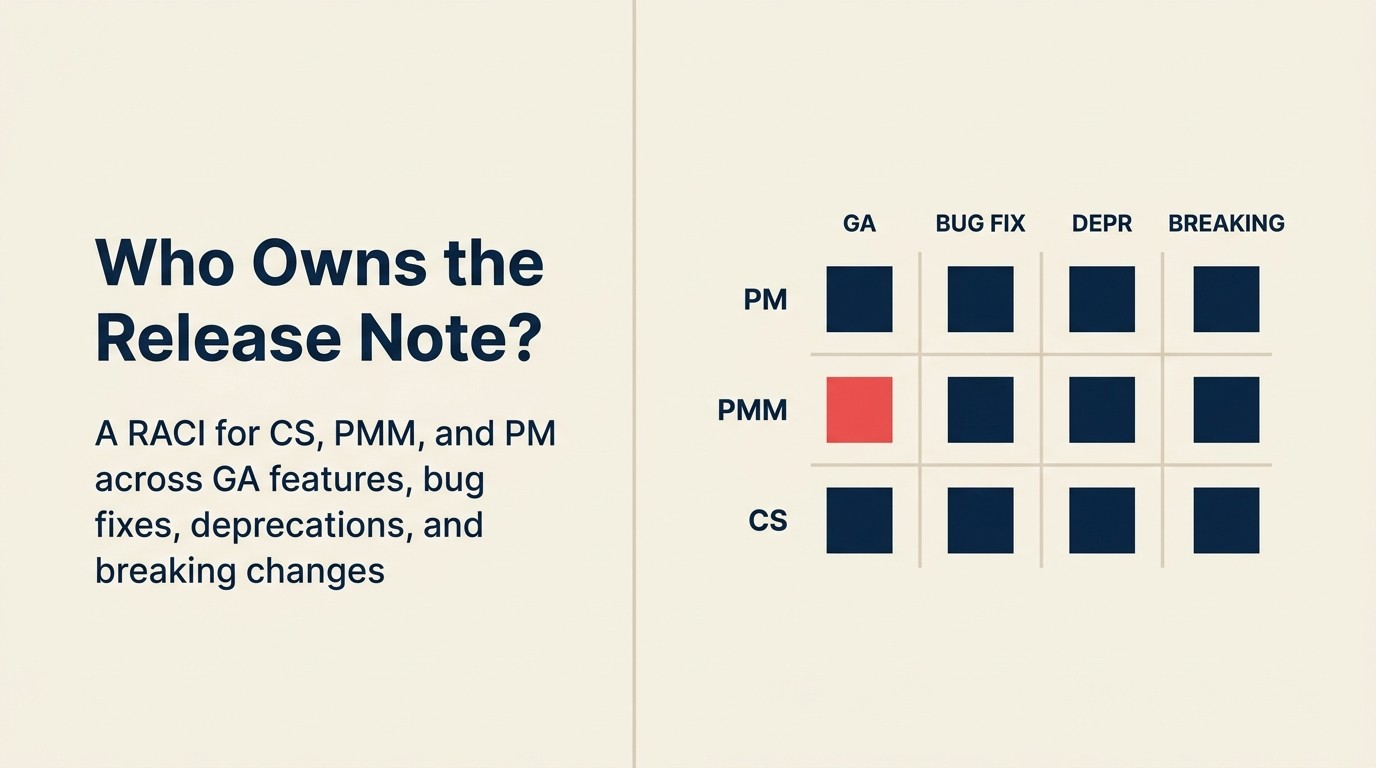
O RACI de 4 Tipos de Mudança: O Framework de Decisão para Responsabilidade de Lançamento
Uma matriz RACI é a ferramenta padrão de gerenciamento de projetos para esclarecer exatamente esse tipo de questão de responsabilidade de múltiplas equipes. O RACI de 4 Tipos de Mudança mapeia cada tipo de mudança para uma estrutura de responsabilidade distinta, porque o modo de falha de uma mudança disruptiva não é o mesmo que o de uma correção de bug, e tratá-los de forma idêntica produz um processo em que ninguém confia.

| Tipo de Mudança | Redigir | Revisar | Aprovar | Comunicar | Arquivar |
|---|---|---|---|---|---|
| Nova Funcionalidade em GA | PMM | PM (precisão) | Líder de CS (impacto ao cliente) | CS (contato direto); PMM (in-app, notas de versão) | PMM |
| Melhoria / Correção de Bug | PM ou PMM | CS (verificação de enquadramento) | Líder de CS ou Líder de PMM | Automático (changelog, in-app) | PM |
| Descontinuação / Sunset | PMM | PM (precisão do cronograma); CS (risco da conta) | Líder de CS | CSM (direto, pré-público); PMM (aviso público) | CS Ops |
| Mudança Disruptiva | PM | Líder de CS (risco da conta) | VP CS ou Head of Product | CSM (proativo, pré-lançamento) | CS Ops |
Responsabilidade clara não significa responsabilidade única. O RACI mostra quem redige, quem revisa e quem envia, porque o modo de falha geralmente é uma lacuna entre essas três etapas, não uma disputa sobre quem deveria se importar.
Banner In-App vs. Notas de Versão vs. Contato Direto do CSM
Nem toda mudança precisa de uma conversa com o CSM. E nem toda mudança é bem atendida por uma nota de versão. Escolher o canal errado é tão custoso quanto nenhuma comunicação. Um banner in-app para uma mudança disruptiva não é suficiente, e uma ligação direta do CSM para uma melhoria menor de UI desperdiça o tempo de todos.

Use banner in-app quando: a mudança é uma melhoria de baixo risco ou funcionalidade opt-in. O cliente precisa saber que ela existe. Não precisa de uma conversa sobre isso. A mudança não requer nenhuma ação do cliente.
Use notas de versão como canal principal quando: a mudança é legível pelo changelog por compradores técnicos ou defensores internos que monitoram o que foi lançado. As notas de versão são o registro oficial. A mensagem in-app a leva à superfície de forma contextual; as notas de versão a tornam pesquisável e duradoura.
O CSM deve entrar em contato diretamente quando:
- A conta tem uso ativo de um fluxo de trabalho afetado
- A mudança é uma descontinuação ou mudança disruptiva
- A conta é de alto ARR (defina o limite, tipicamente os 20% superiores de ARR)
- A conta está atualmente em risco ou tem um escalamento aberto
- A mudança envolve um compromisso feito durante o ciclo de vendas (verifique o pacote de transferência)
O padrão para mudanças disruptivas e descontinuações é sempre o contato direto do CSM, antes de qualquer anúncio público ser feito.
O Problema de Timing: Quando os Clientes Descobrem vs. Quando Deveriam
A falha padrão é que os clientes descobrem pelo changelog após o lançamento. Eles abrem o produto, veem algo diferente, verificam o changelog e leem sobre isso. O CSM deles ainda não sabe. O e-mail do cliente chega na caixa de entrada do CSM antes do briefing. Essa lacuna de timing está diretamente relacionada a como o CS comunica o roadmap sem fazer promessas excessivas: quando a cadência de briefing é sólida, os CSMs têm contexto suficiente para gerenciar as expectativas dos clientes nos dois lados.

Isso é inteiramente evitável. Mas corrigi-lo requer aceitar que "a funcionalidade está pronta" e "a comunicação está pronta" são dois marcos separados, e que o GA não deveria acontecer até que ambos estejam completos.
Melhor prática: os CSMs recebem o briefing antes do GA. As contas estratégicas e de alto ARR recebem contato direto 24 a 48 horas antes do GA para mudanças significativas. O banner in-app entra em vigor no GA. A nota de versão pública é publicada no mesmo dia. Para mudanças disruptivas: nenhuma mudança é lançada sem que o contato do CSM com todas as contas afetadas esteja completo.
Construir uma cadência de briefing não requer um gargalo em cada lançamento. Melhorias de baixo risco saem com uma breve mensagem no Slack para a equipe de CS e uma linha no resumo interno de lançamento. Mudanças de alto risco disparam a sequência completa. O filtro que determina qual é qual deve ser escrito, não deixado ao critério individual do PM.
PMM como Camada de Coordenação
O PMM não é o responsável por tudo neste framework. Mas o PMM é a camada de coordenação: a função que é responsável pelos modelos, o calendário e o protocolo de transferência entre Produto e CS.
O que o PMM deve ser responsável: padrões de mensagem, o calendário de comunicação de lançamento, o modelo de briefing de CS, o modelo de mensagem in-app e o arquivo de notas de versão anteriores. Quando um PM pergunta "como comunicamos isso?", a resposta deve ser um modelo mantido pelo PMM, não um documento em branco.
O que o PMM não deve ser responsável: decisões específicas de conta sobre quais contas contactar, quando contactá-las e o que dizer além do modelo padrão. Isso fica com o CS. Um CSM sabe quais contas têm escalamentos abertos, quais defensores internos são novos e quais contas têm fluxos de trabalho ativos que serão afetados. O PMM define a mensagem; o CS define a lista de contatos.
Para o contexto estrutural sobre o papel do PMM na divisão CS-Produto, veja Marketing de Produto como a Ponte.
Como é um Processo de Comunicação de Lançamento Funcionando
Aqui está um ciclo de lançamento concreto de 30 dias com quatro momentos de transferência definidos entre Produto, PMM e CS.

Dia menos 30 (planejamento de sprint): o PM confirma quais itens são destinados ao lançamento e sinaliza quaisquer mudanças com impacto significativo no CS: mudanças disruptivas, descontinuações ou funcionalidades que afetam contas de alto ARR. O líder de CS é notificado nesse momento, não no GA.
Dia menos 10 (transferência de conteúdo): o PM fornece ao PMM o resumo da funcionalidade, o coorte de clientes afetados e quaisquer detalhes técnicos necessários para mensagens precisas. Este é o insumo para o briefing, nota de versão e mensagem in-app.
Dia menos 5 (distribuição do briefing): o PMM entrega o briefing de CS para o líder de CS: o que foi lançado, como explicar aos clientes, quais perguntas esperar, quais contas contactar proativamente. O líder de CS distribui para as equipes de conta no mesmo dia.
Dia zero (GA): a mensagem in-app entra em vigor. A nota de versão é publicada. Os CSMs com contas sinalizadas já fizeram contato ou estão fazendo hoje. O PMM arquiva os materiais de lançamento. CS Ops registra a distribuição do briefing para a revisão pós-lançamento.
Pós-lançamento (dia mais 14): o PM e CS Ops revisam os sinais de adoção iniciais. Se a adoção está baixa, o CS executa uma campanha de ativação. Se há relatórios de atrito no nível da conta, eles entram no pipeline de VoC.
Modos de Falha a Evitar
CS descobrindo ao mesmo tempo que os clientes. Esta é a falha mais comum e a mais prejudicial ao relacionamento CS-cliente. Quando um cliente envia um e-mail para o CSM e o CSM não sabe o que mudou, a erosão de confiança é imediata. A solução é estrutural: o GA não acontece até que o briefing seja distribuído. Para uma análise mais profunda do padrão completo de falhas nessa divisão, veja 8 sinais de alerta de desalinhamento CS-Produto.
PMM escrevendo notas de versão que os CSMs não conseguem traduzir em conversas com clientes. Notas de versão escritas em linguagem de lançamento de funcionalidade ("Apresentando funcionalidade avançada de dashboard") não ajudam os CSMs a responder "por que meu fluxo de trabalho mudou?" Os briefings precisam ser escritos no registro da conversa com o cliente: o que o cliente vai notar, o que deve fazer, quais perguntas vai fazer.
PM escrevendo changelogs técnicos que os clientes não conseguem compreender. Changelogs técnicos são adequados como registro interno. Não são substitutos para comunicação voltada ao cliente. Quando o changelog é o único artefato, os clientes com defensores internos não técnicos, que são a maioria da sua base de clientes, ficam sem contexto útil.
O Modelo de RACI de Uma Página
Use isso como ponto de partida. Adapte as funções à estrutura da sua equipe e os limites à sua distribuição de ARR. O objetivo é um documento que tanto o VP CS quanto o Head of Product possam aprovar em uma única reunião.
| Nova Funcionalidade em GA | Melhoria / Correção | Descontinuação | Mudança Disruptiva | |
|---|---|---|---|---|
| Redigir | PMM | PM ou PMM | PMM | PM |
| Revisar | PM, Líder de CS | CS (enquadramento) | PM, Líder de CS | Líder de CS |
| Aprovar | VP CS, Head of Product | Líder de PMM ou Líder de CS | VP CS | VP CS + Head of Product |
| Comunicar (interno) | Líder de CS para equipes de conta | Líder de CS (se houver contas afetadas) | CS Ops para CSMs | Líder de CS para todos os CSMs afetados |
| Comunicar (externo) | CSM direto + in-app + nota de versão | In-app ou nota de versão | CSM direto (pré-público) + aviso PMM | CSM direto (pré-lançamento) |
| Arquivar | PMM | PM | CS Ops | CS Ops |
| Cronograma | Briefing D-5; contato GA D0 | Nota de versão no lançamento | Contato CSM antes do aviso público | Contato CSM antes do lançamento |
A ambiguidade custa mais do que a clareza imperfeita. A pesquisa do Gartner sobre lançamentos de produto mostra que o alinhamento multifuncional sobre responsabilidade de comunicação é um dos principais fatores que separam lançamentos bem-sucedidos dos confusos. O RACI exato importa menos do que se ambas as equipes concordam com ele e o utilizam. Um RACI que tanto o VP CS quanto o Head of Product revisaram e aprovaram será seguido de forma mais consistente do que um teoricamente melhor que nunca foi discutido.
Análise Rework: A Lacuna de Briefing como Variável de Retenção
Com base em benchmarks do setor, a lacuna de timing do briefing (quantos dias antes do GA um CSM recebe comunicação estruturada) é uma das alavancas de retenção mais controláveis na divisão CS-Produto. Empresas que operacionalizam uma janela de briefing de cinco dias veem adoção significativamente maior na primeira semana e menos ligações de escalamento pós-lançamento. O modelo RACI de 4 Tipos de Mudança funciona melhor quando a data de entrega do briefing é tratada como um pré-requisito obrigatório para a data de GA, não uma meta aspiracional. Quando o PMM é responsável pelo modelo de briefing e o PM é responsável pela transferência de conteúdo no D-10, a janela de cinco dias se torna estrutural em vez de aspiracional. Uma ferramenta de fluxo de trabalho com um calendário de lançamento compartilhado, onde tanto o PMM quanto o CS podem ver o prazo do briefing ao lado da data de GA, remove o ônus de coordenação do julgamento individual.
Saiba Mais
- Marketing de Produto como a Ponte
- Como o CS Comunica o Roadmap Sem Fazer Promessas Excessivas
- Descontinuação de Funcionalidades: Protegendo a Retenção
- Glossário de Alinhamento CS-Produto
- Falhas e Correções Comuns de CS-Produto
- Conteúdo de Educação do Cliente: como as equipes de CS constroem o conteúdo de treinamento que faz a adoção de lançamentos funcionar

Principal Solution Architect
On this page
- Por que Este é um Problema Organizacional, Não um Problema de Comunicação
- Os Quatro Tipos de Mudanças Visíveis ao Cliente
- Tipo 1: Nova Funcionalidade em GA
- Tipo 2: Melhoria ou Correção de Bug
- Tipo 3: Descontinuação ou Aviso de Sunset
- Tipo 4: Mudança Disruptiva
- O RACI de 4 Tipos de Mudança: O Framework de Decisão para Responsabilidade de Lançamento
- Banner In-App vs. Notas de Versão vs. Contato Direto do CSM
- O Problema de Timing: Quando os Clientes Descobrem vs. Quando Deveriam
- PMM como Camada de Coordenação
- Como é um Processo de Comunicação de Lançamento Funcionando
- Modos de Falha a Evitar
- O Modelo de RACI de Uma Página
- Saiba Mais