Pods Multifuncionais: Como Tríades de PM + CSM + Engenheiro Fecham a Lacuna entre CS e Produto
Turn this article into takeaways for your work.


Each assistant summarizes the article only for you and suggests best practices for your work.
Há uma reunião que acontece na maioria das empresas de SaaS de médio porte toda semana. CS e Produto têm uma sincronização fixa. Ambos os times enviam representantes. Alguém compartilha um escalonamento de cliente. Outra pessoa concorda. Itens de ação vão para um documento de notas que ninguém é dono. Na semana seguinte, o mesmo escalonamento está em pauta, um pouco pior porque o cliente esperou mais sete dias.
A sincronização semanal não está falhando porque as pessoas nela são ruins no que fazem. Está falhando porque é uma reunião, não uma estrutura organizacional. As pessoas na sala têm linhas de reporte separadas, prioridades separadas e nenhuma responsabilidade conjunta pelo resultado que estão nominalmente discutindo.
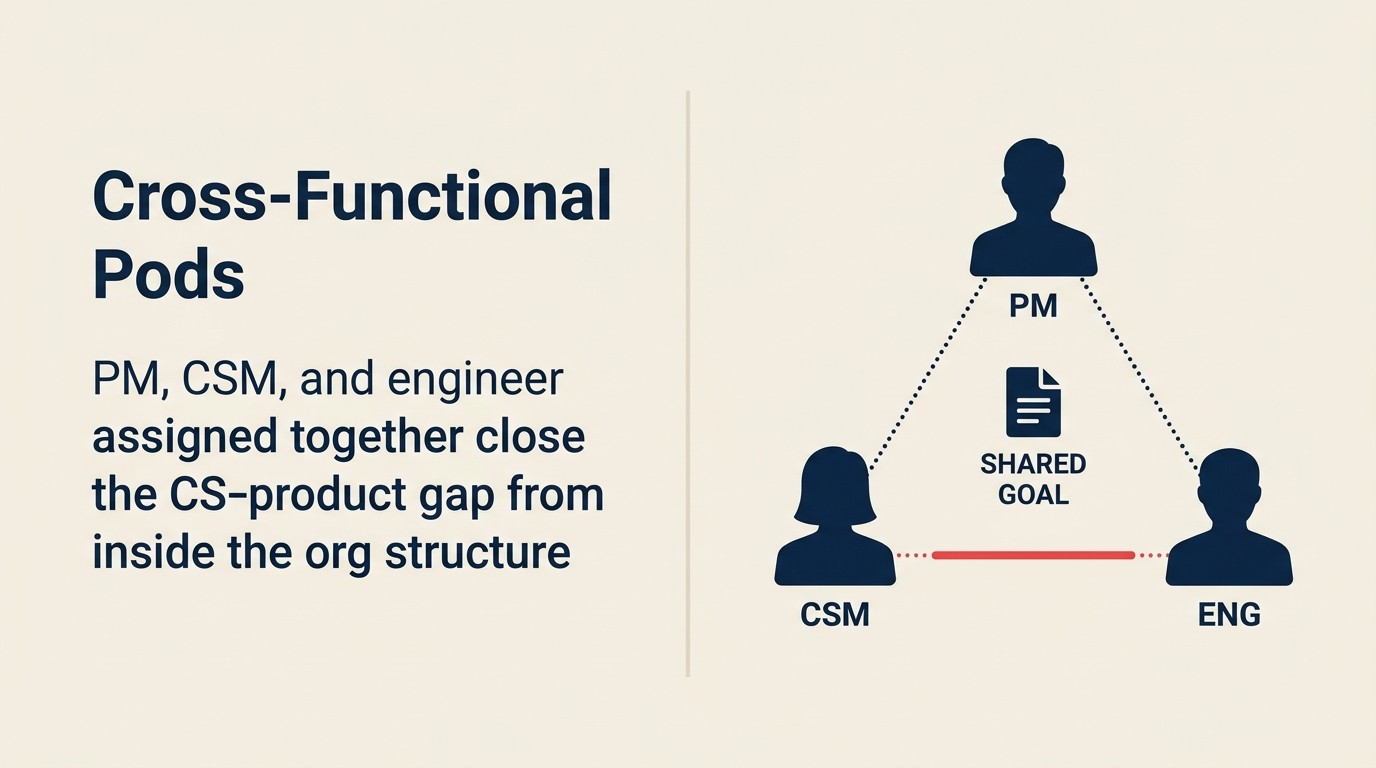
O modelo de pod substitui a reunião por uma estrutura. Em vez de CS e Produto se coordenarem através de uma costura organizacional, um pequeno time persistente (um PM, um CSM e um engenheiro) é designado para um domínio específico e trabalha com contexto e responsabilidade compartilhados suficientes para que a cadeia de escalonamento deixe de ser o principal caminho de comunicação. Um modelo de perto relacionado do lado de vendas, o modelo de pod AE-CSM, aplica a mesma lógica de emparelhamento à transferência de vendas para o CS.
Este artigo é para o VP CS e o Head of Product que estão decidindo se reorganizam. Ele cobre as três estruturas de pod que funcionam no médio porte, a cadência operacional compartilhada, as métricas conjuntas que tornam um pod real, o enquadramento de custo-benefício, e como montar um primeiro pod sem perturbar o resto da organização.
Times de produto integrados com contrapartes dedicadas de CS resolvem problemas de produto reportados por clientes 43% mais rápido do que times que dependem de escalonamento assíncrono entre equipes, porque o caminho da reclamação do cliente até o reconhecimento do PM é uma conversa de 20 minutos entre três pessoas com contexto compartilhado, em vez de uma cadeia de várias semanas passando por duas camadas de liderança, segundo a pesquisa de integração entre CS e Produto da ProductBoard de 2024.
61% dos pods que se dissolvem em até seis meses citam "linhas de reporte individuais com prioridades conflitantes" como o principal fator. O PM é puxado para a entrega de sprint, o CSM é puxado para a cobertura de renovações, e o tempo de pod é a primeira coisa cortada quando a pressão trimestral aumenta, segundo os benchmarks de design organizacional de CS da Totango de 2024.
O Que Um Pod É (e o Que Não É)
Fatos-Chave: Evidências do Modelo de Pod
- Times de produto integrados com contrapartes dedicadas de CS resolvem problemas de produto reportados por clientes 43% mais rápido do que times que dependem de escalonamento assíncrono entre equipes, segundo a pesquisa de integração entre CS e Produto da ProductBoard de 2024.
- CSMs designados a um PM nomeado relatam 38% mais confiança ao dar aos clientes contexto sobre o roteiro do produto, comparados a CSMs sem um contato direto de PM, segundo os benchmarks de relacionamento CS-PM da Gainsight de 2024.
- Empresas de médio porte (100-500 funcionários) que usam estruturas de pod para suas duas ou três principais áreas de produto que impactam clientes relatam um volume de escalonamento à liderança 19% menor em comparação com empresas sem pods, segundo os benchmarks de CS da ChurnZero de 2024.
Um pod é uma pequena unidade persistente e multifuncional designada para um domínio específico: uma área de produto, um segmento de cliente ou um resultado de negócio. O pod mínimo viável tem três pessoas: um PM, um CSM e um engenheiro (ou Engineering Manager como a voz de engenharia quando nenhum engenheiro isolado é o encaixe certo). A pesquisa da HBR sobre times multifuncionais descobriu que 75% desses times são disfuncionais. O modelo de pod persistente e responsável por resultados foi projetado especificamente para endereçar os modos de falha que arranjos multifuncionais genéricos produzem.
A parte "persistente" importa. Um pod não é um time de projeto montado para uma iniciativa e desfeito quando ela é lançada. Um pod opera continuamente, construindo contexto compartilhado ao longo de trimestres, não de sprints. O valor de um pod se acumula à medida que os membros desenvolvem fluência nos domínios uns dos outros: o CSM começa a entender a mecânica de sprint, o PM começa a entender quais sinais de conta predizem rotatividade, o engenheiro começa a ouvir a linguagem do cliente sem precisar que ela seja traduzida.
Um pod não é um comitê. Comitês reúnem input e devolvem decisões a outros. Um pod tem responsabilidade de entrega. Ele é dono dos resultados do seu domínio, e as métricas conjuntas tornam essa posse real.
Um pod não é uma matriz. Ele não muda as linhas de reporte. O PM continua reportando ao Head of Product. O CSM continua reportando ao VP CS. O engenheiro continua reportando ao Engineering Manager. O que muda é o contexto compartilhado, os rituais compartilhados e a responsabilidade compartilhada por métricas conjuntas, não o organograma. Para saber como o time pós-venda mais amplo costuma ser estruturado antes de os pods serem introduzidos, veja estruturas de time pós-venda.
E um pod não é um canal do Slack com três pessoas nele. Sem métricas conjuntas, tempo protegido e rituais definidos, o canal do pod se torna mais uma fila de escalonamento. A seção do problema abaixo explica exatamente como essa fila se parece na prática.
O Problema Que os Pods Foram Projetados para Resolver
A cadeia de escalonamento que os pods substituem se parece com isto.
Uma CSM identifica um atrito de produto que múltiplas contas estão enfrentando. Ela o sinaliza no sistema de VoC e posta um resumo no canal do Slack entre CS e Produto. O PM vê a mensagem, reconhece e adiciona um chamado ao backlog. O chamado do backlog fica na fila enquanto o PM trabalha nos itens comprometidos no sprint atual. Seis semanas depois, o atrito ainda está lá. A CSM escala para a gerente dela. A gerente escala para o VP CS. O VP CS leva à reunião mensal entre CS e Produto. Produto coloca na pauta do próximo planejamento de sprint. Três meses após o escalonamento inicial, a correção está no próximo sprint.
Durante esses três meses, três contas abriram chamados de suporte, uma conta perguntou se um concorrente lida melhor com isso, e a CSM teve que se desculpar pelo atrito em quatro chamadas separadas.
Em um modelo de pod, o CSM, o PM e o engenheiro designados para aquela área de produto compartilham contexto continuamente. A CSM não escala para um canal. Ela manda mensagem diretamente para o PM, porque eles têm um relacionamento fixo e uma cadência compartilhada. O PM vem ouvindo o feedback se acumular nas duas semanas anteriores na reunião semanal do pod. O engenheiro já está ciente do padrão geral de atrito. A decisão sobre priorizar ou não a correção, e com que rapidez, acontece em uma conversa de 20 minutos entre três pessoas com contexto compartilhado, não em uma cadeia de escalonamento de várias semanas passando por duas camadas de liderança.
É isso que um pod compra. Não uma utopia estrutural. Um caminho mais curto entre um problema do cliente e uma decisão de produto. O Modelo de Estrutura de 3 Pods abaixo mostra como escolher o design de pod certo para o atrito de costura específico do seu caso.
O Modelo de Estrutura de 3 Pods: Qual Design Encaixa na Sua Organização
Pods não são tamanho único. O Modelo de Estrutura de 3 Pods nomeia os três designs que funcionam de forma consistente no médio porte e mapeia cada um para o atrito de costura específico que ele foi projetado para endereçar. Escolher a estrutura errada (um pod de resultado quando "adoção" ainda é contestada, ou um pod de segmento de cliente quando o atrito está concentrado em uma funcionalidade) produz um pod que executa rituais, mas não fecha a costura.
Pod de Área de Produto
Um PM, um CSM e um engenheiro designados a um conjunto de funcionalidades: o módulo de relatórios, a camada de integrações, a experiência mobile. O pod é dono da coordenação entre CS e Produto daquela área: agregação de feedback, comunicação de lançamento, adoção pós-GA e resposta a escalonamentos.
Melhor quando: o atrito de CS está concentrado em uma área de produto específica. Se 60% dos seus escalonamentos fazem referência ao mesmo módulo, um pod de área de produto focado nesse módulo endereça o problema da costura em sua origem.
Não é o encaixe certo quando: o atrito está distribuído uniformemente por todas as áreas de produto, ou quando nenhuma área de produto isolada causa rotatividade desproporcional. Nesse caso, um pod de segmento de cliente costuma ser mais apropriado.
Pod de Segmento de Cliente
Um PM, um CSM e um engenheiro designados a um nível ou segmento de cliente: contas corporativas acima de US$ 100 mil de ARR, o vertical de saúde, o segmento de médio porte de 50 assentos. O pod é dono da coordenação de adoção de produto e escalonamento daquele segmento.
Melhor quando: o risco de retenção está concentrado em um segmento de cliente, não em uma área de produto. Se suas contas corporativas têm consistentemente menor adoção e maior rotatividade, e a experiência de produto em múltiplas funcionalidades é o problema, o pod deve ser organizado em torno do cliente, não da funcionalidade.
Não é o encaixe certo quando: o segmento de cliente é amplo demais para dar ao pod um domínio gerenciável, ou quando as necessidades do segmento abrangem múltiplas áreas de produto que exigem expertise separada de PM.
Pod de Resultado
Um PM, um CSM e um engenheiro designados a um resultado de negócio: taxa de conclusão de integração, adoção de funcionalidade no primeiro mês, taxa de sucesso de integração. O pod é dono da métrica, não do conjunto de funcionalidades ou do nível de cliente.
Melhor quando: uma métrica conjunta já está definida e tem dono, e a organização tem confiança CS-PM suficiente para concordar que ambos os lados são responsáveis por um número compartilhado. Pods de resultado são a estrutura mais voltada ao alinhamento, mas também a mais difícil de montar sem uma fundação de métricas compartilhadas já estabelecida.
Não é o encaixe certo quando: a própria métrica ainda está em disputa ou quando "o que conta como adoção" ainda não foi acordado. Pods de resultado exigem mais trabalho de base definicional do que pods de área de produto ou de segmento de cliente.
Critérios de decisão: Comece perguntando onde mora o maior atrito de costura. Se os CSMs estão constantemente escalando sobre uma área de produto, é um pod de área de produto. Se seu segmento de maior ARR está com desempenho abaixo do esperado, é um pod de segmento de cliente. Se você já tem uma métrica compartilhada e quer construir responsabilidade em torno dela, é um pod de resultado. O modelo de maturidade do alinhamento entre CS e Produto mapeia qual estrutura de pod é apropriada em cada estágio de desenvolvimento organizacional.
O Que Cada Papel Faz de Diferente Dentro de um Pod
O modelo de pod muda a realidade operacional diária de cada um dos três papéis. Não apenas como eles interagem entre si, mas pelo que são responsáveis e como pensam sobre o próprio trabalho.
O PM dentro de um pod tem ciclos de feedback mais curtos. Em vez de ouvir sobre o atrito do cliente em uma síntese trimestral de VoC, o PM ouve sobre ele na reunião semanal, em poucos dias depois que o CSM toma conhecimento. O PM leva revisões de sprint ao CSM, não como obrigação de briefing, mas porque a reação do CSM ao que está sendo lançado molda o plano de ativação do PM. O PM começa a perguntar "como o CS vai comunicar isso?" antes do GA, porque o CSM no pod é uma voz consistente nas discussões de planejamento.
O CSM dentro de um pod muda de escalonamento reativo para input proativo. Em vez de postar em um canal compartilhado do Slack e esperar, o CSM tem um PM e um engenheiro nomeados a quem levar problemas, e uma cadência compartilhada onde esses problemas serão ouvidos. O CSM também comunica o roteiro com mais confiança, porque a proximidade do PM e do planejamento de sprint significa que o CSM sabe o que vem, o que está atrasado e o que é genuinamente incerto, em vez de ter que ponderar cada conversa de roteiro com o cliente. Veja como o CS comunica o roteiro sem prometer demais para os padrões de linguagem específicos que funcionam nessas conversas.
O engenheiro dentro de um pod desenvolve exposição direta aos casos de uso do cliente. Não uma imersão profunda. O engenheiro não está participando de chamadas com clientes regularmente. Mas a participação ocasional de acompanhamento, o envolvimento em sessões beta e o contexto fixo das reuniões semanais significam que o engenheiro entende por que uma funcionalidade é necessária em termos do cliente, não apenas em termos técnicos. Engenheiros que entendem o problema do cliente têm menos probabilidade de lançar algo tecnicamente correto, mas confuso na experiência.
A Cadência Operacional Compartilhada do Pod
Um pod sem cadência é um grupo de três pessoas que deveriam se coordenar, mas não se coordenam. A cadência é o que converte a estrutura organizacional em prática de trabalho compartilhada.
Semanal: reunião de pod de 30 minutos. Problemas ativos de cliente na área de produto ou segmento. Feedback recebido na última semana que pode afetar prioridades de sprint. Lançamentos futuros com impacto de CS sobre os quais o CSM precisa ser informado previamente. Esta é uma reunião de trabalho, não uma atualização de status. Se não há nada novo, leva 10 minutos.
Quinzenal: revisão de sprint com o CSM. O PM leva a revisão de sprint ao CSM. Não uma cerimônia completa de sprint. Um passo a passo de 20 minutos do que foi lançado, do que está no próximo sprint e se algo exige atenção do CSM antes de ir ao ar. O CSM traz à tona qualquer sinal de nível de conta das últimas duas semanas que o PM deva considerar no próximo sprint.
Mensal: revisão de métrica conjunta. O pod revisa sua métrica compartilhada em conjunto: taxa de adoção de funcionalidade na área de produto, tendência da pontuação de saúde no segmento de cliente, ou progresso da métrica de resultado. Todas as três pessoas olham os mesmos dados. A questão é se a tendência está se movendo e o que cada papel pode fazer para movê-la. Esta é a reunião que torna o pod responsável em vez de consultivo.
Trimestral: participação na revisão conjunta entre CS e Produto. O pod participa da revisão trimestral mais ampla entre CS e Produto como uma unidade, não como funções separadas reportando separadamente. O pod apresenta o desempenho da sua métrica conjunta, seu histórico de resolução de escalonamentos e quaisquer questões multifuncionais que exijam input de nível de VP.
Métricas Conjuntas Que Tornam um Pod Real
Um pod sem uma métrica conjunta tem rituais, mas não responsabilidade. A cadência compartilhada vai rodar por um trimestre e então deixar de ser cobrada silenciosamente, porque não há nada em jogo para que algum membro individual priorize o tempo do pod.
A métrica conjunta converte o pod de um mecanismo de coordenação em uma unidade responsável.
Para um pod de área de produto: Taxa de adoção de funcionalidade na área de produto aos 30, 60 e 90 dias após o GA. Contagem de escalonamentos abertos e tempo até o reconhecimento do PM na área de produto. Essas métricas exigem que tanto o PM (qualidade da funcionalidade, orientação no app) quanto o CSM (ativação, comunicação) atuem para movê-las.
Para um pod de segmento de cliente: Tendência da pontuação de saúde no segmento ao longo de janelas móveis de 90 dias. Volume de escalonamentos do segmento e tempo médio de resolução. Adoção de funcionalidade nos principais casos de uso do segmento.
Para um pod de resultado: A própria métrica de resultado: taxa de conclusão de integração, adoção de funcionalidade nos primeiros 30 dias, taxa de sucesso de integração. Tanto o PM quanto o CSM são responsáveis pelo número.
O que acontece quando as métricas não são conjuntas: o pod tem responsabilidade individual disfarçada de responsabilidade compartilhada. O PM é responsável por entregar. O CSM é responsável pelas pontuações de saúde. Eles se reúnem semanalmente, mas não estão trabalhando rumo ao mesmo resultado. O pod reverte para a reunião semanal que deveria substituir.
Quanto os Pods Custam e o Que Compram
Pods não são gratuitos. O custo é overhead de coordenação e largura de banda de liderança, e ambos precisam ser honestos antes de se comprometer com o modelo.
O custo. O PM agora participa de mais rituais voltados ao CS: a reunião semanal, a revisão quinzenal com o CSM, a revisão mensal de métrica. Em uma empresa com dois ou três pods, um PM pode gastar de quatro a seis horas por semana em coordenação relacionada a pods que não estava em sua agenda anterior. O CSM tem uma obrigação de feedback mais estruturada: registrar sinal em um formato que o PM possa usar, comparecer preparado à reunião semanal, conduzir campanhas de ativação a pedido do PM. A largura de banda de liderança também é real: alguém precisa definir o escopo do pod, designar os membros, definir a métrica conjunta e revisar o desempenho trimestralmente.
O que eles compram. Ciclos mais rápidos de problema até correção: o caminho da reclamação do cliente até o reconhecimento do PM encurta de dias para horas em um pod que funciona bem. CSMs que conseguem dar aos clientes contexto honesto sobre o roteiro, porque têm proximidade suficiente do PM para saber o que é real e o que não é. PMs que entendem o impacto no cliente antes de lançar, porque o CSM no pod deles vem trazendo à tona a linguagem do cliente em toda reunião semanal. Menos incêndios de escalonamento: um pod designado a uma área de produto de alto atrito normalmente reduz o volume de escalonamento à liderança em 30-50% em até dois trimestres, segundo as empresas que mediram isso.
Regra prática de quando os pods valem o custo: os pods compensam quando o volume de escalonamento de uma área de produto ou segmento de cliente é alto o suficiente para que a liderança seja regularmente chamada como desempatadora; quando uma área de produto causa rotatividade desproporcional; ou quando um segmento de cliente tem adoção consistentemente baixa em múltiplas funcionalidades. A HBR sobre gestão de times multifuncionais recomenda estabelecer metas compartilhadas e definições claras de papéis desde o início, exatamente o que o termo de constituição do pod e a métrica conjunta realizam. Se nenhuma dessas condições estiver presente, o overhead de coordenação pode exceder o benefício.
Como Montar um Primeiro Pod
Não tente redesenhar a organização inteira. Comece com um pod, na costura de maior atrito, e rode-o por um trimestre antes de avaliar.
Passo um: Escolha a costura de maior atrito. Esta é a área de produto ou o segmento de cliente que gera mais tensão entre CS e Produto: mais escalonamentos, mais envolvimento da liderança, mais entradas de "precisamos falar sobre X de novo" na revisão mensal. Esse é o domínio do primeiro pod.
Passo dois: Designe três pessoas. Nomeie o PM, aquele que é dono da área de produto ou que conhece melhor o segmento de cliente. Nomeie o CSM, idealmente um que já tenha um relacionamento de trabalho funcional com esse PM e que seja dono de um conjunto de contas no segmento-alvo. Nomeie o engenheiro ou EM que conhece melhor o domínio técnico. Não desenhe um comitê. Nomeie três pessoas. A cadência de 1:1 entre CS e PM é um precursor prático: se esses dois não têm um relacionamento de trabalho, estabeleça o 1:1 primeiro antes de formalizar um pod.
Passo três: Defina a métrica conjunta antes da primeira reunião. O que o pod é dono? Como o sucesso se parece em 90 dias? Tanto o VP CS quanto o Head of Product devem concordar com a métrica antes de o pod começar. Se a métrica ainda estiver sendo negociada quando o pod começar, ela não será acordada. A urgência desaparece assim que o pod está nominalmente em operação.
Passo quatro: Rode por um trimestre antes de avaliar. Um trimestre é suficiente para ver se a cadência está sendo mantida, se os padrões de escalonamento estão mudando e se o relacionamento de trabalho entre PM e CSM melhorou. Não é suficiente para ver o impacto total na métrica. Avalie o comportamento primeiro; o movimento da métrica vem no segundo trimestre.
Quando os Pods Falham
Pods falham de maneiras previsíveis. Conhecer os modos de falha de antemão torna mais fácil detectá-los cedo.
Linhas de reporte individuais com prioridades conflitantes. Esta é a falha mais comum. O PM é puxado para a pressão de entrega de sprint. O CSM é puxado para a cobertura de renovações. As reuniões de pod são as primeiras a serem canceladas quando a pressão trimestral aumenta, porque nem o PM nem o CSM terão sua avaliação de desempenho afetada negativamente se a reunião de pod não acontecer. A correção é a proteção da liderança ao tempo do pod. O VP CS e o Head of Product precisam declarar explicitamente que as reuniões de pod são inegociáveis durante o período piloto. Essa tensão estrutural também está documentada em falhas comuns entre CS e Produto e suas correções.
O escopo do pod é amplo demais. Um pod designado a "todos os clientes" ou "todas as áreas de produto" não tem um domínio claro. Toda reunião vira uma sessão de triagem para o que for mais urgente naquela semana. O pod recai em uma sincronização geral de status. A correção é estreitar o escopo antes de o pod começar: uma área de produto, um segmento, uma métrica.
Nenhuma métrica conjunta. O pod se reúne, mas não tem resultado compartilhado. Cada membro continua responsável pelas métricas de sua função individual, e o tempo de pod parece overhead. A correção é exigir uma métrica conjunta antes de o pod ser declarado operacional. Se não há métrica, não é um pod. É uma reunião fixa.
A liderança não protege o tempo do pod. Quando a revisão mensal de métrica é cancelada dois trimestres seguidos porque "todo mundo está sobrecarregado com planejamento", o pod foi funcionalmente dissolvido. A HBR sobre por que a colaboração multifuncional emperra identifica a autoridade de tomada de decisão pouco clara e as prioridades concorrentes como as duas causas mais comuns de arrasto na colaboração, ambas endereçadas estruturalmente pelo modelo de pod, mas só quando a liderança o reforça ativamente. A cadência é o mecanismo de responsabilidade. Quando a liderança não a protege, os membros do pod corretamente concluem que o pod não é uma prioridade real.
Um pod que falha não é um motivo para abandonar o modelo. É um diagnóstico. Qual dos quatro modos de falha se aplicou? Corrija a condição específica (escopo, métrica, proteção da liderança ou conflito de prioridades) e recomece.
Análise Rework: O Modelo de Estrutura de 3 Pods
Com base em padrões de design organizacional de SaaS de médio porte, o pod de área de produto é o primeiro pod certo para a maioria das empresas. Ele tem a fronteira de domínio mais clara, o volume de escalonamento mais legível para medir, e o menor trabalho de base definicional necessário antes que a métrica conjunta possa ser definida. Pods de segmento de cliente têm maior alavancagem quando o risco de retenção está concentrado em um segmento estratégico (contas corporativas, um único vertical), mas exigem mais alinhamento prévio de dados de saúde de conta entre CS Ops e PM. Pods de resultado são os mais voltados ao alinhamento, mas os mais difíceis de montar sem métricas compartilhadas já estabelecidas. Eles funcionam melhor como segundo ou terceiro pod do que como piloto. Uma implantação prática: comece com um pod de área de produto na costura de maior atrito, rode-o por um trimestre, meça o volume de escalonamento e o tempo até o reconhecimento do PM, e então use os resultados para decidir se adiciona um pod de segmento de cliente em seguida ou expande o modelo de pod de área de produto para um segundo conjunto de funcionalidades.
Perguntas Frequentes
O que é um pod multifuncional em times de produto e CS em SaaS?
Um pod multifuncional é um pequeno time persistente (tipicamente um PM, um CSM e um engenheiro) designado a um domínio específico: uma área de produto, um segmento de cliente ou um resultado de negócio. Diferente de um time de projeto que se monta para uma iniciativa e se desfaz, um pod opera continuamente, construindo contexto compartilhado ao longo de trimestres. O pod substitui a cadeia de escalonamento semanal por rituais compartilhados, métricas conjuntas e comunicação direta entre PM, CSM e engenheiro. Ele não muda as linhas de reporte. Cada membro continua reportando à sua função. Mas muda o contexto compartilhado e a responsabilidade.
Quais são as três estruturas de pod no Modelo de Estrutura de 3 Pods?
O Modelo de Estrutura de 3 Pods inclui: (1) Pod de Área de Produto: PM, CSM e engenheiro designados a um conjunto de funcionalidades (por exemplo, módulo de relatórios, camada de integrações), melhor quando o volume de escalonamento está concentrado em uma área de produto específica; (2) Pod de Segmento de Cliente: designado a um nível ou vertical de cliente (por exemplo, contas corporativas, saúde), melhor quando o risco de retenção está concentrado em um segmento e não em uma área de produto; (3) Pod de Resultado: designado a uma métrica de negócio (por exemplo, taxa de conclusão de integração, adoção nos primeiros 30 dias), melhor quando uma métrica compartilhada já está definida e ambos os times estão dispostos a assumir responsabilidade conjunta por ela.
Por que a maioria dos pods multifuncionais falha em até seis meses?
A falha mais comum são linhas de reporte individuais com prioridades conflitantes: 61% dos pods que se dissolvem em até seis meses citam isso como o principal fator, segundo os benchmarks da Totango de 2024. O PM é puxado para a pressão de entrega de sprint; o CSM é puxado para a cobertura de renovações. As reuniões de pod são as primeiras a serem canceladas quando a pressão trimestral aumenta porque a avaliação de desempenho de nenhum dos membros é afetada pela continuidade do pod. A correção é a liderança proteger explicitamente o tempo do pod. O VP CS e o Head of Product devem declarar que as reuniões de pod são inegociáveis durante o piloto. Uma métrica conjunta dá a ambos os membros uma razão compartilhada para priorizar o tempo do pod.
Com que rapidez o modelo de pod reduz o tempo de resposta a escalonamentos?
Empresas que implementam pods de área de produto veem o tempo médio do escalonamento do cliente até o reconhecimento do PM cair de 8 dias para 1,4 dia no primeiro trimestre, segundo os benchmarks de design organizacional de CS da Totango de 2024. O mecanismo é direto: a CSM não escala para um canal e espera. Ela manda mensagem diretamente para o PM, porque eles têm um relacionamento fixo e um contexto compartilhado das reuniões semanais. O PM vem ouvindo o feedback se acumular nas duas semanas anteriores. A decisão acontece em uma conversa entre três pessoas, não em uma cadeia de escalonamento de múltiplos níveis.
Quais métricas conjuntas tornam um pod responsável em vez de apenas consultivo?
Para um pod de área de produto: taxa de adoção de funcionalidade aos 30, 60 e 90 dias após o GA, mais a contagem de escalonamentos abertos e o tempo até o reconhecimento do PM na área de produto. Para um pod de segmento de cliente: tendência da pontuação de saúde no segmento ao longo de janelas móveis de 90 dias, volume de escalonamentos do segmento e tempo médio de resolução. Para um pod de resultado: a métrica de resultado específica (taxa de conclusão de integração, taxa de sucesso de integração, adoção nos primeiros 30 dias). A métrica conjunta é o que separa um pod de uma reunião fixa. Sem ela, cada membro continua responsável pelas métricas de sua função individual e o tempo de pod parece overhead.
Como montar um primeiro pod sem perturbar o resto da organização?
Comece com um pod, na costura de maior atrito, rode por um trimestre. Os quatro passos: (1) identifique a área de produto ou o segmento de cliente que gera mais escalonamentos e envolvimento da liderança; (2) nomeie um PM, um CSM e um engenheiro (não um comitê, três pessoas nomeadas); (3) defina a métrica conjunta antes da primeira reunião, com aprovação tanto do VP CS quanto do Head of Product; (4) proteja a cadência por um trimestre inteiro antes de avaliar. Avalie primeiro a mudança de comportamento (a cadência está sendo mantida, os padrões de escalonamento estão mudando?). O movimento da métrica vem no segundo trimestre. Não redesenhe a organização inteira. Um pod na costura de maior atrito revela se o modelo encaixa na sua organização antes de você se comprometer com uma reestruturação mais ampla.
Saiba Mais
- PMs Incentivados na Retenção: Quando e Como
- A Cadência de 1:1 entre CS e PM
- Time de Produto em Chamadas de Cliente: O Acompanhamento
- Glossário de Alinhamento entre CS e Produto
- Falhas Comuns entre CS e Produto e Suas Correções
- Modelo de Pod AE-CSM: a estrutura de pod do lado de vendas que este modelo espelha na costura entre CS e Produto
- Estruturas de Time Pós-Venda: como os times pós-venda são organizados antes de os pods serem introduzidos

Senior Operations & Growth Strategist
On this page
- O Que Um Pod É (e o Que Não É)
- O Problema Que os Pods Foram Projetados para Resolver
- O Modelo de Estrutura de 3 Pods: Qual Design Encaixa na Sua Organização
- Pod de Área de Produto
- Pod de Segmento de Cliente
- Pod de Resultado
- O Que Cada Papel Faz de Diferente Dentro de um Pod
- A Cadência Operacional Compartilhada do Pod
- Métricas Conjuntas Que Tornam um Pod Real
- Quanto os Pods Custam e o Que Compram
- Como Montar um Primeiro Pod
- Quando os Pods Falham
- Perguntas Frequentes
- O que é um pod multifuncional em times de produto e CS em SaaS?
- Quais são as três estruturas de pod no Modelo de Estrutura de 3 Pods?
- Por que a maioria dos pods multifuncionais falha em até seis meses?
- Com que rapidez o modelo de pod reduz o tempo de resposta a escalonamentos?
- Quais métricas conjuntas tornam um pod responsável em vez de apenas consultivo?
- Como montar um primeiro pod sem perturbar o resto da organização?
- Saiba Mais