Executando Programas Beta para Clientes: O Guia Operacional para Testes Liderados por CS
Turn this article into takeaways for your work.


Each assistant summarizes the article only for you and suggests best practices for your work.
A maioria das empresas que acredita executar programas beta na verdade não os executa. O que executam é uma prévia de funcionalidade. Encontram algumas contas que gostam delas, ativam uma flag e esperam para ver o que acontece. Quando as contas não reclamam, a funcionalidade é enviada. Quando reclamam, alguém agenda uma chamada. Não há coleta estruturada de feedback, nenhum critério definido de graduação, nenhum protocolo para o que acontece se o beta der errado, e nenhum alinhamento CS-Produto sobre quem é responsável pelo quê. O glossário de alinhamento CS e Produto define o vocabulário (beta, acesso antecipado, GA, VoC) que ambos os lados precisam concordar antes de qualquer programa ser lançado.
Essa abordagem não é um beta. É acesso antecipado com otimismo. E custa retenção quando os participantes sentem que foram usados para QA em vez de genuinamente consultados, e custa credibilidade quando funcionalidades chegam ao GA com os mesmos pontos de fricção que o beta deveria revelar e corrigir.
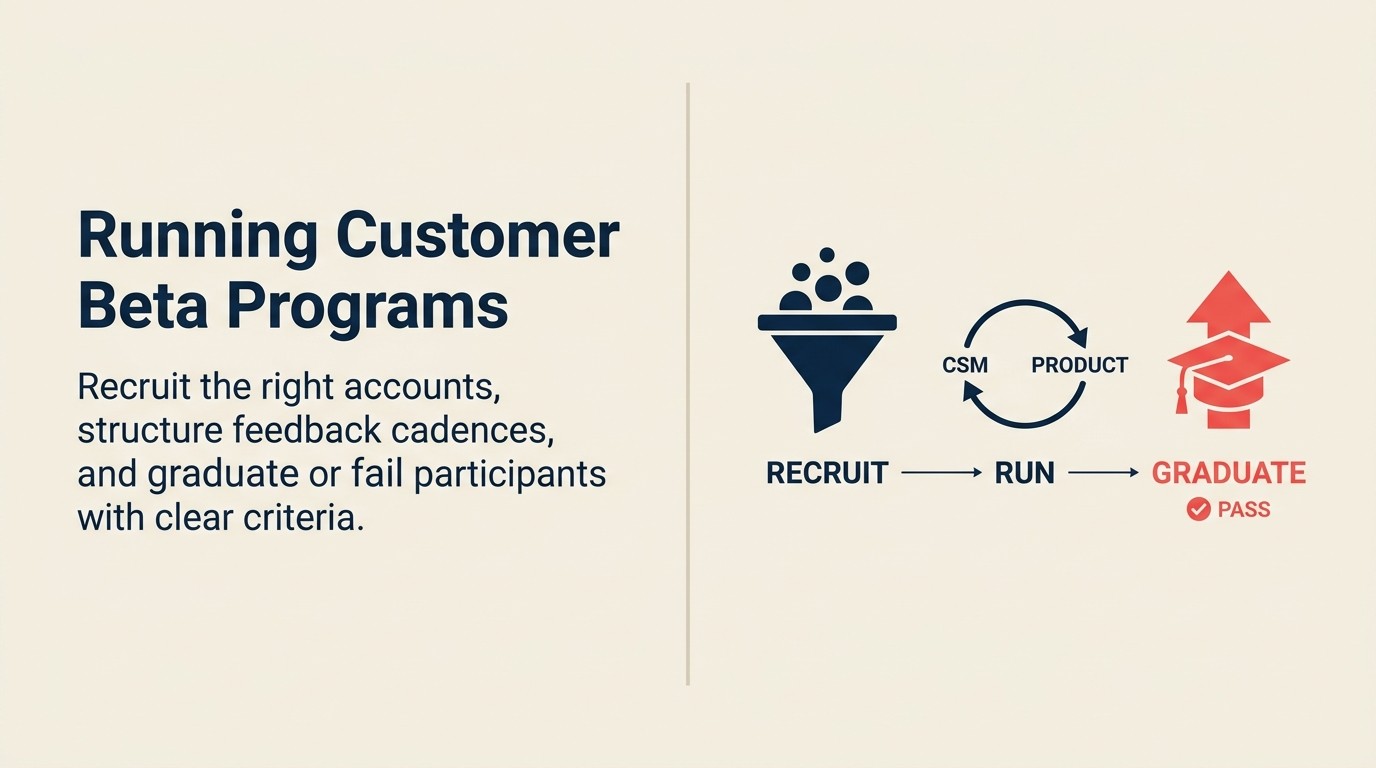
Um programa beta real é operacionalmente distinto de uma prévia. Tem uma hipótese. Tem critérios de seleção. Tem uma cadência de feedback que produz sinais estruturados que Produto pode agir. E tem uma transferência definida: entre CS e Produto no lado do design, e entre beta e GA no lado da graduação. Este é esse manual.
O Modelo de Operações de Programa Beta é a estrutura operacional que este artigo define. CS é responsável pela camada de relacionamento: seleção de participantes com base em saúde e adequação, definição de expectativas, coleta de feedback e gerenciamento de risco de relacionamento. Produto é responsável pela camada de critérios: a hipótese sendo testada, a lista de verificação de graduação e a resolução do feedback. A disciplina central do modelo: as funções não devem se confundir. Quando Produto recruta participantes, escolhe contas de que gosta. Quando CS decide os critérios de graduação, escolhe critérios que protegem o relacionamento. A junção só funciona quando ambos os lados ficam em sua área.
Por Que CS Deve Ser o Operador (Não Apenas um Recrutador)
O guia do HBR para programas de usuários iniciais descobriu que empresas B2B frequentemente ficam desapontadas com os resultados do beta especificamente porque CS é reduzido a um papel de recrutamento em vez de operacional. Essa é a falha de design que esta seção aborda diretamente. A alocação incorreta mais comum em programas beta é tratar CS como um gerador de listas. Produto diz "precisamos de 10 contas beta" e CS produz 10 nomes. Isso não é responsabilidade de CS. É CS como uma lista de contatos. E produz exatamente os problemas que você esperaria: participantes que não são o ICP certo para a funcionalidade, contas em saúde frágil que se tornam riscos de rotatividade quando a experiência beta é difícil, e ninguém gerenciando o relacionamento durante o período de testes quando as coisas inevitavelmente se complicam.
"Programas beta onde CS é responsável pela seleção de participantes e coleta de feedback produzem 2,3x mais itens de feedback acionáveis por participante do que programas onde Produto executa a seleção diretamente." (Gainsight, 2024)
CS deve ser responsável por três coisas que Produto não pode:
Avaliação de risco de relacionamento. CS sabe quais contas podem absorver a fricção de testar uma funcionalidade inacabada e quais não podem. Uma conta que está a três meses da renovação, tem um defensor interno cético e teve dois escalonamentos de suporte no último trimestre não é uma participante de beta. A pontuação de saúde de CS é o portão de entrada. Se CS não está responsável pela lista de participantes, o portão de saúde não é aplicado. O framework de pontuação de saúde do cliente cobre como interpretar dados de saúde exatamente nesse tipo de decisão de risco de relacionamento.
Gerenciamento de expectativas durante todo o engajamento. Produto define a funcionalidade; CS a traduz para a linguagem do relacionamento. Quando a experiência beta é confusa, o participante liga para o CSM, não para o contato de PM. Se o CSM não foi informado, não recebeu o enquadramento de feedback e não sabe o que deveria acontecer a seguir, essa confusão se torna um problema de relacionamento além de um problema de produto.
Superfície de feedback para sinais que Produto não vê. Os canais de feedback de Produto (pesquisas, prompts no aplicativo, check-ins estruturados) capturam a resposta articulada. Os CSMs capturam o tom, o nível de entusiasmo, o comentário casual em uma chamada sobre um ponto de fricção que o cliente não achou que valia a pena relatar formalmente. Esses sinais informais costumam ser os mais preditivos. Eles não chegam ao feedback estruturado a menos que CS esteja no relacionamento e saiba quando sinalizá-los.
Fatos-Chave: Resultados de Programas Beta
- Programas beta onde CS é responsável pela seleção de participantes e coleta de feedback produzem 2,3x mais itens de feedback acionáveis por participante do que programas onde Produto executa a seleção diretamente, segundo análise da Gainsight de 2024 de programas SaaS de médio porte.
- Produtos SaaS de médio porte que executam programas beta estruturados (hipótese definida, critérios de seleção, cadência de feedback) têm taxas de adoção de funcionalidades 38% maiores no GA de 90 dias do que produtos que usam prévias informais, segundo pesquisa da ProductLed de 2024.
- Participantes de beta que sentem que seu feedback foi considerado são 4,1x mais propensos a se tornar defensores públicos (estudo de caso, referência ou avaliação no G2) dentro de 12 meses do lançamento do GA (Salesforce State of the Connected Customer, 2024).
Antes do Lançamento: As Perguntas de Design que Produto e CS Devem Responder Juntos
Um programa beta que é lançado sem essas perguntas respondidas vai derivar. Seja em direção às contas que CS mais gosta em vez das contas que melhor representam o caso de uso, ou em direção a feedback vago demais para agir, ou em direção a critérios de graduação com os quais ninguém consegue concordar porque nunca foram definidos.

Qual hipótese este beta está testando? Esta é responsabilidade de Produto definir em uma única frase: "Acreditamos que equipes de operações de médio porte gerenciando projetos multifuncionais reduzirão o tempo de reuniões de status semanais em 30% usando esta visão de fluxo de trabalho." Se Produto não consegue declarar a hipótese, o beta não tem uma condição clara de sucesso, e CS não pode selecionar participantes que realmente a testam.
Quais perfis de cliente devem testá-la? CS contribui aqui. CS sabe quais contas têm o caso de uso para o qual a funcionalidade foi construída, quais têm a maturidade de fluxo de trabalho para avaliá-la com justiça, e quais têm a saúde de relacionamento para participar sem que isso se torne uma experiência negativa. Produto não deve selecionar participantes de uma lista no CRM. CS traduz os critérios de ICP em contas reais.
Como é o sucesso em 30 dias? Na graduação? Ambos os lados devem concordar com isso antes de qualquer pessoa ser convidada. "Os participantes estão usando ativamente a funcionalidade e fornecendo feedback estruturado" não é critério de sucesso. É uma descrição do programa. Critérios reais: "Pelo menos 70% dos participantes concluíram o fluxo de trabalho principal pelo menos duas vezes, e pelo menos 60% do feedback estruturado identificou um ponto de fricção específico ou confirmou uma suposição de usabilidade."
O que estamos preparados para fazer se o feedback for esmagadoramente negativo? Essa conversa quase nunca acontece antes do lançamento e sempre precisa acontecer durante ele. Defina o protocolo de encerramento com antecedência para que, se o beta precisar parar, tanto CS quanto Produto saibam a sequência de comunicação, o processo de remoção de acesso e o que é um debrief honesto com os participantes que investiram seu tempo.
Recrutando Participantes Beta
O processo de seleção tem três filtros que devem ser todos aprovados. Executar apenas um ou dois produz a coorte errada.

O filtro de ICP. Esta conta representa o caso de uso para o qual a funcionalidade foi construída? Não "são um bom cliente", mas "o fluxo de trabalho deles corresponde à hipótese?" Um cliente fiel com um contrato de $200K ARR que não tem o caso de uso é um participante beta pior do que uma conta de $40K ARR que vive o problema todos os dias. CS deve aplicar esse filtro de acordo com a definição de hipótese de Produto. A perspectiva de Jobs-to-be-Done para dados de CS é uma ferramenta prática para tornar essa tradução de ICP precisa.
O filtro de saúde do relacionamento. Pontuação mínima de saúde de CS: verde ou amarelo. Contas vermelhas não participam de programas beta. Um programa beta com uma conta em crise não é um engajamento de pesquisa. É uma extração. O participante está em má posição para dar feedback honesto sobre uma nova funcionalidade quando está ativamente gerenciando um problema com o produto existente. E uma experiência beta negativa sobre um problema existente acelera a rotatividade de clientes.
O filtro de histórico de engajamento. Esta conta concluiu sessões de feedback no passado? Respondeu à última pesquisa? Participou do último QBR? Um cliente que diz sim à participação no beta e depois não pode ser contatado para check-ins estruturados não fornece dados úteis. Torna-se um buraco de participante na coorte. O histórico de conta de CS é a única forma de avaliar isso.
Tamanho da coorte para médio porte: 5-15 contas. Menos de 5 significa que a experiência idiossincrasica de uma única conta pode distorcer o conjunto de dados de feedback. Mais de 15 significa que os CSMs não conseguem manter contato individual significativo com cada participante durante o período de testes, portanto, a qualidade do feedback cai e o gerenciamento do relacionamento se torna impossível. O ponto ideal prático para a maioria das equipes de CS de médio porte com contas nomeadas é entre 8-12.
O enquadramento do convite importa. O CSM pedindo participação no beta não deve vender demais. "Esta é uma chance de ter acesso antecipado a algo que acreditamos que vai mudar como sua equipe trabalha" cria dívida de expectativa. O enquadramento honesto: "Estamos testando uma nova capacidade e procuramos contas com seu fluxo de trabalho específico para nos dar feedback estruturado durante seis semanas. Seu insumo moldará diretamente o que é enviado. É um compromisso de tempo, tipicamente três a quatro horas durante o período de testes, e queremos ser claros sobre isso desde o início."
Integrando Participantes Beta
A chamada de início define o tom inteiro. CSMs que pulam a chamada de integração e simplesmente ativam a flag da funcionalidade produzem participantes que não sabem o que estão testando, não sabem como relatar problemas e não sabem o que o feedback deles deveria realizar.
A chamada de início tem três objetivos: alinhar sobre o que estão testando e por quê, definir expectativas sobre a cadência e o formato do feedback e estabelecer o que acontece quando as coisas não funcionam.
Os participantes precisam de um briefing escrito (não um documento longo, mas um resumo de uma página) com: qual funcionalidade está no escopo, o que está explicitamente fora do escopo para este beta, como relatar problemas (qual canal, qual formato), como é o cronograma de check-in estruturado e o que acontece com seus dados se o beta for cancelado. Este briefing é um documento coautorado por CS e Produto. CS escreve a linguagem do relacionamento. Produto escreve o escopo da funcionalidade e as expectativas técnicas.
O gerenciamento de acesso é responsabilidade de Produto definir e de CS comunicar. Quem controla a flag da funcionalidade? O que acontece com dados criados na funcionalidade beta se o programa terminar antes do previsto? Quais perguntas de segurança ou conformidade os participantes devem encaminhar à Engenharia? Os CSMs devem ter respostas para isso antes da chamada de início, não estar descobrindo na chamada.
Coletando Feedback que É Realmente Utilizável
A falha de feedback de beta mais comum não é que os participantes não deem feedback. É que o feedback que eles dão não está em um formato sobre o qual Produto pode agir. "Isso é confuso" não é acionável. "Quando tento atribuir o responsável pela subtarefa na visão de fluxo de trabalho, o menu suspenso não persiste depois que navego para outra página, então acabo tendo que reatribuir toda vez que volto ao projeto" é acionável.

A cadência de check-in para um beta de seis semanas:
| Check-in | Formato | Duração | O que Produto precisa |
|---|---|---|---|
| Semana 2 | Pulso rápido (assíncrono) | 5 min | Primeiras impressões, pontos de fricção iniciais, bloqueadores de configuração |
| Semana 4 | Sessão de aprofundamento (ao vivo) | 30 min | Pontos de fricção específicos, mapeamento de fluxo de trabalho, soluções alternativas inventadas |
| Semana 6 | Sessão final (ao vivo) | 45 min | Avaliação de adoção, problemas não resolvidos, prontidão para graduação |
O pulso rápido é uma pesquisa assíncrona de 3-5 perguntas projetada para levar cinco minutos. Seu objetivo é capturar a fricção no início antes que se torne um problema de relacionamento e confirmar que os participantes estão realmente usando a funcionalidade. Se o pulso da semana dois mostra que dois terços dos participantes ainda não abriram a funcionalidade, esse é um sinal de falha de integração que CS precisa agir imediatamente, não esperar até a semana quatro.
A sessão de aprofundamento é onde o sinal valioso mora. CS facilita, não Produto. O motivo: se um PM está conduzindo a sessão, os participantes tendem a suavizar o feedback negativo para proteger o relacionamento com a pessoa que construiu o que estão criticando. A pesquisa da McKinsey sobre transformações de experiência do cliente confirma que separar a camada de relacionamento da camada de avaliação (o que este artigo chama de CS facilitando em vez de Produto) produz insumos de clientes consistentemente mais honestos e acionáveis. Um CSM conduzindo a sessão cria separação. O trabalho do CSM é perguntar "o que não está funcionando" sem piscar quando a resposta é desfavorável, e capturar a resposta em linguagem específica e técnica em vez de linguagem emocional. O Pipeline de VoC de CS para Produto descreve como esse sinal estruturado viaja upstream depois que sai da sessão.
O que Produto precisa de cada sessão: pontos de fricção específicos vinculados a fluxos de trabalho específicos (não reclamações gerais), as soluções alternativas que os clientes inventaram quando a funcionalidade não funcionou como esperado (essas frequentemente revelam o que a funcionalidade deveria ter feito) e o mapeamento de caso de uso: exatamente como o participante integra essa funcionalidade em seu fluxo de trabalho existente, porque o uso real muitas vezes difere do assumido.
O que CS captura separadamente e não compartilha automaticamente com Produto: tom do relacionamento (o entusiasmo do participante está diminuindo?), sinais de risco de renovação (eles estão fazendo comentários sobre orçamento ou pressão de partes interessadas internas?) e confiança do defensor interno (o patrocinador ainda acredita no potencial da funcionalidade, ou está sendo cauteloso?). Esses sinais informam a estratégia de conta de CS. Devem ser sinalizados à liderança de CS, não incorporados ao fluxo de feedback de Produto.
Critérios de Graduação
A graduação de beta para GA deve ter dois componentes que CS e Produto aprovam juntos: prontidão da funcionalidade (domínio de Produto) e prontidão do participante (domínio de CS).

Prontidão da funcionalidade: A hipótese foi testada. Os principais pontos de fricção foram abordados. A funcionalidade funciona de forma confiável para os casos de uso para os quais foi construída. As limitações conhecidas estão documentadas e CS tem linguagem de posicionamento atualizada que as reflete honestamente.
Prontidão do participante: O participante consegue usar a funcionalidade sem orientação. Entende seu escopo e limitações. A pontuação de saúde de CS não diminuiu durante o período do beta. Cumpriu suas obrigações de feedback.
A lista de verificação de graduação deve ser construída antes do início do beta, não no final. Quando os critérios de graduação são definidos depois do fato, tendem a derivar em direção a "gostamos da funcionalidade agora e os participantes não estão reclamando", o que não é a mesma coisa.
O que acontece com os participantes que não conseguem se graduar (cujo fluxo de trabalho a funcionalidade acabou não se encaixando, ou cujo ambiente técnico não conseguiu suportar a integração)? A comunicação honesta é melhor do que o silêncio. O CSM liga para eles: "Com base no que aprendemos juntos, esta funcionalidade não é a adequada para sua configuração atual. Aqui está o que isso significa para você, e aqui está o que estamos fazendo com o sinal que você nos deu." Essa chamada, bem feita, preserva o relacionamento e frequentemente gera mais goodwill do que uma graduação bem-sucedida do beta.
Análise Rework: Equipes de CS executando programas beta no Rework podem rastrear pontuações de saúde dos participantes, cadência de sessões e status de feedback junto com o trabalho regular de conta, sem uma planilha separada de gerenciamento de beta necessária. O ponto ideal de coorte de 5-15 contas corresponde ao modelo de gerenciamento de contas nomeadas do Rework: cada participante recebe um registro de conta dedicado, e as notas de check-in estruturado do CSM alimentam diretamente o pipeline de feedback sem tradução de formato. Quando um beta falha na verificação de saúde, a pontuação de saúde do Rework revela isso antes que o convite seja enviado.
Quando o Beta Falha
Um beta em falha se parece com um ou mais destes: as sessões de feedback estão vazias porque os participantes não estão usando a funcionalidade, as pontuações de NPS dos participantes do beta estão caindo, ou os CSMs estão evitando conversas beta com suas contas porque a experiência é dolorosa demais para discutir.
A resposta certa a um beta em falha não é estendê-lo. É encerrá-lo com integridade. A sequência de encerramento: a liderança de CS e a liderança de Produto decidem juntas que o beta está falhando e concordam com a justificativa. CS notifica os participantes com uma explicação específica e honesta. Não "estamos ajustando nosso roteiro", mas "o feedback que coletamos mostrou que a funcionalidade precisa de mais trabalho fundamental antes de estar pronta para testes com clientes." O acesso é removido de forma limpa. Uma chamada de debrief é oferecida a cada participante que a deseja.
"61% dos participantes de beta SaaS B2B que não receberam nenhuma comunicação de encerramento estruturada relataram pontuações de NPS mais baixas pós-beta do que pré-beta. A experiência beta em si se tornou uma responsabilidade de confiança." (ChurnZero, 2024)
O resultado mais valioso de um beta com falha é o próprio sinal de falha. Por que essa funcionalidade não funcionou? Foi a hipótese (construímos para o problema errado)? O segmento (selecionamos o ICP errado)? A implementação (construímos a coisa certa de forma errada)? O trabalho de Produto é documentar essa resposta formalmente e trazê-la para o próximo ciclo de roteiro. Os dados de falha só são desperdiçados se não forem usados. O problema do cemitério de solicitações de funcionalidades explora o que acontece quando esses sinais nunca voltam ao ciclo de produto.
Após o Beta: Fechando o Ciclo em Escala
Quando a funcionalidade chega ao GA, duas coisas precisam acontecer: os não-participantes precisam saber que a funcionalidade existe, e os participantes do beta precisam saber que sua contribuição importou. A pesquisa de experiência do cliente B2B da McKinsey observa que clientes B2B que se sentem ouvidos e reconhecidos em momentos-chave são significativamente mais propensos a expandir seu relacionamento com o fornecedor. A chamada de encerramento do GA é exatamente esse tipo de momento.

O anúncio do GA para a base geral de clientes não precisa fazer referência ao programa beta em detalhes. Mas deve reconhecer que foi testado com clientes. Algo como "esta funcionalidade foi desenvolvida com insumo de uma coorte de clientes em nosso programa de acesso antecipado" sinaliza que o processo de desenvolvimento de produto é colaborativo, não unilateral.
Para os participantes do beta, o momento do GA é o ponto de contato de relacionamento de maior valor de todo o programa. O CSM entra em contato pessoalmente: "A funcionalidade que você ajudou a testar agora está disponível para todos os clientes. Queria que você soubesse primeiro porque seu feedback moldou diretamente [mudança específica]. Obrigado." Esse encerramento é o que distingue um programa beta que constrói defensores de um que apenas extrai dados.
A Transferência entre CS e Produto no GA
Antes que CS possa posicionar com confiança a funcionalidade graduada para contas que não participaram do beta, Produto precisa entregar três coisas: linguagem de posicionamento atualizada que reflete o que o beta ensinou sobre o caso de uso real da funcionalidade (não o hipotético), um FAQ interno de uma página sobre as limitações que ainda estão presentes no lançamento do GA e a lista de verificação de ativação que CS deve executar com as contas durante a integração à nova funcionalidade. Um programa de treinamento estruturado para clientes acelera a ativação para a base de contas mais ampla uma vez que as lições do beta são codificadas.
Sem essa transferência, CS está posicionado exatamente como estava no lançamento: sem informações melhores do que as que estavam no anúncio original de versão, e sem linguagem atualizada que reflita o que o beta realmente aprendeu. A funcionalidade pode ter se graduado. A transferência de conhecimento não.
Perguntas Frequentes sobre Programas Beta para Clientes
O que é o Modelo de Operações de Programa Beta?
O Modelo de Operações de Programa Beta é a estrutura operacional CS-Produto em que CS é responsável pela camada de relacionamento (seleção de participantes, definição de expectativas e coleta de feedback), enquanto Produto é responsável pela camada de critérios: a hipótese sendo testada, a lista de verificação de graduação e a resolução do feedback. A disciplina do modelo é a separação de funções. Quando Produto recruta participantes, escolhe contas de que gosta. Quando CS define os critérios de graduação, protege o relacionamento. Nenhum dos dois produz sinal confiável sozinho.
Quantas contas devem estar em um programa beta para clientes?
O tamanho ideal da coorte para programas beta de médio porte é de 5-15 contas. Abaixo de 5, a experiência idiossincrasica de uma única conta pode distorcer o conjunto de dados de feedback. Acima de 15, os CSMs não conseguem manter contato individual significativo com cada participante, então a qualidade do feedback cai e o gerenciamento do relacionamento se torna ingerenciável. A maioria das equipes de CS de médio porte com contas nomeadas encontra o ponto ideal prático entre 8-12 participantes (Winning by Design, 2024).
Por que CS deve facilitar as sessões beta em vez de Produto?
Sessões facilitadas por PM produzem feedback mais suave e menos acionável porque os participantes protegem os sentimentos da pessoa que construiu o que estão criticando. Sessões facilitadas por CS criam separação entre a camada de relacionamento e a camada de avaliação. A pesquisa da McKinsey sobre transformações de experiência do cliente confirma que essa separação produz consistentemente insumos mais honestos e acionáveis. O trabalho do CSM é perguntar "o que não está funcionando" sem piscar quando a resposta é desfavorável.
Quais são os critérios de graduação para um programa beta de clientes?
A graduação requer aprovação tanto de CS quanto de Produto. Prontidão da funcionalidade (domínio de Produto): a hipótese foi testada, os principais pontos de fricção foram abordados, as limitações conhecidas estão documentadas. Prontidão do participante (domínio de CS): o participante consegue usar a funcionalidade sem orientação, entende seu escopo e limitações, e sua pontuação de saúde não diminuiu durante o período do beta. Ambos os componentes devem ser atendidos antes do GA. A lista de verificação de graduação deve ser construída antes do início do beta. Critérios definidos depois do fato derivam em direção a "ninguém está reclamando."
O que deve acontecer quando um programa beta falha?
Um beta em falha deve ser encerrado com integridade, não estendido. A sequência: a liderança de CS e de Produto concordam que o beta está falhando e documentam a justificativa. CS notifica os participantes com uma explicação específica e honesta. Não "estamos ajustando nosso roteiro." Dê o motivo real: a hipótese estava errada, o ICP selecionado estava incorreto, ou a funcionalidade precisa de reestruturação fundamental. O acesso é removido de forma limpa. Uma chamada de debrief é oferecida a cada participante que a deseja. O próprio sinal de falha (por que não funcionou) é o resultado mais valioso.
Como os programas beta afetam a defesa do cliente?
Produtos SaaS de médio porte que executam programas beta estruturados têm taxas de adoção de funcionalidades 38% maiores no GA de 90 dias em comparação com produtos que usam prévias informais (ProductLed, 2024). Mais significativamente, os participantes do beta que sentem que seu feedback foi considerado são 4,1x mais propensos a se tornar defensores públicos (participação em estudo de caso, introduções de referência ou avaliações no G2) dentro de 12 meses do lançamento. O mecanismo é a confiança: participantes que vivenciaram consulta genuína se tornam os validadores externos mais credíveis do produto.
O que é dívida de expectativa em programas beta e como evitá-la?
A dívida de expectativa ocorre quando os participantes do beta acreditam que foram prometidos influência sobre o roteiro do produto, mas receberam apenas acesso de prévia de funcionalidade. Isso vem mais comumente de CSMs que vendem demais o convite: "seu feedback moldará o que construímos" é ouvido como "você decidirá o que é construído." A solução é um enquadramento honesto no momento do recrutamento: "isso é sobre insumo estruturado em uma funcionalidade específica, não controle do roteiro." Depois, no GA, feche o ciclo pessoalmente para cada participante do beta: diga a eles especificamente o que seu insumo mudou, e o que não mudou.
Saiba Mais

Principal Solution Architect
On this page
- Por Que CS Deve Ser o Operador (Não Apenas um Recrutador)
- Antes do Lançamento: As Perguntas de Design que Produto e CS Devem Responder Juntos
- Recrutando Participantes Beta
- Integrando Participantes Beta
- Coletando Feedback que É Realmente Utilizável
- Critérios de Graduação
- Quando o Beta Falha
- Após o Beta: Fechando o Ciclo em Escala
- A Transferência entre CS e Produto no GA
- Saiba Mais