Fechando o Ciclo de Feedback: A Disciplina de Informar os Clientes Sobre o que Aconteceu com o Que Disseram
Turn this article into takeaways for your work.


Each assistant summarizes the article only for you and suggests best practices for your work.
Eis a sequência de destruição de confiança que se repete em milhares de empresas SaaS de médio porte todo ano: um cliente compartilha um feedback específico, num QBR, num chamado de suporte, numa sessão beta, numa resposta de NPS. O CSM diz "vou repassar isso." Produto recebe, registra e toma uma decisão sobre o que fazer. Ninguém diz ao CSM qual foi essa decisão. O CSM não consegue dizer ao cliente. O cliente dá o mesmo feedback seis meses depois, um pouco mais frustrado. O CSM diz "vou repassar isso." O cliente para de dar feedback. Quando a conta entra em risco de rotatividade, ninguém percebe que o sinal estava lá dois anos atrás e morreu num pipeline que não fechou. O glossário de alinhamento CS e Produto define os termos de VoC, NPS e QBR que aparecem ao longo deste artigo. Tanto CS quanto Produto devem usá-los de forma consistente para que qualquer sistema de fechamento funcione.
A destruição não é deliberada. A maioria das equipes de CS genuinamente tenta coletar e repassar feedback. A maioria das equipes de Produto genuinamente toma decisões sobre o que construir. O problema é estrutural: não existe um sistema que conecte as decisões de Produto de volta ao CS, e não existe um sistema que conecte o fechamento do CS de volta ao cliente. O feedback entra por um lado e nada sai pelo outro. O ciclo permanece aberto. E um ciclo aberto, sustentado por tempo suficiente, destrói a disposição de dar feedback completamente.
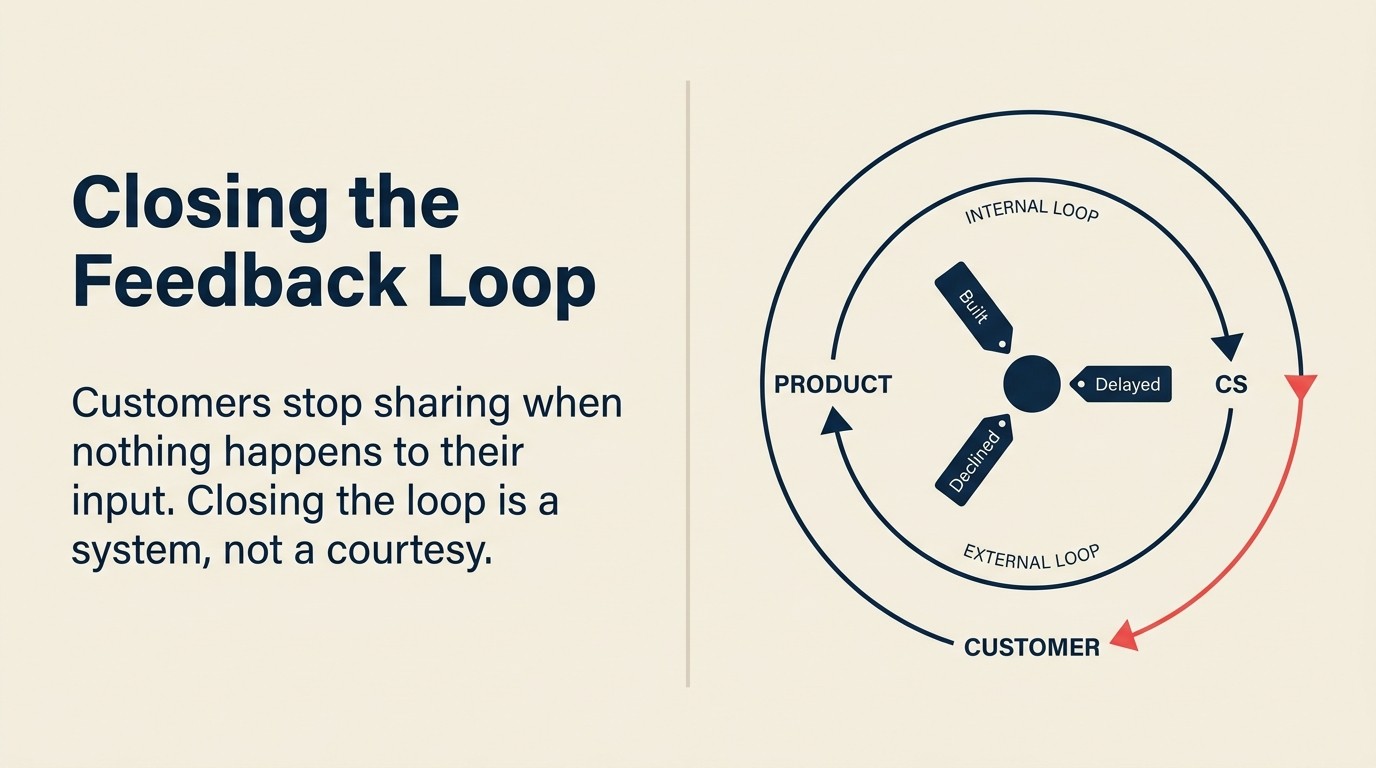
Fechar o ciclo de feedback não é um gesto de relacionamento. É uma disciplina operacional. Exige infraestrutura, um ritmo definido e obrigações explícitas tanto do CS quanto do Produto. A pesquisa fundamental da HBR sobre fechamento do ciclo de feedback do cliente, baseada no trabalho de NPS da Bain em centenas de empresas, descobriu que o maior impacto vem de transmitir os resultados do feedback imediatamente para quem atendeu o cliente e capacitá-los para agir, não de agregar em relatórios trimestrais que chegam tarde demais para importar. E, de forma crítica, o ciclo interno entre Produto e CS precisa fechar antes que o ciclo externo entre CS e o cliente seja sequer possível. Você não consegue dizer aos clientes o que aconteceu com o que informaram se ninguém disse a você.
A Disciplina do Ciclo de Feedback com Foco Interno Primeiro é o princípio operacional que este artigo define: o ciclo interno (Produto para CS) deve fechar antes que o ciclo externo (CS para o cliente) seja possível. Há exatamente três resoluções válidas para cada pedaço de feedback estruturado (construído, recusado ou enfileirado) e "não sei" não é uma delas. A disciplina funciona em dois estágios: o Estágio 1 é o ciclo interno: Produto comunica uma resolução para cada pedaço de feedback estruturado ao CS, num formato estruturado, num ritmo mensal definido. O Estágio 2 é o ciclo externo: CS encaminha essa resolução ao CSM correto, que a comunica ao cliente em até cinco dias úteis usando a linguagem adequada à resolução. Nenhum dos dois estágios funciona sem o outro. Pular o estágio 1 e tentar executar o estágio 2 produz CSMs improvisando explicações para decisões sobre as quais nunca foram informados. Isso é rotineiramente pior do que nenhuma resposta.
O Que "Fechar o Ciclo" Realmente Significa
Um ciclo fechado tem uma definição operacional específica: para cada pedaço de feedback estruturado coletado de um cliente, o cliente recebe uma resposta que explica o que aconteceu com ele.

Essa definição tem três partes que merecem ser detalhadas.
"Feedback estruturado": não todo comentário, não toda observação casual numa ligação, não todo item de lista de desejos que surge de passagem. Feedback estruturado é o feedback que foi deliberadamente solicitado e registrado: verbatims de NPS, itens de feedback de QBR, notas de sessão beta, contribuições de conselho consultivo, solicitações formais de funcionalidades enviadas por um canal definido. Sinais informais pertencem às notas de conta do CSM. Feedback estruturado é o que precisa de uma resolução.
"Recebe uma resposta": não "o CSM pensou sobre isso," não "foi para o backlog," não "o Produto está ciente disso." O cliente recebe comunicação do CSM, de forma proativa, que fecha o item especificamente.
"O que aconteceu com ele": que é uma de três coisas, e apenas três:
Construído. O feedback informou diretamente uma funcionalidade ou mudança que foi lançada. A resposta: "A capacidade que você levantou foi lançada como parte de [nome da funcionalidade]. Veja onde encontrá-la e como ativá-la. Sua contribuição foi parte do motivo pelo qual construímos dessa forma." Esse é o fechamento mais fácil de entregar. Também é o mais comumente ignorado, porque "eles vão ver as notas de lançamento" não é o mesmo que "nós dissemos a eles que os ouvimos."
Recusado. O feedback foi considerado e a decisão foi tomada de não agir sobre ele, neste ciclo de lançamento ou no futuro previsível. A resposta: "Revisamos sua contribuição sobre [item específico]. Não vamos implementar isso agora, porque [razão específica: não 'estamos focando em outras prioridades,' mas o motivo real: escopo, restrição técnica, adequação ao ICP, demanda conflitante, direção estratégica]. Agradecemos a especificidade que você nos deu." Recusado é a resolução mais difícil de entregar e a mais importante. Clientes que recebem um "não e o porquê" específico respeitam a transparência. Clientes que recebem silêncio para um item recusado assumem que o feedback nunca foi lido.
Enfileirado. O feedback foi reconhecido, está no radar, e não está agendado para o roteiro de curto prazo. A resposta: "Registramos isso e está em consideração ativa para um ciclo futuro. Ainda não temos um prazo, mas vamos revisitá-lo quando [gatilho específico: revisão de categoria, próximo ciclo de planejamento do roteiro, quando tivermos mais dados sobre padrões de uso]. Vou sinalizá-lo para você quando houver uma atualização." O CSM define um lembrete no calendário para o ciclo de revisão informado. Enfileirado não é uma descarga. É um compromisso real de acompanhamento.
As três resoluções cobrem todos os resultados possíveis para um pedaço de feedback. Não há uma quarta opção. "Não sei" não é uma resolução. Significa que o ciclo interno ainda não fechou. "Estamos analisando" sem compromisso de acompanhamento não é uma resolução. É um adiamento.
Fatos-Chave: O Custo de um Ciclo de Feedback Aberto
- Clientes que enviam feedback estruturado e não recebem resposta em 60 dias têm 3,4x mais probabilidade de relatar baixa confiança no processo de desenvolvimento de produto do fornecedor na próxima pesquisa de NPS (Gainsight, 2024).
- CSMs que conseguem comunicar resoluções específicas para o feedback do cliente ("aquela funcionalidade foi lançada em março" ou "recusamos aquela solicitação e veja o porquê") relatam 2,1x maior engajamento da conta nas revisões trimestrais em comparação com CSMs que só conseguem dizer "repassei isso" (ChurnZero, 2024).
- Clientes que descobrem que o feedback que enviaram levou a uma funcionalidade lançada têm 3,8x mais probabilidade de enviar feedback detalhado no próximo ciclo de solicitação (Totango, 2024).
Por Que a Maioria das Empresas Não Faz Isso
"Clientes que enviam feedback estruturado e não recebem resposta em 60 dias têm 3,4x mais probabilidade de relatar baixa confiança no processo de desenvolvimento de produto do fornecedor na próxima pesquisa de NPS." (Gainsight, 2024)
A falha do sistema é previsível quando você a enxerga. E não é que CS não se importa ou que Produto não se importa. É que ninguém construiu a infraestrutura para conectar os dois.
CS coleta feedback; Produto nunca diz ao CS o que aconteceu; CSMs não conseguem fechar o que nunca receberam. Essa é a forma mais comum. Os CSMs capturam diligentemente feedback nos QBRs, encaminham pelo canal que existe (e-mail, Slack, o pipeline de VoC se um foi construído) e então aguardam. Produto toma decisões. Alguns itens são lançados, alguns são recusados, muitos são adiados. Ninguém dispara uma notificação de volta ao CS. O CSM verifica com o cliente seis meses depois e não tem ideia do que aconteceu com os itens da última conversa.
O feedback vive numa ferramenta de backlog à qual ninguém em CS tem acesso. Jira, Productboard, Aha: qualquer ferramenta que a equipe de PM usa para rastrear itens do roteiro. CS não consegue vê-la. Mesmo que CS pudesse vê-la, não consegue interpretar os rótulos de status sem contexto. E ninguém construiu o processo de exportação ou notificação que leva as resoluções relevantes ao CSM correto no momento certo.
Sem ritmo definido para Produto enviar resoluções de volta ao CS. Mesmo quando Produto está tomando decisões, a cadência de comunicação com CS é ad hoc. Um PM menciona numa reunião multifuncional que uma funcionalidade foi lançada. Uma mensagem no Slack vai para #product-updates. O CSM que gerencia a conta que a solicitou não estava na reunião e perdeu o Slack. O ciclo permanece aberto por acidente, não por intenção.
Volume. Uma equipe de CS de médio porte com 80 contas, cada uma enviando 3 a 5 pedaços de feedback estruturado por trimestre, está gerenciando 240 a 400 itens de feedback abertos a qualquer momento. O rastreamento manual em planilha entra em colapso com esse volume. Sem suporte do sistema (marcação na plataforma de CS, atualizações automatizadas de status, processamento em lote por meio de EBRs), CSMs individuais não conseguem manter o fechamento nesse volume sozinhos. O guia de captura sistemática de feedback aborda a taxonomia de marcação e a disciplina de registro que torna o volume gerenciável. Mas antes que CS consiga fechar o ciclo externamente, Produto precisa fechá-lo internamente primeiro.
O Ciclo Interno Primeiro: Produto Fechando o Ciclo com CS
Antes que o ciclo externo (CS para o cliente) seja possível, o ciclo interno (Produto para CS) deve fechar. Essa é a obrigação que a maioria dos designs de processo ignora ou assume que acontecerá naturalmente. Não acontece naturalmente. Exige um mecanismo formal.

A obrigação do Produto. Quando um pedaço de feedback de cliente é acionado, recusado ou adiado para um ciclo futuro específico, CS é notificado. Não numa mensagem casual no Slack que os CSMs precisam procurar. Num formato estruturado que inclui tudo que CS precisa para fechar o ciclo externo.
O formato do registro de resolução:
| Campo | Conteúdo |
|---|---|
| Nome da funcionalidade / solicitação | Descrição específica, na mesma linguagem que CS usou ao capturar |
| Clientes que a enviaram | Nomes de conta, contato do CSM |
| Resultado | Construído / Recusado / Enfileirado |
| Prazo ou motivo | Data de lançamento (construído) / Motivo específico (recusado) / Próximo ciclo de revisão (enfileirado) |
| Ação necessária do CSM | Sim / Não: este item requer contato proativo com o cliente? |
O ritmo de entrega. Digest mensal do PM para CS: uma lista estruturada de todos os itens que receberam uma resolução nos últimos 30 dias. Mais notificações ad hoc para itens de alta prioridade. Se uma funcionalidade que várias contas solicitaram acabou de ser lançada, CS não deve esperar 30 dias para descobrir. O digest mensal cobre a maioria; o ad hoc cobre a urgência.
O que CS faz com o registro de resolução. Encaminha para os CSMs corretos. O CSM cuja conta enviou o item recebe o registro de resolução específico e o sinalizador de ação do CSM. Se o sinalizador de ação for sim, o CSM tem cinco dias úteis para entrar em contato com o cliente. Se o sinalizador de ação for não (itens de baixa prioridade onde o cliente provavelmente não estava acompanhando o resultado), o CSM adiciona às notas da conta para referência no próximo EBR.
O Ciclo Externo: CS Fechando o Ciclo com os Clientes
Com o ciclo interno funcionando, o ciclo externo é direto. O CSM tem a resolução. O CSM tem o prazo. O CSM entra em contato.

Para itens "construídos." Não espere o cliente encontrar nas notas de lançamento. Entre em contato proativamente: "Lançamos o [nome da funcionalidade] que você levantou no nosso QBR de março. Está disponível em [local específico]. Eu queria garantir que você soubesse que isso foi diretamente informado pela sua contribuição: veja como se conecta ao que você descreveu." O contato proativo é o que transforma um lançamento em um sinal de relacionamento. O cliente aprende que seu feedback foi ouvido, rastreado e acionado, não que teve sorte e viu uma nota de lançamento por acaso.
Para itens "recusados." Essa conversa é mais difícil, e é a que a maioria dos CSMs instintivamente evita. Mas a evitação é o que danifica a confiança. O enquadramento: "Queria fechar o ciclo sobre [solicitação específica] que você levantou em [contexto]. Após revisá-la, a equipe de Produto decidiu não persegui-la no roteiro atual ou de curto prazo. O motivo: [explicação específica e honesta, não uma esquiva, sem redirecionamentos vagos]. Eu sei que não é o que você esperava ouvir. Queria te dizer diretamente em vez de deixar sem resposta." A maioria dos clientes que recebe um "não" específico e honesto responde com apreciação pela transparência. Muitos fornecem feedback mais útil em resposta ("se essa é a restrição, que tal essa abordagem alternativa?"), que o CSM pode encaminhar de volta para o pipeline de VoC.
Para itens "enfileirados." Defina um lembrete no calendário para o ciclo de revisão informado. Naquele momento, ou o item foi revisado e tem uma nova resolução (entregue), ou não foi revisado (diga ao cliente que o prazo foi adiado e qual é a nova data prevista de revisão). Não deixe itens enfileirados expirarem silenciosamente em recusados sem dizer ao cliente. Um item que foi enfileirado e depois nunca revisitado é uma promessa quebrada.
Prazo. Dentro de cinco dias úteis a partir da notificação de resolução interna. Não quando for conveniente. Não no próximo EBR agendado se isso estiver a três meses. Cinco dias úteis é o padrão porque é a janela em que o cliente ainda associa a resposta ao feedback que deu. Depois disso, o fechamento chega como administrativo em vez de responsivo.
Tornando Isso Escalável
O processo descrito acima funciona para uma equipe de cinco CSMs gerenciando 40 contas. Não funciona sem suporte de sistema para uma equipe de 30 CSMs gerenciando 600 contas.

Rastreamento de feedback na plataforma de CS, não em planilha. Cada pedaço de feedback estruturado enviado por um cliente deve ser registrado na plataforma de CS com um campo de status: aberto / acionado / recusado / enfileirado. Quando Produto entrega um digest mensal de resoluções, CS Ops atualiza o campo de status para cada item. Os CSMs veem a mudança de status na visão da conta. A carga de rastreamento manual passa dos CSMs individuais para o CS Ops, que consegue gerenciá-la sistematicamente.
Gatilhos automatizados quando Produto marca feedback como lançado. A versão mais poderosa: uma integração direta entre a ferramenta de roteiro de produto (Productboard, Aha) e a plataforma de CS (Gainsight, ChurnZero). Quando um PM marca uma funcionalidade como lançada, uma tarefa automática aparece para os CSMs relevantes para fechar o ciclo com as contas que a solicitaram. Isso remove a dependência do digest mensal para itens "construídos", a categoria mais urgente, porque clientes que solicitaram algo e veem ser lançado antes de serem notificados sentem menos protagonismo sobre o resultado.
Processamento em lote por meio de EBRs. Nem todo item fechado justifica um contato independente. Para itens enfileirados de baixa prioridade ou itens recusados de contas que não os acompanhavam de perto, o EBR é o lugar certo: "Quero passar por alguns itens do nosso backlog de feedback e fechá-los." O CSM revisa 3 a 5 itens abertos em uma conversa em vez de enviar 3 a 5 e-mails separados. A disciplina é que "abordar no próximo EBR" é um compromisso, não um adiamento. O EBR acontece conforme programado.
A revisão trimestral de feedback como o momento formal de fechar o ciclo. A revisão trimestral de feedback de clientes é a cadência estruturada onde todos os itens abertos do trimestre passado recebem uma resolução, ou uma razão documentada para serem levados adiante. Todo item enviado nos últimos 90 dias deve ter um status ao final dessa revisão. Os CSMs então fecham os ciclos abertos restantes em suas contas nas duas semanas seguintes à revisão.
A Versão de Alto Risco: Participantes de Beta e Cocriação
Clientes que investiram tempo em programas beta ou de cocriação têm uma expectativa maior de fechamento do ciclo de feedback do que os clientes em geral. Eles não enviaram uma solicitação por um formulário. Passaram horas em sessões avaliando o que você estava construindo. Quando a funcionalidade é lançada e ninguém diz a eles o que a contribuição deles produziu, o abandono parece pessoal.
O fechamento para participantes de beta e cocriação é uma chamada de debriefing dedicada de 30 minutos, não um e-mail. O PM a conduz (com o CSM presente para gestão do relacionamento). A pauta: aqui está o que construímos, aqui está onde sua contribuição o moldou diretamente, aqui está o que decidimos não implementar e por quê. O resumo escrito segue dentro de 48 horas: o mesmo conteúdo em formato permanente, para que não haja ambiguidade posterior sobre o que foi comprometido e o que não foi. Veja executando programas beta com clientes e operações de cocriação com clientes para ver como cada tipo de programa estrutura o engajamento que produz o feedback que exige esse fechamento.
Este debriefing é o investimento de maior valor em todo o programa beta ou de cocriação. É o que transforma participantes em defensores, não porque a funcionalidade foi perfeita, mas porque eles se sentiram genuinamente consultados em vez de extraídos.
O Que Se Rompe Quando o Ciclo Permanece Aberto
"CSMs que conseguem comunicar resoluções específicas para o feedback do cliente ('aquela funcionalidade foi lançada em março' ou 'recusamos aquela solicitação e veja o porquê') relatam 2,1x maior engajamento da conta nas revisões trimestrais em comparação com CSMs que só conseguem dizer 'repassei isso.'" (ChurnZero, 2024)
Fadiga de pesquisa. A análise da McKinsey sobre fadiga de pesquisa deixa claro que o problema não é a frequência das pesquisas. É a ausência de ação visível em resposta a elas. Os clientes param de responder a pesquisas de NPS, solicitações de feedback de QBR e verificações de pulso. Não porque não têm opiniões, mas porque aprenderam que suas opiniões não produzem nenhum resultado observável. A taxa de participação em feedback caindo trimestre após trimestre é um sintoma de falhas de ciclo em trimestres anteriores, não um sinal de que o cliente está satisfeito e não tem nada a dizer.
"Vou repassar isso" se torna uma piada. CSMs que não conseguem fechar ciclos param de dizer qualquer coisa definitiva sobre os resultados do feedback porque já foram prejudicados antes. Disseram "vou descobrir e te aviso" e depois não tinham nada a dizer no próximo check-in. A frase se torna um sinal de que o feedback morreu. Os clientes começam a prefaciar suas próprias contribuições com "Eu sei que isso provavelmente não vai a lugar nenhum, mas..." Esse prefácio é uma falha de confiança, revelada em tempo real.
Sinal de retenção perdido. Clientes que se desengajam mentalmente do relacionamento com o fornecedor geralmente param de dar feedback antes de parar de responder às conversas de renovação. A taxa de engajamento de feedback em declínio é um sinal de alerta antecipado para rotatividade, mas só se alguém estiver rastreando. Uma conta que foi de cinco itens de feedback no Q1 para zero no Q3 sem um ciclo fechado para nenhum dos itens do Q1 é uma conta que se desengajou do relacionamento seis meses antes de o risco de renovação aparecer no dashboard. A camada de rastreamento de uso e análise é o que torna esse sinal de desengajamento precoce visível antes que apareça como uma conversa de renovação.
O efeito composto. Cada ciclo não fechado torna a próxima coleta de feedback mais difícil. Da primeira vez que nada acontece, o cliente fica incerto. Da segunda vez, está cético. Da terceira vez, para. Quando o CSM realiza uma pesquisa formal de feedback e se pergunta por que a taxa de resposta é de 12%, o efeito composto já fez seu trabalho.
Métricas Que Provam que o Ciclo Está Fechado
Três métricas que podem ser rastreadas sem ferramentas caras:

Taxa de resolução de feedback. A pesquisa da HBR sobre NPS 3.0 argumenta que os programas de feedback precisam ser combinados com o rastreamento de crescimento conquistado: uma estrutura de métricas que trata a taxa de resposta ao feedback e a taxa de acionamento de feedback como um par, não como sinais independentes. A porcentagem de itens de feedback estruturado coletados num trimestre que têm um resultado registrado (construído / recusado / enfileirado) em 60 dias após o envio é o equivalente à taxa de resolução: a medida direta de se o ciclo interno está funcionando. Meta: 80% ou acima. Abaixo de 60% significa que o ciclo interno está falhando. Produto não está entregando resoluções ao CS rápido o suficiente para que CS consiga fechar com os clientes numa janela razoável.
Taxa de confirmação do cliente. Dos itens "construídos" num determinado trimestre, qual porcentagem resultou em contato documentado do CSM com o cliente solicitante? Meta: 90% ou acima. Essa é a métrica mais comumente rastreada e a mais fácil de manipular (CSMs podem registrar o contato sem que seja significativo), então combine com a taxa de resposta a esse contato para verificar a qualidade.
Taxa de recorrência de feedback. Os clientes estão enviando a mesma solicitação trimestre após trimestre? Um cliente que levanta o mesmo problema em três QBRs consecutivos está dizendo duas coisas: o problema importa o suficiente para continuar levantando, e eles nunca receberam uma resolução que o fechasse para eles. Rastreie a recorrência como um sinal de falha de ciclo, não de persistência do cliente.
Construindo o Hábito numa Equipe CS-Produto Começando do Zero
A versão mínima viável não requer integração com plataforma de CS ou migração de ferramentas de gestão de produto. Exige três coisas:
Um documento compartilhado (acessível tanto ao CS quanto ao Produto) onde os itens de feedback estruturado são registrados com status. Não uma ferramenta de backlog. Um documento compartilhado que ambos os lados podem atualizar. Formato: nome do cliente / item de feedback / data de envio / responsável CSM / responsável PM / status / data de resolução.
Um digest mensal de PM para CS: 30 minutos no calendário, com a participação de um PM por área de produto e do responsável de CS Ops, onde o PM passa por todos os itens que receberam uma resolução nos últimos 30 dias. CS Ops atualiza o documento compartilhado e encaminha para os CSMs.
Uma lista de verificação de fechamento do CSM: um item permanente na reunião mensal da equipe de CS onde cada CSM relata quais itens de feedback abertos fechou com clientes nos últimos 30 dias e quais permanecem abertos além do limite de 60 dias.
O desenvolvimento de 90 dias a partir dessa linha de base adiciona suporte do sistema: registro de feedback na plataforma de CS, status de resolução sincronizado da ferramenta de roteiro, tarefas automatizadas do CSM para notificações de itens "construídos." Mas a linha de base é funcional sem nada disso. A maior parte do valor vem do ritmo, não das ferramentas.
"Empresas com um processo formal de resolução de feedback (resultados definidos, formato estruturado, entrega cronometrada de Produto para CS) veem taxas de envio de feedback 44% maiores dos clientes nos trimestres subsequentes." (ProductBoard, 2024)
Quem é dono do design do processo. CS Ops projeta o lado voltado para o CSM (taxonomia de registro, cadência de fechamento, métricas de rastreamento). Product Ops co-projeta o lado voltado para o Produto (formato de resolução, ritmo de entrega, caminho de escalonamento para itens em atraso). Ambos aprovam a estrutura do documento compartilhado e o formato do digest mensal. Nenhum dos dois lados consegue projetar isso sozinho. É um problema de interface, e problemas de interface exigem ambos os lados na mesa desde o início.
Análise Rework: O ciclo de feedback mínimo viável (documento compartilhado, digest mensal de PM para CS, lista de verificação de fechamento do CSM) é alcançável sem uma plataforma de CS dedicada. Mas em escala de médio porte (80+ contas, 240 a 400 itens de feedback abertos por trimestre), a disciplina entra em colapso sem suporte do sistema. A plataforma unificada do Rework permite que CS Ops registre itens de feedback estruturado ao lado dos dados de saúde da conta, encaminhe atualizações de resolução para CSMs nomeados e rastreie taxas de fechamento como uma métrica de equipe, tudo dentro do mesmo ambiente onde os QBRs são preparados e as datas de renovação são gerenciadas. A janela de fechamento de cinco dias úteis é um compromisso, não uma meta. As ferramentas são o que tornam isso alcançável em volume.
Saiba Mais

Principal Solution Architect
On this page
- O Que "Fechar o Ciclo" Realmente Significa
- Por Que a Maioria das Empresas Não Faz Isso
- O Ciclo Interno Primeiro: Produto Fechando o Ciclo com CS
- O Ciclo Externo: CS Fechando o Ciclo com os Clientes
- Tornando Isso Escalável
- A Versão de Alto Risco: Participantes de Beta e Cocriação
- O Que Se Rompe Quando o Ciclo Permanece Aberto
- Métricas Que Provam que o Ciclo Está Fechado
- Construindo o Hábito numa Equipe CS-Produto Começando do Zero
- Saiba Mais