PMM como a Ponte: Como o Marketing de Produto Conecta CS e Produto na Fronteira
Turn this article into takeaways for your work.


Each assistant summarizes the article only for you and suggests best practices for your work.
O tradutor que chega depois da reunião. O PMM é convocado quando a funcionalidade já está especificada, o roteiro já está bloqueado e o lançamento está a três semanas de distância. O pedido: escreva o e-mail de lançamento, atualize o site, crie o one-pager. O PMM executa. O conteúdo sai. O CS lê as mensagens externas ao mesmo tempo que os clientes.
Isso não é a ponte. É a equipe de limpeza.
O padrão de equipe de limpeza é como a maioria das empresas de médio porte usa o PMM na fronteira CS-Produto. E é também por que a fronteira continua vazando. O CS não sabe o que está sendo lançado nem como falar sobre isso. O Produto não sabe quais problemas dos clientes são urgentes nem como enquadrá-los para priorização. E o PMM está ocupado escrevendo e-mails de lançamento para funcionalidades que foram projetadas sem contexto suficiente do cliente para fazer sentido. Esses são sinais clássicos de desalinhamento entre CS e produto.
Este artigo é sobre como a ponte realmente funciona, de forma estrutural e não relacional. Porque o erro que a maioria dos times comete é pensar que a eficácia do PMM na fronteira é uma função de quão colaborativo ou comunicativo o PMM é. Não é. Um PMM colaborativo numa organização que não o integra estruturalmente não pode construir a ponte. A ponte é construída por design organizacional, entregas definidas e um papel permanente nos rituais em que as decisões da fronteira são tomadas.
Empresas onde o PMM é incluído nas sessões de síntese de voz do cliente (VoC) ao lado do CS Ops relatam 29% mais adoção de funcionalidades aos 90 dias pós-GA, em comparação com empresas onde o PMM só atua no lançamento, segundo pesquisa de alinhamento de 2024 do ProductBoard.
O tempo médio entre o primeiro rascunho de especificação de uma funcionalidade pelo PM e o primeiro envolvimento do PMM é de 18 dias em empresas sem um protocolo estruturado de integração de PMM. Nesse ponto, a maioria das decisões de UX e escopo já estão bloqueadas e o PMM está traduzindo algo que não ajudou a moldar, segundo o mesmo estudo.
O Modelo de Tradução Bidirecional do PMM: Como a Ponte Realmente Funciona Estruturalmente
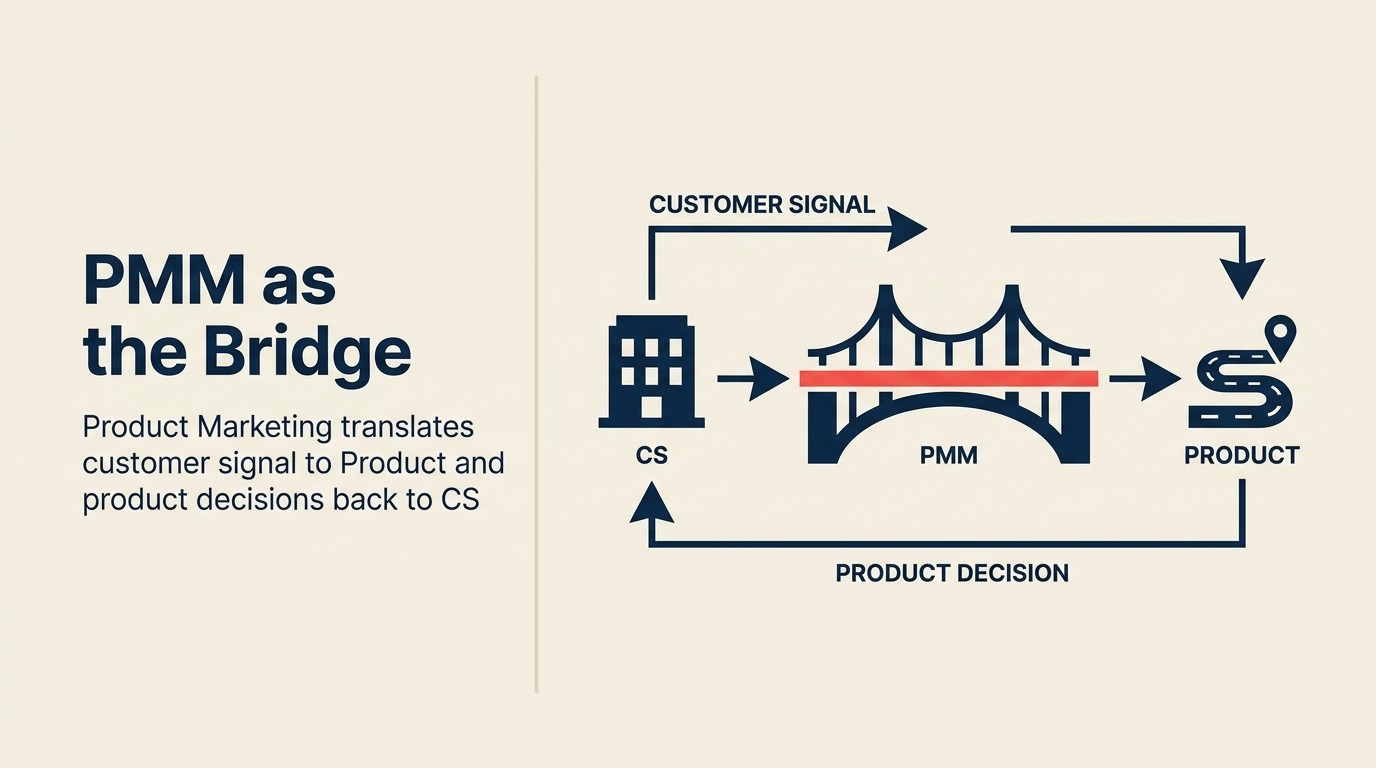
Uma ponte tem duas funções de suporte de carga. Ela transporta tráfego em ambas as direções e aguenta peso. O Modelo de Tradução Bidirecional do PMM nomeia essas duas funções explicitamente porque a maioria das empresas integra o PMM em apenas uma direção (downstream, do Produto para o CS) e se pergunta por que o sinal do CS nunca chega ao Produto de forma útil.

Um PMM atuando como ponte entre CS e Produto deve levar o sinal do cliente do CS para o Produto e levar as decisões de produto do Produto para o CS. E deve aguenta peso, ou seja, deve estar integrado no design organizacional, não apenas no organograma. A pesquisa de estratégia de marketing de produto da Gartner descreve os profissionais de marketing de produto como orquestradores que devem unir produto, vendas e customer success em torno de um objetivo de go-to-market compartilhado: exatamente a função de fronteira descrita aqui.
A versão estrutural disso parece duas funções de tradução operando simultaneamente.
Fatos Relevantes: A Lacuna da Ponte de PMM
- Apenas 34% dos PMMs em empresas SaaS de médio porte têm assento permanente nas revisões de roteiro de produto antes que as decisões sejam bloqueadas, segundo o relatório State of Product Marketing 2024 da ProductMarketing Alliance.
- 61% dos times de CS relatam que sua principal fonte de informação sobre novas funcionalidades é o changelog público, não um briefing interno antecipado do Produto ou do PMM, segundo os benchmarks anuais de 2024 do ChurnZero.
- CSMs em empresas com um processo estruturado de briefing antecipado do PMM gastam 2,3 horas a menos por ciclo de lançamento improvisando explicações para clientes, segundo os benchmarks de eficiência de CS de 2024 do Totango.
Direção 1: CS para Produto. O PMM pega o sinal qualitativo bruto dos CSMs (verbatins, padrões de escalada, temas de QBR) e o traduz para o formato que os PMs podem usar na priorização. Estruturado, ponderado, categorizado, rotulado com ARR. Não "os clientes estão frustrados com os relatórios", mas "nove contas representando R$2,1M em ARR têm usado uma solução alternativa em Excel para exportações de intervalo de datas personalizado nos últimos dois trimestres". Esse é o pipeline de VoC com o PMM como camada de síntese.
Direção 2: Produto para CS. O PMM pega especificações de funcionalidades em linguagem de engenharia e notas de lançamento, e os traduz em três outputs voltados ao cliente: um briefing antecipado de CS, uma mensagem in-app e uma nota de lançamento externa. Não "melhorias avançadas no mecanismo de consulta", mas "seus clientes agora podem filtrar exportações por intervalos de datas personalizados. Aqui está o que dizer quando perguntarem sobre isso, e aqui estão as três perguntas que você vai receber."
Ambas as direções exigem a mesma habilidade subjacente: entender o vocabulário de ambos os lados bem o suficiente para traduzir sem perder significado. Mas nenhuma das direções funciona estruturalmente sem que o PMM esteja integrado nos rituais onde o material de origem se origina. Esses rituais são onde a Direção 1 e a Direção 2 acontecem ou não.
Direção 1: Sinal de CS para Input de Produto
Os CSMs coletam verbatins qualitativos. Os PMs precisam de input estruturado, ponderado e categorizado. A lacuna entre esses dois formatos é onde a maioria dos pipelines de VoC falha. Um CSM dizendo "os clientes estão frustrados com o módulo de relatórios" não dá a um PM o suficiente para agir. Um PMM sintetizando esse sinal em "sete contas representando R$1,4M em ARR estão usando soluções alternativas em Excel porque a função de exportação não suporta intervalos de datas personalizados, confirmado em três ciclos de QBR" dá a um PM algo que ele pode colocar numa sessão de priorização.

O papel do PMM na Direção 1 tem três funções concretas.
Manter a taxonomia de feedback. Tanto o CS quanto o Produto precisam marcar o sinal do cliente usando as mesmas categorias: área do produto, severidade, status de solução alternativa, impacto no ARR. Quando os CSMs marcam o feedback de forma inconsistente, o PM não consegue agregá-lo de forma significativa. O PMM é responsável pela taxonomia, treina os times de CS sobre como usá-la e audita a conformidade trimestralmente. Isso é infraestrutura operacional, não trabalho criativo. O guia sobre capturar feedback sistematicamente aborda a mecânica do lado do CSM nesse processo.
Conduzir a síntese trimestral de VoC. Uma vez por trimestre, o PMM agrega os últimos 90 dias de feedback enviado pelo CS (tickets de VoC, verbatins de NPS, notas de QBR, temas de escalada) e os pondera pelo impacto no ARR. O output é um documento de síntese curto: os cinco principais temas por peso de ARR, os principais verbatins que suportam cada tema e uma ordem de prioridade recomendada para o PM considerar. O PMM apresenta isso ao lado do CS Ops na revisão trimestral CS-Produto.
Traduzir a linguagem do cliente em problemas de produto. Essa é a função de maior alavancagem na Direção 1. Um cliente diz "odeio os relatórios". Um CSM escreve "cliente frustrado com o módulo de relatórios". Um PMM traduz: "os clientes não conseguem ver dados de múltiplos módulos em uma única visualização, então estão exportando para planilhas e reconstruindo o relatório manualmente, o que leva de 2 a 3 horas por semana por usuário". A tradução preserva o contexto do cliente e dá ao PM uma definição de problema que pode ser usada como especificação.
Direção 2: Decisões de Produto para Comunicação do CS
Os PMs escrevem especificações e notas de lançamento em linguagem de engenharia. Os CSMs se comunicam em resultados do cliente. O PMM traduz, e a tradução deve acontecer antes do GA, não depois.

A falha padrão: o PM escreve um changelog técnico. Os CSMs o leem mas não sabem o que dizer aos clientes. O cliente fica sabendo pela nota de lançamento pública ou pelo próprio produto. O CSM recebe um e-mail do cliente perguntando o que mudou antes que o CSM tenha uma resposta útil.
O papel do PMM na Direção 2 tem três outputs concretos por lançamento.
O briefing antecipado de CS. Um documento curto, de uma página com cinco seções, que vai para o time de CS cinco dias úteis antes do GA. Seções: o que foi lançado (em linguagem simples), o que os clientes vão notar (especificamente o que muda no fluxo de trabalho deles), as três perguntas que os clientes vão fazer e como respondê-las, quais segmentos de clientes são mais afetados e quais contas devem receber contato proativo do CSM antes ou no dia do GA.
A mensagem in-app. Escrita em linguagem de resultado do cliente, não em linguagem de descrição de funcionalidade. "Agora você pode criar relatórios com intervalos de datas personalizados sem exportar para o Excel" em vez de "Motor de consulta de relatórios avançados agora disponível". O PMM é responsável pelo template e pelo texto; o Produto revisa para precisão; o CS revisa o tom.
A nota de lançamento. O registro externo oficial do que foi lançado. Mais técnica do que a mensagem in-app; mais legível pelo cliente do que a especificação interna. O PMM escreve; o PM revisa; o PMM publica. O arquivo é de responsabilidade do PMM.
Os três outputs precisam existir antes do GA. Não no dia do GA. Antes. Isso exige que o PMM receba o resumo da funcionalidade do PM pelo menos dez dias antes do GA, e esse cronograma deve ser uma expectativa definida, não um pedido.
O Que o PMM Carrega Que Nem o CS Nem o Produto Conseguem
O papel de ponte funciona porque o PMM carrega de forma única três tipos de contexto que nem o CS nem o Produto conseguem acessar facilmente por conta própria.
Contexto de posicionamento. O PMM sabe como o produto está posicionado no mercado: quais afirmações estão sendo feitas, quais diferenciais estão sendo enfatizados, como o produto está sendo vendido. Quando uma funcionalidade é lançada em conflito com o posicionamento atual (ou que deveria mudá-lo), o PMM é quem detecta isso antes que o CS e as Vendas comecem a comunicá-la incorretamente. O CS não tem visibilidade do mercado. O Produto não tem visibilidade das mensagens. O PMM está na interseção.
Inteligência competitiva. O PMM acompanha o que os concorrentes estão lançando. O CS ouve quando os clientes levantam comparações competitivas. A Forrester observa que a colaboração antecipada e estruturada em inteligência competitiva é uma prática definidora de times de marketing de produto de alto desempenho. O PMM sintetiza ambos os fluxos em input útil para o Produto: não "os clientes mencionam muito o Concorrente X", mas "o Concorrente X lançou uma funcionalidade no 3T que aborda a mesma lacuna de relatórios que nossos clientes estão sinalizando. Aqui está o que eles fizeram e o que isso significa para nosso roteiro." O sinal do CS que apresenta comparações competitivas deve passar pelo modelo de priorização de feedback ponderado por ARR antes de chegar ao PM.
Teste de mensagem. O PMM pode fazer testes A/B de como os clientes respondem a diferentes enquadramentos da mesma funcionalidade antes que o CS precise comunicá-la em escala. Duas descrições diferentes da mesma mudança de fluxo de trabalho podem produzir reações de clientes dramaticamente diferentes. Testar com uma amostra pequena antes do lançamento completo evita uma comunicação que faz uma boa funcionalidade cair mal.
As Condições Estruturais Que Tornam o PMM uma Ponte Real
A eficácia do PMM na fronteira é determinada pelo design organizacional, não pela personalidade. A pesquisa da Forrester sobre alinhamento de marketing de produto e gestão indica que quando essas funções têm responsabilidades claramente definidas e métricas compartilhadas, as organizações apresentam maior eficiência de execução e menos falhas de comunicação no lançamento. Essas quatro condições são a diferença entre PMM como ponte e PMM como equipe de limpeza.

O PMM é incluído nas revisões de roteiro antes que as decisões sejam bloqueadas. Não em revisões retrospectivas. Não em sessões de "queríamos te dizer antes de sair". O PMM precisa estar na sala quando as prioridades do roteiro estão sendo definidas, antes que as especificações sejam escritas, para que o contexto de mercado e a linguagem do cliente possam moldar as funcionalidades antes de serem construídas. Se o primeiro envolvimento do PMM é após a especificação, a ponte é unidirecional e tardia.
O PMM tem assento permanente na revisão trimestral de VoC. A revisão trimestral de feedback do cliente é onde o feedback do cliente do trimestre anterior se torna o input de roteiro do próximo trimestre. Se o PMM não estiver nessa mesa ao lado do CS Ops e do PM, a função de tradução falha: o sinal do CS vai diretamente para o PM e perde a camada de síntese; ou o PMM descobre o que foi priorizado depois e escreve para um briefing que não ajudou a moldar.
Os entregáveis do PMM para o CS seguem um cronograma definido. Os briefings antecipados chegam cinco dias úteis antes do GA. As sínteses de VoC são publicadas até o décimo dia de cada mês. O calendário de lançamento é atualizado na primeira segunda-feira de cada mês. Quando os entregáveis do PMM para o CS são agendados, o CS pode planejar em torno deles. Quando são ad hoc, o CS recorre à improvisação.
O PMM tem autoridade para bloquear um lançamento se a comunicação não estiver pronta. Essa é a condição que a maioria das empresas ignora. A prontidão para o lançamento inclui a aprovação do PMM. Se o briefing antecipado não está completo, se a mensagem in-app não foi revisada, se o time de CS não recebeu o briefing, o PMM deve ter autonomia para sinalizar isso e atrasar a data do GA. Isso parece radical. Mas é menos radical do que os CSMs improvisando explicações para clientes no dia seguinte a uma mudança confusa ser lançada.
O Que o PMM Não Deve Assumir na Fronteira
O papel de ponte tem um escopo definido. Quando o PMM expande além dele, o papel deixa de funcionar.
O PMM não deve assumir decisões de relacionamento específicas do cliente. Quais contas ligar, qual CSM envolver, como lidar com um cliente que já está insatisfeito com uma mudança: isso fica com o CS. O PMM define as mensagens; o CS define o contato.
O PMM não deve assumir decisões de priorização de produto. O PMM informa com contexto de mercado e sinal sintetizado do cliente, mas não é responsável pelo backlog ou pelo roteiro. Quando o PMM começa a fazer argumentos de priorização em vez de fornecer inputs de priorização, cria conflito com o PM que mina a confiança que o papel de ponte exige.
O PMM não deve assumir a pontuação de saúde ou a avaliação de risco de conta. Essa é uma função do CS Ops. O PMM sabe em qual nível de comunicação cada conta está; o CS sabe quais contas estão em risco. São conjuntos de dados diferentes.
Quando as Empresas Ainda Não Têm um PMM
Isso é comum em empresas de médio porte pré-Série B. A função de tradução cai para quem estiver disposto, normalmente o Head of Product ou o VP CS, e funciona mal porque nenhum dos dois tem tempo ou contexto de ambos os times para fazê-la bem.
O padrão de equipe de limpeza é o resultado natural quando não há PMM: o Produto lança, o CS corre, e o Head of Product escreve uma descrição da funcionalidade numa mensagem no Slack para o canal do CS porque ninguém mais o fez. O framework RACI de quem é responsável pelas mudanças voltadas ao cliente mostra como distribuir esse trabalho explicitamente sem uma posição de PMM completa.
O modelo provisório que funciona melhor do que a equipe de limpeza: atribua uma pessoa do CS Ops e um PM para assumir a função de tradução conjuntamente, com um protocolo de transferência claro. O CS Ops escreve o briefing antecipado de CS a partir do resumo de funcionalidade do PM. O PM revisa. O protocolo é documentado e repetido a cada lançamento. É mais lento do que um PMM dedicado e produz output de menor qualidade, mas é estruturalmente sólido e escala até que um PMM seja contratado.
Uma nota importante sobre o período provisório pré-PMM: não contrate um PMM e imediatamente o coloque no padrão de equipe de limpeza. A falha mais comum quando empresas contratam seu primeiro PMM é que o PMM chega numa organização que o trata como o redator de e-mails de lançamento. Construa o design organizacional da ponte antes do PMM começar, para que o papel tenha suporte estrutural desde o primeiro dia.
Um Modelo Operacional Concreto de PMM na Fronteira
O design organizacional abstrato é fácil de concordar e difícil de implementar. Aqui está a cadência específica.

Mensalmente (contínuo): O PMM publica a síntese de VoC dos dados de CS do mês anterior até o décimo dia do mês. A síntese cobre os cinco principais temas de feedback, ponderados por ARR, com verbatins representativos. O PM revisa até o décimo quinto dia. A sessão de input para o backlog é realizada antes do fim do mês, com PMM e CS Ops presentes.
Por lançamento: O PMM recebe o resumo da funcionalidade do PM dez dias antes do GA. O PMM entrega o briefing antecipado de CS ao líder de CS cinco dias antes do GA. O líder de CS distribui para as equipes de conta no mesmo dia. No dia do GA, o PMM publica a mensagem in-app e a nota de lançamento. O PMM arquiva todos os recursos de lançamento.
Trimestralmente: O PMM co-apresenta a síntese de VoC na revisão trimestral conjunta CS-Produto ao lado do CS Ops. O PM apresenta a resposta do roteiro: o que foi priorizado com base no input de VoC, o que não foi, e por quê. O PMM conduz a sessão de alinhamento de mensagens para os lançamentos planejados do próximo trimestre.
Sinais de Que o PMM Não Está Funcionando como Ponte
Use estes como diagnóstico, não como acusação.
O CS fica sabendo sobre mudanças de funcionalidade ao mesmo tempo que os clientes. Esse é o sinal mais inequívoco de que o PMM não está no loop da Direção 2 ou não está entregando os briefings antecipados com tempo suficiente.
Os PMs apresentam citações de clientes em reuniões de priorização que os times de CS nunca ouviram. Isso significa que o sinal do CS está chegando ao Produto por um canal que contorna o PMM, então a síntese, a ponderação e a função de tradução não estão acontecendo.
O output do PMM são e-mails de lançamento, não briefings antecipados. Os e-mails de lançamento servem ao funil de aquisição. Os briefings antecipados servem à retenção. Quando o output do PMM é inteiramente orientado para aquisição, a função de ponte entrou em colapso na equipe de limpeza.
A síntese trimestral de VoC não existe. Isso significa que o PMM não está na Direção 1 de forma alguma. O Produto está recebendo sinal bruto de CS ou nenhum sinal de CS, e o PMM está esperando para escrever sobre o que for lançado.
Esses sinais são problemas estruturais, não falhas individuais. Quando aparecem, a solução é auditar as quatro condições estruturais (inclusão na revisão de roteiro, assento permanente na revisão de VoC, cronograma definido de entregáveis e autoridade de prontidão para lançamento), não ter uma conversa com o PMM sobre ser mais proativo.
Análise Rework: Quando Integrar o PMM vs. Quando Usar Provisório
Com base em benchmarks de SaaS de médio porte, a função de ponte do PMM entrega seu maior retorno em dois momentos específicos: antes que o roteiro seja bloqueado (Direção 1, síntese de sinal de CS) e cinco dias antes do GA (Direção 2, entrega de briefing antecipado). Empresas que só conseguem priorizar um momento devem priorizar o briefing antecipado. Um briefing antecipado de CS estruturado entregue cinco dias antes do GA consistentemente reduz o tempo de improvisação pós-lançamento em 2+ horas por CSM por lançamento e aumenta mensuravelmente a adoção na primeira semana. A função de síntese de VoC (Direção 1) tem maior valor estratégico ao longo dos trimestres, mas menor impacto imediato por lançamento. Para empresas sem um PMM dedicado, o modelo provisório (CS Ops escreve o briefing a partir do resumo do PM, o PM revisa) captura cerca de 70% do valor da Direção 2 com a equipe existente, segundo estimativas operacionais de empresas que rodaram esse modelo antes de contratar seu primeiro PMM.
Perguntas Frequentes sobre o PMM como a Ponte
O Que é o Modelo de Tradução Bidirecional do PMM?
O Modelo de Tradução Bidirecional do PMM descreve o papel estrutural do PMM na fronteira CS-Produto como duas funções de tradução simultâneas: a Direção 1 (CS para Produto) converte o sinal bruto do cliente dos CSMs em input ponderado e rotulado com ARR que os PMs podem usar na priorização; a Direção 2 (Produto para CS) converte especificações de funcionalidades de engenharia em três outputs voltados ao cliente: um briefing antecipado de CS, uma mensagem in-app e uma nota de lançamento externa. A maioria das empresas integra o PMM apenas na Direção 2 e se pergunta por que o sinal do CS nunca chega ao Produto de forma útil.
O Que o PMM Possui na Fronteira CS-Produto em Relação ao Que o CS e o PM Possuem?
O PMM possui a camada de tradução: os templates de mensagem, a síntese de VoC, o briefing antecipado, o calendário de comunicação de lançamento e o texto da mensagem in-app. O PMM não possui decisões de contato específicas do cliente (quais contas ligar, quais CSMs envolver). Isso fica com o CS. O PMM não possui priorização do backlog. Isso fica com o PM. O papel de ponte tem um escopo definido, e quando o PMM expande além dele para decisões de relacionamento com o cliente ou argumentos de prioridade de produto, o papel deixa de funcionar.
Por Que Apenas 34% dos PMMs Têm Assento Permanente nas Revisões de Roteiro Antes que as Decisões Sejam Bloqueadas?
O motivo mais comum é timing e inércia: as revisões de roteiro são tratadas como reuniões internas do produto, e o PMM é convocado somente depois que as decisões são tomadas para escrever a narrativa de lançamento. Mas no momento em que a especificação é finalizada, a maioria das decisões de UX e escopo já estão bloqueadas. O PMM integrado após a especificação é uma equipe de limpeza, não uma ponte. A solução é um protocolo formal, não um pedido cultural, que torne a presença do PMM nas revisões de roteiro uma expectativa permanente antes do início do próximo ciclo.
O Que um Briefing Antecipado de CS Deve Conter?
Um briefing antecipado de CS deve cobrir cinco elementos: o que foi lançado em linguagem simples, o que os clientes vão notar ou experimentar de forma diferente especificamente, as três perguntas mais comuns que os clientes vão fazer e como os CSMs devem respondê-las, quais segmentos de clientes são mais afetados e quais contas o CSM deve contatar proativamente antes ou no dia do GA. Deve ter uma página e ser entregue cinco dias úteis antes do GA. Não é o mesmo documento que a nota de lançamento pública.
O Que Acontece Quando uma Empresa Ainda Não Tem um PMM?
Sem um PMM, a função de tradução cai para quem estiver disposto, normalmente o Head of Product ou o VP CS, e funciona mal porque nenhum dos dois tem tempo ou contexto de ambos os times para sustentá-la. O modelo provisório que funciona: atribua uma pessoa do CS Ops e um PM para assumir o briefing antecipado conjuntamente por lançamento. O CS Ops escreve o briefing voltado ao CS a partir do resumo de funcionalidade do PM; o PM revisa para precisão. É mais lento do que um PMM dedicado, mas estruturalmente sólido. O erro principal a evitar: contratar um primeiro PMM e imediatamente colocá-lo no padrão de equipe de limpeza. Construa o design organizacional da ponte antes do PMM começar, não depois.
Como o Papel de Inteligência Competitiva do PMM se Conecta ao CS?
O PMM acompanha o que os concorrentes estão lançando. O CS ouve quando os clientes levantam comparações competitivas em reuniões. Sem uma função de síntese do PMM, esses dois fluxos nunca convergem: o CS encaminha escaladas para cima, o Produto vê comparações competitivas nos dados de win/loss e nenhum dos times tem o quadro completo. O PMM sintetiza os dois: não "os clientes mencionam muito o Concorrente X", mas "o Concorrente X lançou uma funcionalidade no 3T que aborda a mesma lacuna de relatórios que nossos clientes estão sinalizando. Aqui está o que eles fizeram e o que isso significa para a priorização". O sinal do CS que apresenta comparações competitivas deve ser sinalizado para o PMM antes de entrar no pipeline de VoC.
Saiba Mais
- Quem É Responsável pelas Mudanças Voltadas ao Cliente (Notas de Lançamento, In-App)
- O Pipeline de VoC: Como o CS Alimenta o Produto
- Revisão Trimestral de Feedback do Cliente (Conjunta)
- Glossário de Alinhamento CS-Produto
- Como o CS Comunica o Roteiro Sem Fazer Promessas Excessivas
- O Argumento do CRO sobre Vendas e CS: como a liderança de receita unificada muda o problema de integração do PMM

Principal Solution Architect
On this page
- O Modelo de Tradução Bidirecional do PMM: Como a Ponte Realmente Funciona Estruturalmente
- Direção 1: Sinal de CS para Input de Produto
- Direção 2: Decisões de Produto para Comunicação do CS
- O Que o PMM Carrega Que Nem o CS Nem o Produto Conseguem
- As Condições Estruturais Que Tornam o PMM uma Ponte Real
- O Que o PMM Não Deve Assumir na Fronteira
- Quando as Empresas Ainda Não Têm um PMM
- Um Modelo Operacional Concreto de PMM na Fronteira
- Sinais de Que o PMM Não Está Funcionando como Ponte
- Saiba Mais