Creative Assistant Job Description (2026): AI-Era Skills, Responsibilities & Hiring Guide
Turn this article into takeaways for your work.


Each assistant summarizes the article only for you and suggests best practices for your work.
What You'll Get From This Guide
- Complete job description template ready for immediate use
- Key responsibilities for supporting senior creative team members
- Essential qualifications and creative skills requirements
- Professional development opportunities and career growth path
- Compensation insights for entry-level creative positions
- Interview questions and portfolio evaluation criteria
- Hiring tips for identifying creative potential and cultural fit
- Context variations for different creative environments
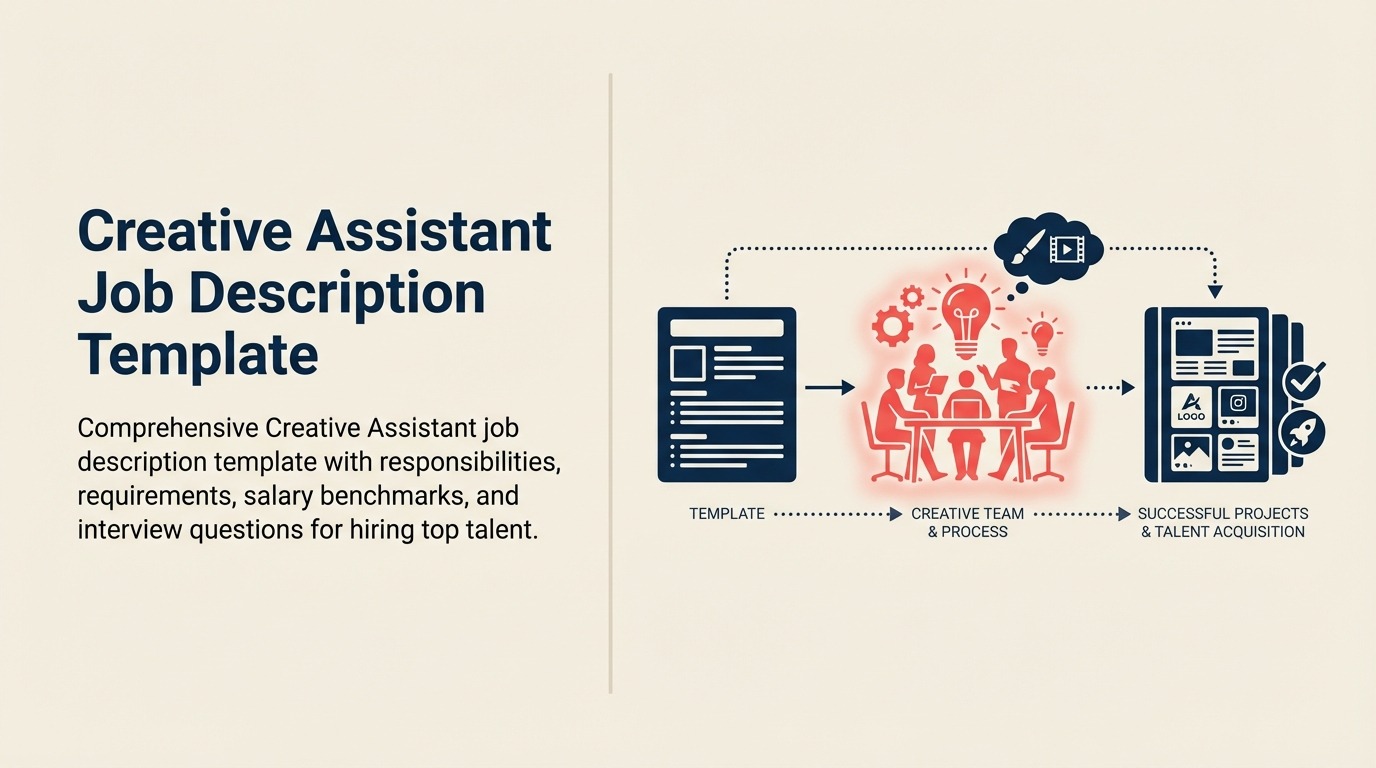
Looking to hire a talented Creative Assistant who can support your creative team while contributing fresh ideas and executing high-quality design work? This comprehensive template will help you attract motivated creative professionals ready to grow their skills and make meaningful contributions to your brand.
A Creative Assistant provides essential creative support across multiple projects while learning from experienced creative professionals, handling day-to-day design tasks, and contributing to larger creative initiatives that drive brand success.
Key Highlights
- Support senior creative team members with daily design tasks and project execution
- Assist with creative asset development across digital and print media channels
- Learn and apply brand guidelines while maintaining consistency across all materials
- Collaborate with cross-functional teams to deliver creative solutions on time
- Contribute fresh perspectives and creative ideas to brainstorming sessions
- Manage creative asset organization and maintain project file systems
Why This Role Matters
AI image generators and design tools can now produce a reference image, resize a banner, or reformat a social asset in seconds. That has not reduced demand for Creative Assistants; it has shifted what the role actually does. The production bottleneck is gone. The quality-control, brand-consistency, and judgment bottleneck is very much not.

Creative Assistants in 2026 are the human layer between AI output and finished brand work. They direct AI tools, catch what the generator got wrong, make the on-brand call the tool cannot, and handle the communication with senior designers that keeps projects moving. Teams that once needed a Creative Assistant to execute every resize still need one; they just need that person to be skilled at directing AI tools rather than doing every task manually.
AI Skills & Tools for Creative Assistants in 2026
- Claude and ChatGPT for creative brief support: Generate creative brief summaries, copy variations for assets, and caption sets from approved artwork; edit AI output to match brand voice and campaign intent
- Adobe Firefly for reference and mood board work: Generate reference images and mood board variations quickly; use as inspiration inputs rather than final deliverables, and flag anything that conflicts with brand guidelines
- Midjourney for concept exploration: Explore visual directions at speed during early brief stages; Creative Assistant owns the review pass that confirms AI visuals align with brand and campaign direction
- Canva AI for fast asset creation: Accelerate production of templated social assets, presentation decks, and campaign materials; Creative Assistant applies brand consistency check before any asset ships
- Figma AI for design workflow support: Use AI-powered design suggestions and auto-layout tools; Creative Assistant validates outputs against design system specs
- AI agents for asset reformatting and caption generation: Set up agents to resize and reformat approved artwork across formats and generate social media caption sets; Creative Assistant owns brand consistency review at every agent output gate
- AI-skill market context: Demand for creative roles that include AI tool proficiency is up roughly 144% year-over-year; creative professionals who can direct AI tools and QA their output carry a wage premium near 56%

Working Alongside AI Agents
AI agents handle the highest-volume repeatable layer of creative production: resizing and reformatting approved design assets across required formats, generating caption sets from a master brief, organizing and renaming files to naming conventions, and batching reference image generation for mood boards.

The Creative Assistant owns what the agent cannot: checking that every asset actually matches brand guidelines (agents miss subtle color drift and font substitutions), making judgment calls when a resized asset breaks layout at a new dimension, communicating status and exceptions to senior designers, and deciding which AI-generated outputs are worth keeping versus re-running. The handoff line sits between volume execution and brand integrity. Agents ship the batch; the Creative Assistant ships work the brand can stand behind.
AI Fluency by Career Stage
At the entry level, daily use of AI tools is now a baseline expectation, not a bonus skill. Creative Assistants entering the field are expected to use AI image tools, AI writing assistants, and AI-powered features in design software as a normal part of their workflow on day one.

At the mid-level (2-3 years in), the expectation shifts to building reusable prompt templates for recurring asset types and configuring simple AI agent workflows for reformatting tasks, so the team does not have to touch routine production manually.
At the senior Creative Assistant level, the expectation includes designing the AI workflow the junior team uses, defining the QA checklist for agent output, and advising Art Directors on which production tasks are worth automating versus keeping under direct human control.
About the Role
We're seeking an enthusiastic Creative Assistant to join our dynamic creative team and support our brand's visual communications. You'll work closely with Creative Directors, Art Directors, and Senior Designers to execute creative concepts while developing your own skills and creative voice.
As our Creative Assistant, you'll handle a variety of creative tasks including asset creation, file management, research, and production support. You'll have opportunities to contribute ideas during brainstorming sessions and take on increasing responsibilities as you demonstrate growth and competency.
This role offers excellent learning opportunities in a collaborative environment where creativity is valued and professional development is encouraged. You'll gain exposure to diverse creative challenges while building a strong foundation for your creative career.
Key Responsibilities
- Creative Asset Development: Create and modify graphics, layouts, and visual elements for digital and print materials under senior team guidance
- Brand Consistency: Ensure all creative work adheres to established brand guidelines and maintains visual consistency across projects
- Project Support: Assist senior team members with campaign development, asset preparation, and production coordination
- File Management: Organize and maintain creative asset libraries, project files, and version control systems
- Research Assistance: Conduct competitive research, gather inspiration, and compile reference materials for creative projects
- Production Coordination: Support print and digital production processes, including vendor communication and quality control
- Creative Collaboration: Participate in brainstorming sessions and contribute fresh ideas and perspectives to creative solutions
- Administrative Tasks: Handle creative department administrative needs including meeting scheduling and project tracking
- Quality Control: Review creative materials for accuracy, consistency, and adherence to project specifications
- Skill Development: Actively learn new design techniques, software, and creative methodologies through training and practice

Requirements
Must-Have Qualifications
- Bachelor's degree in Graphic Design, Visual Arts, Marketing, or related creative field
- 1-3 years of design experience or strong portfolio demonstrating creative potential
- Proficiency in Adobe Creative Suite (Photoshop, Illustrator, InDesign) with willingness to learn advanced techniques
- Understanding of basic design principles including typography, color theory, and composition
- Strong attention to detail and ability to follow creative direction accurately
- Excellent organizational skills and ability to manage multiple projects simultaneously
- Collaborative mindset with eagerness to learn from experienced creative professionals
- Portfolio showcasing diverse design work and creative problem-solving abilities
Nice-to-Have Qualifications
- Experience with motion graphics software (After Effects) or video editing tools
- Basic web design knowledge and understanding of digital design best practices
- Familiarity with project management tools and creative workflow systems
- Photography or illustration skills that complement design abilities
- Experience with social media content creation and digital marketing materials
What We Offer
Compensation & Benefits
- Competitive salary range: $35,000 - $55,000 annually (varies by location and experience)
- Annual performance reviews with growth-based salary adjustments
- Comprehensive health, dental, and vision insurance coverage
- 401(k) retirement plan with company matching contributions
Professional Development
- Mentorship from senior creative team members and leadership opportunities
- Annual budget for creative workshops, online courses, and skill development
- Access to premium design software, creative tools, and resource libraries
- Opportunities to work on high-visibility projects and build portfolio
Work Environment
- Modern creative workspace with latest design equipment and software
- Flexible work arrangements with core collaboration hours
- Creative culture that encourages experimentation and learning
- Regular team building activities and creative inspiration sessions
Context Variations
Corporate Environment: Focus on adherence to established brand guidelines, professional communication standards, and experience with corporate approval processes. Emphasize reliability and attention to detail in formal business environments.
Startup Environment: Highlight adaptability, willingness to wear multiple hats, and comfort with rapid project turnaround. Experience with resource constraints and creative problem-solving with limited budgets is valuable.
Remote/Hybrid: Strong digital communication skills, self-motivation, and experience with cloud-based creative tools and collaboration platforms. Ability to work independently while staying connected to team objectives.
Industry Considerations
| Industry | Key Requirements | Special Considerations |
|---|---|---|
| Technology | Digital design focus, UI/UX awareness | Understanding of product design principles |
| Healthcare | Attention to regulatory compliance, professional tone | Experience with medical/scientific content helpful |
| Fashion/Retail | Strong visual sense, e-commerce experience | Knowledge of seasonal campaigns and product photography |
| Financial Services | Conservative design approach, attention to compliance | Understanding of trust-building visual communications |
| Entertainment | Dynamic visual storytelling, multimedia skills | Portfolio showing entertainment or event marketing work |
| Non-Profit | Mission-driven creative approach, emotional storytelling | Experience with cause marketing and donor communications |
Note: Some industries may require additional portfolio demonstrations or specific software proficiency relevant to their sector.

Compensation Guide
Salary Information
Based on 2026 market data, Creative Assistant salaries typically range from $32,000 to $60,000+ annually, with significant variation based on location, industry, and experience level.
| Metro Area | Salary Range | Notes |
|---|---|---|
| New York City | $42,000 - $65,000 | Higher cost of living, premium agency market |
| Los Angeles | $38,000 - $58,000 | Entertainment industry opportunities |
| San Francisco | $45,000 - $68,000 | Tech companies offer competitive packages |
| Chicago | $35,000 - $52,000 | Strong corporate and agency presence |
| Atlanta | $32,000 - $48,000 | Growing creative market, lower cost of living |
| Austin | $34,000 - $50,000 | Emerging creative hub with tech influence |
| Seattle | $36,000 - $55,000 | Strong demand in tech and retail sectors |
| Boston | $37,000 - $54,000 | Healthcare and education sectors prevalent |
Factors Affecting Compensation:
- Portfolio quality and demonstrated creative potential
- Relevant internship or freelance experience
- Software proficiency and technical skills
- Industry sector and company size
Salary data compiled from industry reports, job postings, and compensation surveys as of 2026.
Interview Questions
Technical/Creative Questions
Walk me through your design process when working on a new project from brief to final delivery. Evaluate creative process understanding and organizational approach.
How do you ensure brand consistency when working on multiple projects simultaneously? Assess attention to detail and understanding of brand guidelines importance.
Describe a challenging design problem you solved and the approach you took. Test creative problem-solving skills and learning ability.
Which Adobe Creative Suite programs are you most comfortable with, and which would you like to improve? Gauge technical proficiency and growth mindset.
How do you handle feedback and revisions on creative work? Evaluate receptiveness to feedback and professional growth attitude.
What's your approach to organizing project files and creative assets? Test organizational skills and attention to systematic workflows.
How do you stay inspired and current with design trends? Assess passion for creative growth and industry awareness.
Describe your experience collaborating with team members on creative projects. Evaluate teamwork skills and collaborative mindset.
Behavioral Questions
Tell me about a time when you had to learn a new skill quickly to complete a project. Assess adaptability and learning agility.
Describe a situation where you had to manage multiple deadlines. How did you prioritize? Test time management and organizational abilities.
Give me an example of when you received critical feedback on your work. How did you respond? Evaluate resilience and professional development mindset.
How do you handle working on projects that may not align with your personal creative preferences? Test professionalism and ability to serve client/brand needs.
Tell me about a time when you contributed an idea that was implemented in a final project. Assess creative contribution and collaborative confidence.
Culture Fit Questions
What attracts you to working as part of a creative team versus working independently? Evaluate team orientation and collaborative preferences.
How do you define good creative work, and what motivates you in your creative career? Assess creative values and career motivation alignment.
What type of creative environment helps you do your best work? Test cultural fit and work environment preferences.
How do you balance following direction with contributing your own creative ideas? Evaluate ability to take guidance while showing initiative.
Hiring Tips
Quick Sourcing Guide
Top Platforms for Creative Assistant Recruitment:
- Indeed: Large pool of entry-level creative professionals and recent graduates
- LinkedIn: Professional networking with creative industry filters and university connections
- Dribbble: Portfolio platform for identifying emerging creative talent
- Behance: Adobe's showcase platform with junior designer profiles
Professional Communities:
- Local AIGA chapter student groups and recent graduate networks
- University career centers and design program alumni networks
- Creative meetups and portfolio review events in major cities
Posting Optimization Tips:
- Emphasize learning opportunities and mentorship available in the role
- Include specific software requirements and portfolio expectations
- Highlight company culture and creative team collaboration benefits
- Mention career growth potential and skill development opportunities
Red Flags to Avoid
Portfolio Warning Signs:
- Extremely limited portfolio with only class assignments or personal projects
- No variety in project types or creative approaches shown
- Inability to explain creative decisions or problem-solving process
- Poor file organization or presentation quality in portfolio materials
Interview Red Flags:
- Lack of enthusiasm for learning new skills or taking feedback
- Unrealistic salary expectations without corresponding experience level
- Poor communication skills or inability to articulate creative thinking
- Resistance to following established processes or brand guidelines
Experience Concerns:
- No demonstrated ability to work within established visual guidelines
- Lack of basic design software proficiency despite claiming competency
- Inability to handle constructive criticism or incorporate feedback effectively
For Employers - Hiring Creative Assistants
What's the ideal experience level for a Creative Assistant role?
Creative Assistants typically have 1-3 years of experience or strong portfolio work from internships, freelance projects, or academic work. Focus on potential and willingness to learn over extensive experience.
Should I prioritize technical skills or creative potential when hiring?
Balance both. Strong technical foundation in design software is essential, but creative thinking and growth potential often matter more for long-term success. Look for candidates who demonstrate both competency and eagerness to improve.
How can I assess a candidate's ability to work under direction while contributing ideas?
Ask for examples of collaborative projects and how they handled feedback. Look for candidates who show respect for senior guidance while demonstrating creative confidence and initiative.
What portfolio size should I expect from Creative Assistant candidates?
8-12 diverse projects showing range and growth. Quality matters more than quantity. Look for projects that demonstrate problem-solving, attention to detail, and understanding of design principles.
How important is industry-specific experience for entry-level creative roles?
Less important than foundational design skills and cultural fit. Strong candidates can learn industry-specific requirements quickly with proper training and mentorship.
For Job Seekers - Creative Assistant Careers
What skills should I focus on developing to become a competitive Creative Assistant candidate?
Master Adobe Creative Suite basics, develop strong organizational skills, build a diverse portfolio, and practice articulating your creative process. Soft skills like communication and receptiveness to feedback are equally important.
How can I build relevant experience if I'm just starting my creative career?
Take on freelance projects, volunteer for local non-profits, participate in design challenges, and create personal projects that solve real design problems. Document your process and results for portfolio inclusion.
What should I include in my Creative Assistant portfolio?
Show 8-12 diverse projects including branding, print design, digital graphics, and any specialties. Include process work, explain your role in collaborative projects, and demonstrate problem-solving thinking.
How do I prepare for Creative Assistant interviews?
Practice explaining your creative process, prepare examples of how you handle feedback, and be ready to discuss your career goals. Research the company's brand and creative work to show genuine interest.
What's the typical career progression from Creative Assistant?
Creative Assistants often advance to Graphic Designer, then Senior Designer, Art Director, and potentially Creative Director roles. The timeline varies, but showing growth in both technical skills and creative thinking accelerates advancement.

Senior Operations & Growth Strategist
On this page
- Key Highlights
- Why This Role Matters
- AI Skills & Tools for Creative Assistants in 2026
- Working Alongside AI Agents
- AI Fluency by Career Stage
- About the Role
- Key Responsibilities
- Requirements
- Must-Have Qualifications
- Nice-to-Have Qualifications
- What We Offer
- Context Variations
- Industry Considerations
- Compensation Guide
- Interview Questions
- Technical/Creative Questions
- Behavioral Questions
- Culture Fit Questions
- Hiring Tips
- Quick Sourcing Guide
- Red Flags to Avoid