Agile Coach Job Description (2026): AI-Era Skills, Responsibilities & Hiring Guide
Turn this article into takeaways for your work.


Each assistant summarizes the article only for you and suggests best practices for your work.
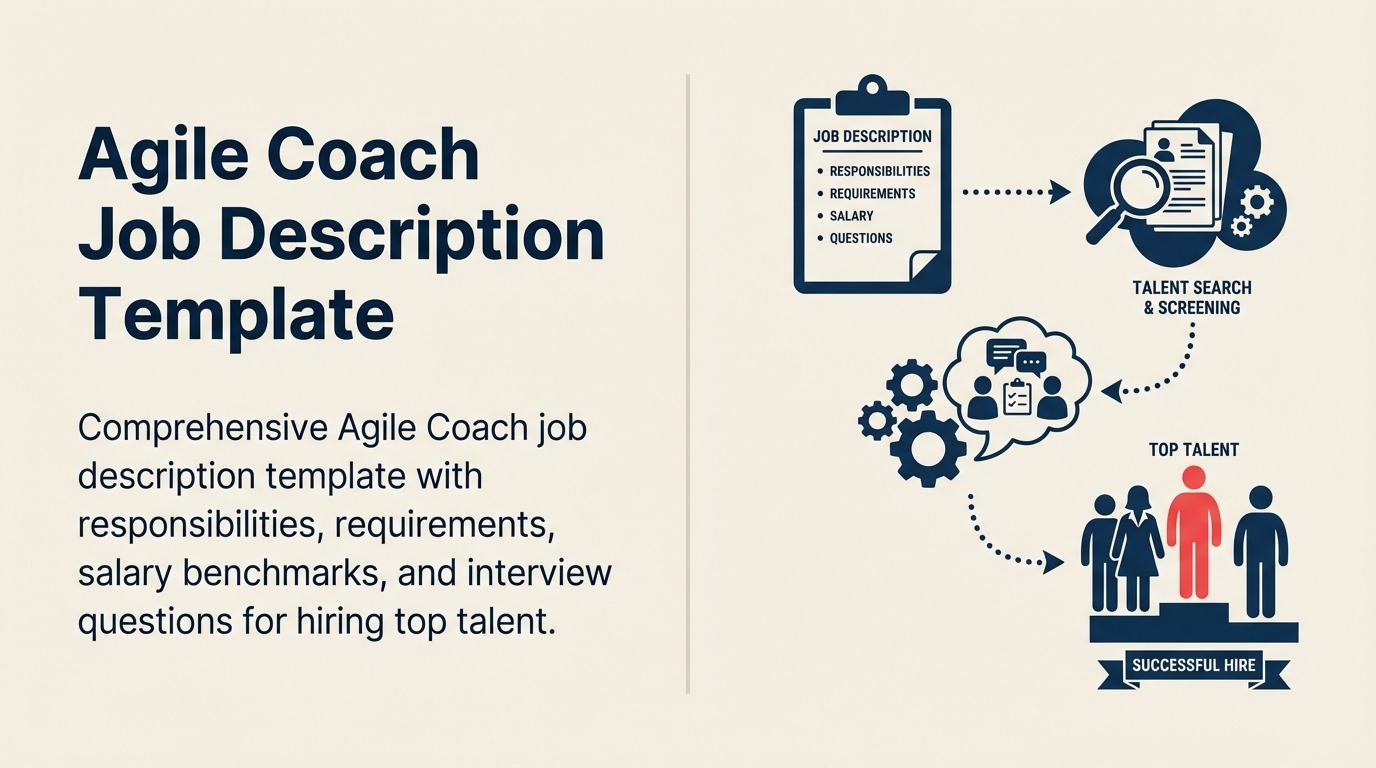
What You'll Get From This Guide
- Complete job description template with detailed responsibilities and requirements
- Comprehensive salary information across major metropolitan areas with market adjustments
- 25+ interview questions covering technical proficiency, behavioral traits, and culture fit
- Industry-specific considerations and compliance needs across different sectors
- Context variations for corporate, startup, and remote work environments
- Sourcing strategy with specialized platforms and professional communities
- Red flags to avoid and evaluation criteria for identifying strong candidates
- FAQ sections addressing common questions for employers and job seekers
An Agile Coach guides organizations through their agile transformation journey, working with teams, leadership, and stakeholders to implement and optimize agile practices. They serve as mentors, facilitators, and change agents who help build high-performing teams and sustainable agile cultures.
Key Highlights
- Average Salary: $95,000 - $165,000 annually (varies by location and experience)
- Experience Level: Mid to senior-level position requiring 3-7+ years of agile experience
- Growth Potential: Path to Enterprise Agile Coach, Transformation Lead, or Agile Director roles
- Key Skills: Scrum/Kanban mastery, facilitation, coaching, organizational change management
- Industry Demand: High demand across technology, finance, healthcare, and consulting sectors
- Remote Opportunities: Strong remote work options with some travel for on-site coaching
Why This Role Matters in 2026
Agile Coaches are essential catalysts for organizational transformation. They bridge the gap between agile theory and practical implementation, helping organizations become more responsive, collaborative, and customer-focused. By developing both individual capabilities and team dynamics, Agile Coaches directly impact delivery speed, quality, and employee engagement.
In the AI era, the Agile Coach's core value intensifies rather than diminishes. AI tools now handle standup summarization, velocity tracking, and burndown alerts automatically. That frees the coach to spend more time on the work that actually shifts organizations: coaching conversations that change how teams think, navigating resistance to change at the leadership level, building psychological safety within teams under delivery pressure, and designing the cultural conditions where continuous improvement becomes self-sustaining. The human elements of agile coaching, trust-building, conflict navigation, organizational influence, are exactly what AI cannot replicate. The coach who understands AI as a co-pilot for the operational layer becomes dramatically more effective at the strategic layer.
AI Skills & Tools for Agile Coaches in 2026
AI tools are now embedded in the agile delivery lifecycle. Coaches who can interpret AI-generated insights and help teams use them well are more effective than those who ignore the tooling layer. Demand for AI-skilled agile and transformation professionals has grown roughly 144% year-over-year, with a roughly 56% wage premium attached to AI-fluent roles.

- LinearB and Jellyfish for AI-powered engineering analytics: these platforms surface cycle time, deployment frequency, and DORA metrics automatically, giving coaches data-backed visibility into team performance patterns without manual collection.
- Parabol AI for AI-assisted retrospectives: automated reflection prompts, sentiment analysis on retrospective inputs, and action item tracking across sprints help coaches run more effective retros and track whether follow-through actually happens.
- ChatGPT or Claude for drafting agile artifacts: sprint goals, Definition of Done updates, working agreements, team charters, OKR alignment write-ups, and coaching session prep notes.
- Prompt fluency for agile workflows: strong Agile Coaches in 2026 use reusable prompts for recurring tasks, such as generating retrospective facilitation guides for specific team dysfunctions, drafting stakeholder communication about transformation progress, and summarizing impediment patterns across multiple teams.
- AI standup and meeting summarization tools (such as Copilot for Teams or Otter.ai): understanding how these tools work and how to help teams configure them well, so the coach can focus stand-up time on blockers and decisions rather than status.
- Backlog health and tech debt analytics: using AI to surface sprint health patterns that indicate systemic agile anti-patterns (endless carryover, story size inflation, sprint scope creep) that coaching conversations need to address.
Coaches who use AI to handle the data-gathering and artifact layer of agile practice bring more bandwidth to the relationship-based, judgment-intensive coaching conversations that drive real transformation.
Working Alongside AI Agents
AI agents now participate in the agile ceremony and metrics layer. The Agile Coach owns everything that requires human judgment, organizational awareness, and trust.

- What agents handle: velocity tracking and burndown alerts, sprint retrospective action item follow-up reminders, standup summarization and blocker extraction, team health survey aggregation, Definition of Done compliance checking, and agile artifact formatting.
- What the Agile Coach owns: coaching conversations with individuals and teams, organizational change navigation, culture transformation work, team dynamics and psychological safety, conflict resolution between roles (Scrum Master vs. Product Owner, team vs. leadership), training design, and the strategic judgment about when a team needs more challenge vs. more support.
- The handoff line: an AI analytics tool surfaces that Team A has had 40% carryover for three consecutive sprints; the Agile Coach investigates, runs a targeted coaching session to understand root causes, and works with the team and their manager to address the underlying issue. The agent identifies the signal; the coach does the human work of understanding and resolving it.
Agile Coaches who know how to interpret AI-generated team health signals, and integrate them into coaching conversations without turning every sprint into a metrics review, are the profile that fits 2026 transformation work.
Primary Job Description Template
About the Role
We are seeking an experienced Agile Coach to guide our organization's agile transformation and help teams achieve peak performance. You will work directly with multiple teams, product owners, and leadership to implement agile practices, resolve impediments, and foster a culture of continuous improvement. This role combines hands-on coaching with strategic transformation initiatives.

As our Agile Coach, you will be responsible for assessing current practices, designing improvement strategies, and facilitating organizational change. You will mentor Scrum Masters, coach Product Owners, and work with leadership to align agile practices with business objectives. The ideal candidate brings deep agile expertise, strong facilitation skills, and a passion for helping others succeed.
Key Responsibilities
| Category | Primary Responsibilities |
|---|---|
| Team Coaching | Mentor and coach Scrum Masters, Product Owners, and development teams on agile practices and principles |
| Process Improvement | Assess current agile maturity, identify improvement opportunities, and design implementation roadmaps |
| Facilitation | Lead ceremonies, workshops, and training sessions to build agile capabilities across the organization |
| Organizational Change | Partner with leadership to drive cultural transformation and remove systemic impediments |
| Metrics & Assessment | Establish and track agile metrics, conduct team assessments, and report on transformation progress |
| Training & Development | Design and deliver agile training programs tailored to different roles and experience levels |
| Conflict Resolution | Address team dynamics issues, facilitate difficult conversations, and resolve cross-functional conflicts |
| Standards & Practices | Establish agile standards, best practices, and governance frameworks appropriate for the organization |
| Tool Implementation | Evaluate, implement, and optimize agile tools and workflows to support team effectiveness |
| Community Building | Foster communities of practice, organize learning events, and promote knowledge sharing |
Requirements
Must-Have Qualifications
| Category | Requirements |
|---|---|
| Experience | 3-7+ years of hands-on agile experience with multiple teams and frameworks |
| Certifications | Professional coaching certification (CSP, ICP-ACC, or equivalent) required |
| Frameworks | Expert knowledge of Scrum, Kanban, SAFe, or other scaled agile frameworks |
| Skills | Strong facilitation, presentation, and workshop design capabilities |
| Leadership | Proven ability to influence without authority and drive organizational change |
| Communication | Excellent written and verbal communication skills for all organizational levels |
| Problem Solving | Analytical mindset with experience in root cause analysis and process improvement |
| Adaptability | Ability to work effectively in ambiguous, rapidly changing environments |
| AI Fluency | Comfortable using AI tools for agile artifact creation and interpreting AI-generated team analytics |
Nice-to-Have Qualifications
| Category | Preferred Qualifications |
|---|---|
| Advanced Certifications | Enterprise coaching certifications (ICP-ENT, SPC, CSP-SM) |
| Industry Experience | Background in specific industry relevant to the organization |
| Technical Background | Software development or technical project management experience |
| Change Management | Formal training in organizational change management methodologies |
| Analytics | Experience with AI-powered agile analytics tools (LinearB, Jellyfish, or similar) |
| AI Tool Experience | Experience with AI retrospective facilitators (Parabol AI) or meeting summarization tools |
AI Fluency by Experience Level
| Level | AI Expectation |
|---|---|
| Entry-level / Team Coach | Uses AI tools daily for standup summarization, retrospective prep, and agile artifact drafting |
| Mid-level Agile Coach | Builds reusable prompt workflows for agile ceremonies; interprets AI-generated velocity and cycle time analytics to inform coaching conversations |
| Senior / Enterprise Agile Coach | Designs AI-augmented agile processes across multiple teams; configures engineering analytics platforms; helps organizations decide which agile signals to automate vs. which require human coaching judgment |
What We Offer
| Category | Benefits & Opportunities |
|---|---|
| Compensation | Competitive market-rate salary based on experience and certification level; AI-fluent coaches command a meaningful premium |
| Professional Development | $3,000+ annual learning budget for certifications, conferences, and AI tool training |
| Work Flexibility | Hybrid work model with 2-3 days remote, travel for on-site coaching |
| Health Benefits | Comprehensive medical, dental, vision, and mental health support |
| Career Growth | Clear progression path to senior coaching roles and transformation leadership |
| Impact | Direct influence on organizational culture and team performance |
| Community | Access to internal and external agile coaching communities |
| Tools & Resources | Premium coaching tools, AI analytics platforms, training materials, and conference attendance |
Context Variations
Corporate Environment
Large enterprises typically require Agile Coaches with scaled agile framework experience (SAFe, LeSS, DAD) and the ability to navigate complex organizational structures. Focus on governance, compliance, and integration with existing processes. Emphasize experience with distributed teams, vendor management, and executive stakeholder communication.
Startup Environment
Startups need Agile Coaches who can build agile practices from the ground up while maintaining startup agility and speed. Highlight experience with lean startup methodologies, rapid experimentation, and resource-constrained environments. Emphasize hands-on approach and ability to wear multiple hats while establishing foundational practices.
Remote/Hybrid Environment
Remote-first organizations require coaches skilled in virtual facilitation, digital collaboration tools, and building team cohesion across distributed teams. Emphasize experience with remote coaching techniques, virtual workshop facilitation, and asynchronous collaboration practices. Include specific tools like Miro, Mural, and video conferencing platforms.
Industry Considerations
| Industry | Specific Requirements | Compliance/Certification Needs |
|---|---|---|
| Financial Services | - Regulatory compliance integration - Risk management framework alignment - Experience with audit processes |
- SOX compliance knowledge - PCI DSS familiarity |
| Healthcare | - HIPAA compliance understanding - Clinical workflow sensitivity - Patient safety considerations |
- Healthcare IT certifications - FDA regulation awareness |
| Government/Defense | - Security clearance requirements - Procurement process knowledge - Bureaucratic navigation skills |
- Security clearance - CMMI familiarity |
| Technology/Software | - DevOps integration expertise - Technical debt management - Engineering practices coaching |
- Technical certifications beneficial - Open source familiarity |
| Manufacturing | - Lean manufacturing alignment - Supply chain understanding - Safety protocol integration |
- Lean Six Sigma certification - ISO quality standards |
| Consulting | - Client engagement skills - Multiple industry adaptability - Proposal and sales support |
- Industry-specific certifications - Professional services experience |
Compensation Guide
Salary Ranges
Agile Coach compensation varies significantly by experience level, certifications, industry, and geography. Major tech hubs (San Francisco Bay Area, New York, Seattle) run materially above national averages. Enterprise organizations and regulated industries (financial services, healthcare) typically pay more than startups or consulting engagements at the same experience level. Coaches with advanced certifications (ICP-ENT, SPC) and hands-on experience with AI analytics platforms are commanding a growing premium.

Factors Affecting Compensation:
- Certifications: Advanced coaching certifications (ICP-ENT, SPC) add meaningful salary uplift
- Industry Specialization: Regulated industries (finance, healthcare) often pay 10-20% premiums
- Company Size: Enterprise organizations typically offer higher base compensation than startups
- AI Tool Fluency: Experience with LinearB, Jellyfish, or Parabol AI is an emerging differentiator
- Travel Requirements: On-site coaching roles with significant travel may include additional compensation
For current benchmarks by metro area and experience level, consult Glassdoor, PayScale, and the Scrum Alliance's annual State of Agile report, which tracks compensation trends across roles and geographies.
Interview Questions
Structured scenarios reveal whether an Agile Coach can assess maturity, work through resistance, facilitate safely, and connect coaching to measurable change.

Technical/Functional Questions
| Question | What to Listen For |
|---|---|
| "Describe your approach to assessing a team's agile maturity." | Look for structured assessment methods, multiple data gathering techniques, and focus on both practices and mindset |
| "How do you handle resistance to agile transformation?" | Evaluate change management skills, empathy, and strategies for addressing different types of resistance |
| "Walk me through how you would facilitate a retrospective for a struggling team." | Assess facilitation skills, psychological safety awareness, and ability to create actionable outcomes |
| "What metrics do you use to measure agile transformation success?" | Listen for balanced approach including velocity, quality, team satisfaction, and business value metrics |
| "How do you coach a Product Owner who struggles with prioritization?" | Evaluate coaching approach, understanding of product management challenges, and practical techniques |
| "Describe a time you helped resolve a conflict between a Scrum Master and Product Owner." | Look for conflict resolution skills, neutrality, and focus on systemic improvements |
| "How do you scale agile practices across multiple teams?" | Assess knowledge of scaling frameworks, coordination mechanisms, and cultural considerations |
| "What's your approach to working with leadership who don't understand agile?" | Evaluate ability to communicate value, adapt messaging for different audiences, and influence upward |
Behavioral Questions
| Question | Evaluation Focus |
|---|---|
| "Tell me about a time you failed to achieve transformation goals. What did you learn?" | Self-awareness, learning mindset, and ability to adapt strategies |
| "Describe a situation where you had to coach someone who was initially skeptical of your approach." | Patience, empathy, and ability to build trust and credibility |
| "Give an example of how you've influenced organizational change without formal authority." | Influence skills, stakeholder management, and strategic thinking |
| "Tell me about a time you had to deliver difficult feedback to a team or individual." | Communication skills, courage, and ability to maintain relationships |
| "Describe a situation where you had to quickly adapt your coaching approach." | Flexibility, situational awareness, and problem-solving abilities |
Culture Fit Questions
| Question | Purpose |
|---|---|
| "What motivates you most about agile coaching?" | Assess passion for the role and alignment with coaching values |
| "How do you stay current with agile practices and industry trends?" | Evaluate commitment to continuous learning and professional development |
| "Describe your ideal working relationship with the teams you coach." | Understand coaching philosophy and collaboration approach |
| "What does success look like for an Agile Coach in the first 90 days?" | Gauge realistic expectations and understanding of ramp-up time |
Evaluation Tips:
- Technical Questions: Focus on methodology depth and practical application rather than theoretical knowledge
- Behavioral Questions: Use STAR method evaluation and look for specific examples with measurable outcomes
- Culture Fit: Assess alignment with servant leadership principles and collaborative mindset
Hiring Tips
Quick Sourcing Guide
| Platform | Best Use | Key Search Terms |
|---|---|---|
| Primary sourcing platform | "Agile Coach," "Scrum Master," "Agile Transformation," "CSM," "ICP-ACC" | |
| Agile Alliance Community | Certified professionals | Active community members, event speakers, certification holders |
| Scrum.org & Scrum Alliance | Certified coaches | Professional Scrum Master, Certified Scrum Professional directories |
| AngelList | Startup-focused coaches | "Agile Coach startup," "lean startup," "early-stage coaching" |
Posting Optimization Tips
- Highlight Growth Opportunities: Emphasize learning budget, conference attendance, and career progression
- Specify Frameworks: Clearly mention which agile frameworks are most relevant to your organization
- Include Travel Requirements: Be upfront about on-site coaching expectations and travel frequency
- Mention Tools: List specific collaboration and coaching tools the candidate will use
Red Flags to Avoid
| Red Flag | Why It Matters |
|---|---|
| Purely Theoretical Knowledge | Coaching requires practical experience and real-world problem-solving skills |
| Rigid Framework Adherence | Effective coaches adapt practices to organizational context rather than forcing compliance |
| Lack of Continuous Learning | Agile landscape evolves rapidly; coaches must stay current with trends and practices |
| Poor Listening Skills | Coaching success depends heavily on active listening and understanding team dynamics |
| Overly Directive Approach | Coaches should facilitate discovery rather than dictate solutions to teams |
| No Metrics Experience | Modern coaching requires data-driven approaches to measure and demonstrate progress |
For Employers: Hiring Agile Coaches
What's the difference between an Agile Coach and a Scrum Master?
Scrum Masters focus on single teams and Scrum framework implementation, while Agile Coaches work across multiple teams and focus on broader organizational transformation. Coaches typically have more experience and work at a strategic level.
Should we hire an internal or external Agile Coach?
Internal coaches understand your culture but may lack fresh perspectives. External coaches bring diverse experience and objectivity but need time to understand your context. Many organizations use a combination approach.
How long should an agile transformation take with a coach?
Initial team improvements typically show within 3-6 months, but cultural transformation takes 12-24 months or longer. Sustainable change requires ongoing coaching support and leadership commitment.
What's the ROI of hiring an Agile Coach?
Organizations typically see 15-25% improvement in delivery speed, 20-30% reduction in defects, and significant increases in employee engagement. However, ROI varies based on starting maturity and commitment level.
Do we need certified coaches?
While certification isn't everything, it demonstrates commitment to professional development and provides standardized knowledge foundation. Look for combination of certification and practical experience.
For Job Seekers: Agile Coach Careers
What certifications should I pursue as an aspiring Agile Coach?
Start with Certified ScrumMaster (CSM) or Professional Scrum Master (PSM), then advance to coaching certifications like ICP-ACC, CSP-SM, or SAFe Program Consultant (SPC) depending on your focus area.
How do I transition from Scrum Master to Agile Coach?
Gain experience with multiple teams, develop coaching and facilitation skills, pursue advanced certifications, and seek opportunities to work on transformation initiatives. Building a track record of successful team improvements is crucial.
What's the typical career progression for Agile Coaches?
Common path includes: Scrum Master → Team Coach → Agile Coach → Senior/Enterprise Agile Coach → Transformation Lead → Director of Agile Practices or Chief Transformation Officer.
How important is technical background for Agile Coaches?
While not required, technical understanding helps with credibility and problem-solving. Focus on understanding software development practices, DevOps, and technical debt concepts even without hands-on coding experience.
What soft skills are most important for Agile Coaches?
Active listening, emotional intelligence, facilitation, conflict resolution, and influence without authority are crucial. The ability to ask powerful questions and create psychological safety is essential for coaching success.
How do I demonstrate coaching impact in interviews?
Prepare specific examples with metrics: team velocity improvements, defect reduction, cycle time decreases, and team satisfaction scores. Include before/after scenarios and explain your specific interventions and techniques used.

Senior Operations & Growth Strategist
On this page
- Key Highlights
- Why This Role Matters in 2026
- AI Skills & Tools for Agile Coaches in 2026
- Working Alongside AI Agents
- Primary Job Description Template
- About the Role
- Key Responsibilities
- Requirements
- AI Fluency by Experience Level
- What We Offer
- Context Variations
- Corporate Environment
- Startup Environment
- Remote/Hybrid Environment
- Industry Considerations
- Compensation Guide
- Salary Ranges
- Interview Questions
- Technical/Functional Questions
- Behavioral Questions
- Culture Fit Questions
- Hiring Tips
- Quick Sourcing Guide
- Posting Optimization Tips
- Red Flags to Avoid