Angular Developer Job Description (2026): AI-Era Skills, Responsibilities & Hiring Guide
Turn this article into takeaways for your work.


Each assistant summarizes the article only for you and suggests best practices for your work.
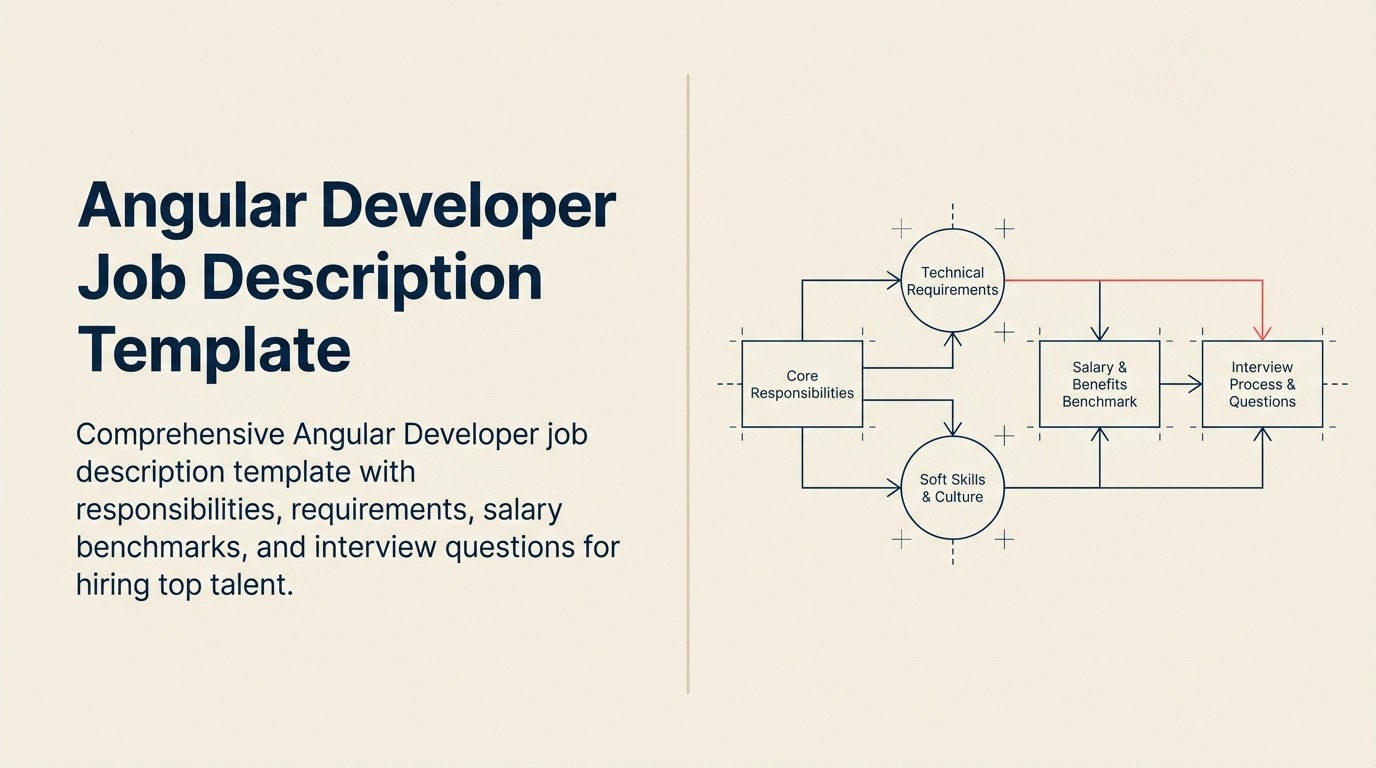
What You'll Get From This Guide
- Ready-to-use job description template for all Angular experience levels
- Comprehensive salary data across 20+ metropolitan areas for 2026
- Technical and behavioral interview questions with evaluation criteria
- Industry-specific considerations for different business sectors
- Essential and preferred qualifications for Angular developers
- Context variations for corporate, startup, and remote environments
- Proven sourcing strategies and platform recommendations
- Red flags to avoid when evaluating Angular candidates
Looking to hire an Angular developer who can build dynamic, scalable web applications? This comprehensive template provides everything you need to attract top Angular talent, from junior developers to senior architects. Angular developers are essential for creating modern, responsive user interfaces that deliver exceptional user experiences.
Key Highlights
- Average Salary: $75,000 - $140,000+ annually (varies by experience and location)
- High Demand: Angular remains one of the top 3 frontend frameworks globally
- Enterprise Adoption: Used by Google, Microsoft, Samsung, and thousands of enterprises
- Full-Stack Integration: Works seamlessly with Node.js.NET, Java, and Python backends
- Career Growth: Clear progression from developer to architect to technical lead
- Job Security: Consistent demand across industries from startups to Fortune 500
Why This Role Matters in 2026
Angular developers are the architects of modern web experiences, transforming complex business requirements into intuitive, performant applications. What changes in 2026 is that AI handles a growing share of the routine work: generating boilerplate components, catching type errors, suggesting test cases, and flagging accessibility violations. That shift makes the Angular developer more valuable, not less, because the bottleneck moves from writing code to making sound architectural and UX decisions.
The developer who pairs Angular expertise with AI tooling ships faster and catches more issues before production. More important, they can take on the architectural questions, component composition strategy, performance tradeoff analysis, state management design, that used to consume most of a senior developer's time. AI handles the first draft; the Angular developer makes it production-ready.
Enterprise adoption of Angular remains strong precisely because the framework's opinionated structure and TypeScript foundation give AI code generation tools reliable scaffolding to work within. Angular developers who understand that structure can direct AI assistants effectively, while developers without that depth get generic output that requires heavy rework.
AI Skills & Tools for Angular Developer in 2026
AI fluency is now a practical differentiator for Angular developers, not a nice-to-have:

- AI-assisted code generation: Working with GitHub Copilot, Tabnine, or CodeWhisperer to accelerate component scaffolding, service generation, and RxJS operator chains, while reviewing output for Angular idioms, type safety, and architectural fit rather than accepting it wholesale.
- Prompt engineering for frontend workflows: Writing effective prompts for Angular-specific tasks (generating unit test cases, drafting component documentation, producing mock data for development) and building a reusable prompt library that the team can standardize on.
- AI-powered testing: Using tools like Testim or Mabl that apply AI to identify flaky tests, generate end-to-end test scenarios from user flows, and reduce the maintenance burden of large test suites across Angular upgrades.
- AI code review and static analysis: Integrating SonarQube AI, CodeClimate, or similar tools into the development workflow to catch security vulnerabilities, complexity hotspots, and Angular anti-patterns at the PR stage, not in production.
- Using AI agents for dependency management: Directing automated agents that scan for outdated Angular packages, test upgrade compatibility, and surface breaking changes before they reach the main branch.
- Accessibility and performance auditing with AI: Leveraging AI-powered Lighthouse extensions and axe tools to catch WCAG violations and performance regressions earlier in the build cycle, reducing the manual audit burden.
- Market context: Demand for Angular developers who can demonstrate AI-augmented productivity has grown sharply. Candidates who can ship faster and maintain higher code quality by directing AI tools effectively command a premium over those whose workflow remains entirely manual. The ~56% wage premium observed for AI-fluent software roles reflects real productivity gaps that hiring managers can measure.
Working Alongside AI Agents
Angular development in 2026 increasingly involves directing AI agents as part of the standard workflow, knowing when to trust them, when to override them, and when they cannot substitute for developer judgment:

What agents handle: Code generation for repetitive component patterns, boilerplate service creation, automated test scaffolding, dependency update PRs with compatibility notes, and accessibility lint checks that run on every commit.
What the developer owns: Architecture decisions, how to decompose features into components, which state management approach fits the application's complexity, when OnPush change detection is the right call and when it creates bugs. UX judgment on interactions that go beyond what a spec captures. Performance tradeoff analysis when lazy loading, bundle splitting, and SSR interact in non-obvious ways. Code review quality, catching the cases where AI-generated code is syntactically correct but architecturally wrong. Accessibility compliance, where automated checks catch maybe 30% of real issues and human judgment covers the rest.
The handoff line: An AI agent can generate a working Angular component in seconds. Whether that component fits the application's architecture, handles edge cases correctly, performs at scale, and passes a thorough accessibility review, those judgments belong to the developer. The best Angular developers in 2026 treat AI output the way a senior engineer treats a junior's PR: read it carefully, merge what's good, rewrite what isn't, and explain why.
Job Description Template
About the Role
We are seeking a skilled Angular Developer to join our development team and help build next-generation web applications. You will be responsible for developing user-facing features, implementing responsive designs, and ensuring optimal application performance. Working in an agile environment, you will collaborate with cross-functional teams to deliver high-quality software solutions that meet business objectives.

As an Angular Developer, you will play a crucial role in our technology stack, working with the latest Angular versions, TypeScript, and modern development tools. You will contribute to architectural decisions, mentor junior developers, and help establish best practices for frontend development. This role offers the opportunity to work on challenging projects while growing your expertise in one of the industry's most popular frameworks.
The ideal candidate combines technical expertise with strong problem-solving abilities and excellent communication skills. You will be expected to write clean, maintainable code while staying current with Angular ecosystem updates and industry best practices.
Key Responsibilities
- Application Development: Design and implement robust Angular applications using latest framework versions, TypeScript, and modern development patterns
- Component Architecture: Create reusable, modular components and services following Angular style guide and best practices
- API Integration: Integrate frontend applications with RESTful APIs and GraphQL endpoints using HttpClient and RxJS observables
- Performance Optimization: Implement lazy loading, change detection strategies, and other performance optimization techniques
- Testing Implementation: Write comprehensive unit tests using Jasmine/Karma and end-to-end tests using Cypress or Protractor
- Code Quality: Maintain high code standards through code reviews, linting, and adherence to established coding conventions
- UI/UX Collaboration: Work closely with designers to implement pixel-perfect, responsive interfaces using Angular Material or custom CSS
- Documentation: Create and maintain technical documentation for components, services, and application architecture
- Agile Participation: Actively participate in sprint planning, daily standups, and retrospectives while meeting delivery commitments
- Continuous Learning: Stay updated with Angular ecosystem changes, new features, and emerging frontend technologies
Requirements
Essential Qualifications:
- Bachelor's degree in Computer Science, Engineering, or related field, or equivalent practical experience
- 3-5 years of hands-on experience with Angular (versions 12+) and TypeScript development
- Strong proficiency in HTML5, CSS3, SCSS/SASS, and responsive web design principles
- Solid understanding of RxJS, observables, and reactive programming patterns
- Experience with Angular CLI, npm/yarn package management, and build tools like Webpack
- Proficiency with RESTful API integration and HTTP client implementation
- Knowledge of version control systems (Git) and collaborative development workflows
- Understanding of Angular testing frameworks (Jasmine, Karma) and testing methodologies
Preferred Qualifications:
- Experience with Angular Universal for server-side rendering (SSR)
- Knowledge of state management solutions (NgRx, Akita) for complex applications
- Familiarity with Angular Material Design and component library implementation
- Experience with Progressive Web App (PWA) development and service workers
- Understanding of micro-frontend architecture and module federation
What We Offer
Compensation & Benefits:
- Competitive salary range: $75,000 - $140,000 based on experience and location
- Performance-based bonuses and annual salary reviews
- Comprehensive health, dental, and vision insurance
- 401(k) retirement plan with company matching
- Flexible PTO and paid holidays
Professional Development:
- Annual learning and development budget for conferences, courses, and certifications
- Access to online learning platforms (Pluralsight, Udemy Business)
- Opportunity to contribute to open-source Angular projects
- Mentorship programs and career advancement paths
- Conference attendance and speaking opportunities
Work Environment:
- Flexible hybrid work arrangements with modern office spaces
- Latest development tools and high-performance workstations
- Collaborative team environment with experienced developers
- Agile development methodologies with regular retrospectives
Context Variations
Corporate Environment: Large enterprises often require additional focus on Angular Enterprise features, extensive testing protocols, and integration with complex backend systems. Expect more formal code review processes, documentation requirements, and compliance considerations. Projects typically have longer development cycles with emphasis on maintainability and scalability.
Startup Environment: Fast-paced startups prioritize rapid development and MVP delivery. Angular developers may work across the full stack, handle DevOps tasks, and make more architectural decisions. Expect shorter development cycles, direct stakeholder interaction, and the need to balance technical debt with feature delivery speed.
Remote/Hybrid: Remote Angular development requires strong async communication skills and experience with collaborative tools like Slack, Figma, and project management platforms. Emphasis on code documentation, regular progress updates, and timezone-aware collaboration with distributed teams becomes crucial for success.
Industry Considerations
| Industry | Key Requirements | Compliance Notes |
|---|---|---|
| Financial Services | Security focus, accessibility compliance, real-time data handling | SOX compliance, WCAG 2.1 AA standards |
| Healthcare | HIPAA compliance, data privacy, offline functionality | FDA regulations for medical devices, PHI protection |
| E-commerce | Performance optimization, payment integration, SEO | PCI DSS compliance, conversion optimization |
| Enterprise SaaS | Multi-tenancy, white-labeling, enterprise SSO | OAuth 2.0, SAML integration, audit logging |
| Media/Publishing | Content management, video streaming, mobile optimization | Copyright management, CDN integration |
| Government | Accessibility, security clearances, legacy system integration | Section 508 compliance, FISMA requirements |
Salary Information
National Salary Ranges (2026)
- Entry Level (0-2 years): $60,000 - $85,000
- Mid Level (3-5 years): $75,000 - $115,000
- Senior Level (5-8 years): $100,000 - $140,000
- Lead/Architect (8+ years): $120,000 - $180,000
Major Metro Areas:
- San Francisco Bay Area: $95,000 - $200,000+
- New York City: $85,000 - $170,000+
- Seattle: $80,000 - $160,000+
- Austin: $75,000 - $145,000+
- Chicago: $70,000 - $135,000+
- Denver: $70,000 - $130,000+
- Remote (US): $65,000 - $150,000+
Factors Affecting Compensation:
- Angular version expertise (latest versions command premium)
- TypeScript proficiency and advanced patterns knowledge
- Experience with enterprise-scale applications and architecture
- AI tooling fluency: developers who demonstrably ship faster and with higher quality using AI assistants are negotiating from a stronger position
AI Fluency by Experience Level
| Level | AI fluency expectation |
|---|---|
| Entry (0-2 years) | Uses AI coding assistants (Copilot, Tabnine) daily; reviews generated code for correctness and Angular idioms; uses AI to learn framework patterns faster |
| Mid (3-5 years) | Builds reusable prompt templates for team workflows; configures AI-powered testing and lint tools in the CI pipeline; reviews AI-generated component code for architectural fit |
| Senior (5-8 years) | Designs AI-augmented development processes for the team; evaluates and selects AI tooling; oversees dependency-update agents and sets policy on when automated PRs can merge without manual review |
| Lead/Architect (8+ years) | Defines AI coding standards and governance for the frontend org; architects systems where AI agents and human developers have clear, documented handoff boundaries; mentors team on effective AI collaboration |
AI-fluent Angular developers at the senior and lead levels are increasingly difficult to find and command compensation above the ranges shown. A general premium of 10-20% for demonstrated AI productivity is emerging in competitive markets.
Salary data compiled from Glassdoor, Stack Overflow Developer Survey, and Robert Half Technology Salary Guide 2026
Interview Questions
Technical/Functional Questions
- What are the key differences between Angular and AngularJS, and why would you choose Angular for a new project? Evaluate: Framework knowledge, understanding of modern web development

Explain the Angular component lifecycle hooks and when you would use each one. Evaluate: Core Angular concepts, practical application knowledge
How do you handle state management in large Angular applications, and what are the pros/cons of NgRx? Evaluate: Architecture thinking, experience with complex applications
Describe the difference between reactive and template-driven forms. When would you use each approach? Evaluate: Practical Angular knowledge, decision-making skills
How do you optimize Angular application performance, especially for large datasets? Evaluate: Performance awareness, advanced Angular techniques
Explain Angular's change detection mechanism and how OnPush strategy affects performance. Evaluate: Deep Angular understanding, performance optimization skills
How do you implement lazy loading in Angular routing, and what are the benefits? Evaluate: Application architecture, performance optimization
What is Angular Universal and how does server-side rendering work with Angular? Evaluate: Full-stack understanding, SEO/performance awareness
Behavioral Questions
Tell me about a time when you had to refactor a large Angular codebase. What was your approach? Evaluate: Problem-solving, code quality focus, project management
Describe a situation where you had to learn a new Angular feature or library quickly for a project. Evaluate: Learning agility, adaptability, self-motivation
How do you handle disagreements with team members about Angular implementation approaches? Evaluate: Communication skills, collaboration, technical leadership
Give an example of how you've mentored junior developers in Angular best practices. Evaluate: Leadership potential, knowledge sharing, teaching ability
Describe a challenging bug you encountered in an Angular application and how you resolved it. Evaluate: Debugging skills, persistence, analytical thinking
Culture Fit Questions
How do you stay current with Angular updates and the broader JavaScript ecosystem? Evaluate: Continuous learning, professional development
What motivates you most about frontend development and working with Angular? Evaluate: Passion, long-term interest, cultural alignment
How do you balance perfectionism with delivery deadlines in your development work? Evaluate: Pragmatism, time management, quality focus
Describe your ideal development team environment and collaboration style. Evaluate: Team fit, communication preferences, work style
Hiring Tips
Quick Sourcing Guide
- GitHub: Search for Angular repositories, contributions to Angular projects, and open-source involvement
- Stack Overflow: Look for users with high Angular reputation and active community participation
- LinkedIn: Target candidates with Angular, TypeScript, and RxJS skills from relevant companies
- Angular Community: Engage with local Angular meetups, conferences (ng-conf), and online forums
Posting Optimization Tips
- Include specific Angular version requirements in job titles
- Highlight modern development practices (TypeScript, testing, CI/CD)
- Mention exciting projects or technologies to attract top talent
- Be specific about team size and collaboration opportunities
Red Flags to Avoid
- Outdated Framework Knowledge: Candidates stuck on AngularJS or very old Angular versions without migration experience
- No TypeScript Experience: Modern Angular development requires strong TypeScript skills
- Poor Testing Practices: Inability to discuss unit testing, integration testing, or testing strategies
- Weak Problem-Solving: Cannot explain debugging approaches or performance optimization techniques
- Limited RxJS Understanding: Struggles with observable patterns and reactive programming concepts
- No Version Control: Lacks experience with Git workflows and collaborative development practices
For Employers
What Angular version should we require for new hires?
Focus on Angular 12+ experience, with preference for candidates familiar with Angular 15-18. The framework's regular update cycle means developers should demonstrate ability to adapt to new versions.
Should Angular developers know backend technologies?
While not required, understanding of REST APIs, HTTP protocols, and basic backend concepts is valuable. Full-stack knowledge is a plus but shouldn't be mandatory for frontend-focused roles.
How important is TypeScript proficiency for Angular developers?
Critical. Angular is built with TypeScript, and modern Angular development requires strong TypeScript skills including interfaces, generics, and advanced typing patterns.
What's the difference between Angular and React developers in terms of hiring?
Angular developers typically have stronger TypeScript backgrounds and experience with opinionated frameworks. They often excel in enterprise environments requiring structured, scalable applications.
Should we require NgRx experience for all Angular positions?
NgRx experience is valuable for senior roles but not necessary for all positions. Focus on general state management understanding, with NgRx as a plus for complex application development.
For Job Seekers
What Angular version should I focus on learning?
Learn the latest stable version (Angular 18 as of 2026) while understanding the migration path from earlier versions. Employers value developers who stay current with framework updates.
Is Angular still relevant compared to React and Vue?
Absolutely. Angular remains highly relevant, especially in enterprise environments. It offers excellent TypeScript integration, comprehensive tooling, and strong architectural patterns for large applications.
How can I demonstrate Angular skills without work experience?
Build personal projects showcasing Angular features, contribute to open-source Angular projects, create a portfolio demonstrating component architecture, testing, and modern Angular patterns.
What's the career progression for Angular developers?
Common paths include Senior Developer → Lead Developer → Frontend Architect → Engineering Manager. Many Angular developers also transition to full-stack roles or specialize in performance optimization.
Should I learn React if I know Angular?
While beneficial for market flexibility, deep Angular expertise is often more valuable than surface-level knowledge of multiple frameworks. Focus on becoming an Angular expert first, then expand your skillset.

Senior Operations & Growth Strategist
On this page
- Key Highlights
- Why This Role Matters in 2026
- AI Skills & Tools for Angular Developer in 2026
- Working Alongside AI Agents
- Job Description Template
- About the Role
- Key Responsibilities
- Requirements
- What We Offer
- Context Variations
- Industry Considerations
- Salary Information
- AI Fluency by Experience Level
- Interview Questions
- Technical/Functional Questions
- Behavioral Questions
- Culture Fit Questions
- Hiring Tips
- Quick Sourcing Guide
- Posting Optimization Tips
- Red Flags to Avoid