AI Engineer Job Description (2026): AI-Era Skills, Responsibilities & Hiring Guide
Turn this article into takeaways for your work.


Each assistant summarizes the article only for you and suggests best practices for your work.
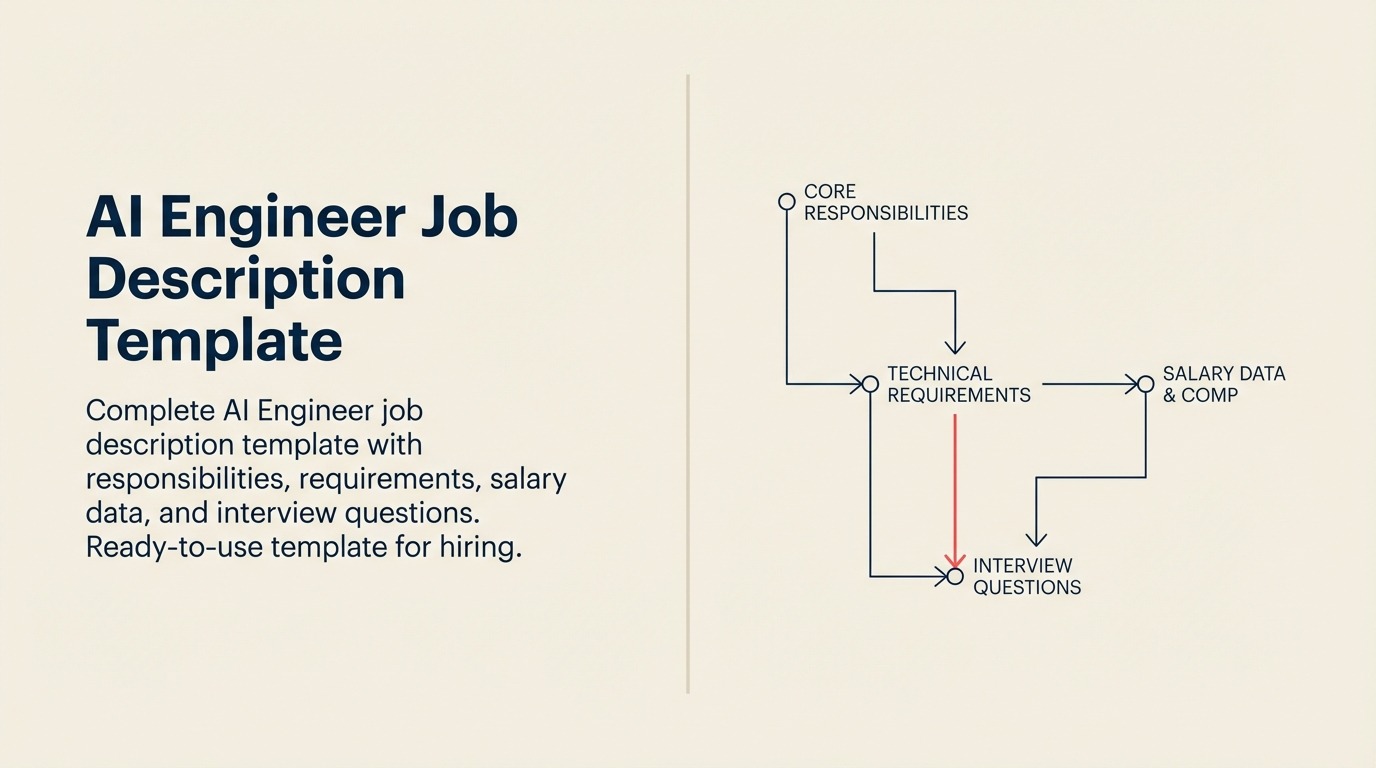
What You'll Get From This Guide
- Complete AI Engineer job description template with technical requirements
- Salary benchmarks and compensation data across major markets
- 25+ technical interview questions for evaluating AI engineering skills
- Skills matrix for different experience levels from junior to senior
- Industry-specific variations for healthcare, finance, and tech sectors
- Real examples from leading AI companies and startups
- Remote work considerations and team structure recommendations
- Legal compliance guidelines for inclusive hiring
Overview
An AI Engineer is a specialized software engineer who designs, develops, and implements artificial intelligence solutions to solve complex business problems. This role combines deep technical expertise in machine learning, data science, and software engineering with practical application development skills.
Key Highlights
- Average Salary: $130,000 - $200,000+ annually
- Growth Rate: 35% projected job growth through 2030
- Remote Friendly: 85% of positions offer remote/hybrid options
- High Demand: Critical role in digital transformation initiatives
- Career Path: Clear progression to Senior AI Engineer, AI Solutions Architect, or AI Team Lead
- Industry Impact: Drive innovation across healthcare, finance, automotive, and technology sectors
Why This Role Matters in 2026
AI Engineers are at the center of the most consequential technology decisions organizations are making. They build the systems that transform AI research into production applications, and they make the architectural choices that determine whether an AI initiative succeeds or becomes a cautionary tale about poor design.
What becomes more valuable as AI capabilities expand is the human capacity for architecture decisions, safety and alignment review, and stakeholder communication about what AI systems can and cannot reliably do. An LLM can write code; an AI Engineer designs the system the LLM runs inside, ensures it behaves safely in production, and explains its outputs and limits to the people who depend on it. That combination of engineering depth and communicative clarity is what the role selects for in 2026.
AI Skills & Tools for AI Engineers in 2026
This role is unique: the AI Engineer both builds AI systems and uses AI to build those systems faster. The expectation is deep technical fluency across the production AI stack, not just familiarity.

- LLM application development (OpenAI API, Anthropic SDK, Hugging Face). Building production applications on top of large language models, including prompt design, context management, function calling, and streaming. Understanding of each provider's capabilities and pricing tradeoffs is expected. Anthropic SDK and Claude API knowledge is specifically valuable for enterprise deployments with strong safety and reliability requirements.
- RAG pipeline design (LangChain, LlamaIndex, vector databases). Retrieval-augmented generation is the dominant pattern for production LLM applications. Engineers are expected to design, optimize, and debug RAG systems including chunking strategy, embedding model selection, and retrieval quality evaluation.
- Agent orchestration (LangChain, LlamaIndex, CrewAI, AutoGen). Building multi-agent systems where LLMs call tools, delegate to sub-agents, and complete multi-step tasks autonomously. This requires understanding both the frameworks and the failure modes: hallucinated tool calls, runaway loops, and non-deterministic behavior in production.
- Fine-tuning workflows. Supervised fine-tuning and RLHF for domain-specific models, including data curation, evaluation, and the engineering work to run training jobs on cloud infrastructure. Knowing when fine-tuning is warranted versus prompt engineering or RAG is itself a key judgment call.
- MLOps and model monitoring (MLflow, Weights and Biases, Prometheus). Production AI systems require ongoing monitoring for performance drift, latency regression, and output quality degradation. Engineers are expected to build and maintain these monitoring systems, not just hand off to an ops team.
- Using AI to accelerate engineering work. AI Engineers are expected to use GitHub Copilot, Claude, and similar coding assistants to accelerate their own development, write test coverage, and document systems. The irony of the role is that the best practitioners use the tools they build to build them faster.
- Market context. AI Engineers with production agent-building and LLM application experience are among the most sought-after engineers in the market. Demand for AI-fluent engineers is up roughly 144% year over year, and AI-fluent engineering roles command an estimated 56-80% wage premium over traditional software engineering at comparable seniority.
Working Alongside AI Agents
AI Engineers are not just users of AI agents; they are the professionals who design, deploy, monitor, and improve them. The governance and safety responsibilities that come with this are a core part of the role, not an add-on.

What agents handle: Automated code generation and test writing, automated documentation from codebase analysis, monitoring alerts and first-pass incident triage, scheduled data pipeline execution, and generation of draft PR descriptions and release notes.
What the human owns: Architecture decisions about how agents are structured and what they are allowed to do autonomously, safety and alignment review of agent behavior before and after deployment, stakeholder communication about what a given agent system reliably does and where human oversight is still needed, escalation design (which agent failures trigger human review vs. automated remediation), and the fundamental decision about when an autonomous agent is appropriate and when a human-in-the-loop design is required.
The handoff line: The AI Engineer designs the rails the agent runs on: the tools it can call, the guardrails it operates under, the monitoring that catches when it goes wrong, and the fallback logic when it fails. No agent system ships to production without the engineer signing off on its safety properties and failure modes. As agents become more capable, this governance role grows in importance rather than shrinking; the AI Engineer's judgment about what an agent should and should not do autonomously is a critical safety function the organization depends on.
Primary Job Description Template
About the Role
We are seeking a talented AI Engineer to join our innovative team and drive the development of cutting-edge artificial intelligence solutions. As an AI Engineer, you will design, implement, and deploy machine learning models and AI systems that solve complex business challenges and enhance our products and services.

You will work closely with cross-functional teams including data scientists, software engineers, product managers, and business stakeholders to translate AI research into scalable production systems. This role requires both technical depth in machine learning and the engineering skills to build robust, maintainable AI applications.
The ideal candidate will have hands-on experience with modern AI frameworks, strong programming skills, and a passion for applying artificial intelligence to real-world problems. You'll have the opportunity to work on diverse projects ranging from natural language processing and computer vision to predictive analytics and recommendation systems.
Key Responsibilities
- Design and develop machine learning models using frameworks like TensorFlow, PyTorch, or Scikit-learn to address specific business requirements
- Build and maintain AI/ML pipelines for data preprocessing, model training, validation, and deployment at scale
- Implement data collection and preprocessing systems to ensure high-quality datasets for model training and evaluation
- Deploy AI models to production environments using cloud platforms (AWS, GCP, Azure) and containerization technologies
- Optimize model performance and efficiency through techniques like hyperparameter tuning, model compression, and distributed training
- Collaborate with data science teams to translate research prototypes into production-ready AI solutions
- Monitor and maintain deployed models including performance tracking, drift detection, and automated retraining workflows
- Conduct A/B testing and experimentation to validate AI solution effectiveness and measure business impact
- Stay current with AI/ML research trends and evaluate new technologies for potential integration into existing systems
- Document AI solutions and best practices to ensure knowledge sharing and maintainable codebases
Requirements
Must-Have Qualifications:
- Bachelor's degree in Computer Science, Engineering, Mathematics, or related technical field
- 3+ years of experience in machine learning, artificial intelligence, or related software development
- Proficiency in Python and/or R with extensive experience in ML libraries (TensorFlow, PyTorch, Scikit-learn)
- Strong understanding of machine learning algorithms, deep learning architectures, and statistical methods
- Experience with cloud platforms (AWS, GCP, Azure) and their AI/ML services
- Knowledge of data engineering concepts including ETL processes, data warehousing, and big data technologies
- Experience with version control systems (Git) and collaborative development workflows
- Understanding of software engineering best practices including testing, code review, and CI/CD
Nice-to-Have Qualifications:
- Master's degree or PhD in AI, Machine Learning, or related field
- Experience with MLOps tools and practices (MLflow, Kubeflow, Airflow)
- Knowledge of containerization technologies (Docker, Kubernetes)
- Familiarity with edge computing and model optimization for mobile/embedded devices
- Experience with specific AI domains (NLP, computer vision, reinforcement learning)
What We Offer
- Competitive Compensation: Base salary $130,000 - $180,000 plus equity and performance bonuses
- Comprehensive Benefits: Health, dental, vision insurance with company-paid premiums
- Professional Development: $5,000 annual learning budget for conferences, courses, and certifications
- Flexible Work Environment: Remote-first culture with optional office access and flexible hours
- Cutting-Edge Technology: Access to latest AI/ML tools, high-performance computing resources, and research partnerships
- Career Growth: Clear advancement paths to senior technical roles or management tracks
- Innovation Time: 20% time allocation for research projects and experimental AI applications
Context Variations
Corporate Environment
Large enterprises typically require AI Engineers who can work within established frameworks and integrate with existing enterprise systems. Focus on experience with enterprise-grade ML platforms, compliance requirements, and large-scale deployment. Emphasize collaboration with multiple stakeholders and ability to work within structured development processes.
Startup Environment
Startups need AI Engineers who can wear multiple hats and move quickly from prototype to production. Highlight adaptability, full-stack capabilities, and experience building AI solutions from scratch. Emphasize ownership mentality and ability to make architectural decisions with limited resources.
Remote/Hybrid Work
Remote AI positions require strong communication skills and experience with distributed development workflows. Emphasize asynchronous collaboration abilities, documentation skills, and experience with cloud-based development environments. Include requirements for home office setup and reliable internet connectivity.
Industry Considerations
| Industry | Key Requirements | Special Considerations |
|---|---|---|
| Healthcare | HIPAA compliance, FDA regulations | Experience with medical imaging, EHR systems, clinical data |
| Finance | Risk management, regulatory compliance | Knowledge of quantitative finance, fraud detection, algorithmic trading |
| Automotive | Safety-critical systems, real-time processing | Experience with computer vision, sensor fusion, embedded systems |
| Retail/E-commerce | Scalability, personalization | Recommendation systems, demand forecasting, customer analytics |
| Technology | Innovation focus, research integration | Latest AI techniques, research publication experience |
| Manufacturing | Industrial IoT, predictive maintenance | Knowledge of operational technology, quality control systems |
Experience Level Requirements Matrix
Seniority progresses from guided implementation to production ownership, architecture, safety, and technical leadership.

Entry Level (0-2 years)
Core AI Engineering Skills:
- Proficiency in Python with working knowledge of at least one ML framework (PyTorch, TensorFlow, or Scikit-learn)
- Can build basic LLM applications using API integrations (OpenAI, Anthropic, Hugging Face)
- Uses AI coding assistants (GitHub Copilot, Claude) daily to accelerate development and write test coverage
- Understands the end-to-end ML lifecycle from data preparation through model deployment
- Familiar with RAG concepts and can implement a basic pipeline from documentation or examples
AI-Fluency Expectation: Uses AI tools daily as a core part of engineering practice, not as a supplement.
Red Flags: No production AI project exposure; cannot explain the difference between fine-tuning and RAG; has not built anything with an LLM API.
Mid-Level (3-5 years)
Core AI Engineering Skills:
- Builds and optimizes RAG pipelines including chunking strategy, embedding selection, and retrieval quality evaluation
- Designs and deploys LLM-powered features to production with appropriate monitoring and fallback logic
- Builds prompt workflows and templates for repeatable LLM tasks; writes evaluations to measure output quality
- Understands MLOps fundamentals including experiment tracking, model versioning, and drift monitoring
- Experience with at least one agent orchestration framework (LangChain, LlamaIndex, CrewAI, or similar)
AI-Fluency Expectation: Builds reusable LLM application patterns and prompt workflows; evaluates AI outputs systematically rather than relying on manual spot-checks.
Red Flags: Only theoretical knowledge of production LLM systems; no experience with evaluation frameworks; cannot discuss failure modes of agentic systems.
Senior Level (6+ years)
Core AI Engineering Skills:
- Architects multi-agent systems and LLM application stacks with clear safety properties and failure-mode documentation
- Designs and oversees production AI agent pipelines; defines what agents can and cannot do autonomously
- Leads fine-tuning initiatives including data curation, training infrastructure, and evaluation design
- Establishes engineering standards for AI system safety, observability, and responsible deployment across a team
- Communicates AI system capabilities, limitations, and risks credibly to non-technical stakeholders
AI-Fluency Expectation: Designs AI-augmented engineering processes for the team; sets governance standards for agent systems; makes the architectural decisions that determine how much autonomy AI systems are granted in production.
Red Flags: Strong ML research background but no production system ownership; cannot articulate the safety properties of systems they have built; no experience designing monitoring and fallback logic for agentic systems.
Compensation Guide
Salary Information
National Average Range: $130,000 - $200,000 annually
AI-fluency premium: AI Engineers with production LLM application and agent orchestration experience command a significant premium above the ranges below. Market data suggests AI-fluent engineers at all levels are commanding 56-80% above traditional software engineering salaries at comparable seniority, reflecting how much demand for this combination of skills exceeds supply.
Experience-Based Breakdown:
- Entry Level (0-2 years): $110,000 - $140,000
- Mid-Level (3-5 years): $130,000 - $180,000
- Senior Level (5+ years): $160,000 - $200,000+
Regional Salary Data
| Metro Area | Average Salary | Cost of Living Factor |
|---|---|---|
| San Francisco Bay Area | $180,000 - $250,000 | High (1.8x national average) |
| Seattle | $160,000 - $220,000 | High (1.4x national average) |
| New York City | $155,000 - $210,000 | High (1.5x national average) |
| Boston | $145,000 - $195,000 | High (1.3x national average) |
| Austin | $135,000 - $185,000 | Moderate (1.1x national average) |
| Chicago | $130,000 - $175,000 | Moderate (1.0x national average) |
| Denver | $125,000 - $170,000 | Moderate (1.0x national average) |
| Remote | $120,000 - $180,000 | Varies by company policy |
Compensation Factors: Company size, funding stage, industry vertical, specific AI expertise, and security clearance requirements can significantly impact salary ranges.
Ranges are directional benchmarks. AI Engineers with production agent and LLM application experience should expect offers at or above the upper end of each band. Data sourced from Glassdoor, LinkedIn Salary Insights, and industry surveys, updated June 2026.
Interview Questions
Test fundamentals, system design, production trade-offs, safety judgment, and evidence from shipped AI systems.

Technical/Functional Questions
Machine Learning Fundamentals
- Explain the bias-variance tradeoff and how it impacts model selection. How would you diagnose and address high bias vs. high variance in a model?
- Walk me through the process of building an end-to-end machine learning pipeline from data ingestion to model deployment.
- How would you handle imbalanced datasets in a classification problem? Describe at least three different approaches.
- Explain the differences between batch learning and online learning. When would you choose one over the other?
- Describe how you would approach feature engineering for a time series forecasting problem.
- What is regularization and why is it important? Explain the differences between L1 and L2 regularization.
- How would you evaluate the performance of an unsupervised learning model, such as a clustering algorithm?
- Explain the concept of gradient descent and describe different variants (SGD, Adam, RMSprop). When would you use each?
Behavioral Questions
Problem-Solving and Innovation
- Describe a challenging AI project where you had to solve a problem with limited or poor-quality data. How did you approach it?
- Tell me about a time when a machine learning model you deployed to production started performing poorly. How did you diagnose and fix the issue?
- Give an example of how you've had to explain a complex AI concept or model results to non-technical stakeholders.
- Describe a situation where you had to balance model accuracy with computational efficiency or interpretability.
- Tell me about a time when you had to learn a new AI technique or framework quickly for a project.
Culture Fit Questions
- How do you stay current with the rapidly evolving field of AI and machine learning?
- Describe your approach to collaborating with data scientists, software engineers, and product teams.
- How do you handle ethical considerations in AI development, such as bias in models or privacy concerns?
- What excites you most about working in artificial intelligence, and where do you see the field heading?
Evaluation Tips: Look for candidates who demonstrate both technical depth and practical problem-solving skills. Strong candidates will show experience with the full ML lifecycle, not just model development. Pay attention to their ability to communicate complex concepts clearly and their awareness of real-world constraints and ethical considerations.
Hiring Tips
Quick Sourcing Guide
Top Platforms for AI Engineers:
- LinkedIn: Use targeted searches with specific AI frameworks and techniques
- GitHub: Search for contributors to popular ML repositories and open-source projects
- Kaggle: Identify top performers in machine learning competitions
- AI/ML Conference Networks: Connect with speakers and attendees at NeurIPS, ICML, ICLR
Professional Communities:
- Reddit: r/MachineLearning, r/artificial, r/MLQuestions for active community members
- Stack Overflow: Contributors to AI/ML tags demonstrate practical problem-solving skills
- Research Communities: ArXiv contributors, Google Scholar profiles for research-oriented roles
Posting Optimization Tips:
- Include specific AI frameworks and technologies in job titles and descriptions
- Highlight unique datasets or problem domains your team works with
- Mention access to high-performance computing resources or cutting-edge tools
- Emphasize learning opportunities and conference attendance support
Red Flags to Avoid
- Theoretical knowledge without practical implementation experience - Look for hands-on project examples
- Only academic research experience with no production deployment - Ensure understanding of real-world constraints
- Inability to explain concepts simply - AI Engineers must communicate with diverse stakeholders
- No awareness of ethical AI considerations - Modern AI roles require responsible development practices
- Over-reliance on automated ML tools without understanding fundamentals - Seek deep technical understanding
- Lack of software engineering best practices - AI systems require maintainable, scalable code
AI Engineer Hiring - For Employers
What's the difference between an AI Engineer and a Data Scientist?
AI Engineers focus on implementing and deploying AI solutions in production environments, while Data Scientists typically focus on analysis, research, and model development. AI Engineers have stronger software engineering skills and production system experience.
How important is a PhD for AI Engineer roles?
While a PhD can be valuable, it's not required for most AI Engineer positions. Practical experience with production AI systems and strong engineering skills are often more important than advanced academic credentials.
Should I require experience with specific AI frameworks?
Focus on fundamental ML knowledge and programming skills rather than specific frameworks. Strong engineers can adapt to new tools quickly, and the AI landscape evolves rapidly.
How can I assess practical AI skills during interviews?
Include hands-on coding exercises, system design questions focused on ML pipelines, and discussions about real projects they've deployed to production.
What's a reasonable timeline for finding qualified AI Engineers?
Expect 2-4 months for senior positions due to high demand and limited talent pool. Consider growing junior talent internally or partnering with AI bootcamps and universities.
AI Engineer Careers - For Job Seekers
What programming languages should I focus on as an AI Engineer?
Python is essential, with R being valuable for statistical work. Knowledge of Java, C++, or Scala can be beneficial for production systems and big data processing.
Do I need a computer science degree to become an AI Engineer?
While helpful, it's not strictly required. Many successful AI Engineers come from mathematics, physics, engineering, or even non-technical backgrounds with strong self-directed learning.
How can I gain practical AI experience without work experience?
Build personal projects, contribute to open-source ML libraries, participate in Kaggle competitions, and create a portfolio showcasing end-to-end AI solutions.
What's the career progression path for AI Engineers?
Typical progression includes Senior AI Engineer, ML Architect, AI Team Lead, or specialization in areas like MLOps, AI Research, or Product Management.
How important are cloud platform certifications?
Cloud certifications (AWS ML, Google Cloud ML, Azure AI) can be valuable differentiators and demonstrate practical deployment skills, though hands-on experience is more important than certifications alone.
What soft skills are most important for AI Engineers?
Communication skills for explaining complex concepts, collaboration abilities for cross-functional teams, and problem-solving mindset for addressing ambiguous challenges.

Senior Operations & Growth Strategist
On this page
- Overview
- Key Highlights
- Why This Role Matters in 2026
- AI Skills & Tools for AI Engineers in 2026
- Working Alongside AI Agents
- Primary Job Description Template
- About the Role
- Key Responsibilities
- Requirements
- What We Offer
- Context Variations
- Corporate Environment
- Startup Environment
- Remote/Hybrid Work
- Industry Considerations
- Experience Level Requirements Matrix
- Entry Level (0-2 years)
- Mid-Level (3-5 years)
- Senior Level (6+ years)
- Compensation Guide
- Salary Information
- Regional Salary Data
- Interview Questions
- Technical/Functional Questions
- Behavioral Questions
- Culture Fit Questions
- Hiring Tips
- Quick Sourcing Guide
- Red Flags to Avoid