Call Center Director Job Description (2026): AI-Era Skills, Responsibilities & Hiring Guide
Turn this article into takeaways for your work.


Each assistant summarizes the article only for you and suggests best practices for your work.
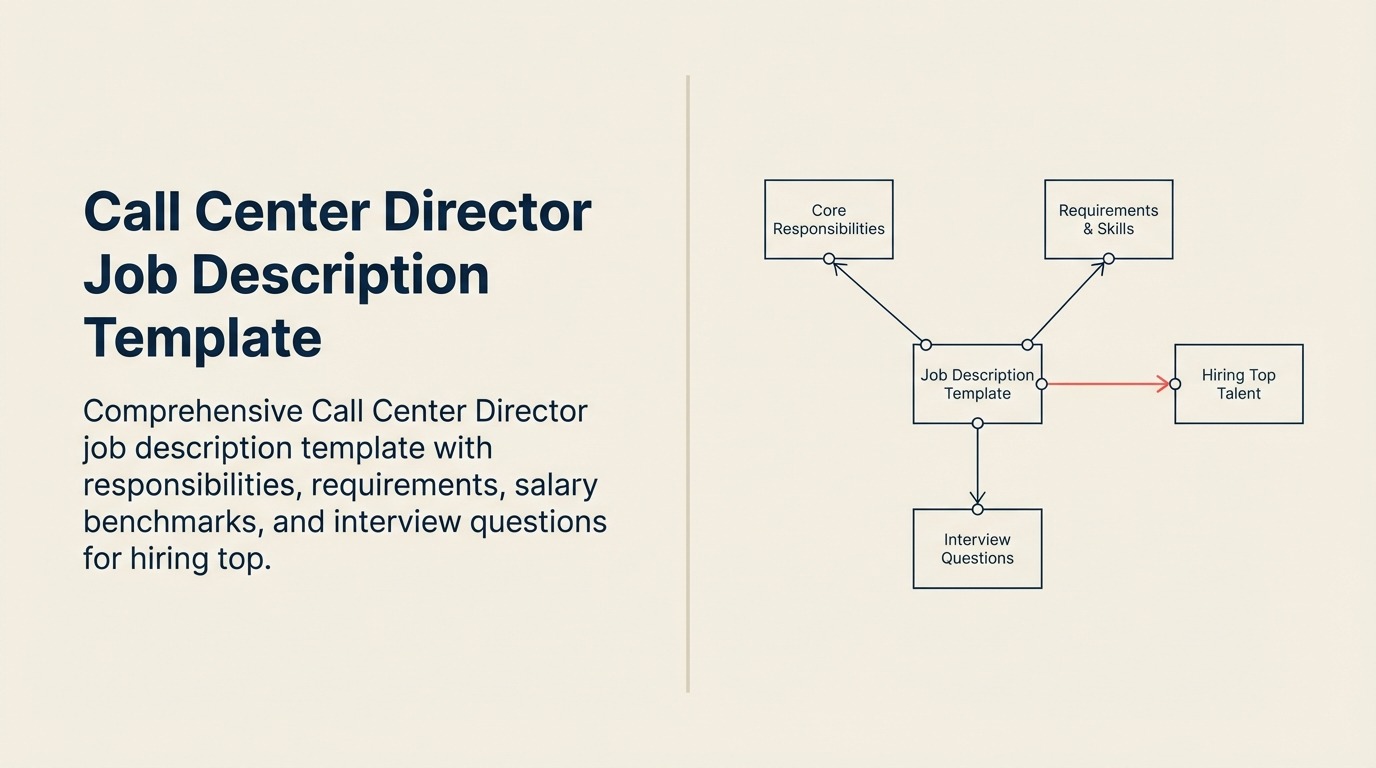
What You'll Get From This Guide
- Executive-level job description template for large-scale call center operations leadership
- Compensation guidance including AI-governance premiums and how to benchmark executive-level ranges by scale and industry
- Strategic interview questions covering P&L management, technology implementation, and team leadership
- Industry-specific considerations for financial services, healthcare, telecommunications, and BPO environments
- Executive competency framework for evaluating large-scale operations management capabilities
- Specialized sourcing strategies for finding experienced call center executives
Overview
The Call Center Director is a senior executive role responsible for overseeing large-scale call center operations, managing multi-site contact centers, and driving strategic initiatives to optimize customer interactions across all channels. This leadership position combines operational expertise with strategic vision to ensure call center operations deliver exceptional customer experiences while meeting efficiency and cost-effectiveness goals.
Key Highlights:
- Executive leadership of large-scale call center operations (typically 200+ agents)
- Responsible for multi-million dollar operational budgets and P&L accountability
- Manages complex workforce planning, scheduling, and performance optimization
- Oversees technology infrastructure including telephony, CRM, and workforce management systems
- Drives strategic initiatives for automation, AI integration, and digital transformation
- Ensures compliance with industry regulations and service level agreements
Why This Role Matters: The Call Center Director is critical to organizational success, directly impacting customer satisfaction, operational costs, and revenue generation. As AI tools take over routine customer interactions, handling FAQ resolution, simple transactions, and first-contact triage, the Director's role becomes more strategic, not less. The AI layer handles volume; the Director designs the system, sets the guardrails, and owns the outcomes.
What becomes more valuable when AI handles the routine: the Director's ability to define where AI should and should not be the first point of contact, to read quality-at-scale through AI scoring systems rather than individual call reviews, to manage a workforce that is now partly human and partly automated, and to make calls about edge cases and escalation policy that no AI can make. The center's performance ceiling is now set by how well the Director deploys AI, not just how efficiently they schedule agents.
This position directly shapes thousands of customer interactions daily and carries P&L responsibility for significant operational budgets. The decisions made here ripple through agent morale, customer retention, and the organization's cost structure.
AI Skills & Tools for Call Center Director in 2026
The Director's AI skill set is not about using tools personally, it is about knowing them well enough to deploy, evaluate, and govern them at scale across an operation of hundreds or thousands of agents. Demand for senior contact center leaders with proven AI implementation track records has increased significantly, and organizations increasingly treat AI fluency as a threshold requirement for this level.

- AI workforce management platforms: using predictive staffing tools (Verint, NICE Workforce Engagement, or similar) that apply machine learning to forecast call volume and optimize scheduling at a granularity traditional WFM cannot match
- Quality AI at scale: deploying automated QA tools that score 100% of calls against rubrics rather than sampling, and using those scores to identify coaching needs, script gaps, and emerging customer issues without manually reviewing recordings
- Conversational AI governance: defining where the IVR or chatbot ends and the human queue begins, including escalation rules, containment targets, and the criteria for adding or removing topics from the AI layer
- Predictive analytics for operations: using AI-generated forecasts for customer contact patterns, agent attrition risk, and FCR trends to get ahead of operational problems rather than reacting to them
- Agent assist oversight: evaluating the performance of AI copilot systems that support live agents, measuring whether AI suggestions improve or hurt handle time and satisfaction, and making adjustment decisions
- AI vendor evaluation: assessing contact center AI vendors on implementation track record, integration fit, and governance capabilities, not just demo performance
- Building reusable prompt libraries for operations analysis: structuring recurring analytical questions (scheduling scenarios, budget sensitivity, staffing mix models) as reusable AI prompts that the ops team runs without starting from scratch each time
Working Alongside AI Agents as a Call Center Director
At the Director level, the relationship with AI is about system design and governance, not day-to-day tool use. You are the architect of how AI integrates into the contact center, not just a user of it.

What AI agents handle at scale: first-contact resolution for a defined set of interaction types (account management, FAQs, status checks, basic troubleshooting); 100% call transcription and QA scoring; real-time agent coaching suggestions; scheduling optimization; customer sentiment trend analysis; and after-call summary generation.
What the Director owns: deciding which interaction types the AI layer should and should not handle, and reviewing that call regularly as the AI's capabilities improve; setting containment rate targets and owning the customer experience when the AI mishandles a call; interpreting quality-at-scale data and converting it into coaching strategy; managing the human workforce in an environment where some agents work alongside AI copilots and others are increasingly doing escalation-only work; and keeping the organization accountable for AI errors, not just AI successes.
The governance function: in 2026, the Call Center Director typically owns the contact center's AI operating policy, what data the AI can access, what it can do autonomously, when it must route to a human, how errors get logged and remediated, and how agent feedback on AI suggestions gets channeled back to improvement teams. This is a new function that did not exist in the role five years ago and is now a hiring priority for most large operations.
What this means for candidates: the bar is no longer "comfortable with AI implementation." Organizations want directors who have owned AI governance at scale, including the failure modes, not just the success metrics.
Primary Job Description Template
About the Role
You will lead our call center operations as Call Center Director, responsible for developing and executing comprehensive strategies that optimize large-scale customer contact operations while driving continuous improvement in service delivery, operational efficiency, and customer satisfaction. This executive position requires deep operational expertise combined with strategic leadership to manage complex contact center environments across multiple channels and locations.

In this role, you will oversee contact center operations serving thousands of customers daily, manage substantial operational budgets, and lead teams of managers and supervisors who coordinate hundreds of customer service representatives. You will be responsible for implementing advanced technologies, optimizing workforce management, and ensuring consistent service delivery that meets or exceeds established KPIs and SLAs.
The ideal candidate will have extensive experience scaling contact center operations, implementing process improvements and automation, and leading high-performing organizations in complex, high-volume environments.
Key Responsibilities
- Strategic Operations Leadership: Develop and execute comprehensive call center strategies that support business objectives while optimizing operational efficiency and customer experience
- Large-Scale Team Management: Lead and develop management teams overseeing 200+ customer service representatives across multiple shifts, sites, or channels
- Performance Optimization: Establish and monitor critical KPIs including service levels, average handle time, first call resolution, abandonment rates, and customer satisfaction scores
- Workforce Management: Oversee complex workforce planning, forecasting, scheduling, and real-time management to optimize staffing levels and service delivery
- Budget and P&L Management: Manage multi-million dollar operational budgets, forecast expenses, and optimize cost per contact while maintaining service quality standards
- Technology Leadership: Evaluate, implement, and manage contact center technologies including ACD systems, IVR, CRM integration, workforce management platforms, and emerging AI solutions
- Quality Assurance Programs: Establish comprehensive quality monitoring, coaching programs, and performance improvement initiatives across all customer touchpoints
- Compliance and Risk Management: Ensure adherence to industry regulations, data protection requirements, and corporate compliance standards
- Process Improvement: Lead continuous improvement initiatives, implement automation solutions, and optimize operational workflows to enhance efficiency
- Strategic Vendor Management: Manage relationships with technology vendors, outsourcing partners, and service providers to optimize costs and capabilities
Requirements
Must-Have Qualifications:
- Bachelor's degree in Business Administration, Operations Management, or related field
- 10+ years of call center or contact center leadership experience with P&L responsibility
- 7+ years managing large-scale operations with 200+ employees
- Proven experience with contact center technologies (ACD, IVR, CRM, WFM systems)
- Strong analytical skills with experience in workforce management and performance analytics
- Experience with budget management, cost optimization, and operational planning
- Knowledge of compliance requirements and quality assurance programs
- Excellent leadership and communication skills for executive-level interactions
- Demonstrated AI fluency appropriate to leadership scope (see progression below)
AI Fluency Expectations by Career Stage:
- Senior Manager level: has implemented or overseen an AI tool deployment (agent assist, automated QA, or AI-driven WFM); can evaluate AI vendor claims against operational reality
- Director level (this role): owns the AI operating policy for the contact center, containment targets, escalation rules, QA scoring governance, and error remediation; has managed a workforce transition where agent roles changed as AI took over a class of interactions; treats AI governance as a standing operational function, not a one-time project
- VP / executive level: sets enterprise-wide AI contact center strategy; defines the investment thesis for AI automation versus headcount, and owns the stakeholder narrative on AI's impact on the workforce
Nice-to-Have Qualifications:
- Master's degree in Business Administration (MBA) or Operations Management
- Proven track record with AI/automation implementation at scale in contact centers (not just evaluation or pilot experience)
- Six Sigma, Lean, or other process improvement certifications
- Experience in regulated industries (financial services, healthcare, telecommunications)
- Knowledge of omnichannel customer experience strategies
- Experience with outsourcing and vendor management
What We Offer
- Executive Compensation: Competitive base salary commensurate with operational scale, AI governance experience, and industry; benchmark via Radford or LinkedIn Salary
- Performance Incentives: Annual bonus potential of 20-30% based on operational KPIs and business results
- Comprehensive Benefits: Premium health, dental, and vision insurance with executive-level coverage
- Leadership Development: Executive coaching, industry conference attendance, and advanced leadership programs
- Equity Participation: Stock options or equity grants aligned with company performance
- Flexible Executive Schedule: Hybrid work options with modern facilities and executive workspace
Context Variations
Corporate Environment
In large corporate settings, the Call Center Director typically manages multiple contact centers across different regions or business units. The role involves complex stakeholder management, enterprise system integration, and alignment with corporate governance structures. Emphasis on standardization, compliance, and integration with global operations strategies.
Technology/SaaS Environment
In technology companies, this role requires deeper technical knowledge and integration with product development teams. Directors must understand complex technical products, manage technical support escalations, and implement advanced analytics and AI solutions. Focus on product feedback loops and customer success integration.
Outsourcing/BPO Environment
For business process outsourcing companies, the role emphasizes client relationship management, SLA compliance, and multi-client operations management. Strong focus on cost optimization, scalability, and maintaining service delivery across diverse client requirements and industry verticals.
Industry Considerations
| Industry | Key Requirements | Unique Considerations |
|---|---|---|
| Financial Services | Regulatory compliance expertise, fraud prevention protocols | PCI DSS compliance, regulatory reporting, security protocols |
| Healthcare | HIPAA compliance, medical terminology knowledge | Patient privacy protection, clinical escalation processes |
| Telecommunications | Technical troubleshooting capabilities, outage management | 24/7 operations, network knowledge, field service coordination |
| Insurance | Claims processing knowledge, regulatory compliance | Complex product knowledge, regulatory oversight, fraud detection |
| E-commerce/Retail | High-volume transaction support, seasonal planning | Order management, returns processing, peak season scaling |
| Utilities | Emergency response protocols, regulatory compliance | Critical infrastructure support, outage management, safety protocols |
Compensation Guide
Salary Information
Call Center Director compensation is executive-level and reflects the scale, industry, and complexity of the operation. Directors managing 500+ agents in regulated industries (financial services, healthcare) earn well above those running smaller operations in general services sectors. Total compensation packages typically include base salary, performance bonus tied to operational KPIs, and in many cases equity or long-term incentive plans.
The most significant premium emerging in hiring data is for directors with a track record of AI implementation and governance, designing and running AI-augmented contact centers at scale is now a distinct credential that the market is pricing above general operational leadership.
What affects compensation most:
- Scale of operations managed (agent count, budget size, number of sites)
- Industry and regulatory complexity (financial services and healthcare carry meaningful premiums)
- AI implementation track record and governance experience
- P&L scope and cost-per-contact improvement results
- Geographic location (high-cost metros carry higher base ranges; remote executive roles vary widely)
For current figures, use Radford / Aon executive compensation surveys, LinkedIn Salary (for title + metro), and direct recruiter benchmarks for the most accurate read. The metro-by-metro table approach ages quickly at this salary level, where individual negotiation factors matter as much as geography.
Interview Questions
Executive interviews should test operating scale, workforce decisions, customer outcomes, crisis leadership, and AI governance judgment.

Technical/Functional Questions
Describe your approach to workforce management in a 24/7 contact center environment. How do you optimize staffing while controlling costs? Evaluate: Workforce management expertise, cost optimization skills, operational planning capabilities
Walk me through how you would handle a situation where service levels are consistently missing targets during peak periods. Evaluate: Problem-solving skills, analytical thinking, real-time management capabilities
How would you evaluate and implement AI or automation technologies in a large contact center operation? Evaluate: Technology leadership, change management skills, innovation mindset
Describe your process for managing a multi-million dollar contact center budget while maintaining service quality. Evaluate: Financial acumen, cost management skills, operational efficiency focus
How do you ensure compliance and quality consistency across multiple contact center locations? Evaluate: Quality management experience, standardization capabilities, compliance knowledge
What metrics do you consider most critical for contact center performance, and how do you use them to drive improvements? Evaluate: Analytics expertise, performance management skills, continuous improvement mindset
Describe your experience with contact center technology implementations. How do you manage large-scale system changes? Evaluate: Technology implementation experience, project management skills, change leadership
How would you approach building a disaster recovery plan for critical contact center operations? Evaluate: Risk management thinking, business continuity planning, crisis management capabilities
Behavioral Questions
Tell me about a time when you had to significantly reduce contact center costs while maintaining service levels. Evaluate: Cost optimization skills, creative problem-solving, operational efficiency mindset
Describe a situation where you implemented a major operational change that initially faced resistance from your team. Evaluate: Change leadership skills, communication abilities, perseverance in driving transformation
Give me an example of how you've used data analytics to solve a complex operational problem. Evaluate: Analytical thinking, data-driven decision making, problem-solving approach
Tell me about a crisis situation you managed in a contact center environment. Evaluate: Crisis management skills, leadership under pressure, stakeholder communication
Describe how you've developed and mentored contact center managers to advance their careers. Evaluate: Leadership development skills, talent management focus, coaching abilities
How have you handled a situation where you disagreed with senior leadership about operational priorities? Evaluate: Professional courage, influence skills, strategic thinking abilities
Culture Fit Questions
How do you maintain team morale and engagement in a high-pressure, metrics-driven environment? Evaluate: Leadership style, employee engagement strategies, emotional intelligence
What role does technology play in your vision for the future of contact centers? Evaluate: Innovation mindset, strategic thinking, technology adoption philosophy
How do you balance efficiency goals with providing excellent customer experiences? Evaluate: Customer-centric thinking, operational balance, service philosophy
Describe your approach to building relationships with other department heads and senior leadership. Evaluate: Collaboration skills, stakeholder management, executive presence
Hiring Tips
Quick Sourcing Guide
- Executive Search Firms: Specialized operations and customer experience recruiting firms
- LinkedIn Recruiter: Target call center directors at companies with similar scale and complexity
- Industry Associations: Call Center Industry Advisory Council (CCIAC), Customer Contact Weeks
- Professional Networks: Contact center leadership groups and operations management communities
Posting Optimization Tips
- Emphasize scale and complexity of operations to attract experienced leaders
- Highlight technology innovation opportunities and transformation initiatives
- Include specific operational metrics and performance expectations
- Mention career advancement opportunities and executive development programs
Red Flags to Avoid
- Limited scale experience: Candidates who haven't managed operations with 200+ employees or complex multi-site environments
- Poor technology adoption: Resistance to implementing new technologies or automation solutions
- Weak analytical skills: Inability to demonstrate data-driven decision making or performance optimization experience
- Limited crisis management experience: Lack of examples handling operational emergencies or service disruptions
- Over-focus on cost reduction: Excessive emphasis on cutting costs without consideration for service quality impact
- Weak leadership development: Limited experience developing and retaining management talent in high-turnover environments
Common Questions for Employers
What's the difference between a Call Center Director and a VP of Customer Experience?
Call Center Directors focus specifically on contact center operations, workforce management, and operational efficiency. VPs of Customer Experience have broader responsibility for the entire customer journey across multiple touchpoints and departments.
How important is industry-specific experience for this role?
While industry knowledge is valuable, especially in regulated sectors, strong operational leadership and contact center expertise are typically more critical. Look for transferable skills in managing large-scale operations and complex technology environments.
Should this role have P&L responsibility?
Yes, most Call Center Director roles include budget responsibility and cost center P&L accountability. This ensures alignment between operational decisions and business outcomes.
What size team typically reports to a Call Center Director?
This varies significantly but typically ranges from 200-1000+ employees, often managed through multiple layers including operations managers, team leads, and supervisors.
How do you evaluate candidates' technology expertise?
Ask specific questions about contact center technology implementations, workforce management systems, and their experience with emerging technologies like AI and automation. Look for hands-on experience rather than just theoretical knowledge.
Common Questions for Job Seekers
What career path typically leads to a Call Center Director role?
Common paths include progression from Contact Center Manager to Senior Manager to Director, or lateral moves from Operations Management, Workforce Management, or Customer Experience leadership roles with relevant scale and complexity.
How much travel is typically required in this position?
Travel requirements vary but often include 15-30% travel for multi-site management, vendor meetings, industry conferences, and executive meetings, especially if managing distributed operations.
What's the work-life balance like for this role?
This role often requires availability during extended business hours and occasional emergency response for operational issues. Many companies offer flexible scheduling and remote work options, though some on-site presence is typically required.
How do I demonstrate operational impact in interviews?
Prepare specific examples of cost savings, efficiency improvements, service level achievements, and technology implementations you've led. Quantify impact with metrics like cost per contact, service level improvements, and employee retention rates.
What skills should I develop to advance to this level?
Focus on developing strategic thinking, advanced analytics, technology implementation experience, and executive leadership skills. Consider pursuing certifications in operations management, workforce management, or customer experience.
How do I prepare for technical questions about contact center operations?
Review current industry trends, technology solutions, and best practices. Be prepared to discuss specific workforce management challenges, technology implementations, and performance optimization strategies you've experienced.

On this page
- Overview
- AI Skills & Tools for Call Center Director in 2026
- Working Alongside AI Agents as a Call Center Director
- Primary Job Description Template
- About the Role
- Key Responsibilities
- Requirements
- What We Offer
- Context Variations
- Corporate Environment
- Technology/SaaS Environment
- Outsourcing/BPO Environment
- Industry Considerations
- Compensation Guide
- Salary Information
- Interview Questions
- Technical/Functional Questions
- Behavioral Questions
- Culture Fit Questions
- Hiring Tips
- Quick Sourcing Guide
- Posting Optimization Tips
- Red Flags to Avoid