Sales Methodologies Compared: BANT, MEDDIC, SPIN, and More
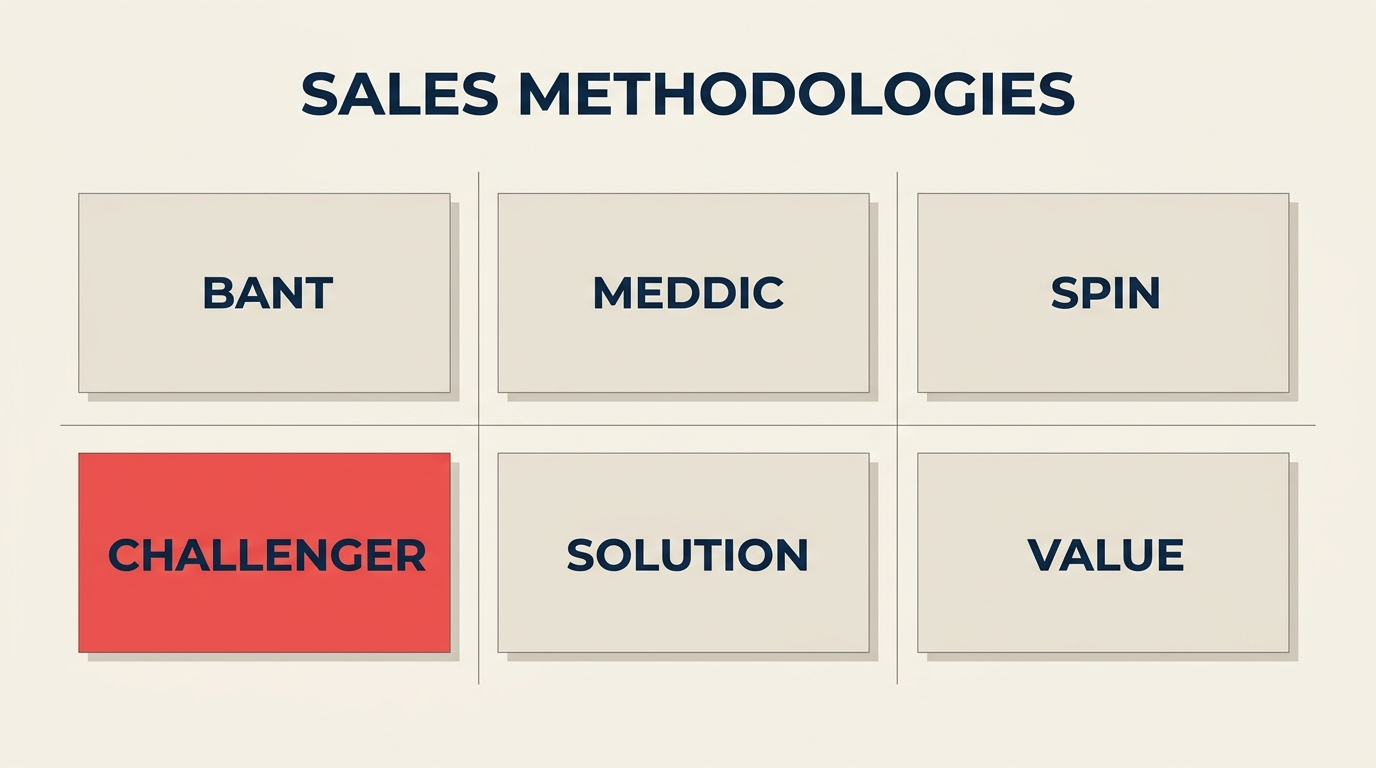
Choosing between sales methodologies is one of the decisions that shapes how your entire revenue team sells -- and most teams never make it deliberately. They inherit a framework from a VP who learned it a decade ago, or they piece together vocabulary from three different training programs and call it a process.
This guide puts the eight most common sales methodologies side by side so you can pick the right one for your deal type, buyer, and team maturity.
What is a sales methodology?
A sales methodology is the approach, philosophy, or set of principles that guides how your reps sell. It defines the behaviors, questions, and mental models they bring to every call and every deal. Think of it as the playbook for how selling actually happens.
It's different from a sales process, which defines the stages a deal moves through (Discovery, Demo, Proposal, Close). The process tells you where you are; the methodology tells you how to behave at each stop.
Most B2B organizations need both. A well-designed pipeline with no underlying methodology produces reps who advance deals by pushing rather than progressing, who use stage movement as a filing system rather than a diagnostic tool.
Key Facts
- Korn Ferry research (2022) found that companies with a consistently applied sales methodology outperformed their peers on quota attainment by roughly 14 to 18 percentage points compared to teams with no formal approach.
- Gartner B2B buying research shows the typical enterprise buying group now involves 6 to 10 stakeholders -- a reality that MEDDIC (Metrics, Economic Buyer, Decision Criteria, Decision Process, Identify Pain, Champion) frameworks were built to navigate, but that simpler qualification models like BANT (Budget, Authority, Need, Timing) were not.
- Forrester's State of Sales research consistently shows that less than a third of B2B reps are rated as "effective at communicating value" by their buyers -- an insight that both Challenger Sale and Value Selling directly address.
"A sales methodology without a process is a philosophy. A process without a methodology is a checklist. You need both, deployed together." -- a framing widely used in enterprise sales enablement.
Sales methodology vs sales process
People use these terms interchangeably, but mixing them up creates real problems when you're designing enablement or diagnosing pipeline issues.
| Concept | What it defines | Example |
|---|---|---|
| Sales methodology | How to think and behave during selling | SPIN Selling: lead with situation and problem questions before proposing |
| Sales process | The stages a deal moves through | Discovery > Demo > Technical Review > Commercial Proposal > Close |
A methodology is portable across many different processes. A team running MEDDIC-style qualification can apply it inside a four-stage or eight-stage process equally well. And a team can adopt Challenger Sale behaviors inside whatever CRM stages they already have.
The main sales methodologies at a glance
| Methodology | What it is | Best for | Where it fits the funnel |
|---|---|---|---|
| BANT | Budget, Authority, Need, Timing -- four qualification criteria to assess whether a prospect is worth pursuing | Transactional sales, SDR-led outbound, simple deals with short cycles | Top of funnel / early qualification |
| MEDDIC | Metrics, Economic Buyer, Decision Criteria, Decision Process, Identify Pain, Champion -- six criteria for qualifying and navigating complex enterprise deals | Enterprise B2B with long cycles, multi-stakeholder buying groups | Mid-to-late funnel; opportunity qualification and progression |
| SPIN Selling | Situation, Problem, Implication, Need-Payoff -- a question-sequencing model for discovery conversations | Complex B2B deals where reps need to build buyer awareness of problems | Discovery and needs analysis |
| Challenger Sale | Teach-Tailor-Take Control -- reps challenge the buyer's assumptions and bring commercial insight rather than just responding to stated needs | Mid-market to enterprise; mature reps selling differentiated solutions | Discovery through proposal |
| Solution Selling | Build understanding of the buyer's specific problem before positioning any product; sell outcomes not features | SMB and mid-market; reps who were trained on product-led pitches | Discovery and value positioning |
| Consultative Selling | Act as a trusted advisor; prioritize the buyer's success over short-term close velocity | Long relationship cycles; professional services, account management | Full cycle, especially later stages and expansion |
| Value Selling | Quantify and communicate business value explicitly; tie every conversation to measurable buyer outcomes | CFO-led buying, ROI-sensitive deals, competitive situations | Mid-to-late funnel; proposal and negotiation |
| Gap Selling | Identify the gap between the buyer's current state and their desired future state; tie that gap to your solution | SaaS, technology, and any deal where the buyer hasn't fully defined their own problem | Discovery through close |
Qualification frameworks: BANT vs MEDDIC vs CHAMP
Qualification frameworks answer a specific question: is this deal worth pursuing? They don't prescribe how to run the full sales conversation -- they screen for fit and readiness.
BANT (Budget, Authority, Need, Timing) is the oldest and most widely recognized. IBM used it internally, then it spread everywhere. Its simplicity is both a strength and a weakness. In complex B2B deals, budget is rarely known early, the "authority" is almost never a single person, and timing shifts constantly. BANT works well for transactional or inbound-heavy motions where the buyer has already diagnosed their own problem.
MEDDIC (Metrics, Economic Buyer, Decision Criteria, Decision Process, Identify Pain, Champion) was developed at PTC in the 1990s and became the standard for enterprise sales. It's not a sequence of questions -- it's a map of what you need to know to move a deal forward. MEDDIC asks you to find and develop a Champion inside the buying organization, understand the formal decision process, and quantify impact in metrics the Economic Buyer cares about. Teams who apply it consistently report fewer forecast surprises because blind spots get surfaced early.
CHAMP (Challenges, Authority, Money, Prioritization) reorders BANT to lead with the buyer's challenges rather than budget. The argument is that starting with "what's your budget?" before you've established value makes reps sound transactional and puts them in a weaker negotiating position. CHAMP is a useful upgrade for teams who rely on BANT but find it feels adversarial in early conversations.
The three frameworks aren't mutually exclusive. Many enterprise teams use MEDDIC for qualification and BANT or CHAMP as a quick screen at the SDR-to-AE handoff. The goal is always the same: get to the right information without wasting your team's time or the buyer's.
Relationship and discovery methodologies: SPIN, Consultative, Solution, Value, Gap, Challenger
Where qualification frameworks tell you whether to pursue a deal, this group of methodologies tells you how to advance it. They shape the conversations, not just the scorecards.
SPIN Selling, developed by Neil Rackham from studying 35,000 sales calls, argues that the sequence of questions matters enormously. Situation questions build context. Problem questions surface dissatisfaction. Implication questions make that dissatisfaction feel urgent. Need-Payoff questions invite the buyer to articulate what a solution would be worth. Reps who ask implication questions consistently close larger deals because they're helping buyers connect problems to business impact rather than just logging issues.
Consultative Selling predates SPIN but overlaps with it. The core idea: your rep is an expert who helps buyers solve problems, not a vendor trying to hit quota. In practice, consultative selling shows up in behaviors like investing more time in diagnosis than in pitching, being willing to tell a buyer they don't need your product if that's true, and bringing relevant external knowledge to every meeting. It's the methodology of choice for professional services, account management, and any sale where trust is a hard requirement.
Solution Selling, created by Michael Bosworth in the 1980s, asks reps to map their offering to a specific, diagnosed customer problem rather than leading with product features. It introduced the idea of pain chains -- the chain of consequences that flows from an unresolved problem -- and pushed salespeople to speak in outcomes. It was revolutionary in the 1980s and remains the structural foundation that Challenger and other modern methodologies build on.
Value Selling takes solution selling further by insisting that every conversation include quantified business value. Where solution selling might say "this solves your reporting problem," value selling says "this saves your ops team 12 hours a week, worth $78,000 annually at your loaded labor cost." Value selling is particularly relevant when finance or procurement is involved in the buying decision, and when competitors are competing on price.
Gap Selling, developed by Keenan, starts not with your product but with the buyer's current state. What's the situation today? What's creating friction? What does a better state look like? The gap between current and desired state is where value lives. Gap Selling is closely related to both SPIN and solution selling, but it's more explicit about making the buyer feel the cost of staying where they are.
Challenger Sale, from the 2011 research by Brent Adamson and Matthew Dixon, found that the most effective reps weren't the relationship-builders -- they were the "challengers" who brought commercial insight, challenged buyer assumptions, and taught buyers something about their own business. The Teach-Tailor-Take Control model works particularly well in markets where buyers have done their research and think they understand their problem, but their diagnosis is incomplete or their criteria favor the status quo.
How to choose a sales methodology (step by step)
Step 1: Map your deal complexity
Simple, transactional deals with one or two decision-makers and short cycles don't need MEDDIC. BANT or CHAMP as a qualification layer plus consultative behaviors in the conversation is often enough. Complex enterprise deals with multi-year contracts and 8-person buying committees need MEDDIC-level rigor.
Step 2: Understand your sales motion
Are you doing product-led growth, outbound prospecting, inbound response, or land-and-expand account management? Each motion has different information requirements. Outbound SDRs need a fast qualification framework. AEs closing large deals need discovery methodology. CSMs expanding accounts need consultative and value-selling behaviors.
Step 3: Profile your buyer
Who's in the room? If it's primarily technical buyers, SPIN's implication questions land well. If it's finance or C-level, value selling's ROI framing is essential. If buyers think they already know what they need (common in software RFPs), Challenger's commercial insight framing can reopen the conversation.
Step 4: Assess your team's maturity
Challenger Sale is a demanding methodology. It requires reps to be credible enough to push back on buyers. Deploying it with a team of new reps who haven't built product and market depth usually backfires. Start with SPIN or Solution Selling for teams in their first 12 to 18 months. Layer Challenger behaviors in once reps can hold an informed opinion.
Step 5: Match to your CRM and process
The best methodology is the one your team will actually use. If your CRM has MEDDIC fields built in, MEDDIC wins by default because the system reinforces it. If you're building from scratch, pick one methodology, define what "good" looks like at each stage, and build your inspection criteria around it. See opportunity qualification for how to wire qualification criteria into stage gates.
Can you combine sales methodologies?
Yes, and most high-performing teams do. The key is to be intentional about which methodology handles which job.
A common combination in enterprise B2B:
- MEDDIC as the qualification and deal inspection framework (what you need to know to forecast the deal)
- SPIN or Challenger as the conversation methodology (how reps behave in discovery and proposal meetings)
- Value Selling as the commercial framing in late-stage negotiations
This works because the three layers don't conflict. MEDDIC is a checklist of knowledge. SPIN is a sequencing of questions. Value Selling is a framing for how you present the business case. They operate at different levels of the sales conversation.
What doesn't work is asking reps to toggle between two full methodologies that make conflicting demands. Telling a rep to "be consultative and build trust, but also challenge the buyer's assumptions" sounds reasonable in a training room and creates confusion on actual calls. Pick one primary mode of engagement, and treat the others as tools for specific situations.
Frequently asked questions
What is the difference between a sales methodology and a sales process?
A sales process is the sequence of stages a deal moves through -- from prospecting to close. A sales methodology is the philosophy and behaviors that guide how reps act at each stage. You need both: the process gives deals structure; the methodology gives reps direction.
Which sales methodology is best for B2B?
It depends on deal complexity and team maturity. MEDDIC is the most widely adopted for complex enterprise B2B. SPIN Selling works well for teams building their discovery skills. Challenger Sale is effective for mature reps selling differentiated solutions. For early-stage teams or simpler deals, BANT or CHAMP qualification plus consultative behaviors covers most situations.
Can you use more than one sales methodology at the same time?
Yes. Many enterprise teams combine MEDDIC for qualification with SPIN or Challenger for discovery conversations and Value Selling for late-stage commercial discussions. The layers handle different jobs and don't conflict. What you want to avoid is deploying two full methodologies that make contradictory demands on rep behavior in the same conversation.
Is BANT still relevant?
BANT (Budget, Authority, Need, Timing) remains useful as a fast qualification screen, especially for inbound leads or transactional deals. Its weakness in enterprise selling is that budget is rarely confirmed early, and "authority" is rarely a single person. Many teams use BANT for SDR qualification and upgrade to MEDDIC or CHAMP once deals enter the pipeline.
How long does it take to implement a new sales methodology?
Most sales enablement research suggests that consistent adoption of a new methodology takes 6 to 12 months of reinforcement. Reps learn the vocabulary quickly; changing actual call behavior takes repetition, coaching, and CRM enforcement. Methodology changes that aren't wired into inspection, forecasting, and manager coaching rarely stick past the initial training.
Related reading
- BANT Framework
- MEDDIC Framework
- CHAMP Framework
- SPIN Selling
- Challenger Sale
- Solution Selling
- Consultative Selling
- Opportunity Qualification
Picking the right sales methodology won't automatically fix win rates. But it gives your team a shared language, a consistent approach to discovery, and criteria that actually predict whether a deal will close. That's the foundation every pipeline review, forecast call, and rep coaching conversation builds on.

Senior Operations & Growth Strategist
On this page
- What is a sales methodology?
- Key Facts
- Sales methodology vs sales process
- The main sales methodologies at a glance
- Qualification frameworks: BANT vs MEDDIC vs CHAMP
- Relationship and discovery methodologies: SPIN, Consultative, Solution, Value, Gap, Challenger
- How to choose a sales methodology (step by step)
- Step 1: Map your deal complexity
- Step 2: Understand your sales motion
- Step 3: Profile your buyer
- Step 4: Assess your team's maturity
- Step 5: Match to your CRM and process
- Can you combine sales methodologies?
- Frequently asked questions
- Related reading