LTV:CAC Ratio: What It Is and the Ideal Benchmark
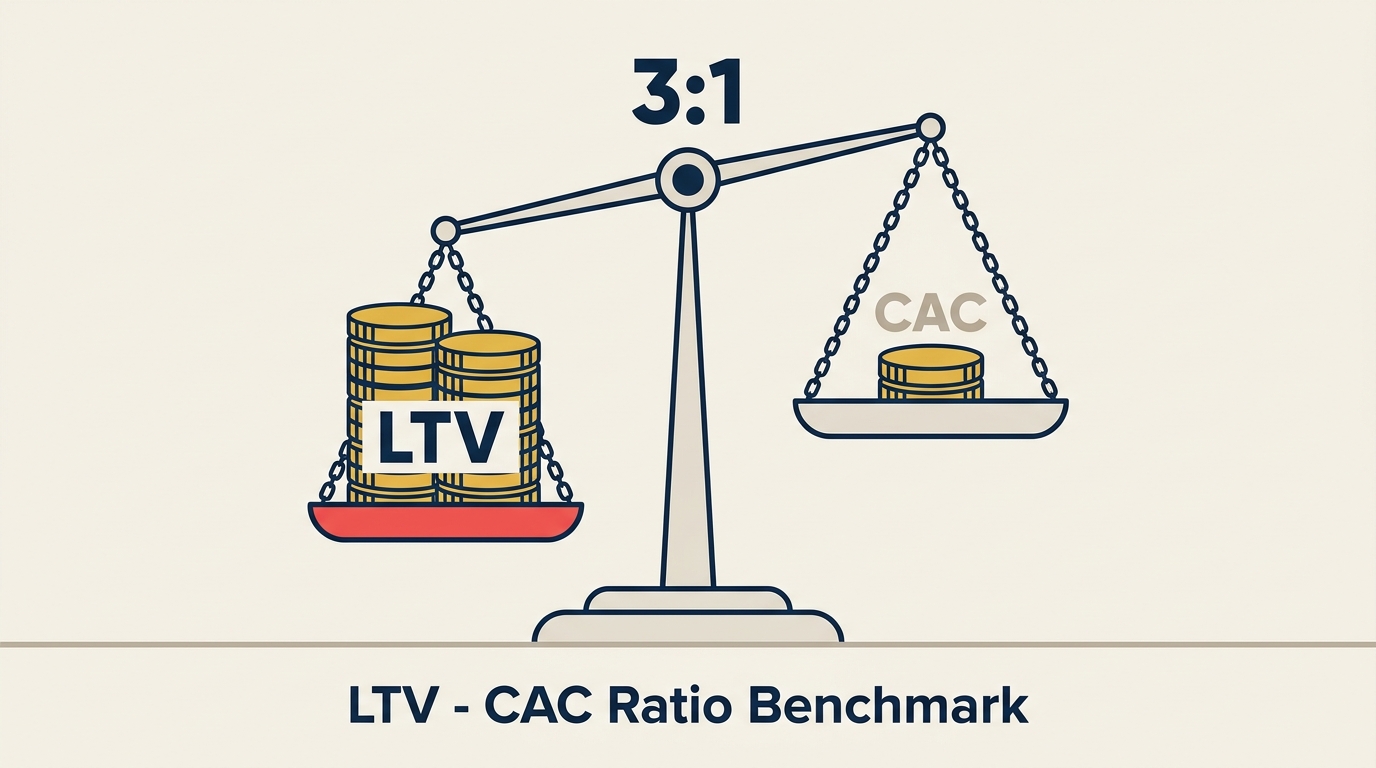
The LTV:CAC ratio is one of the clearest windows into whether a SaaS business is growing sustainably or just burning cash for growth. It puts customer lifetime value (LTV) - the total revenue a customer generates over their time with you - against customer acquisition cost (CAC) - everything you spend to win that customer in the first place.
What is the LTV:CAC ratio?
The LTV:CAC ratio compares customer lifetime value to customer acquisition cost. It answers one direct question: for every dollar you spend acquiring a customer, how many dollars of lifetime value do you get back?
A ratio of 3:1 means each customer generates three dollars in lifetime value for every one dollar spent to acquire them. Below 1:1, you're losing money on every new customer before you even think about overhead.
Key facts: LTV:CAC ratio
- David Skok of Matrix Partners popularized the 3:1 benchmark in his SaaS Metrics 2.0 framework, derived from analysis of mature public SaaS companies (For Entrepreneurs, 2012)
- The median CAC payback period across SaaS companies was 18 months in 2024, up from 14 months the prior year (Benchmarkit 2025 SaaS Performance Metrics Report, 2025)
- Best-in-class SaaS companies achieve a CAC payback period of 5-7 months, while the general target for startups is 12 months or less (Optifai SaaS Benchmarks, 2024)
How to calculate LTV and CAC
You need both components before you can compute the ratio.
LTV formula:
LTV = Average Revenue Per Account (ARPA) x Gross Margin / Monthly Churn Rate
In words: take the monthly revenue per customer, multiply by your gross margin percentage (to strip out cost of goods sold), then divide by the fraction of customers who leave each month. Higher margin or lower churn both push LTV up.
CAC formula:
CAC = Total Sales and Marketing Spend / Number of New Customers Acquired
This covers salaries, tools, ads, events, and any other cost tied to winning new customers in a given period.
The ratio:
LTV:CAC = LTV / CAC
Worked example:
Suppose a SaaS company has:
- ARPA: $400 per month
- Gross margin: 75%
- Monthly churn rate: 2% (0.02)
- Sales and marketing spend last quarter: $120,000
- New customers won last quarter: 80
Step 1 - LTV: $400 x 0.75 / 0.02 = $15,000
Step 2 - CAC: $120,000 / 80 = $1,500
Step 3 - Ratio: $15,000 / $1,500 = 10:1
That 10:1 looks impressive, but it may actually signal that this company is underinvesting in growth (more on that below).
LTV:CAC benchmarks
| Ratio | What it signals | Recommended action |
|---|---|---|
| Below 1:1 | Losing money on every customer | Stop or fundamentally rethink acquisition spend |
| 1:1 to 2:1 | Barely breaking even; no margin for error | Raise prices, cut CAC, or improve retention urgently |
| 3:1 | Healthy unit economics; room to grow | Maintain and optimize; standard SaaS target |
| 4:1 to 5:1 | Strong - likely a pricing or retention edge | Consider reinvesting to accelerate growth |
| Above 5:1 | Possibly underinvesting in acquisition | Model whether more spend could drive compounding returns |
The 3:1 benchmark isn't arbitrary. At that level you cover acquisition cost, fund ongoing operations, and retain enough margin to reinvest. Going much above 5:1 consistently suggests you're leaving growth on the table rather than pushing into addressable markets.
CAC payback period (complementary metric)
LTV:CAC tells you the magnitude of returns. CAC payback period tells you how quickly you recover your acquisition investment. They work together.
CAC payback period formula:
Payback Period (months) = CAC / (ARPA x Gross Margin)
Using the example above: $1,500 / ($400 x 0.75) = 5 months.
Benchmarks by segment (Benchmarkit, 2025):
- SMB-focused companies: 8-12 months is considered good
- Mid-market companies: 14-18 months
- Enterprise companies: 18-24 months is typical due to longer sales cycles
A long payback period hurts cash flow even when your LTV:CAC ratio looks healthy. If your payback is 30 months on a 3-year average contract, you're financing customers for over two years before breaking even, which strains working capital.
Why the LTV:CAC ratio matters
Unit economics clarity. Every growth decision eventually comes down to unit economics. The LTV:CAC ratio reduces a messy mix of churn, pricing, margin, and acquisition efficiency into a single number you can track over time and compare across channels.
Fundraising and valuation. Investors use LTV:CAC as a filter. A ratio below 3:1 raises questions about the sustainability of the business model. A ratio consistently above 3:1 with a short payback period signals a capital-efficient growth machine, which commands higher multiples.
Channel and cohort comparison. Different acquisition channels rarely have the same economics. Paid search might generate customers with a 2:1 ratio while inbound content brings in customers at 5:1. Without segmenting by channel, you optimize the average and miss the insight.
Early warning system. LTV:CAC deteriorating quarter-over-quarter is one of the earliest signs that something structural is changing, whether that's rising ad costs, declining retention, or pricing pressure. Catching it early gives you time to respond before it shows up in revenue.
How to improve your LTV:CAC ratio
Step 1: Reduce churn first
Churn is the most powerful lever because it sits in the denominator of the LTV formula. Cutting monthly churn from 3% to 2% on a $400 ARPA, 75% margin business raises LTV from $10,000 to $15,000 - a 50% improvement without touching acquisition at all. Start with exit interviews, onboarding gaps, and product engagement data to find where customers drop off.
Step 2: Increase ARPA through expansion revenue
Upsells, cross-sells, and seat expansions all increase the revenue you earn per customer without adding acquisition cost. If your net revenue retention is above 100%, expansion revenue compounds LTV further, because the average customer becomes more valuable over time, not less. See deal size optimization for tactics on building expansion into your pipeline.
Step 3: Improve gross margin
LTV:CAC calculations that use revenue instead of gross margin overstate the ratio. If your gross margin is 60% but a competitor operates at 80%, their LTV is 33% higher on the same ARPA. Audit your cost of goods sold: hosting infrastructure, customer success headcount, and implementation costs all affect margin. Reducing these by investing in automation or self-serve onboarding directly improves LTV.
Step 4: Lower CAC by improving conversion rates
CAC drops when more prospects convert without increasing spend. This is where win rate improvement and sales forecasting methods pay off - better qualification means you spend sales capacity on deals that are more likely to close. Review your sales funnel stage by stage to find the biggest drop-off point, then test interventions there.
Step 5: Segment your LTV:CAC by cohort and channel
Aggregate LTV:CAC hides variation. A 3:1 average might be masking a 1.5:1 on paid social and a 6:1 on referrals. Build cohort tables by acquisition channel, contract size, and industry vertical. Shift budget toward high-ratio segments and either fix or cut low-ratio segments. This is core to pipeline metrics overview discipline.
LTV:CAC examples
Example A: Early-stage startup with high churn
| Metric | Value |
|---|---|
| ARPA | $200/month |
| Gross margin | 65% |
| Monthly churn | 5% |
| LTV | $200 x 0.65 / 0.05 = $2,600 |
| CAC | $3,000 |
| LTV:CAC | 0.87:1 |
This company is losing money on every customer. The fastest fix is churn reduction; at 3% churn, LTV jumps to $4,333 and the ratio moves to 1.4:1. Still below target, but no longer cash-destructive.
Example B: Mature SMB SaaS
| Metric | Value |
|---|---|
| ARPA | $600/month |
| Gross margin | 78% |
| Monthly churn | 1.5% |
| LTV | $600 x 0.78 / 0.015 = $31,200 |
| CAC | $9,000 |
| LTV:CAC | 3.47:1 |
Solid. Payback period: $9,000 / ($600 x 0.78) = 19.2 months, which is within range for a mid-market motion. This company can justify continued acquisition investment.
Example C: Enterprise with long contracts
| Metric | Value |
|---|---|
| ARPA | $8,000/month |
| Gross margin | 72% |
| Monthly churn | 0.6% |
| LTV | $8,000 x 0.72 / 0.006 = $960,000 |
| CAC | $180,000 |
| LTV:CAC | 5.33:1 |
The ratio is strong, but payback is $180,000 / ($8,000 x 0.72) = 31.25 months, meaning nearly three years to recover acquisition cost. Cash management matters here. Read revenue predictability and annual recurring revenue for how enterprise teams smooth these cash flow dynamics.
Common mistakes
Using revenue instead of margin. The single most common error. If you calculate LTV on revenue alone, you're treating a 60% margin business the same as an 80% margin one. Always use gross margin-adjusted revenue. See customer acquisition cost for the same principle applied on the cost side.
Ignoring customer success costs in CAC. Many teams count only sales and marketing spend, leaving out onboarding, professional services, and the first 90 days of customer success. That understates CAC and inflates the ratio. If your CS team spends significant time converting free trials or onboarding paid customers, those costs belong in CAC.
Treating churn as fixed. Churn isn't a constant. It varies by cohort, price tier, product tier, and how customers were acquired. Using a blended churn rate hides the signal. Segment churn by acquisition channel and contract type to find where the real problems are.
Comparing LTV:CAC ratios across different business models. A 3:1 ratio in a high-margin SaaS business is very different from a 3:1 ratio in a services business with 40% margins. Context matters. And comparing your ratio to public company benchmarks can mislead if their customer mix, pricing, and go-to-market model differ significantly from yours.
Optimizing the ratio in isolation. A company that cuts acquisition spend to zero will have an extraordinary LTV:CAC ratio and no growth. The ratio is a health indicator, not an optimization target. Pair it with growth rate, pipeline metrics overview, and absolute ARR growth to get a complete picture.
Frequently asked questions
What is a good LTV:CAC ratio? The standard benchmark is 3:1. At this level, you generate three dollars in lifetime value for every dollar spent acquiring a customer. Ratios below 1:1 mean you're losing money on acquisition. Ratios above 5:1 often indicate you could invest more aggressively in growth without hurting unit economics.
What does LTV:CAC stand for? LTV stands for customer lifetime value, sometimes written as CLV or CLTV. CAC stands for customer acquisition cost. The ratio compares these two figures to assess the return on your acquisition investment.
How often should I calculate LTV:CAC? Most SaaS teams track it quarterly. Monthly tracking is possible but can be noisy because CAC in particular fluctuates with hiring cycles and campaign timing. Year-over-year trends are often more useful than month-over-month changes.
Can my LTV:CAC ratio be too high? Yes. A ratio consistently above 5:1 or 6:1 often means you're underinvesting in acquisition relative to the available opportunity. The question is whether additional acquisition spend would grow the denominator (more customers) faster than it grows the acquisition cost. For high-growth companies with strong unit economics, the answer is usually yes.
How does LTV:CAC relate to CAC payback period? They measure different things. LTV:CAC is a ratio of total returns to total cost. CAC payback period tells you how many months until you break even on a single customer. A company can have a great LTV:CAC ratio but a long payback period, which creates cash flow pressure even when the long-run economics are sound.
As growth channels become more competitive and acquisition costs rise, getting the LTV:CAC ratio right becomes less optional. Teams that build it into their regular pipeline reviews - alongside pipeline metrics overview and sales forecasting methods - tend to make better decisions about where to invest and when to pull back.

Senior Operations & Growth Strategist
On this page
- What is the LTV:CAC ratio?
- How to calculate LTV and CAC
- LTV:CAC benchmarks
- CAC payback period (complementary metric)
- Why the LTV:CAC ratio matters
- How to improve your LTV:CAC ratio
- Step 1: Reduce churn first
- Step 2: Increase ARPA through expansion revenue
- Step 3: Improve gross margin
- Step 4: Lower CAC by improving conversion rates
- Step 5: Segment your LTV:CAC by cohort and channel
- LTV:CAC examples
- Common mistakes
- Frequently asked questions