Mutual Action Plan (MAP): How to Build One
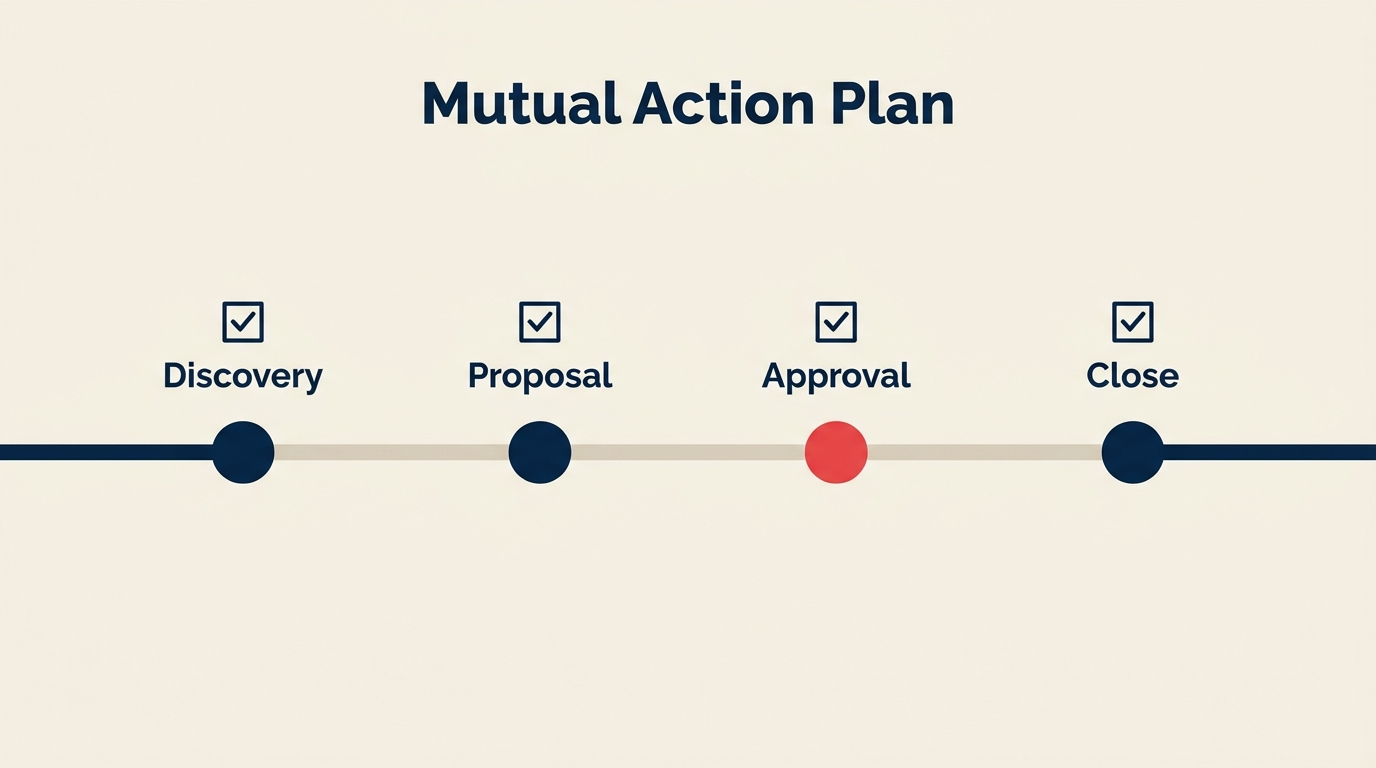
A mutual action plan is the document that separates deals that close on time from deals that drift. It's a shared timeline you build with your buyer listing every step, owner, and deadline between today and go-live. Both sides sign off on it, and both sides work it. That's the "mutual" part.
Most sellers manage deals alone. They track stages in the CRM, guess at internal approval timelines, and hope the buyer stays engaged. A mutual action plan (MAP) changes that dynamic. Instead of pushing the deal forward by yourself, you and the buyer navigate it together.
What Is a Mutual Action Plan?
A mutual action plan is a co-owned project document that maps every step, owner, and date a buyer and seller need to complete for a deal to close and go live. It's also called a close plan, a success plan, or a joint execution plan.
The terminology matters less than the behavior it creates. When a buyer helps build the plan, they're committing to the timeline. When they assign names to milestones, those people become accountable stakeholders, not vague "internal approvers." The MAP turns a one-sided sales motion into a collaborative project.
It's worth distinguishing a MAP from a standard proposal or statement of work. A proposal describes what you'll deliver. A MAP describes what needs to happen, by whom, and by when, for the deal to cross the finish line. It lives during the sales cycle, not after.
Key Facts
- According to Gartner, B2B buyers now involve an average of 6 to 10 stakeholders in a complex purchase decision, making alignment documents like MAPs increasingly critical for keeping everyone on the same page.
- Research from DealHub found that sellers using structured mutual action plans see measurably shorter sales cycles and fewer last-minute deal slippages compared to teams relying solely on CRM stage updates.
- Forrester reports that 77% of B2B buyers say their last purchase was complex or difficult, largely because of internal coordination challenges. That is the exact problem a MAP addresses.
Key Components of a Mutual Action Plan
A MAP is only as useful as the information it contains. Vague milestone lists don't hold anyone accountable. Here are the components that give a MAP real teeth:
| Component | Purpose |
|---|---|
| Milestones | Discrete steps that must be completed for the deal to advance (e.g., "Security review submitted", "Legal redlines returned") |
| Owners | Named individuals on both the buyer and seller side responsible for each milestone (job titles are not enough) |
| Target dates | Specific calendar dates for each milestone, not "in two weeks" or "ASAP" |
| Dependencies | Milestones that block other milestones (e.g., security review must complete before procurement approval can start) |
| Success criteria | What "done" looks like for each step, so there's no ambiguity about whether a milestone is actually finished |
| Decision maker confirmation | Explicit documentation that the economic buyer has reviewed and approved the plan |
| Go-live date | The shared target everyone is working backward from |
When all seven are present, the MAP functions like a project plan. When any are missing, it becomes a wish list.
Why Mutual Action Plans Work
The single biggest reason deals stall is asymmetric urgency. You need the deal to close. Your buyer has twelve other priorities and no personal deadline attached to signing your contract. A MAP creates shared urgency by giving the buyer a stake in hitting the same timeline.
There's also the social commitment effect. When a buyer's head of IT agrees in writing that they'll complete a security review by June 15, that person has made a public commitment to their colleagues. They're far more likely to follow through than if you'd simply said "we'll need security sign-off at some point."
MAPs also dramatically improve forecast accuracy. When your CRM stage says "Proposal Sent" but the MAP shows the security review hasn't started and legal is two weeks out, you know that close date is unrealistic. That visibility lets you either fix the blockers or reforecast accurately, rather than defending an optimistic number at the end of the quarter.
For complex deals with multiple stakeholders, the MAP becomes a coordination mechanism inside the buyer's organization. Your champion can share it with their CFO, IT lead, and legal team without you in the room. They don't have to translate your sales pitch into internal language; the MAP already speaks to timelines and responsibilities, not product features.
Common Mistakes
Even well-intentioned MAPs fail when sellers make predictable errors:
Building it alone. A plan the buyer didn't contribute to is a plan the buyer doesn't own. If you send over a completed MAP for their signature, you've just renamed a proposal. The collaborative construction is what creates the commitment.
Using aspirational dates. "We'd love to close by quarter-end" is not a milestone. Real dates come from working backward from the go-live date through each dependency, accounting for the buyer's actual procurement, legal, and approval cycles.
Skipping dependencies. Most deals have at least one milestone that can't start until another finishes. Ignoring dependencies produces plans that look achievable on paper but collapse the moment the security review takes ten days instead of three.
Letting it go stale. A MAP is a living document. If a milestone slips, update the plan and resurface it with the buyer. Sellers who let the MAP sit unchanged while the deal drifts have turned a collaboration tool into decoration.
Introducing it too late. A MAP presented after the demo often feels like a closing trick. Introduced during opportunity qualification or early in the discovery phase, it feels like project planning, which it is.
How to Build a Mutual Action Plan
Step 1: Anchor to the go-live date
Start by agreeing on the business outcome the buyer needs and when they need it. "We need the new system live before our fiscal year starts in October" is a real anchor. Work backward from that date to set every other milestone.
Step 2: Map the buyer's internal process
Ask your champion to walk you through exactly what has to happen internally for the deal to move forward. Who approves the budget? What's the legal review process? Does IT need to run a security assessment? This conversation reveals the real sales cycle length and the blockers you don't know about yet.
Step 3: Build the milestone list together
On a call or shared document, list every step both sides need to complete. Include both seller-side milestones (proposal, custom demo, security documentation) and buyer-side milestones (budget approval, IT review, legal sign-off). When the buyer adds their own steps, those become commitments.
Step 4: Assign owners and dates
For every milestone, assign one named owner and a specific date. If your champion says "legal usually takes two weeks," put a start date and end date on the legal milestone and make sure it doesn't conflict with other dependencies.
Step 5: Share and confirm with the economic buyer
Before the MAP is live, get explicit confirmation from the decision maker that the timeline is realistic and that they've reviewed it. A MAP your champion signed off on but the CFO has never seen won't survive the first budget objection.
Step 6: Review it at every meeting
Open each buyer call by reviewing the MAP. Which milestones are green, yellow, or red? What's blocking anything yellow or red? What needs to move? This routine makes the MAP the center of the sales conversation, not a document filed and forgotten.
Step 7: Update it as conditions change
When a milestone slips, update the MAP, adjust dependent dates, and send the revised version to all stakeholders. Transparency about changes builds more trust than pretending the original timeline still holds.
Mutual Action Plan Example
Here's a simplified MAP for a mid-market SaaS deal targeting a September 1 go-live:
| Milestone | Owner | Target Date | Status |
|---|---|---|---|
| Discovery call complete | Rep (Seller) | June 10 | Complete |
| Business case submitted to CFO | Champion (Buyer) | June 18 | In progress |
| CFO budget approval | CFO (Buyer) | June 25 | Pending |
| Security questionnaire submitted | Rep (Seller) | June 20 | In progress |
| IT security review complete | IT Lead (Buyer) | July 10 | Not started |
| Contract redlines returned | Legal (Buyer) | July 17 | Not started |
| Contract signed | Champion (Buyer) | July 24 | Not started |
| Onboarding kickoff | Customer Success (Seller) | July 28 | Not started |
| Data migration complete | IT Lead (Buyer) + Implementation (Seller) | August 22 | Not started |
| User acceptance testing | Champion (Buyer) | August 29 | Not started |
| Go-live | All | September 1 | Not started |
This example shows dependencies clearly: IT security review can't finish until the questionnaire is submitted; contract redlines can't start until budget approval is confirmed. When legal review takes longer than expected, the rep can see immediately which downstream milestones need to shift.
Best Practices
Introduce early, not at the finish line. Bring up the MAP concept during the first substantive conversation about timeline and stakeholders. Frame it as "how do we make sure this goes smoothly for your team."
Keep it simple enough to share. A MAP that lives in a spreadsheet with seventeen tabs will never be forwarded to the CFO. One page, clear milestones, clean owners, and real dates travels well inside the buyer's organization.
Use it to test deal health. If a buyer resists building a MAP or refuses to assign owners and dates, that's signal. Healthy deals have champions who want to make the timeline real. Reluctance to commit to a plan is often reluctance to commit to the deal.
Connect it to deal progression management. Every stage gate in your pipeline stages design should have corresponding MAP milestones. When a deal can't show completed milestones, it doesn't advance the stage.
Link the MAP to revenue. Teams that track MAP completion rates alongside win rates consistently find that deals with fully built MAPs close at higher rates than deals managed informally. That data is worth sharing with your sales leadership when making the case for MAP adoption.
For more on building a healthy pipeline foundation, see what is a sales pipeline and pipeline stages design. MAPs also directly improve sales quota attainment when used consistently across a team. Teams working on improving close rates should also review sales funnel stages to ensure the funnel and the MAP milestones align.
Frequently Asked Questions
What's the difference between a mutual action plan and a close plan? They're the same thing. "Close plan" is the traditional sales term; "mutual action plan" emphasizes that both the buyer and seller build and own it together. Some teams also call it a success plan or joint execution plan. The name matters less than the practice.
When should I introduce a MAP? Ideally during or right after discovery, when you're first discussing timelines and stakeholders. Introducing it at the proposal stage works but feels more transactional. The earlier you frame it as shared project planning, the more natural it feels to the buyer.
What if the buyer refuses to build a MAP? Treat it as discovery data. Ask what's driving the hesitation. Sometimes it's timing (they're not far enough into their internal process). Sometimes it's deal health (they're not as committed as they seemed). A champion who won't put names and dates on a plan is often a champion who can't get internal alignment, which is a risk you need to know about.
How long should a MAP be? Long enough to cover every real milestone, short enough to fit on one page or one screen. For a simple deal, that might be 6 to 8 milestones. For a complex enterprise deal with multiple workstreams, it might be 20 or more. Let the deal's actual complexity drive the length, not a template.
Does a MAP work for short-cycle deals? Yes, though it looks different. A two-week transactional deal might have a MAP with four milestones: demo, trial, legal/procurement, signature. Even a simple shared timeline aligns expectations and surfaces blockers faster than informal email threads.
A mutual action plan is one of the highest-leverage tools in a rep's kit. It costs a few hours of setup and saves weeks of chasing, guessing, and re-forecasting. The teams that use MAPs consistently don't just close more deals; they close them more predictably, and that's what turns pipeline management from a tracking exercise into a revenue engine.
Related Reading

Senior Operations & Growth Strategist
On this page
- What Is a Mutual Action Plan?
- Key Components of a Mutual Action Plan
- Why Mutual Action Plans Work
- Common Mistakes
- How to Build a Mutual Action Plan
- Step 1: Anchor to the go-live date
- Step 2: Map the buyer's internal process
- Step 3: Build the milestone list together
- Step 4: Assign owners and dates
- Step 5: Share and confirm with the economic buyer
- Step 6: Review it at every meeting
- Step 7: Update it as conditions change
- Mutual Action Plan Example
- Best Practices
- Frequently Asked Questions
- Related Reading