Gap Selling: How to Sell by Closing the Gap
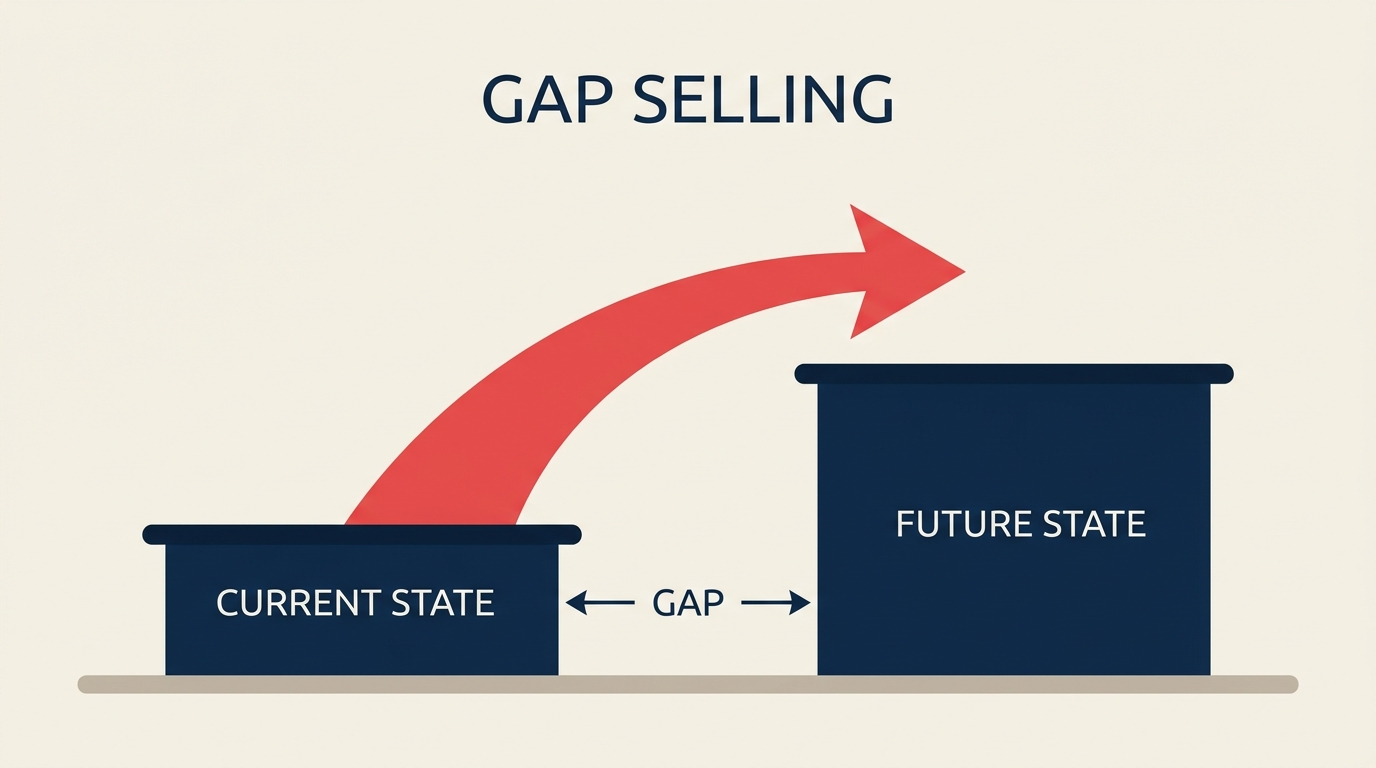
Gap selling is the methodology that reframes every sales conversation around a single question: how big is the distance between where the buyer is today and where they need to be? If that distance is large enough and painful enough, a deal exists. If it isn't, no amount of persuasion will create one.
The framework was formalized by Keenan (Jim Keenan) in his 2018 book "Gap Selling: Getting the Customer to Yes." Its core argument is that most salespeople lose deals not because of price or competition but because they never helped the buyer see the problem clearly enough to justify change.
What is gap selling?
Gap selling is a problem-centric sales methodology in which a seller's job is to identify the buyer's current state, define a better future state, and then quantify the gap between the two. The seller's product or service matters only insofar as it closes that gap. If you can't connect your solution to a gap the buyer actually feels, you don't have a deal -- you have a conversation.
Keenan's argument is that buyers don't buy products. They buy changes in their situation. A company doesn't buy CRM software; it buys a way to stop losing deals to disorganized follow-up. That distinction sounds semantic. It isn't. It changes every question a rep asks, every demo they run, and every objection they encounter.
Gap selling is particularly effective in complex B2B sales where the buyer's problem isn't fully understood, the status quo feels "good enough," and multiple stakeholders need to agree that change is worth it.
Key Facts
- B2B buyers who experience high-quality problem identification during discovery are 2.8x more likely to make a high-quality purchase decision, meaning one they don't regret or reverse (Gartner, 2022).
- 57% of B2B purchase decisions stall not because of budget or competition, but because the buying team can't build internal consensus that the problem is serious enough to fix (CEB/Gartner, 2017).
- Keenan's research from "Gap Selling" found that sellers who led with problem diagnosis rather than solution pitching consistently outperformed peers by 30% or more on quota attainment in complex-sale environments.
The quotable frame: a buyer who can't articulate their problem can't justify a purchase. Your discovery process is the first product you sell.
Current state, future state, and the gap
These three concepts are the structural backbone of gap selling. Every conversation, every question, and every proposal should map back to one of them.
| Concept | What it means | What sellers do |
|---|---|---|
| Current state | Where the buyer is right now: their processes, metrics, pain points, root causes, and the organizational impact of the problem | Ask deep diagnostic questions; listen for symptoms AND root causes; quantify the cost of staying here |
| Future state | Where the buyer wants to be: the outcomes, KPIs, and business conditions they're trying to create | Help the buyer picture a specific, concrete end state; avoid vague "better" language |
| The gap | The measurable distance between current and future state, defined in terms of lost revenue, wasted time, risk, missed growth, or competitive disadvantage | Size the gap so the cost of inaction is clear; the gap must be big enough to justify the investment |
The gap is what creates urgency. A buyer who sees the current state as "fine" and the future state as "slightly better" won't change anything. But a buyer who sees their current state costing them $400,000 a year in churn and their future state recovering most of that within 12 months has a business case. Gap selling gives you the tools to build that picture together with the buyer, not for them.
One thing worth noting: the gap has to be real. You can't manufacture urgency by exaggerating the problem. Buyers who feel manipulated disengage fast, and in B2B you'll see them again. The methodology works because it helps buyers see problems they already have more clearly, not because it tricks them into thinking they have problems they don't.
Gap selling vs solution selling vs traditional selling
Gap selling sits on a spectrum with other sales methodologies. The differences matter because they shape how you run discovery, how early you talk about your product, and how you create urgency.
| Dimension | Traditional selling | Solution selling | Gap selling |
|---|---|---|---|
| Orientation | Product-out | Pain-in | Problem-centric, change-focused |
| Discovery goal | Qualify budget and authority | Diagnose pain and develop a solution vision | Map current state, quantify the gap, and connect the buyer emotionally to the cost of inaction |
| When product enters the conversation | Early (sometimes first meeting) | After pain is diagnosed | Only after the gap is sized and felt |
| Source of urgency | Closing pressure, discounts, deadlines | Pain intensity | The financial and operational cost of staying in the current state |
| Buyer role | Passive (told what they need) | Active (asked about their pain) | Co-author (builds the problem picture alongside the seller) |
| Risk | Commodity wars, feature comparisons | Takes longer to get to the pitch | Requires strong diagnostic skills; shallow discovery breaks the model |
Gap selling and solution selling share DNA -- both are problem-centric. The key difference is depth. Solution selling focuses on diagnosing pain and creating a solution vision. Gap selling goes further by explicitly quantifying the gap and making the cost of inaction the central driver of the deal. SPIN Selling takes a similar approach using its Implication and Need-Payoff questions, which map neatly onto gap sizing. The Challenger Sale methodology overlaps too, especially in its emphasis on teaching buyers something they don't know about their own situation.
Benefits and limitations of gap selling
Gap selling isn't a universal fix. It's a strong methodology for specific sales contexts. Before adopting it, know what you're getting into.
Benefits:
- Creates genuine urgency. When a buyer clearly sees the cost of their current state, the motivation to change comes from inside, not from a rep's closing pressure. That urgency lasts longer and survives multi-stakeholder review.
- Reduces price sensitivity. If the gap is big enough ($500K in lost productivity), a $60K solution looks cheap. Gap selling shifts the buyer's reference point from "what does this cost?" to "what does staying here cost?"
- Shortens stalled pipelines. Most deals stall because the buyer can't justify change internally. A well-sized gap gives champions the internal ammunition to build the business case.
- Improves forecast accuracy. Deals qualified through gap selling have a defined problem, a quantified impact, and a connected solution. That structure makes forecast calls more reliable than gut-feel estimates. See opportunity qualification for how to layer qualification frameworks on top.
- Builds trust faster. Buyers can tell when a rep is diagnosing vs. selling. Deep problem discovery feels like consulting. Buyers who feel understood are more likely to share honest information, including blockers you'd otherwise miss.
Limitations:
- Slow for high-velocity sales. If your average deal size is $1,500 and closes in a week, running a full gap analysis is overkill. The methodology is calibrated for complex, multi-stakeholder, longer-cycle deals.
- Requires strong diagnostic skills. Sellers who are used to product pitching find gap selling uncomfortable at first. Going deep on the current state requires confidence, curiosity, and patience. It's not a script you read.
- Depends on buyer engagement. A buyer who won't share real information about their current state can't be helped by gap selling. You need access and candor, which means you need to earn trust early.
- Can backfire if the gap is small. If your discovery reveals that the buyer's current state is actually functional and the future state isn't materially better, the honest answer is that they don't need your product. Gap selling requires intellectual honesty.
How to use gap selling (step by step)
The six steps below follow Keenan's model and are adapted for a typical B2B complex sale.
Step 1: Research the current state before the call
Effective gap discovery starts before the first conversation. Review the prospect's business model, growth stage, tech stack, recent news, and job postings. Form a hypothesis about what their current state likely looks like and what the probable root causes are. This lets you ask smarter questions instead of generic ones.
An ideal customer profile is useful here. Companies matching your ICP typically share current-state patterns, which means your diagnostic questions can be more targeted and your hypotheses more accurate.
Step 2: Map the current state in depth
In discovery, your primary objective isn't to pitch. It's to build a complete, detailed picture of the buyer's current state. That means going beyond surface symptoms.
Ask about: the existing processes or tools in place, where those processes break down, what the downstream effects of the breakdown are, how the organization has tried to fix the problem before, and what stopped those fixes from working. The goal is to understand the root causes of their pain, not just the symptoms they mention first.
Step 3: Quantify the impact of the current state
Symptoms become compelling when they're measured. If a buyer says "our pipeline visibility is poor," that's a symptom. If they say "we've miscalled our quarterly forecast by 20% for the last three quarters and missed our board targets twice," that's a problem with a number attached.
Help buyers translate symptoms into business impact: lost revenue, wasted sales hours, customer churn, missed growth targets, compliance risk. The bigger the number, the larger the gap will feel. Don't invent the numbers; help them find their own.
Step 4: Define the future state concretely
The future state is not "better visibility" or "more efficiency." Those are too vague to motivate a multi-stakeholder purchase decision. Work with the buyer to define specific outcomes: forecast accuracy above 90%, rep ramp time under 60 days, churn rate below 8%. The more specific the future state, the more tangible the gap.
This is also where you introduce proof points. If you have case studies or benchmarks showing where similar companies landed after implementing your solution, bring them in here. Not as a pitch -- as evidence of what the future state can realistically look like.
A well-built buyer persona helps you anticipate what future states matter to different stakeholders. The CFO cares about one version of the future; the VP of Sales cares about a different one. You need to have both conversations.
Step 5: Size the gap explicitly
Once you have the current state quantified and the future state defined, make the gap explicit. Put it in the room.
"You're losing roughly $350K a year in productivity from manual data entry. With the future state you've described, you'd recover most of that within the first year. The gap right now is about $350K. Does that feel like the right framing?"
This step is uncomfortable for sellers trained in soft sells. But naming the gap is what separates gap selling from other methodologies. When the buyer confirms the gap, they've essentially co-authored the business case. That's very difficult for them to walk away from later.
Step 6: Connect your solution to the gap
Only now do you bring in your product. And the framing is specific: your solution closes this gap in this way over this timeline. You're not explaining features. You're connecting capabilities to the exact gap you mapped together.
This is why product demos in gap selling are very different from traditional demos. You're not running a full feature tour. You're showing exactly the functionality that addresses the root causes identified in step 2, produces the outcomes defined in step 4, and closes the gap quantified in step 5. Everything else can wait for a follow-up.
For deals with multiple stakeholders, use the MEDDIC framework alongside gap selling. MEDDIC helps you verify that the gap is felt by economic buyers and champions, not just your day-to-day contact.
Gap selling discovery questions and examples
The quality of your gap analysis depends entirely on the quality of your questions. Here are discovery questions mapped to each stage, plus a worked example showing how they connect.
| Stage | Sample discovery questions |
|---|---|
| Current state | What does your current process for X look like, step by step? Where does it most often break down? How long has that been an issue? What have you tried to fix it? |
| Impact of current state | What does that cost the business in real terms? How often does it affect your customers? What would happen if it stays unfixed for another 12 months? |
| Future state | If we were talking a year from now and this problem was solved, what would be different? What metrics would look different? What would your team be able to do that they can't do today? |
| Gap sizing | Given what you've shared about the cost now and the outcome you're describing, how do you think about the size of that gap? What would it be worth to close it? |
Worked example:
A VP of Sales at a 200-person B2B SaaS company is running discovery with a sales operations platform. The conversation might look like this:
The buyer says reps spend 90 minutes a day on manual CRM updates. The team has 40 reps. That's 3,600 hours a month on non-selling activity. The VP's target is to get reps to 70% selling time. They're currently at 45%. The gap is 25 percentage points of selling capacity -- approximately 1,200 additional selling hours per month if solved. At an average rep productivity rate, the company's own finance team can run the math on what those hours are worth in pipeline generated.
The gap is now concrete, owned by the buyer, and big enough to justify a purchase decision.
Best practices
Do: go deeper than the first symptom. Buyers often open with a symptom they've already tried to solve. The real root cause is usually one or two layers deeper. Keep asking "what causes that?" until you hit something structural.
Do: reflect the gap back in the buyer's language. When you name the gap, use their numbers and their words. "You mentioned $350K and 25 percentage points -- is that still the right framing?" This creates co-ownership, not a pitch.
Do: let the gap do the work. You don't need to close hard. A well-built gap creates its own urgency. Buyers who've quantified the cost of staying still have a self-generated reason to move.
Don't: skip to the product before the gap is sized. The most common gap-selling mistake is getting excited about a relevant use case and pitching before the gap is fully established. Buyers who haven't yet seen the full cost of their current state will evaluate your product on features and price, not on business impact.
Don't: accept vague future states. "We want better visibility" is not a future state you can sell to. Push for specifics. "What does better visibility look like as a metric? What number would tell you the problem is solved?"
Don't: fake urgency. If the gap is genuinely small, say so. Sellers who push buyers into purchases they don't need create churn, bad references, and damaged trust. Gap selling works because it's honest. Use it that way.
For pipeline management, gap selling pairs well with consultative selling for the conversational approach, and with value selling for quantifying ROI once the gap is established.
Frequently asked questions
What is the gap in gap selling?
The gap is the distance between a buyer's current state (where they are now, including their problems, root causes, and the cost of those problems) and their future state (where they want to be, defined in concrete outcomes). Gap selling is built on the idea that buyers change when the gap is big enough and painful enough to justify action. The seller's job is to help the buyer see, feel, and quantify that gap -- not to pitch a product.
How is gap selling different from solution selling?
Both methodologies are problem-centric: they prioritize diagnosing the buyer's situation before talking about the product. The key difference is depth and emphasis. Solution selling focuses on identifying pain and building a solution vision. Gap selling goes further by explicitly quantifying the gap between current and future state and using the cost of inaction as the primary driver of urgency. Gap selling also puts more emphasis on root-cause analysis rather than surface-level pain identification.
Who created gap selling?
Gap selling was created and popularized by Keenan (Jim Keenan), the CEO and founder of A Sales Guy Inc. He formalized the methodology in his 2018 book "Gap Selling: Getting the Customer to Yes," which drew on his experience as a sales practitioner, coach, and consultant across a range of B2B industries.
When should you not use gap selling?
Gap selling isn't the right fit for high-velocity, transactional, or short-cycle sales where the buyer's problem is already obvious and the buying process is simple. It's also a poor fit when you can't get access to senior stakeholders who understand the full business impact of the current state. In those situations, a faster qualification approach like BANT may be more practical.
Does gap selling work with other sales methodologies?
Yes. Gap selling works well as a discovery layer on top of qualification frameworks. MEDDIC helps you verify that the gap is felt by economic buyers and champions. SPIN Selling's Implication and Need-Payoff questions map directly onto gap quantification. The Challenger Sale's teach-tailor-take-control structure pairs naturally with gap selling's emphasis on helping buyers see their problem more clearly.
Gap selling asks a deceptively simple question: how big is the distance between where the buyer is and where they need to be? The methodology earns its reputation not because it's clever or counterintuitive but because it works with how buyers actually make decisions. When the gap is large and visible and priced out, buyers move. Your job is to build that picture together -- and then show exactly how you close it.
Related reading

Senior Operations & Growth Strategist
On this page
- What is gap selling?
- Current state, future state, and the gap
- Gap selling vs solution selling vs traditional selling
- Benefits and limitations of gap selling
- How to use gap selling (step by step)
- Step 1: Research the current state before the call
- Step 2: Map the current state in depth
- Step 3: Quantify the impact of the current state
- Step 4: Define the future state concretely
- Step 5: Size the gap explicitly
- Step 6: Connect your solution to the gap
- Gap selling discovery questions and examples
- Best practices
- Frequently asked questions
- Related reading