Modelo de Madurez de Alineación CS-Producto: Cuatro Etapas desde lo Improvisado hasta lo Sistemático
Turn this article into takeaways for your work.


Each assistant summarizes the article only for you and suggests best practices for your work.
La alineación CS-Producto no es binaria. No existe un estado de alineación perfecta o desalineación total. Se está en algún punto del espectro, y lo más útil que se puede hacer con este artículo es determinar exactamente dónde. Los equipos que conocen su etapa actual mejoran más rápido que los que tratan la alineación como un objetivo vago. Los movimientos concretos que llevan de la Etapa 1 a la Etapa 2 son completamente distintos de los que llevan de la Etapa 3 a la Etapa 4, y aplicar intervenciones de Etapa 4 a una organización en Etapa 1 es una forma segura de crear complejidad costosa que no resuelve nada. Si es necesario, comience por la base: qué es la alineación CS-Producto y por qué importa.
El modelo a continuación brinda a los líderes de CS y Producto un lenguaje de diagnóstico compartido. No es una herramienta para señalar culpas, sino una superficie de planificación. El objetivo es que un VP CS y un Head of Product lean este artículo juntos, discrepen de forma productiva sobre en qué etapa se encuentran y salgan con un conjunto específico de cambios acordados, no con una buena intención más.
Por Qué Funciona un Modelo de Madurez Aquí
La mayoría de los problemas de alineación se tratan como proyectos puntuales: "configuremos un canal de retroalimentación", "hagamos una sincronía PM-CSM", "compartamos la hoja de ruta con CS." Estas intervenciones son correctas, pero no se acumulan a menos que estén correctamente secuenciadas. No es posible sostener un ritual de Etapa 3 (como una revisión trimestral de retroalimentación CS-Producto) si no se ha establecido la infraestructura de Etapa 2 de la que depende (como un registro compartido de retroalimentación que le dé contenido a la revisión). La investigación de TSIA sobre la colaboración CS-Producto confirma este problema de secuenciación directamente: menos del 30% de las empresas reportan tener objetivos alineados entre estas dos funciones, y las que lo hacen tienen significativamente más probabilidades de ejecutar planes de adopción codiseñados.
El modelo de madurez funciona porque muestra las dependencias. La Etapa 2 no puede funcionar sin la Etapa 1. La Etapa 3 se construye sobre la Etapa 2. Y la Etapa 4 (el estado predictivo en el que los datos de CS alimentan el descubrimiento antes de que se definan las funcionalidades) requiere una base operacional que muy pocas empresas de mercado medio han establecido efectivamente en la Etapa 3 primero.
Piense en las etapas menos como niveles de logro y más como descripciones de lo que está ocurriendo en este momento en su organización, observable por cualquiera que observe con detenimiento.
Datos Clave: La Alineación CS-Producto en la Práctica
- Solo el 22% de los equipos de producto tienen un proceso formal y consistente para incorporar la retroalimentación de CS post-venta en la planificación de la hoja de ruta, lo que significa que la mayoría de las empresas SaaS de mercado medio operan en la Etapa 1 o la Etapa 2 (ProductPlan).
- Las organizaciones con una cadencia estructurada PM-CSM (comportamiento de Etapa 3) registran un abandono por brecha de producto un 30% menor que las organizaciones sin ella (Gainsight).
- Los CSM en organizaciones de Etapa 3 dedican entre el 10 y el 12% de su tiempo a tareas de retroalimentación de producto, frente al 23% en la Etapa 1, una reducción del 50% solo a través de la estructura del proceso (TSIA).
El Modelo de Madurez de Alineación CS-Producto de Rework: Cuatro Etapas
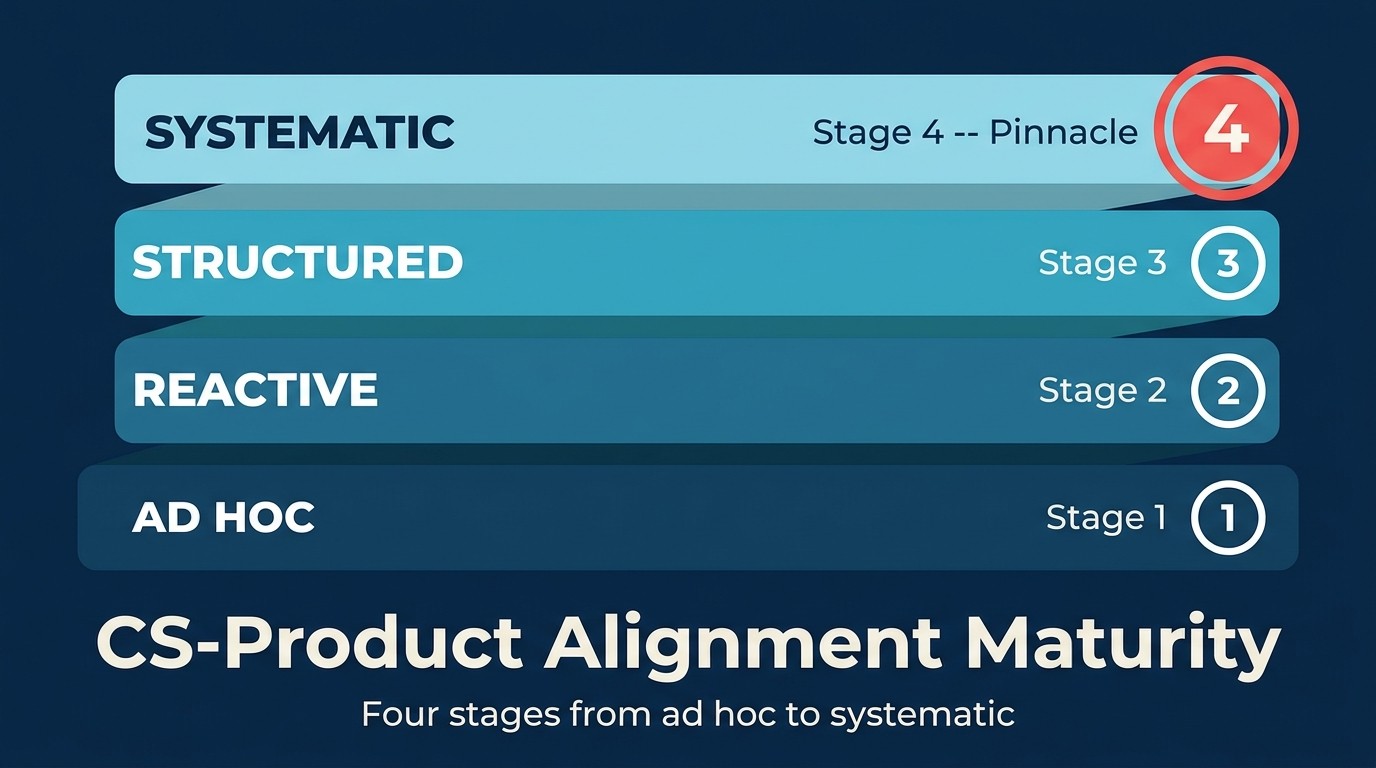
El framework que se presenta a continuación, el Modelo de Madurez de Alineación CS-Producto, define cuatro etapas observables, desde la retroalimentación improvisada hasta la inteligencia predictiva de producto. Cada etapa tiene una firma operacional distinta, un perfil de riesgo y un conjunto de movimientos de mayor apalancamiento para alcanzar la siguiente etapa. El modelo está diseñado para usarse como diagnóstico compartido, no como sistema de calificación.
Etapa 1: Improvisado
Cómo se ve en la práctica: La retroalimentación de CS llega a Producto por el camino de menor resistencia: cualquier relación individual que exista. Un CSM que estudió en la misma universidad que el PM logra que escuchen las solicitudes de sus clientes. Un CSM en una empresa donde el CEO asiste regularmente a las reuniones generales logra que los escalamientos pasen por el CEO. Un CSM que no tiene conexión personal con nadie en el equipo de producto envía solicitudes a un tablero de Jira que se revisa una vez por trimestre, tal vez.
No hay un formato consistente. Distintos CSM presentan retroalimentación de formas diferentes: algunos envían correos, otros usan Slack, algunos la agregan en notas del CRM que nadie lee, otros la mencionan verbalmente en reuniones entre equipos. Los PM se sienten bombardeados por solicitudes sin filtrar. CS se siente ignorado. Ambas sensaciones son reflejos precisos del mismo sistema roto.
Perfil de riesgo: Abandono elevado por brechas de producto no rastreadas, desperdicio elevado de desarrollo por ausencia de señal de CS, daño elevado a la moral del CSM por un sistema de retroalimentación que parece no tener efecto. El costo de la desalineación CS-Producto opera en su punto más alto, pero es invisible porque no hay una línea base con la que comparar.
Cita destacada: "En la Etapa 1, el ciclo de retroalimentación CS-Producto no pasa por el proceso, sino por las relaciones personales. Si el PM y el CSM tienen buena relación, la inteligencia del cliente llega a las decisiones de producto. Si no la tienen, no llega. Las organizaciones que dependen de la suerte relacional en lugar de una infraestructura de enrutamiento pagan el impuesto completo de la desalineación cada trimestre."
Lo que suele faltar: Cualquier sistema compartido para capturar retroalimentación, cualquier definición acordada de cómo luce una "buena retroalimentación", cualquier compromiso de Producto de reconocer o cerrar el ciclo sobre lo que CS envía.
Señales de diagnóstico observables:
- No es posible extraer una lista de elementos de retroalimentación de producto abiertos ordenados por exposición al ARR
- Los CSM dan respuestas diferentes a "¿cuáles son las tres principales brechas de producto en tu cartera?" con mínima coincidencia
- La última vez que Producto compartió la hoja de ruta con CS, los CSM se enteraron en una reunión de equipo menos de una semana antes de que llegara a los clientes
Etapa 2: Reactivo
Cómo se ve en la práctica: Alguien ha creado un espacio compartido para la retroalimentación (una página de Notion, un Airtable, un canal dedicado de Slack, un tablero de producto). La intención existe. Algunos CSM lo usan; otros, no. La retroalimentación se captura de forma inconsistente: los CSM más orientados al proceso envían regularmente, los demás solo envían cuando algo escala.
Producto reconoce el insumo cuando alguien hace seguimiento con suficiente persistencia. Existe una sincronía trimestral o mensual entre CS y Producto que se programa, ocasionalmente se cancela, y cuando ocurre, tiende a ser una conversación que empieza desde cero en lugar de una revisión estructurada de datos acumulados. La comunicación de la hoja de ruta es informal: "pregunta a un PM y te dirá qué viene."
Lo que funciona: La intención existe. Algunas relaciones individuales PM-CSM son funcionales y productivas. La etapa parece un progreso desde la Etapa 1 porque al menos hay un espacio compartido. Pero el sistema funciona según el comportamiento individual más que según el diseño del proceso, lo que lo hace frágil. Se degrada cuando esas personas se van o se ocupan demasiado.
Lo que lo rompe: Sin propiedad del proceso de retroalimentación, sin SLA sobre la respuesta de Producto al feedback enviado, sin ponderación por ARR para la priorización de retroalimentación que le dé a Producto una señal de priorización real, y sin ciclo cerrado para que los CSM sepan si sus envíos tuvieron algún efecto.
Cita destacada: "La investigación de Forrester encontró que las empresas que cierran el ciclo de retroalimentación con los clientes (informándoles qué pasó con sus aportes) tienen puntuaciones de NPS entre 12 y 15 puntos más altas en promedio que las empresas que recopilan retroalimentación sin cerrar el ciclo. El mismo principio se aplica dentro del canal CS-Producto: los CSM que nunca reciben respuesta dejan de enviar, y el conjunto de señales que Producto necesita se reduce a emergencias." (Forrester, 2024)
Señales de diagnóstico observables:
- El documento o canal de retroalimentación compartido tiene entre un 40 y 60% de entradas desactualizadas (solicitudes antiguas que nadie ha actualizado)
- La sincronía trimestral CS-Producto a veces se cancela y nadie la reprograma durante semanas
- Cuando se le pregunta a un CSM si ha recibido respuesta a una solicitud que envió hace dos meses, dice que no ha verificado
Etapa 3: Sistemático
Cómo se ve en la práctica: Un pipeline de VoC definido de CS a producto dirige la retroalimentación de las conversaciones del CSM a un backlog etiquetado y ponderado por ARR que Producto revisa en una cadencia. Los CSM tienen un proceso de captura liviano (un campo en el CRM o la plataforma de CS, un esquema de etiquetado consistente) que lleva menos de dos minutos en completar. El backlog es consultable: se puede preguntar "¿cuántas cuentas con ARR superior a $50K han solicitado una integración con Salesforce en los últimos dos trimestres?" y obtener una respuesta.
Las sesiones individuales PM-CSM están en el calendario, mensualmente o cada dos semanas, entre cada PM y los CSM que gestionan cuentas en el área de producto de ese PM. No son reuniones de estado. Son sesiones de trabajo donde el PM trae lo que está en descubrimiento y el CSM trae lo que está apareciendo en el campo. Producto comparte la hoja de ruta con CS dos semanas antes de cualquier anuncio externo. Los programas beta están estructurados: CS tiene insumos sobre qué cuentas son invitadas, y los CSM son informados antes de que los participantes beta reciban comunicación.
El ciclo de retroalimentación se cierra: cuando un elemento de retroalimentación se actúa, se rechaza o se mueve a un trimestre posterior, el CSM que lo envió recibe una notificación. No siempre, no con una explicación larga, pero con suficiente consistencia como para que los CSM crean que el sistema funciona.
Lo que funciona: El proceso existe y se sigue. Ambas partes confían suficientemente en el sistema como para usarlo de forma consistente. La influencia de la retroalimentación en la hoja de ruta es rastreable, y se puede señalar lanzamientos específicos donde el insumo de CS moldeó la decisión de desarrollo.
Lo que aún falla en la Etapa 3: El insumo de CS típicamente llega después de que ha comenzado la definición del alcance. El ciclo de retroalimentación es retrospectivo: Producto se entera de lo que los clientes quieren después de que ya experimentaron un problema, no antes de que se tome una decisión de desarrollo. El descubrimiento sigue siendo principalmente impulsado por el equipo de producto, con CS como insumo reactivo en lugar de fuente proactiva de señales.
Señales de diagnóstico observables:
- Los CSM registran la retroalimentación en un campo de la plataforma de CS; el PM la revisa en una cadencia regular
- La revisión trimestral de retroalimentación del cliente es una reunión permanente con asistencia de ambas partes
- Se puede señalar un lanzamiento específico en los últimos 6 meses y rastrear su origen hasta un problema del cliente identificado por CS
Etapa 4: Predictivo
Cómo se ve en la práctica: Los datos de CS alimentan el descubrimiento de producto antes de que se definan las funcionalidades. Los PM asisten a llamadas de clientes de forma regular, no para observar sino para probar hipótesis tempranas contra el contexto real de la cuenta. Los modelos de predicción de abandono (construidos sobre datos de uso, volumen de soporte y datos de interacción) informan qué problemas de producto tienen más probabilidades de impulsar la próxima ola de abandono, y la hoja de ruta prioriza contra esas predicciones en lugar de solo contra la retroalimentación histórica.
Los OKR conjuntos cruzan la frontera CS-Producto. La adopción de funcionalidades a los 90 días aparece en los objetivos tanto de CS como del equipo de Producto. Las métricas de retención están en las evaluaciones de desempeño del PM, no como la única medida, sino como un factor real de evaluación. Los PM con incentivos basados en la retención es lo que hace que esto sea estructural en lugar de aspiracional. El PMM es el propietario de la capa de traducción CS-Producto: convierte la señal de relación en insumo de descubrimiento y convierte las decisiones de producto en narrativa para el cliente. El modelo operativo CS-Producto sobrevive los cambios de personal porque está integrado en el diseño organizacional en lugar de depender de relaciones personales.
Lo que funciona: La alineación es estructural, no personal. El ciclo de retroalimentación conecta la experiencia de CS y las decisiones de producto en tiempo real, no con un retraso trimestral. Producto puede anticipar cuál será la próxima ola de dolor del cliente, en lugar de responder a lo que la última ola ya causó.
Límite realista: La mayoría de las empresas de mercado medio llegan como máximo a la Etapa 3 durante su primer esfuerzo serio de alineación. La Etapa 4 requiere decisiones deliberadas de diseño organizacional (inversión en PMM, reestructuración de métricas, cambios en la evaluación de PM, revisión del proceso de descubrimiento) que a menudo son prematuras hasta que la Etapa 3 es operacionalmente sólida. Las empresas que intentan saltar directamente a la Etapa 4 generalmente terminan con un proceso de apariencia impresionante que nadie sigue de forma consistente porque la infraestructura de la Etapa 3 nunca fue construida.
Análisis de Rework: Entre las organizaciones SaaS de mercado medio que han realizado la autoevaluación del Modelo de Madurez de Alineación CS-Producto, el hallazgo más frecuente es una brecha de puntuación entre el liderazgo de CS (que ubica a la organización en la Etapa 2) y el liderazgo de Producto (que la ubica en la Etapa 1). Esa brecha, donde una parte sobreestima cuánto se recibe la retroalimentación enviada mientras la otra subestima cuánto insumo consistente se está perdiendo, es en sí misma una señal de diagnóstico. Cuando CS cree que el canal funciona y Producto cree que está casi vacío, el proceso de envío existe pero las capas de enrutamiento y reconocimiento no. Es una organización en Etapa 2 que cree estar acercándose a la Etapa 3. La autoevaluación de 10 preguntas a continuación revela esta brecha rápidamente cuando ambas partes responden de forma independiente antes de comparar las puntuaciones.
Señales de diagnóstico observables:
- Los PM asisten a llamadas de clientes con un horario regular y llevan preguntas de descubrimiento, no solo observación
- La retención está explícitamente en los objetivos de desempeño del PM
- El PMM dirige una reunión regular de traducción CS-Producto que ambas partes consideran fundamental
- Se puede rastrear una prioridad actual de la hoja de ruta hasta una señal de predicción de abandono y no hasta una solicitud histórica
Resumen por Etapa
| Etapa 1: Improvisado | Etapa 2: Reactivo | Etapa 3: Sistemático | Etapa 4: Predictivo | |
|---|---|---|---|---|
| Captura de retroalimentación | Ninguna (comportamiento individual) | Inconsistente (espacio compartido existe) | Consistente (proceso definido, etiquetado, ponderado por ARR) | Continua (fluye hacia el descubrimiento) |
| Comunicación de hoja de ruta | Ninguna | Bajo solicitud | Cadenciada pre-anuncio | Codiseñada con insumo de CS |
| Relación PM-CSM | Personal, no institucional | Informal | Cadencias programadas | PM en llamadas de clientes |
| Cierre del ciclo de retroalimentación | Nunca | A veces | Consistentemente | En tiempo real |
| Métricas compartidas | Ninguna | Ninguna | Adopción de funcionalidades | Retención en objetivos del PM |
| Resiliencia ante cambios de personal | Baja | Baja | Media | Alta |
| Perfil típico de NRR | <90% | 90-95% | 95-105% | 105%+ |
El análisis de McKinsey sobre empresas tecnológicas B2B muestra que las empresas que priorizan el customer success como función de crecimiento estructurada superan a sus competidoras tanto en NRR como en eficiencia de ARR neto nuevo. Los rangos de perfil de NRR anteriores se corresponden estrechamente con lo que McKinsey identifica como las bandas de desempeño que separan a las empresas de software de crecimiento rápido de las de crecimiento más lento.
Autoevaluación de 10 Preguntas
Responda estas preguntas con honestidad, no aspiracionalmente. Anote 1 punto por cada "sí."
Para el Liderazgo de CS (5 preguntas):
- ¿Puede extraer ahora mismo una lista de elementos de retroalimentación de producto abiertos de su cartera de cuentas, ordenados por ARR?
- En el último trimestre, ¿al menos un elemento de retroalimentación originado en CS resultó en un cambio de producto rastreable o en una respuesta documentada de "decidimos no construir esto porque..."?
- ¿Sus CSM recibieron información de la hoja de ruta al menos dos semanas antes de cualquier anuncio orientado al cliente en los últimos 90 días?
- ¿Sus CSM tienen un punto de contacto programado y recurrente con al menos un PM (no una sincronía de emergencia, sino una cadencia regular)?
- Cuando un CSM envía un elemento de retroalimentación, ¿suele recibir respuesta dentro de los 30 días sobre su estado?
Para el Liderazgo de Producto (5 preguntas):
- ¿Puede extraer ahora mismo retroalimentación de clientes ordenada por exposición al ARR de su backlog, sin enviar un mensaje de Slack al equipo de CS?
- ¿Al menos un PM asistió a una llamada de cliente en el último mes con un propósito distinto a un escalamiento?
- ¿Se hace seguimiento de la adopción de funcionalidades a los 90 días y se revisa junto con las métricas de lanzamiento de cada release?
- En los últimos dos trimestres, ¿CS proporcionó insumos estructurados antes de que comenzara una fase de descubrimiento (no solo después de que se definió el alcance de una funcionalidad)?
- ¿La retención o el NRR es un componente medible de los objetivos de desempeño de algún PM?
Puntuación:
- 0-2: Etapa 1. El modelo operativo aún no existe. Comience con los movimientos de Etapa 1 hacia 2 a continuación.
- 3-5: Etapa 2. La intención existe pero el proceso no es confiable. Los movimientos de Etapa 2 hacia 3 son su prioridad.
- 6-8: Etapa 3. La base sistemática está mayormente establecida. Identifique las brechas específicas y resuélvalas antes de avanzar hacia la Etapa 4.
- 9-10: Etapa 4. La alineación estructural está funcionando. Mantenga y optimice; la prioridad es la resiliencia ante cambios de equipo.
Transición Entre Etapas: Intervenciones de Mayor Apalancamiento
La transición entre etapas no requiere una iniciativa completa. En la mayoría de los casos, dos o tres movimientos específicos impulsan el cambio. A continuación se presentan los de mayor apalancamiento. Si también ha trabajado en el modelo de madurez de alineación ventas-CS, tenga en cuenta que la lógica de etapas es paralela, pero los movimientos son distintos porque la interfaz CS-Producto involucra flujos de trabajo y tipos de información diferentes.
Etapa 1 a Etapa 2
Movimiento 1: Acordar cómo luce una "buena retroalimentación." Antes de cualquier cambio de herramientas o proceso, reúna a CS y Producto durante 30 minutos para responder: ¿qué información necesita un PM de un elemento de retroalimentación de CS para que sea útil en una decisión de hoja de ruta? Ese acuerdo produce el esquema de etiquetado y el formato de envío del que depende todo lo demás.
Movimiento 2: Crear un único camino de envío. Elija un lugar donde vaya la retroalimentación (un campo en el CRM, una funcionalidad de la plataforma de CS, un Airtable estructurado), y no un canal de Slack. Un registro estructurado. No necesita ser sofisticado; necesita ser consistente. Un camino, usado por todos los CSM, para toda la retroalimentación.
Etapa 2 a Etapa 3
Movimiento 1: Agregar ponderación por ARR al registro de retroalimentación existente. Si ya tiene un espacio de retroalimentación compartido con un 40% de entradas desactualizadas, no empiece de nuevo. Agregue un campo: ARR de la cuenta (extraído del CRM). Esa única adición le da a Producto una señal de priorización real y cambia inmediatamente el carácter del backlog.
Movimiento 2: Programar sesiones individuales PM-CSM. Un PM, dos o tres CSM, 45 minutos mensuales. El PM trae lo que está en descubrimiento. Los CSM traen lo que está apareciendo en sus carteras. Agéndenlo para seis meses. No permitan que se cancele. Este es el ritual que produce el flujo de señales más sostenible en la Etapa 3. La guía de cadencia de sesiones individuales CS-PM tiene el formato de agenda y las notas de facilitación listas para usar.
Movimiento 3: Establecer un compromiso de ciclo cerrado. Producto acuerda responder a cada elemento de retroalimentación enviado dentro de los 30 días, no con una explicación completa, sino con uno de tres estados: en la hoja de ruta, no priorizado (con una razón de una oración), en revisión. Ese compromiso, mantenido de forma consistente durante dos trimestres, es lo que convierte a los CSM que dejaron de enviar retroalimentación de nuevo en participantes activos.
Etapa 3 a Etapa 4
Movimiento 1: Llevar a los PM a las llamadas de clientes. No como observadores, sino como participantes activos que prueban hipótesis de descubrimiento. Comience con un PM, un CSM y una llamada de cuenta estratégica por mes. El PM prepara tres preguntas con anticipación. El CSM facilita. Después de la llamada, tienen un debrief de 15 minutos. Escale desde ahí.
Movimiento 2: Agregar la retención a los objetivos del PM. Incluso una adición liviana ("adopción de funcionalidades a los 90 días" como métrica rastreada, no determinante del desempeño) cambia las decisiones que los PM toman en la priorización. La métrica no necesita ser la principal. Necesita ser visible y revisada con suficiente regularidad como para influir en cómo los PM piensan sobre las decisiones de desarrollo. La investigación de benchmarks SaaS de OpenView muestra consistentemente que las empresas lideradas por producto con las tasas de adopción de funcionalidades más sólidas comparten una característica: el equipo de producto tiene responsabilidad explícita sobre los resultados del cliente post-lanzamiento, no solo sobre la finalización del lanzamiento.
Movimiento 3: Contratar o designar un PMM para ser el propietario de la capa de traducción. La alineación en la Etapa 4 solo es sostenible si existe una función que se sitúe entre CS y Producto y convierta la señal en ambas direcciones. Un PMM como Puente que tenga la traducción CS-Producto como responsabilidad explícita es lo que hace que la Etapa 4 sea resiliente ante los cambios de relaciones individuales.
Cómo Usar Este Modelo en la Práctica
La autoevaluación y las descripciones de etapas son herramientas para una conversación específica: el VP CS y el Head of Product sentados juntos, leyendo el mismo diagnóstico y acordando dónde están antes de acordar qué cambia a continuación.
El error más común es que una parte se califique en la Etapa 3 y la otra la califique en la Etapa 1, y luego pasen la conversación de alineación discutiendo sobre la puntuación en lugar de acordar los movimientos. Las puntuaciones son menos importantes que las brechas específicas que revelan.
El uso productivo de este modelo: elija las dos o tres preguntas donde CS y Producto tuvieron las respuestas más claras de "no", y haga de esas el enfoque del trabajo de alineación del próximo trimestre. No intente implementar seis cambios de proceso simultáneamente. Los equipos que mejoran más rápido tienden a hacer uno o dos cambios concretos por trimestre, los mantienen el tiempo suficiente para que el comportamiento cambie, y agregan la siguiente capa después de que la anterior se haya estabilizado.
El artículo de las 8 señales de alerta es un diagnóstico más rápido si necesita identificar un modo de falla específico rápidamente. El artículo del Pipeline de VoC cubre la mecánica operacional de la captura de retroalimentación en la Etapa 3. El artículo de la cadencia de sesiones individuales CS-PM le proporciona el formato de sesión de trabajo para la cadencia que ancla la Etapa 3.
Preguntas Frecuentes
¿Cuál es la etapa más común para las empresas SaaS de mercado medio?
La mayoría de las empresas SaaS de mercado medio con entre 50 y 500 empleados y entre 100 y 500 cuentas operan en la Etapa 1 o la Etapa 2. La Etapa 3 es alcanzable en dos a cuatro trimestres de trabajo de alineación enfocado. La Etapa 4 típicamente requiere entre 12 y 18 meses de disciplina operacional en la Etapa 3 antes de que los cambios de diseño organizacional que la habilitan (objetivos del PM, inversión en PMM, cambios en el proceso de descubrimiento) sean factibles.
¿Se pueden saltar etapas?
Técnicamente sí, pero en la práctica no. Se pueden implementar rituales de la Etapa 4 (PM en llamadas de clientes, retención en los objetivos del PM) antes de establecer la infraestructura de la Etapa 3, pero esos rituales no se sostendrán. La asistencia de un PM a llamadas de clientes solo es valiosa si la retroalimentación que recopila tiene un camino estructurado hacia la hoja de ruta. Si la infraestructura de captura y enrutamiento de la Etapa 3 no existe, los insights del PM de las llamadas de clientes desaparecen de la misma manera que la retroalimentación del CSM lo hace en la Etapa 1. La secuenciación de etapas importa.
¿Cuál es la razón más común por la que las empresas en Etapa 2 se estancan?
El obstáculo más común en la Etapa 2 es la ausencia de un compromiso de ciclo cerrado por parte de Producto. Los equipos de CS que envían retroalimentación a un espacio compartido y nunca saben qué pasó con ella dejan de enviar de forma consistente. El espacio compartido se llena de entradas desactualizadas. El proceso parece funcional desde afuera pero ha dejado de funcionar en la práctica. La solución no es una nueva herramienta. Es un compromiso permanente de Producto de responder a cada envío dentro de los 30 días.
¿Cuánto tiempo lleva pasar de la Etapa 1 a la Etapa 3?
Entre dos y cuatro trimestres para la mayoría de los equipos de mercado medio que lo priorizan explícitamente. El camino más rápido: dedique el primer trimestre a la transición de Etapa 1 a 2 (camino de envío, esquema de etiquetado, acuerdo de retroalimentación), el segundo trimestre a las cadencias PM-CSM y el compromiso de ciclo cerrado, el tercer trimestre a la ponderación por ARR y el protocolo de comunicación de la hoja de ruta. Para el cuarto trimestre, los comportamientos de la Etapa 3 son rutinarios y los equipos pueden comenzar a evaluar si los movimientos de la Etapa 4 son apropiados.
¿Quién debe liderar el trabajo de alineación: Producto o CS?
Liderazgo conjunto desde el principio. Ninguna función puede imponer la alineación a la otra. En la práctica, el VP que tiene más credibilidad con el liderazgo de la otra parte tiende a iniciar la primera conversación, pero el diseño del modelo operativo requiere acuerdo explícito de ambas partes. RevOps o un Chief of Staff a veces facilita el diseño del proceso para que ni CS ni Producto sientan que se les está entregando el framework de alguien más.
Más Información
- Qué es la Alineación CS-Producto
- 8 Señales de Alerta de la Desalineación CS-Producto
- Pipeline de VoC: CS a Producto
- Cadencia de Sesiones Individuales CS-PM
- PM con Incentivos basados en Retención
- Glosario de Alineación CS & Product
- Qué es la Alineación Ventas-CS
- Modelo de Madurez de Alineación Ventas-CS

Senior Operations & Growth Strategist
On this page
- Por Qué Funciona un Modelo de Madurez Aquí
- El Modelo de Madurez de Alineación CS-Producto de Rework: Cuatro Etapas
- Etapa 1: Improvisado
- Etapa 2: Reactivo
- Etapa 3: Sistemático
- Etapa 4: Predictivo
- Resumen por Etapa
- Autoevaluación de 10 Preguntas
- Transición Entre Etapas: Intervenciones de Mayor Apalancamiento
- Etapa 1 a Etapa 2
- Etapa 2 a Etapa 3
- Etapa 3 a Etapa 4
- Cómo Usar Este Modelo en la Práctica
- Preguntas Frecuentes
- ¿Cuál es la etapa más común para las empresas SaaS de mercado medio?
- ¿Se pueden saltar etapas?
- ¿Cuál es la razón más común por la que las empresas en Etapa 2 se estancan?
- ¿Cuánto tiempo lleva pasar de la Etapa 1 a la Etapa 3?
- ¿Quién debe liderar el trabajo de alineación: Producto o CS?
- Más Información