More in
Playbook del Proceso de Ventas
El Traspaso de SDR a AE: Cómo Documentarlo para que Funcione de Verdad
abr. 18, 2026
Conceptos Básicos del Deal Desk: Cómo los Equipos de Ventas Pequeños Pueden Aprobar y Cerrar Más Rápido
abr. 18, 2026
Commit, Best Case, Pipeline: Cómo Definir los Términos de Forecast para que Todo el Equipo los Use Igual
abr. 18, 2026 · Currently reading
Análisis de Win/Loss sin Sesgos: un Proceso Repetible para Equipos de Ventas
abr. 18, 2026
Construir un Proceso de Ventas un Tipo de Deal a la Vez
abr. 18, 2026
Multi-Threading en Deals sin Incomodar a su Champion
abr. 18, 2026
El Estancamiento en la Mitad del Pipeline: Cómo Diagnosticar y Resolver Deals Bloqueados
abr. 18, 2026
Planes de Acción Mutua: Cuándo Ayudan y Cuándo Perjudican
abr. 18, 2026
Cadencia Operativa de Ventas: desde el Stand-Up Diario hasta el QBR Trimestral
abr. 18, 2026
Cadencia de Forecast: Semanal, Mensual o Continua — Qué Funciona y Cuándo
abr. 6, 2026
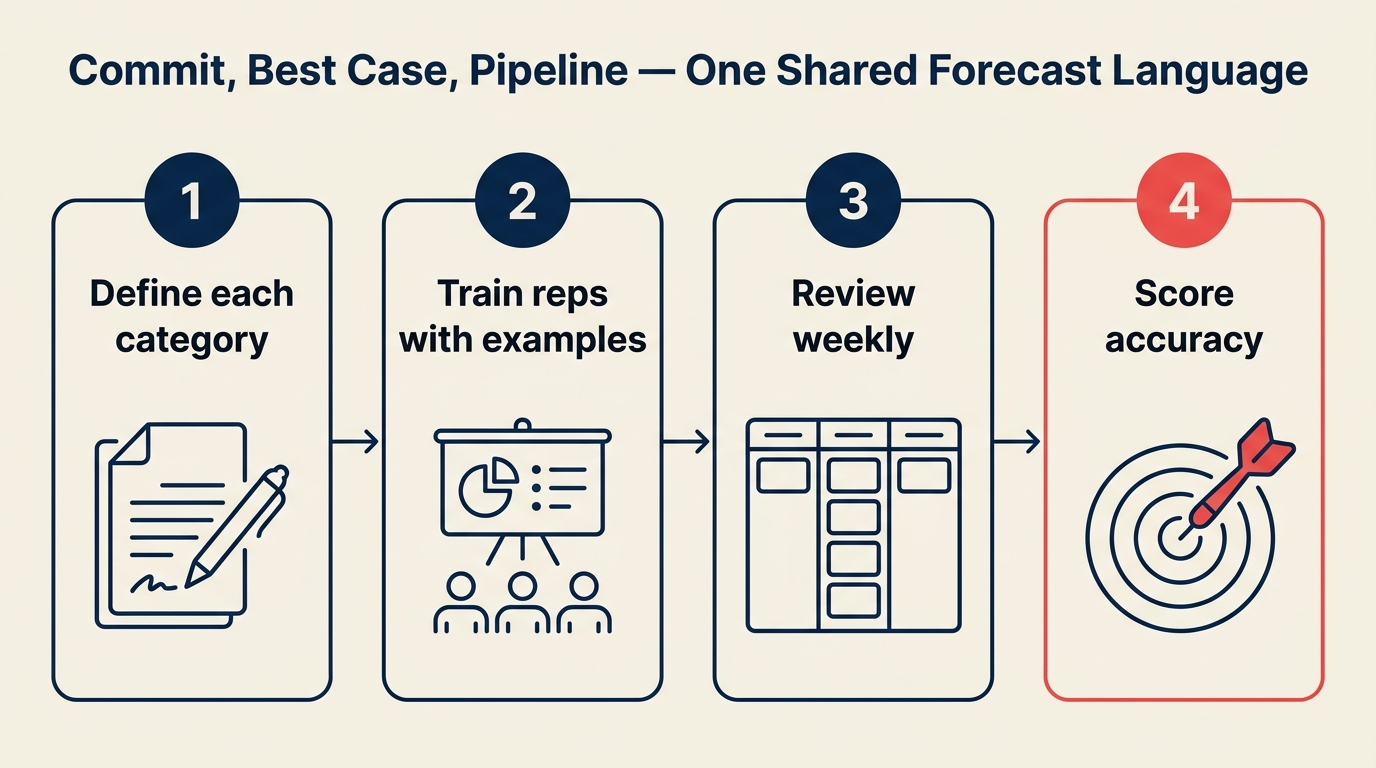
Commit, Best Case, Pipeline: Cómo Definir los Términos de Forecast que Todo su Equipo Usa de la Misma Manera
Turn this article into takeaways for your work.


Each assistant summarizes the article only for you and suggests best practices for your work.
Pregúntele a cinco representantes qué significa «commit» y obtendrá cinco respuestas distintas. Uno dice «lo estoy poniendo». Otro dice «tengo un 80% de confianza». Un tercero dice «el champion me dijo que va a suceder». El cuarto dice «tenemos un acuerdo verbal». El quinto dice «lo hemos trabajado durante tres meses».
Cada uno de esos representantes es honesto. Ninguno usa la misma definición.
Hasta que usted escriba lo que significa «commit» en términos específicos y conductuales (términos que describan lo que debe ser observable en el deal, no cómo se siente el representante al respecto), su forecast es un tablero de deseos. Los gerentes lo consolidan. Los ejecutivos lo leen. Nadie confía en él. Este problema no existe de forma aislada: la cadencia de forecast que ejecute semanal o mensualmente solo es útil si las definiciones con las que trabaja su equipo son sólidas.
Aquí presentamos un proceso paso a paso para definir las categorías de forecast con suficiente precisión como para eliminar la interpretación subjetiva, sin hacer los criterios tan rígidos que los representantes los manipulen.
Por Qué los Forecasts Fallan Antes de que Empiece la Llamada
La llamada de forecast en sí no es donde el forecast se desmorona. Se desmorona una semana antes, cuando un representante asigna un deal a una categoría basándose en su intuición y el gerente no lo cuestiona porque tampoco sabe exactamente qué significa la categoría.
La investigación de Gartner sobre forecast de ventas encuentra consistentemente que menos del 50% de los líderes de ventas reportan alta confianza en la precisión del forecast de su equipo, y la ambigüedad en las categorías es uno de los principales factores.
Dos cosas agravan esto:
Los rangos de probabilidad fomentan las conjeturas. Cuando define «commit» como «probabilidad del 70-90%», cada representante aplica su propia calibración de confianza. El 80% de un representante es el 55% de otro. Obtendrá precisión numérica que oculta el desacuerdo subyacente.
Las categorías premian el optimismo. Los representantes que ponen deals en categorías de forecast más altas sienten que demuestran confianza y salud del pipeline. Poner un deal en «Pipeline» en lugar de «Commit» se percibe como admitir debilidad. Así que los deals se elevan, y el forecast se infla.
La solución son las definiciones conductuales: criterios que describen lo que debe ser observable en el mundo, no en la cabeza del representante.
Paso 1: Las Cuatro Categorías que Realmente Necesita
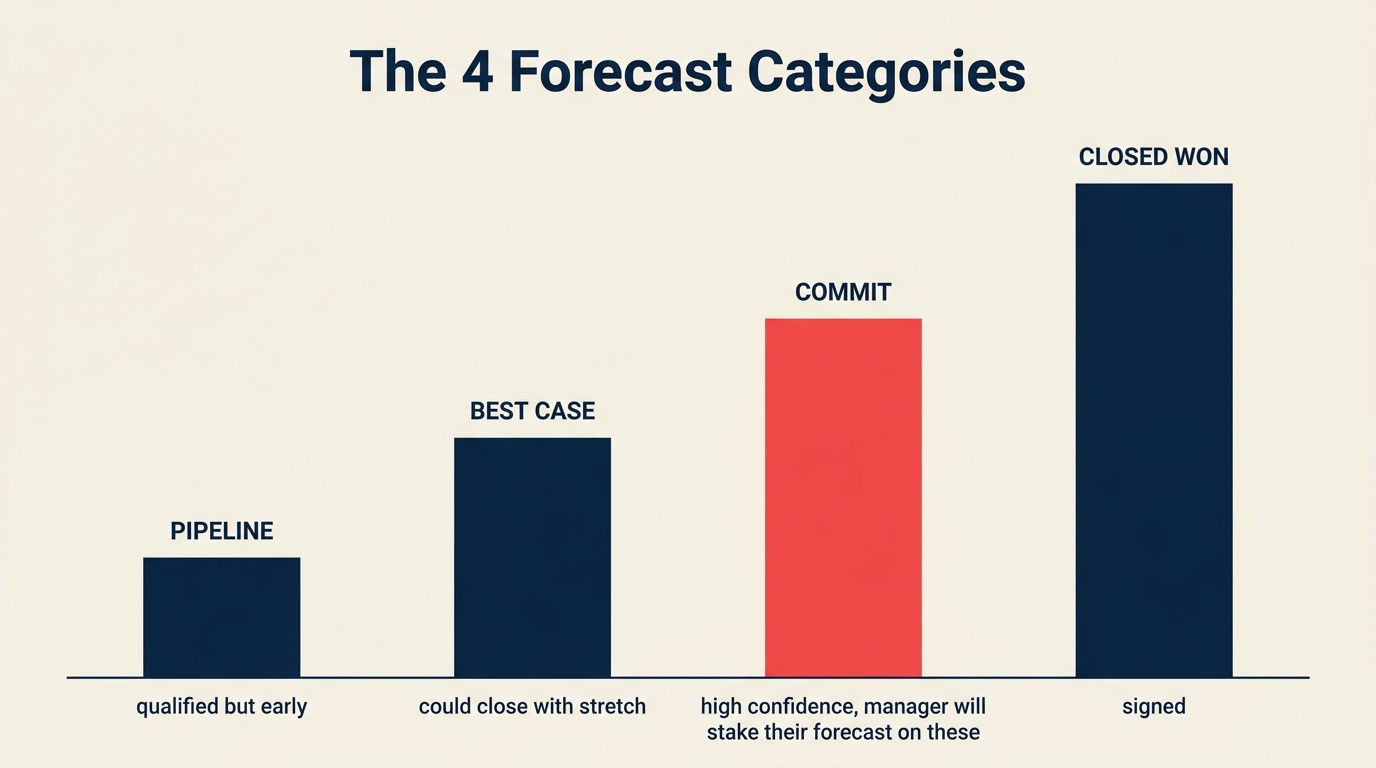
La mayoría de los equipos de ventas pueden ejecutar un forecast funcional con cuatro categorías:
Omit: No se está rastreando para este período de forecast. Demasiado temprano para calificar o ya fue descalificado. Los deals en esta categoría no aparecen en el informe de pipeline.
Pipeline: Oportunidad calificada con trabajo activo, pero aún no en una etapa donde se espera el cierre en el período actual. El deal es real, pero la fecha de cierre probablemente sea el trimestre siguiente o posterior. La forma en que un deal califica para Pipeline depende de su marco de calificación: el mínimo debe coincidir con sus criterios de ICP, no solo con «el representante los llamó».
Best Case: El cierre en el período actual es posible si todo sale bien. El comprador está comprometido, el proceso avanza, pero existe un riesgo de ejecución significativo o una decisión pendiente que no se ha resuelto.
Commit: El representante se compromete a cerrar en el período actual. Esto significa una cantidad en dólares y una fecha de cierre específicas, respaldadas por evidencia observable de que la decisión está tomada y lo que resta es ejecución.
Cuatro categorías. Puede ajustar los nombres, pero resista agregar una quinta o sexta. Más categorías crean más ambigüedad, no menos. La pregunta «¿es esto un soft commit o un commit?» es señal de que ha agregado demasiadas categorías, no muy pocas.
Paso 2: Redacción de Criterios Conductuales, No Rangos de Probabilidad
El error más común al definir las categorías de forecast es anclarlas a porcentajes de probabilidad. Un artículo de Harvard Business Review sobre disciplina en el forecast de ventas señala que la puntuación de confianza subjetiva introduce un sesgo de optimismo sistemático que se amplifica a medida que los forecasts ascienden por la cadena de gestión. «Commit significa más del 80% de probabilidad de cierre» suena preciso. Pero dos representantes con deals idénticos podrían evaluar la probabilidad en un 70% y un 90% basándose únicamente en su calibración de confianza personal, que depende de su experiencia, su relación con el prospecto y su propio historial de aciertos y errores.
Los criterios conductuales eliminan la subjetividad. En lugar de «80% de probabilidad», escriba criterios que describan lo que debe ser cierto en el deal para que la categoría sea aplicable.
Ejemplos de criterios conductuales vs. probabilísticos:
| Débil (probabilidad) | Sólido (conductual) |
|---|---|
| 80% de probabilidad de cierre | El prospecto ha acordado verbalmente la compra pendiente de revisión legal |
| Muy probable | El presupuesto está confirmado y desbloqueado; el cronograma de decisión es inferior a 30 días |
| Casi seguro | Las modificaciones contractuales del MSA están resueltas; el área de compras ha confirmado el proceso |
| Probable | El champion presentó internamente e informó de la aprobación ejecutiva |
La versión conductual describe algo que podría verificarse si usted estuviera en la sala. La versión probabilística describe algo que solo el representante puede medir.
Paso 3: El Estándar de Commit, Tres Condiciones
El commit es la categoría que más importa porque es la que el gerente usa para proyectar el número y la que el negocio usa para planificar los ingresos.
Defina commit como la exigencia de que las tres condiciones siguientes sean verdaderas simultáneamente:
Condición 1: El presupuesto está confirmado y accesible. No «dijeron que tienen presupuesto». Confirmado significa que el representante sabe que el monto de la compra está dentro de un presupuesto aprobado, o que el prospecto ha dicho explícitamente que el presupuesto está aprobado para esta compra. «Tenemos presupuesto» de un champion que no controla el presupuesto no es confirmado.
Condición 2: Un cronograma de decisión está acordado y es específico. El prospecto ha dado un rango de fechas específico para una decisión, el representante lo confirmó recientemente (dentro del período de forecast actual), y no hay indicios de un retraso. «Esperamos cerrar antes de fin de trimestre» de un representante que no ha hablado con el prospecto en tres semanas no es un cronograma.
Condición 3: Existe un próximo paso concreto con un plazo definido, confirmado por el comprador. No «un seguimiento programado». Un próximo paso concreto al que el comprador se ha comprometido: «revisión del MSA programada con legal para el jueves» o «la aprobación de la junta está en la agenda para el día 22».
Contraejemplos (estos NO son commits):
- El champion dice que es un sí pero no ha obtenido la aprobación ejecutiva
- El representante no ha hablado con el prospecto en más de 10 días
- El único paso restante es «esperar que firmen» sin una fecha específica
- El prospecto dijo «cerrar antes de fin de mes» al inicio del trimestre y no lo ha reconfirmado
Si un representante envía un deal como Commit y no cumple las tres condiciones, esa es la conversación de coaching.
Paso 4: Criterios de Best Case
Best Case es la categoría más propensa a la inflación. Los representantes ponen deals aquí porque se siente mejor que Pipeline y hay menos escrutinio que en Commit.
Defina Best Case con criterios positivos (qué lo hace calificar) y criterios de exclusión (qué lo descalifica del Commit):
Best Case califica si:
- El cierre en el período actual es plausible según el cronograma declarado por el comprador
- El champion está comprometido y responde con al menos una cadencia semanal
- Existe un camino claro hacia una decisión (aunque aún no esté confirmado)
- No hay obstáculos bloqueantes importantes de los que el representante tenga conocimiento
Best Case NO califica si:
- El último contacto con el comprador fue hace más de 14 días
- No se ha tomado una decisión presupuestaria
- El deal depende de un evento fuera de la influencia del representante (una reunión de directorio que no ha sido confirmada, una reorganización en curso)
La segunda lista es tan importante como la primera. Best Case debe sentirse aspiracional pero fundamentado. No «esto sería genial si todo nos sale bien» sino «esto es alcanzable si la ejecución continúa».
Paso 5: El Piso del Pipeline, el Mínimo de Calificación
No todos los deals del CRM merecen aparecer en una categoría de forecast. Los deals que no cumplen su umbral de calificación deben estar en Omit, no en Pipeline.
Defina un mínimo para que un deal aparezca en cualquier categoría de forecast:
- Criterios de ICP confirmados (tamaño de empresa, industria, nivel del cargo)
- El prospecto ha articulado un problema (no asumido por el representante)
- Se ha acordado un próximo paso (no solo «hacer seguimiento»)
- El deal ha tenido actividad en los últimos 30 días
Los deals que permanecen en Pipeline durante más de 90 días sin actividad no son Pipeline. Son deseos ocupando espacio en su forecast que distorsiona cada métrica. Un piso de Pipeline limpio es la condición previa para un forecast limpio.
Paso 6: Lograr Alineación a Mitad de Trimestre
El desafío al introducir nuevas definiciones de categorías no es escribirlas. Es conseguir que todos las usen de forma consistente, especialmente a mitad de trimestre cuando los representantes ya tienen deals en categorías bajo las definiciones antiguas (implícitas).
El ejercicio de calibración de una semana:
No lance las nuevas definiciones en un solo correo electrónico y espere adopción. Esta calibración funciona mejor dentro de una revisión de pipeline estructurada donde los deals pueden discutirse en voz alta, uno a la vez, en lugar de en una auditoría de hoja de cálculo donde cada uno interpreta de forma independiente. En su lugar:
Semana 1: Introduzca las definiciones en la revisión de pipeline. Pida a cada representante que reevalúe sus 5 deals principales con los nuevos criterios. Hágalo en la sala, en voz alta, un deal a la vez.
Semana 2: Cada representante vuelve a categorizar su pipeline completo. El gerente revisa los cambios y pregunta sobre cualquier deal que haya subido de categoría.
Semana 3: Primera llamada de forecast usando las nuevas definiciones. El gerente señala cualquier deal que parezca mal categorizado, usando los criterios conductuales como punto de referencia.
La calibración de tres semanas le da a todos el tiempo para interiorizar las definiciones antes de que se usen para proyectar el número. También pone de manifiesto los deals donde el representante y el gerente genuinamente no están de acuerdo, y esas conversaciones son el punto.
Paso 7: El Rol del Gerente en la Disciplina de Categorías
El gerente es el mecanismo de aplicación. Si los gerentes no cuestionan consistentemente los deals mal categorizados, las definiciones vuelven a ser intuición en dos trimestres.
La investigación de Forrester sobre la gestión de ventas en primera línea encontró que la calidad del coaching del gerente es el mayor factor determinante de la mejora en la precisión del forecast a nivel del representante, más impactante que cualquier inversión tecnológica.
Pero hay una forma correcta y una incorrecta de cuestionar.
Incorrecto: «Eso no es un commit». (Acusatorio, sin especificidad)
Correcto: «Recorramos las tres condiciones del commit. ¿Cuáles están verificadas?» (Obliga al representante a aplicar los criterios por sí mismo)
Incorrecto: «Voy a mover eso a Best Case». (El gerente toma la decisión unilateralmente)
Correcto: «Entiendo la confianza del champion. ¿El presupuesto está confirmado explícitamente? ¿Cuál es el próximo paso concreto y cuándo?» (El representante confirma los criterios o revela la brecha)
El objetivo no es pillar a los representantes sobrecomprometiendo. Es construir un juicio compartido sobre cómo se ve una buena evidencia. Los gerentes que aplican consistentemente los criterios en el coaching verán que sus representantes los interiorizan en 60-90 días. Los gerentes que solo auditan las categorías en las llamadas de forecast no verán un cambio duradero.
Errores Comunes
Según el análisis de McKinsey sobre la gestión del crecimiento de ingresos, las empresas que institucionalizan estándares conductuales de ventas ven una mejora del 20-30% en la precisión del forecast dentro de dos o tres trimestres de aplicación consistente.
Representantes que sandbagean los commits. Algunos representantes, una vez que entienden los criterios del commit, los aplican de forma tan estricta que los deals que claramente califican se mantienen en Best Case para protegerse ante un fallo. Esté atento a los representantes cuyo Best Case convierte a tasas altas mientras sus commits son escasos. Eso es sandbagging, no disciplina.
Sesgo de optimismo en Best Case. Best Case es la categoría más probable de inflarse porque requiere menos evidencia que Commit y se siente más impresionante que Pipeline. Aplique los criterios de exclusión de forma agresiva, especialmente la regla de contacto de 14 días.
Pipeline como cementerio. Sin un piso limpio del Pipeline, los deals viejos y obsoletos se acumulan en Pipeline e inflan el número total sin representar oportunidades reales. Exija higiene periódica del pipeline: cualquier deal sin actividad en 30 días va a Omit a menos que el representante pueda justificar un caso específico. La guía sobre la caída del pipeline cubre exactamente cómo ejecutar esta auditoría y qué hacer con los deals que encuentre.
Hoja de Referencia de Cuatro Categorías
| Categoría | Condiciones | Qué significa para el forecast |
|---|---|---|
| Commit | Presupuesto confirmado, cronograma específico y reciente, próximo paso concreto con fecha | El gerente puede proyectar este número |
| Best Case | Cierre plausible este período, champion comprometido, camino hacia la decisión existe, sin bloqueantes | Potencial si la ejecución se mantiene |
| Pipeline | Calificado, activo, pero el cierre se espera en un período futuro | Métrica de salud del Funnel |
| Omit | Aún no calificado o descalificado | Excluido del forecast |
Qué Hacer a Continuación
Comience con un reforecast esta semana, no el mes que viene.
Tome su pipeline actual y aplique las tres condiciones del commit a cada deal que tenga en Commit. Sea honesto sobre cuáles pasan las tres. Luego aplique los criterios de exclusión de Best Case a todo lo que esté en Best Case.
Probablemente verá cambiar el número del forecast. Eso no es un problema. Ese es el punto. El número que ve después del reforecast está más cerca de la realidad que el anterior.
Compare el reforecast con los resultados reales del trimestre pasado. Específicamente: ¿qué porcentaje de los commits del trimestre pasado realmente cerró, y qué porcentaje del Best Case cerró? Si sus commits cierran al 60% y Best Case al 30%, tiene un problema de calibración que las nuevas definiciones pueden resolver.
Esa comparación le indica dónde está su mayor brecha, y ahí es donde enfocarse en las primeras tres semanas de coaching del gerente. Si su tasa de commit a cierre es baja, la guía sobre cultura de higiene del pipeline tiene un marco útil para convertir la disciplina del forecast en un comportamiento del equipo en lugar de un problema de aplicación por parte del gerente.
Más Información

Head of Enterprise Solutions
On this page
- Por Qué los Forecasts Fallan Antes de que Empiece la Llamada
- Paso 1: Las Cuatro Categorías que Realmente Necesita
- Paso 2: Redacción de Criterios Conductuales, No Rangos de Probabilidad
- Paso 3: El Estándar de Commit, Tres Condiciones
- Paso 4: Criterios de Best Case
- Paso 5: El Piso del Pipeline, el Mínimo de Calificación
- Paso 6: Lograr Alineación a Mitad de Trimestre
- Paso 7: El Rol del Gerente en la Disciplina de Categorías
- Errores Comunes
- Hoja de Referencia de Cuatro Categorías
- Qué Hacer a Continuación