More in
AI Jobs und Kompetenzen: Aktuelle Meldungen
Der Finanzsektor baut weiter Stellen ab, waehrend die Gesamtwirtschaft einstellt: Die White-Collar-Warnung
Juni 6, 2026
AI-Kompetenzen sind gerade die schwierigsten Einstellungen weltweit. Durch reine Personalbeschaffung kommen Sie nicht heraus
Juni 6, 2026
Vernichtet AI wirklich Jobs? Die Einstellungszahlen vom Mai sagen: Nicht so schnell
Juni 5, 2026
Sie haben Ihre AI-Agenten in das Organigramm aufgenommen. Die Verantwortlichkeit ist still verschwunden
Juni 5, 2026
Alle geben AI die Schuld fuer die Gen-Z-Jobkrise. Die Federal Reserve zeigt auf Remote Work
Juni 5, 2026
Der Nettorückgang von AI-Jobs sank auf 11.000 pro Monat. Das Baugewerbe verdeckt die Wahrheit
Juni 4, 2026
AI wird fuer einen Rekordanteil von 40 Prozent der US-Entlassungen im Mai verantwortlich gemacht, den dritten Monat in Folge
Juni 4, 2026
Vier Zukunftsszenarien fuer Jobs bis 2030: Der Halbzeit-Check fuer CEOs in der Mitte 2026
Juni 3, 2026
Koennen bundesstaatliche AI-Ausbildungsprogramme Ihre Kompetenzluecke guenstiger schliessen als Neueinstellungen?
Juni 3, 2026
AI-Engineer-Gehaelter teilen sich in zwei Maerkte auf. Nur das obere Segment ist eine Blase
Juni 3, 2026
Benioff: Bei Salesforce stellt nur noch der Vertrieb ein. Die Workforce-Inversion, die kein CHRO einkalkuliert hat
Turn this article into takeaways for your work.


Each assistant summarizes the article only for you and suggests best practices for your work.
Salesforces CEO hat soeben jedem Chief Human Resources Officer (CHRO) das nützlichste Workforce-Signal des Jahres 2026 geliefert. Die meisten Menschen lesen es als Warnung vor AI-bedingten Jobkürzungen. Das ist die falsche Lesart.
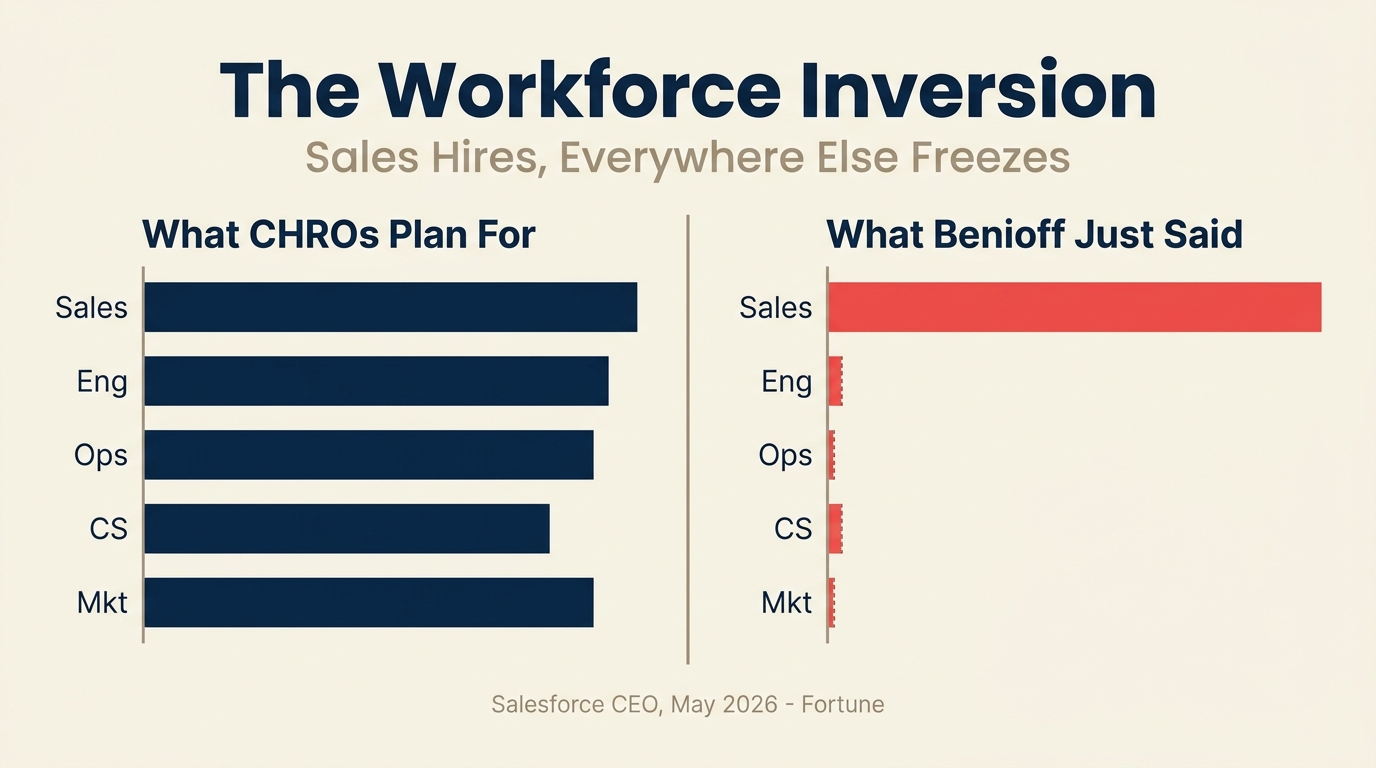
In einem Gespräch Ende Mai, über das Fortune berichtete, beschrieb Marc Benioff eine zweijährige Realität bei Salesforce: Die Engineering-Mitarbeiterzahl ist bei rund 15.000 stabil, während der Output des Unternehmens weiter wächst, weil AI-getriebene Produktivität das abgefedert hat, was sonst neue Einstellungen erfordert hätte. Jede Abteilung außer einer befindet sich in einem Einstellungsstopp. Diese eine Ausnahme ist der Vertrieb. Benioff war explizit: Der Vertrieb ist die einzige Funktion, die aktiv Mitarbeitende hinzufügt.
Das ist keine Randnotiz. Es ist ein strukturelles Signal. Und wenn Ihr Personalplan es nicht vor dem nächsten Vergütungszyklus berücksichtigt, gehen Sie mit Vergütungsbändern, Karriereleitern und Einstellungspipelines in das Jahr 2027, die für eine Welt konzipiert wurden, die nicht mehr existiert. Die breitere Datenlage bestätigt ihn: Laut CBS News wurden rund 17% der ungefähr 300.000 erfassten Jobkürzungen im Jahr 2026 direkt AI-Automatisierung zugeschrieben. Allwork.Space, unter Berufung auf Layoffs.fyi-Daten, berichtete, dass der Tech-Sektor allein bis Anfang Mai über 92.000 Stellen abgebaut hatte. Dennoch konkurrieren dieselben Unternehmen, die White-Collar-Mitarbeiterzahlen abbauen, gleichzeitig um AI-fähige Talente, die sie nicht finden können. Das ist kein Widerspruch. Es ist die Inversion.
Was Benioff tatsächlich sagte (und was es impliziert)
Wichtige Zahlen
- Salesforce Engineering-Mitarbeiterzahl: seit rund zwei Jahren bei etwa 15.000 eingefroren, da AI Kapazitäten absorbiert (Fortune, 28. Mai 2026)
- AI-zugeschriebene Entlassungen: rund 17% von ungefähr 300.000 Jobkürzungen im Jahr 2026 insgesamt (CBS News)
- Tech-Sektor-Entlassungen bis Anfang Mai 2026: über 92.000 gestrichene Stellen (Layoffs.fyi via Allwork.Space)
Die oberflächliche Lesart ist unkompliziert: AI hat Engineers produktiver gemacht, also muss Salesforce dieses Team nicht ausbauen. Aber die Implikationen reichen tiefer als ein einziges Unternehmens-Headcount-Diagramm.
Was Benioff beschrieb, ist eine Engineering-Organisation, die produktivitätselastisch ist. Wenn AI eine Arbeitseinheit absorbiert, muss die Funktion keinen Menschen hinzufügen, um Schritt zu halten. Das Team bleibt flach. Der Verantwortungsbereich wächst. Die Mitarbeiterzahl nicht. Das ist gut für die Bilanz und brutal für jeden, der eine Karriere darauf aufgebaut hat, vom Senior Engineer zum Engineering Manager aufzusteigen, indem er ein wachsendes Team führt.
Nun wechseln Sie zum Vertrieb. Benioff sagt, diese Funktion stellt noch ein. Nicht weil AI den Vertrieb nicht berührt hat. Das hat sie, auf bedeutsame Weise: Outreach-Automatisierung, Pipeline-Scoring, Prognose, Meeting-Vorbereitung. Aber der eigentliche umsatzgenerierende Moment, das Gespräch, das eine qualifizierte Chance in einen unterzeichneten Vertrag verwandelt, erfordert noch immer einen Menschen. AI-Agenten können die Leistung eines Vertriebsmitarbeitenden steigern. Sie können den Abschluss nicht ersetzen. Vertrieb ist produktivitätsinelastisch. Mehr Umfang bedeutet noch immer mehr Menschen.
Das ist die Spaltung, die CHROs noch nicht vollständig einkalkuliert haben. Und sie bricht drei Dinge, von denen die meisten Personalpläne annehmen, dass sie stabil bleiben.
Die Inversion, die niemand einkalkuliert hat
Die meisten Personalpläne wurden auf einem groben Einstellungsverhältnis aufgebaut. Für jede Vertriebseinstellung würden Unternehmen fünf bis sieben Mitarbeitende in Engineering, G&A, Operations und Marketing hinzufügen. Dieses Verhältnis ergab Sinn, als jede Funktion Mitarbeitende brauchte, um den Verantwortungsbereich zu skalieren. Es ergibt keinen Sinn mehr.
AI hat in nicht-umsatzerzeugenden Funktionen den Verantwortungsbereich von der Mitarbeiterzahl entkoppelt. Ein Finance-Team von acht Personen, das früher zwölf brauchte, um nach einer Übernahme die Bücher abzuschließen, kann jetzt dieselben Bücher mit acht oder sechs abschließen, weil AI Abstimmungen, Varianzmarkierungen und Berichtsentwürfe übernimmt. Dasselbe Muster spielt sich in Legal Ops, HR Ops, Marketing Ops und Engineering ab. Sie brauchen nicht mehr Menschen, um mehr Arbeit zu erledigen. Sie brauchen bessere Tools.
Umsatz ist anders. Wenn ein Unternehmen ein neues Marktsegment hinzufügt, braucht es Menschen, die es ansprechen, es demoen, mit ihm verhandeln und es abschließen. AI macht diese Menschen effizienter. Es ersetzt sie nicht. Das Verhältnis von AI-Verstärkung zu menschlichem Ersatz ist in umsatzerzeugenden Rollen viel geringer als in jeder Back-Office-Funktion.
Das ist die Inversion: Die Organigramm-Funktionen, die früher das meiste Wachstum bei den Mitarbeiterzahlen absorbierten, sind jetzt elastisch. Die eine Funktion, die immer schlank aussah, stellt als einzige noch ein. Ihre Vergütungsbänder, Karriereleitern und Recruiting-Budgets wurden mit hoher Wahrscheinlichkeit unter der Annahme des alten Verhältnisses aufgebaut. Sie müssen unter der Annahme des neuen Verhältnisses neu aufgebaut werden.
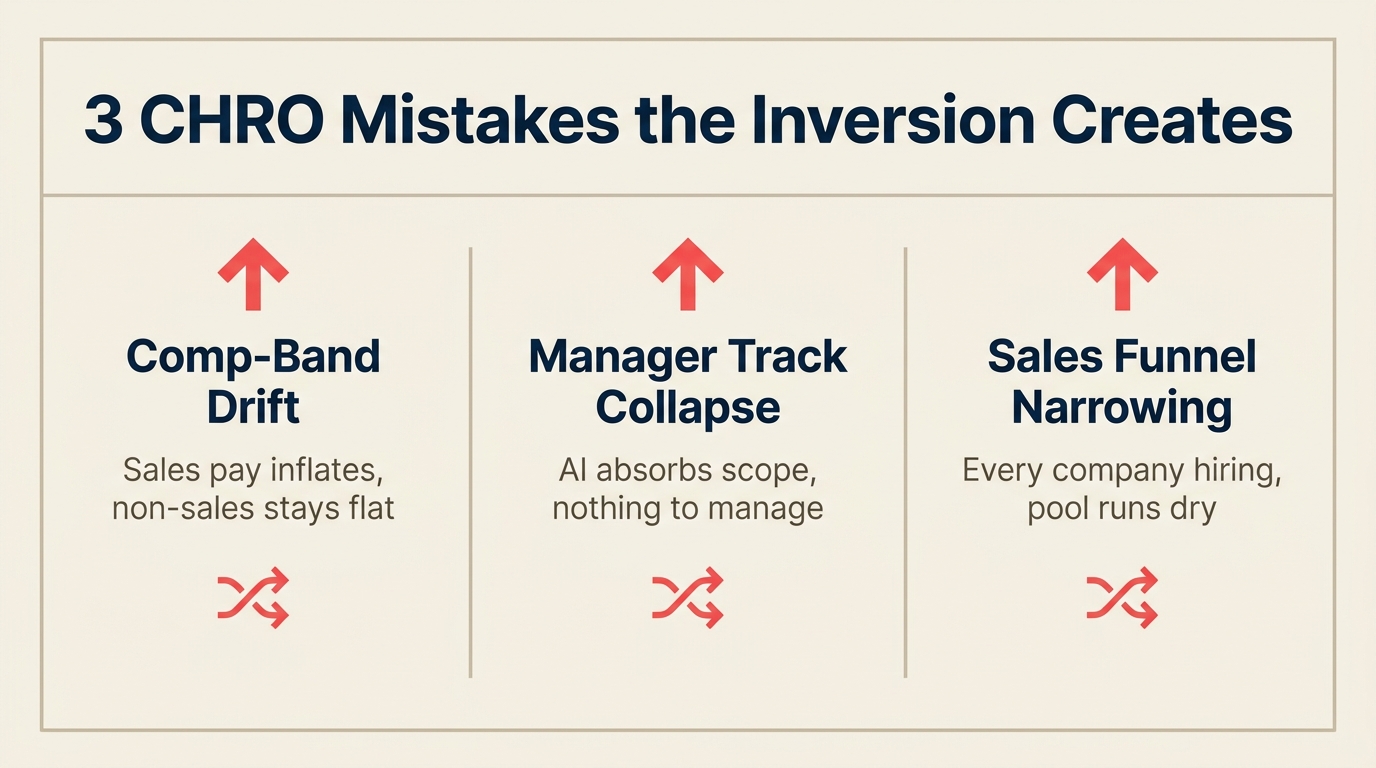
Drei CHRO-Fehler, die die Inversion erzeugt
1. Vergütungsband-Abdrift
Wenn jedes Unternehmen gleichzeitig beginnt, Vertriebsmitarbeitende einzustellen, verengt sich das Angebot schnell. Grundgehälter für Account Executives (AE), On-Target-Earnings und Signing-Pakete werden steigen, weil die Nachfrage den verfügbaren Pool erfahrener Abschlussexperten übersteigt. Gleichzeitig bleibt die Nicht-Vertriebsvergütung verankert, weil AI Verantwortungsbereiche absorbiert, die sonst Gehaltserhöhungen für wachstumswillige Menschen erfordert hätten.
Die relative Lücke zwischen Vertriebs- und Nicht-Vertriebs-Vergütung wird sich vergrößern, und zwar schneller als die meisten Vergütungszyklen darauf ausgelegt sind, sie zu erfassen. CHROs, die Vertriebsbänder nicht proaktiv anheben, werden Angebote verlieren. CHROs, die Nicht-Vertriebs-Bänder nicht an den tatsächlichen Verantwortungsbereich anpassen, werden für Stellen zu viel zahlen, bei denen AI die Wachstumserwartungen reduziert hat. Beide Fehler verstärken sich über 12 bis 18 Monate.
Die Lösung ist nicht kompliziert, aber sie ist dringend: Führen Sie jetzt eine Marktpreisaktualisierung für jedes Vertriebsband durch, vor dem Start Ihres nächsten Vergütungszyklus. Vergleichen Sie mit aktuellen Angebotsdaten, nicht mit den Benchmarks des Vorjahres.
2. Zusammenbruch des Führungstracks für Nicht-Vertriebsrollen
Der klassische Individual-Contributor (IC) zu Führungskraft Beförderungspfad in Engineering, Operations und G&A setzte voraus, dass es mit der Zeit ein größeres Team zu führen geben würde. Diese Annahme bricht. Wenn die Mitarbeiterzahl flach ist oder sinkt, weil AI Verantwortungsbereiche absorbiert, gibt es nichts zu managen, das AI nicht bereits orchestriert. Die Managementebene wird dünner. Beförderungszeiten verlängern sich. Talentierte Nicht-Vertriebs-ICs schauen auf die Karrieredecke und fragen sich, ob ihr nächster Schritt bei einem anderen Unternehmen sein sollte.
CHROs, die keinen Nicht-Vertriebs-IC-Aufstiegspfad aufbauen, um den Führungstrack zu ersetzen, werden erleben, dass Fluktuation still eskaliert. Die Engineers und Analysten, die gut genug für eine Beförderung wären, aber keine erhalten, werden ihre Frustration nicht ankündigen. Sie nehmen einfach das Angebot eines Unternehmens an, das herausgefunden hat, wie man tiefe IC-Beiträge belohnt, ohne ein zu führendes Team vorauszusetzen.
Die Antwort ist eine Staff- oder Principal-IC-Stufe mit Vergütung und Sichtbarkeit, die einem Führungsband entspricht, gebunden an Wirkung und Verantwortungsbereich statt an Teamaufsicht. Das ist kein neues Konzept. Es ist nur neu dringend.
3. Der Vertriebs-Funnel verengt sich von wettbewerbsfähig auf nahezu unmöglich
Wenn jedes Unternehmen, das denselben modernen Personalplan liest, dasselbe Benioff-Signal liest und gleichzeitig entscheidet, die Vertriebseinstellungen zu erhöhen, verengt sich der externe Markt für erfahrene Abschlussexperten sofort. Das Angebot skaliert nicht schnell. Erfahrene AEs entstehen nicht aus dem Nichts. Und die Unternehmen, die interne Talentpipelines für den Vertrieb aufgebaut haben, werden die Unternehmen, die sich vollständig auf externes Recruiting verlassen, schlicht auskonkurrieren.
Das ist der Fehler mit dem längsten Vorlauf und dem am wenigsten sichtbaren kurzfristigen Schaden. Ein CHRO, der bis Q3 wartet, um 20 AE-Stellen zu öffnen, wird sechs Monate damit verbringen, Kandidaten zu suchen, die von 40 anderen Unternehmen rekrutiert werden. Ein CHRO, der vor 12 Monaten ein internes Vertriebsrotationsprogramm gestartet hat, verfügt über eine gut gepflegte Pipeline von Menschen, die das Unternehmen, das Produkt und den Kunden bereits kennen.
Das Vertriebsrotationsprogramm, das sich aufschaukelt
Die beständigste Absicherung gegen einen verengten externen Vertriebstalentmarkt ist ein internes Rotationsprogramm. Das ist nicht neu. Es wird nur zu wenig genutzt, weil es unnötig schien, als Vertriebstalente reichlich vorhanden waren. Diese Ära endet.
Die Mechanik ist unkompliziert. Sie identifizieren High Performer in Nicht-Vertriebsfunktionen, die die Verhaltenssignale eines guten Vertriebsmitarbeitenden zeigen: Ambiguitätstoleranz, Neugier auf Kunden, Resilienz gegenüber Ablehnung und starke Kommunikation. Sie bieten ihnen eine strukturierte 90-tägige Rotation in eine SDR- oder CSM-Rolle mit einem klaren Konversionspfad an. Sie geben ihnen Quota-Exposition, einen Coach und eine definierte Ergebniskennzahl.
Drei Rotationsoptionen, die sich bewährt haben:
- Engineer zu AE. Technische Käufer vertrauen technischen Verkäufern. Engineers, die in AE-Rollen rotieren, übertreffen bei komplexen Enterprise-Deals oft die Erwartungen, weil sie das Produktgespräch ohne Sales Engineer führen können. Die Anlaufzeit ist länger. Das Potenzial ist höher.
- Support zu Customer Success Manager (CSM). Support-Mitarbeitende wissen bereits, wo Kunden Schwierigkeiten haben. Dieses Wissen lässt sich direkt auf Expansionsgespräche anwenden. Ein Support-Mitarbeitender, der 200 Tickets zu Bindungsrisiken bearbeitet hat, ist bereits ein Bindungsspezialist. Er braucht nur noch den kommerziellen Rahmen.
- Marketer zu SDR. Marketer verstehen Messaging, Käuferpsychologie und Einwandmuster. Die Lücke zwischen einem Demand-Gen-Marketer und einem produktiven SDR ist vor allem Pipeline-Mechanik und Anrufwiederholung, beides lässt sich in 60 Tagen erlernen.
Für einen tieferen Einblick in die Anforderungen an eine starke AE-Leistung, bevor Sie die Rotationskriterien aufbauen, bieten die Account Executive Playbooks und BDR/SDR Playbooks die Rollenprofile, die Sie benötigen. Die Sales Manager Job Description Template skizziert die Fähigkeiten, auf die Sie bei Rotationskandidaten achten, bevor sie auf einen Führungstrack wechseln.
Interne Rotationsprogramme haben einen kumulativen Vorteil gegenüber externem Recruiting: Die Menschen, die Sie rotieren, vertrauen bereits Ihrer Unternehmenskultur, kennen Ihr Produkt und verstehen Ihre Kundenbasis. Sie schließen schneller ab, wenn sie die AE-Rolle erreichen. Und weil Sie in sie investiert haben, bleiben sie länger.
Das Inversions-Audit: 5 Fragen für die nächsten 30 Tage
Nutzen Sie dies als Ausgangspunkt für Ihre Personalplanüberprüfung. Wenn Sie nicht alle fünf mit aktuellen Daten beantworten können, sind die Lücken Ihre Handlungsfelder.
1. Wie sieht unsere Vertriebsvergütung im Vergleich zu aktuellen Marktangeboten aus, nicht zu den Daten des Vorjahres? Holen Sie Angebotsschreiben der letzten 60 Tage und vergleichen Sie mit dem, was Sie aktuellen Mid-Level-AEs zahlen. Wenn Sie mehr als 10% unter dem Markt bei der Gesamtvergütung liegen, verlieren Sie bereits Kandidaten an Unternehmen, die angepasst haben.
2. Haben wir eine Nicht-Vertriebs-IC-Karriereleiter mit definierten Vergütungsbändern? Wenn die Antwort "Wir haben einen Führungstrack" lautet, ist das nicht dasselbe. Der Führungstrack setzt voraus, dass es ein Team zu führen gibt. Bauen Sie den IC-Track jetzt auf, bevor das Fluktuationsgespräch beginnt. Die Kompetenz-Frameworks für strategisches Denken und Entscheidungsfindung sind nützliche Anker für die Definition, wie tiefe IC-Beiträge über rein technischen Output hinaus aussehen.
3. Welche Nicht-Vertriebs-Funktionen in unserem Unternehmen sind elastisch, welche neutral, welche inelastisch? Wenden Sie den Produktivitätselastizitätstest an: Fragen Sie für jede Funktion, ob AI eine Arbeitseinheit absorbiert bedeutet, dass Sie Menschen hinzufügen müssen (inelastisch), Mitarbeiterzahl halten (neutral) oder Mitarbeiterzahl reduzieren können (elastisch). Gleichen Sie das mit Ihrem aktuellen Personalplan ab. Die Funktionen, die Sie als elastisch markiert haben, sind diejenigen, aus denen Sie Budget in Richtung Vertrieb umlenken.
4. Welche interne Vertriebsrotationskapazität haben wir aktuell? Wenn Sie kein Programm haben, was würde ein Pilotdurchlauf mit fünf Personen über 90 Tage kosten? Das ist eine deutlich kleinere Zahl als sechs Monate externe Recruitinggebühren für fünf AE-Einstellungen.
5. Wenn jeder Wettbewerber dasselbe Benioff-Signal liest und nächstes Quartal Vertriebsstellen öffnet, was ist unser Sourcing-Plan? Wenn die ehrliche Antwort "LinkedIn und ein Recruiter" lautet, brauchen Sie einen zweiten Plan. Die Account Manager Playbooks behandeln die Bindungsseite dieser Gleichung: Sobald Sie Menschen in Umsatzrollen eingestellt oder rotiert haben, wie halten Sie sie.
Was diese Woche zu tun ist
Das sind die Maßnahmen, die vor der Festschreibung des nächsten Vergütungszyklus wichtig sind.
Führen Sie den Produktivitätselastizitätstest in Ihrem Organigramm durch. Nehmen Sie jede Funktion, wenden Sie den Test an und sortieren Sie in elastisch, neutral und inelastisch. Präsentieren Sie das Ergebnis Ihrem CEO und CFO. Das verändert das Workforce-Gespräch von "Wo kürzen wir?" zu "Wo lenken wir um?"
Starten Sie eine 30-tägige Vergütungsaktualisierung für alle Vertriebsbänder. Warten Sie nicht auf den Jahreszyklus. Holen Sie aktuelle Angebotsdaten, Marktumfragen aus diesem Quartal und Gegenangebotsdaten aus Vertriebsabgängen der letzten 90 Tage. Passen Sie an, bevor das nächste Angebot herausgeht.
Gestalten Sie das Grundgerüst eines internen Vertriebsrotationsprogramms. Sie müssen es noch nicht starten. Sie brauchen das Design: Auswahlkriterien, 90-tägige Curriculum-Übersicht, Coach-Zuweisungsmodell, Konversionskennzahlen und Vergütungsbrücke. Lassen Sie das Design genehmigen, damit Sie es in einem statt in drei Quartalen starten können.
Bauen Sie die Senior-IC-Leiter für mindestens eine Nicht-Vertriebs-Funktion auf. Wählen Sie Engineering oder Operations als Pilot. Definieren Sie zwei Stufen über Senior (Staff und Principal oder Äquivalent). Legen Sie die Vergütungsbänder fest. Kündigen Sie es intern an, bevor Fluktuation daraus einen Bindungsnotfall macht.
Informieren Sie Ihren CEO über die Inversion. Rahmen Sie es mit dem Business-Acumen-Kompetenz-Framework: die strategischen Implikationen eines Personalplans, der für das alte Einstellungsverhältnis bepreist wurde. Die meisten CEOs verstehen das Benioff-Signal auf der Schlagzeilenebene. Sie haben es noch nicht mit der Vergütungsband-Exposition, der Karriereleiter-Fragilität oder einem sich verengenden Vertriebstalentpool in Verbindung gebracht. Diese Verbindung herzustellen ist Ihre Aufgabe.
Weiterlesen
- Account Executive Playbooks: Ihre ersten 30/60/90 Tage als neuer AE
- BDR/SDR: AI im Prospecting und was Sie ignorieren sollten
- Account Manager: Verlängerungsverhandlungs-Playbook
Häufig gestellte Fragen
Wenn der Vertrieb der einzige Einstellungstrack ist, sollten wir in anderen Funktionen komplett aufhören einzustellen?
Nicht vollständig, aber Sie sollten erheblich verlangsamen und Budget umlenken. Der Produktivitätselastizitätstest hilft Ihnen zu entscheiden, welche Funktionen tatsächlich elastisch sind (AI absorbiert Verantwortungsbereich, keine neuen Einstellungen nötig), welche neutral sind (Mitarbeiterzahl halten, weiterqualifizieren) und welche inelastisch sind (benötigen noch immer Menschen zur Skalierung). Die meisten Unternehmen werden feststellen, dass der Vertrieb und Teile des Customer Success inelastisch sind. Der Rest kann weitgehend flach bleiben oder leicht schrumpfen und dabei die Ausgabe erhalten.
Wie binden wir Nicht-Vertriebsmitarbeitende, wenn der Führungstrack sich verkürzt?
Indem Sie ihn durch eine Senior-IC-Leiter ersetzen, die tatsächlich Vergütungsgewicht hat. Forschungen zur Motivation von High Performern zeigen konsistent, dass Sichtbarkeit, Verantwortungsbereich und Vergütung langfristig mehr zählen als Titel. Ein Principal Engineer, der ein kritisches System verantwortet und wie ein Senior Manager vergütet wird, wird nicht gehen, weil er keinen VP-Titel bekam. Ein Senior Engineer ohne Aufstiegsperspektive und mit stagnierendem Gehalt wird es. Bauen Sie die Leiter auf, bevor die Fluktuationszahlen es von Ihnen verlangen.
Ist interne Vertriebsrotation tatsächlich schneller als externes Recruiting?
Beim Erreichen der vollen Produktivität in der Regel ja. Externe Einstellungen brauchen 60 bis 90 Tage Einarbeitungszeit allein zum Verstehen des Produkts und des ICP. Interne Rotationen beginnen mit diesem Wissen. Der inkrementelle Anlauf betrifft vor allem Vertriebsmechanik und Pipeline-Wiederholung. Viele Unternehmen mit Rotationsprogrammen berichten, dass interne Vertriebsrotationen die volle Produktivität 30 bis 45 Tage schneller erreichen als externe Einstellungen in dieselbe Rolle, mit deutlich geringerer Frühfluktuation.

Co-Founder, Rework.com
On this page
- Was Benioff tatsächlich sagte (und was es impliziert)
- Die Inversion, die niemand einkalkuliert hat
- Drei CHRO-Fehler, die die Inversion erzeugt
- Das Vertriebsrotationsprogramm, das sich aufschaukelt
- Das Inversions-Audit: 5 Fragen für die nächsten 30 Tage
- Was diese Woche zu tun ist
- Weiterlesen
- Häufig gestellte Fragen