More in
Sales Tech News
Meta Put an AI Agent in WhatsApp That Closes Sales for Any Business
thg 6 4, 2026
Are AI SDRs Worth It in 2026? The Data Says Build a Hybrid Team
thg 6 3, 2026
GTM Engineering in 2026: The Sales Hire That Replaces Three Roles
thg 6 3, 2026 · Currently reading
ZoomInfo Feeds Verified Data to Your AI Sales Agents: The Single-Vendor Tradeoff
thg 6 3, 2026
Salesforce Summer '26 Drops Multi-Agent Orchestration June 15. Here's the Sales Ops Audit Before Your Agents Start Handing Off
thg 6 2, 2026
Outreach Wired In 20 New Buying Signals for Your Sales Team
thg 6 2, 2026
Salesforce Buys Contentful to Give Agentforce a Content Engine
thg 6 2, 2026
Why AI-Native Startups Pick Their CRM by the Agents, Not the UI
thg 6 2, 2026
Agentforce Just Hit $1.2B ARR in 14 Months: What CROs Should Audit Before Q3 Planning
thg 6 1, 2026
Sierra Just Crossed $15B Selling AI Customer Agents Into Half the Fortune 50. Here's the Sales Ops Read
thg 6 1, 2026
GTM Engineering in 2026: The Sales Hire That Replaces Three Roles

The playbook most sales leaders run: pipeline is soft, so you hire more reps. Two more sales development representatives (SDRs), another account executive, maybe an operations analyst. It's a pattern that made sense when the leverage in outbound was human effort.
That logic is breaking down. And the job market just showed us what's replacing it.
Go-to-market (GTM) engineering is the breakout revenue-team hire of 2026. Not because it's a new concept, but because hiring demand has moved from niche to mainstream faster than most leaders expected. According to an analysis by Bloomberry of 1,000 GTM engineering job postings, this role tripled in volume from 2024 to 2025. The question isn't whether the category is real. It's whether you're hiring the right version of it.
What a GTM Engineer Actually Does
A GTM engineer builds the systems that make your revenue team scale without scaling headcount at the same rate. Instead of manually working a prospect list, they write the code that builds it, scores it against your ideal customer profile (ICP), enriches it with the right signals, routes it to the right rep, and logs everything back into your customer relationship management (CRM) system automatically.
The three traditional roles this consolidates: an SDR doing outreach and enrichment manually, a revenue operations analyst maintaining data integrity and CRM architecture, and a data analyst pulling reports and building scoring models. A strong GTM engineer owns all three output streams, but through systems rather than repetition.
Key Facts
- GTM engineering job postings grew approximately 205% year over year from 2024 to 2025, climbing from roughly 1,400 listings in mid-2025 to more than 3,000 by January 2026, according to Bloomberry's 1,000-posting analysis.
- SQL and Python each appear in roughly 38% of GTM engineer job postings, according to Bloomberry; the highest-paying roles expect candidates to write code, not just configure tools.
- Median GTM engineer salary in the Bloomberry dataset: approximately $127,500 per year, with top employers like Vercel and OpenAI listing compensation near $250,000.
The highest-leverage responsibilities in the role, as Bloomberry's data shows: building and automating go-to-market workflows, integrating the GTM tech stack, and owning CRM architecture. Clay, the workflow and enrichment platform, appears as the most-mentioned tool in postings. HubSpot shows up in roughly 52% of listings, Outreach in roughly 49%, Salesforce in roughly 45%, and Zapier in about 39%. About 43% of hiring companies also list visitor-identification or intent tools such as ZoomInfo, 6sense, or Apollo as part of the stack.
The average experience required is about 4.1 years. This isn't an entry-level role dressed up with a technical-sounding title.
The Builder vs. Operator Split You Can't Ignore
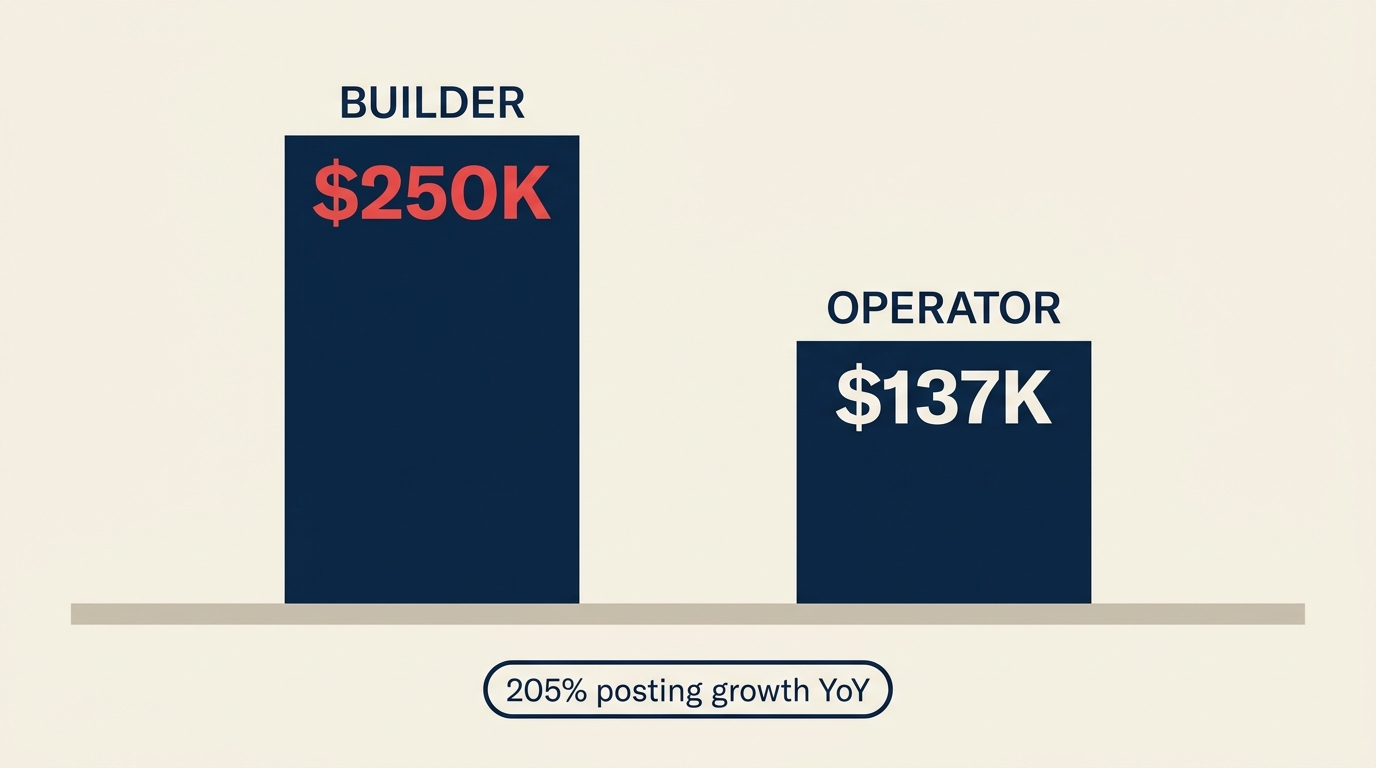
Here's the trap hidden inside the "GTM engineer" label: the compensation data is bimodal, and the two groups have almost nothing in common except the job title.
Pure builder roles, where the candidate writes production-quality code and architects systems from scratch, pay a median near $250,000. Non-technical roles carrying the same "GTM engineer" label, where the work is configuring tools and managing workflows in platforms like Clay and Zapier, pay a median near $137,500. That's a gap of roughly $112,500 inside the same job title, a range confirmed by market analyses from recruiting firms including Revnu, which puts the full span at $99,000 to $310,000.
The mistake most sales leaders make: they write a job description that sounds like the builder role but budget for the operator role. Or they hire the builder, have no engineering infrastructure to support them, and lose them within six months. Getting this wrong is expensive in both directions.
The Builder vs. Operator GTM Hire Test comes down to three questions:
- Does your pipeline bottleneck live in system architecture (broken data, no ICP scoring, manual enrichment at every step) or in workflow execution (the systems exist but aren't being used well)?
- Do you have engineering management, code review, and deployment infrastructure to support a software-engineer-grade hire?
- Is your CRM a mature platform that needs integration and automation, or a partially configured tool that needs someone to finish the setup?
If you answered "architecture" to the first and "yes" to the second, you may genuinely need a builder. Most sales orgs, especially below $50M annual recurring revenue, need the operator first.
Where the Role Sits in Your Org
GTM engineering sits at the intersection of sales, operations, and data. It's not a pure engineering role reporting into a chief technology officer (CTO), and it's not a classic SDR role reporting into a sales manager. The most natural home is revenue operations, with a direct or dotted line to the head of revenue or chief revenue officer (CRO).
That placement matters for two reasons. First, the role needs access to the full GTM stack, including the CRM, sequencing tools, enrichment platforms, and intent data. Those systems live in RevOps. Second, the role needs a mandate to change workflows, not just support them. Parking a GTM engineer inside a rep team without RevOps authority produces someone who runs reports for the team rather than someone who rewrites the system.
The rise of agentic GTM platforms is accelerating this dynamic. Platforms like Apollo are building agent layers that a GTM engineer can wire together without writing backend code. That shifts some builder work toward operators, but it also raises the bar on what "good operator" means.
For a sharper view of how the CRM stack itself is reorganizing around agentic tooling, the agent-first CRM comparison is worth reading alongside the hiring question.
When One Engineer Beats Three More SDRs
The leverage argument is straightforward once you quantify it. A GTM engineer building an outbound system that runs ICP scoring, enrichment, and personalized sequencing for 2,000 accounts per month is doing work that would require two to three SDRs operating manually, at a fraction of the per-output cost after the first quarter.
But the case isn't universal. If your pipeline problem is coverage (you don't have enough people talking to enough accounts), a GTM engineer helps only if the system they build dramatically expands that coverage. If the problem is conversion (reps are talking to accounts but not closing them), the engineer doesn't fix the core issue.
The framing that holds: GTM engineering solves a pipeline efficiency problem, not a pipeline volume problem at the top of the funnel. Before hiring, you need to know which one you have.
The AI SDR evaluation for 2026 covers adjacent territory, including when automation at the SDR layer makes sense versus when it adds complexity without solving the right problem. The two hires often get confused; they're solving different things.
The Salesforce State of Sales 2026 data also shows that top-performing sales organizations are already separating system-building from outreach execution. The GTM engineer role formalizes what high performers have been doing informally for two years.
What to Do This Quarter
Four concrete moves for sales leaders considering this hire.
Audit your pipeline bottleneck first. Before writing a job description, map where pipeline is actually breaking. Is it lead quality? Enrichment gaps? Slow ICP scoring? Poor routing? Broken CRM data? The answer tells you whether you need a builder or an operator, and whether you need this hire at all yet.
Decide builder vs. operator before you post the role. Use the three questions above. If you're not sure, start with the operator profile. An operator who can automate Clay workflows, build Salesforce flows, and maintain enrichment pipelines will generate measurable output within 60 days. A builder who needs six months to understand the business before shipping anything is a harder ROI case for most revenue teams.
Write a job description that screens for code. If you want the builder tier, require a take-home assignment: a sample Clay enrichment table, a Python script that pulls from a public API, or a Salesforce SOQL query. You'll filter out 80% of applicants fast. If you want the operator tier, the assignment should be building a mock multi-step Clay workflow from a prompt. Either way, require a demonstration.
Budget realistically. An operator-tier GTM engineer in a competitive market costs $120,000 to $150,000 in base salary plus benefits. A builder-tier hire costs $200,000 to $250,000 or more in major tech markets. Neither number is wrong; they're just different bets. Factor in six months of ramp time before full productivity either way.
One GTM engineer building pipeline systems outperforms three SDRs working the same volume manually, but only when the role is scoped correctly, placed in the right part of the org, and screened with a demonstration rather than a resume keyword match. That's the hire. Get those three things right.
Frequently Asked Questions
What does a GTM engineer do?
A GTM engineer builds and automates the systems that power a company's go-to-market motion. This includes outbound workflows (lead enrichment, ICP scoring, personalized sequencing), CRM architecture (data integrity, routing rules, automation), and GTM stack integration (connecting tools like Clay, HubSpot, Apollo, and Outreach so data flows without manual intervention). The role replaces work that would otherwise fall to multiple SDRs, ops analysts, and data analysts working manually.
How much does a GTM engineer make in 2026?
The median salary in Bloomberry's 1,000-posting dataset is approximately $127,500 per year. But the market is bimodal. Builder-tier roles, where the candidate writes code and architects systems, pay near $250,000 at top employers. Operator-tier roles, focused on configuring no-code and low-code platforms, pay closer to $137,500. Revnu's market analysis puts the full compensation range at $99,000 to $310,000. The gap inside the same job title is roughly $112,500, which is why the builder vs. operator distinction matters before you post the role.
Should I hire a GTM engineer instead of more SDRs?
It depends on your pipeline problem. GTM engineering solves an efficiency problem: systems are manual, data is messy, enrichment is slow, and scaling headcount doesn't fix any of it. If that's your situation, one GTM engineer building the right systems outperforms two to three SDRs working the same volume by hand. But if your problem is pure coverage or rep-level conversion, the engineer addresses the wrong layer. Audit your bottleneck before deciding.