More in
Sales Tech News
Meta Put an AI Agent in WhatsApp That Closes Sales for Any Business
thg 6 4, 2026
Are AI SDRs Worth It in 2026? The Data Says Build a Hybrid Team
thg 6 3, 2026
GTM Engineering in 2026: The Sales Hire That Replaces Three Roles
thg 6 3, 2026
ZoomInfo Feeds Verified Data to Your AI Sales Agents: The Single-Vendor Tradeoff
thg 6 3, 2026
Salesforce Summer '26 Drops Multi-Agent Orchestration June 15. Here's the Sales Ops Audit Before Your Agents Start Handing Off
thg 6 2, 2026
Outreach Wired In 20 New Buying Signals for Your Sales Team
thg 6 2, 2026
Salesforce Buys Contentful to Give Agentforce a Content Engine
thg 6 2, 2026
Why AI-Native Startups Pick Their CRM by the Agents, Not the UI
thg 6 2, 2026 · Currently reading
Agentforce Just Hit $1.2B ARR in 14 Months: What CROs Should Audit Before Q3 Planning
thg 6 1, 2026
Sierra Just Crossed $15B Selling AI Customer Agents Into Half the Fortune 50. Here's the Sales Ops Read
thg 6 1, 2026
Why AI-Native Startups Pick Their CRM by the Agents, Not the UI
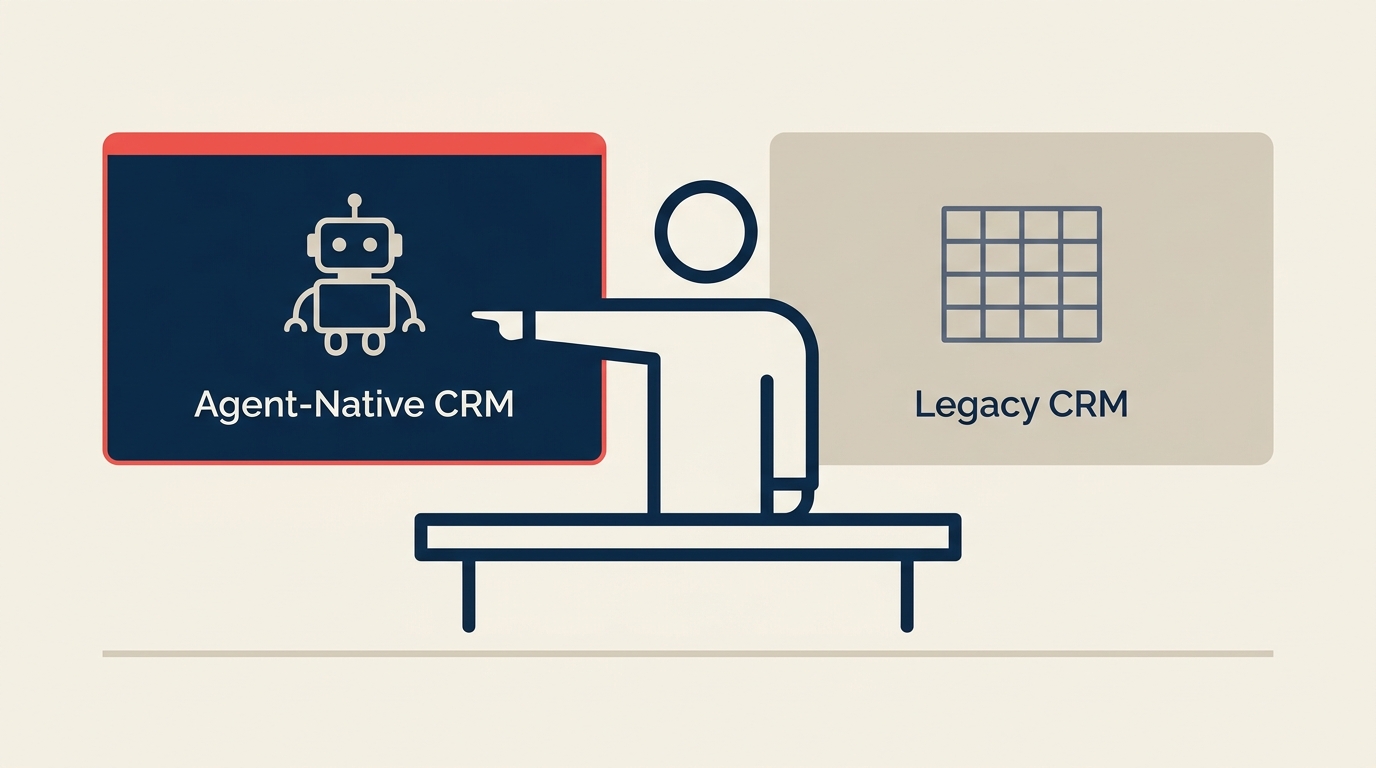
The way founders choose a customer relationship management (CRM) platform is changing fast. It used to be a feature race. Now it's a question of what the platform's agents can do without a human in the loop.
According to SaaStr, the go-to-market (GTM) intelligence publication that tracks B2B software trends, the CRM that wins in 2026 and 2027 is the one whose AI agents actually execute the work, not the one with the longest integration list. SaaStr frames this as "follow the agents": pick the platform where agents are the core product, not a marketing add-on bolted onto a legacy data model. A growing share of AI-native founders are already applying this logic when they start building their commercial stack.
The shift was a dominant theme at SaaStr AI Annual 2026, held May 12-14, where speakers and attendees repeatedly described the market moving from "AI inside the CRM" to "the CRM rebuilt around agents." That framing matters for any founder who is setting up their first real GTM infrastructure or reconsidering a platform choice at scale.
What "Agent-First" Actually Means for a CRM
An agent-first CRM (sometimes called an agentic CRM) puts autonomous AI workflows at the center of the product, rather than treating them as premium add-ons. The agents handle tasks that used to require a rep or an ops hire: enriching new contacts from public signals, researching accounts before a call, drafting and sequencing follow-ups, flagging stale deals, cleaning duplicate records, routing inbound leads by intent score.
The contrast with a traditional CRM is structural, not cosmetic. A traditional platform stores data and surfaces it to humans who then act. An agent-native platform stores data and acts on it directly, reporting outcomes back to humans. For an AI-native startup whose revenue motion depends on a small team moving fast, those two architectures produce very different GTM velocities.
Key Facts
- Attio, an agent-native CRM, raised a $52M Series B led by GV (Google Ventures), bringing total funding to approximately $116M, and counts AI-native companies Lovable, Granola, Modal, and Replicate among roughly 5,000 paying customers. (Source: Attio blog)
- Salesforce Agentforce reached approximately $1.2B in annual recurring revenue (ARR) in roughly 14 months, the fastest ARR ramp in Salesforce's history. (Source: SaaStr / Salesforce earnings recaps)
- OpenAI hired Brian Landsman, former CEO of Salesforce's AgentExchange, as VP of Global Partnerships, a signal that even AI labs are competing for the GTM-agent ecosystem. (Source: public LinkedIn / press coverage)
The Incumbent Bet vs. the Agent-Native Bet
This is not a story where the incumbents are losing. It's a story where the evaluation criteria are diverging by company profile.
Salesforce's Agentforce is a serious product. Reaching $1.2B ARR in roughly 14 months is not a bolted-on feature story: it reflects real enterprise adoption. HubSpot's Breeze suite is similarly moving from copilot features to agent workflows. Both platforms carry something an upstart cannot replicate overnight: data gravity. Years of contact history, activity logs, email threads, and deal records create a flywheel where the agents get smarter the longer the platform runs. At 500 employees, that gravity is a real asset.
But for a founder at seed or Series A, that same gravity is not yet earned. The question is which platform builds it fastest for a company whose sales motion is heavily automated from day one.
Agent-native upstarts like Attio are growing because they started with a different assumption: that the data model, the automation layer, and the agent surface should be designed together, not assembled across three acquisitions. Attio's customer list reads like a who's who of AI-native companies, Lovable, Granola, Modal, Replicate, companies that chose it specifically because the agent capabilities matched how they planned to sell.
SaaStr noted that a large share of current Y Combinator startups are no longer defaulting to Salesforce or HubSpot, choosing agentic GTM platforms instead. That's not a protest vote. It's a pragmatic bet on operational fit.
For a deeper look at how AI is reshaping the sales operations role itself, see What Is an AI Sales Operator? 4 Patterns Working Together and the Salesforce Agentforce $1.2B ARR audit for CROs.
The Founder Decision Framework
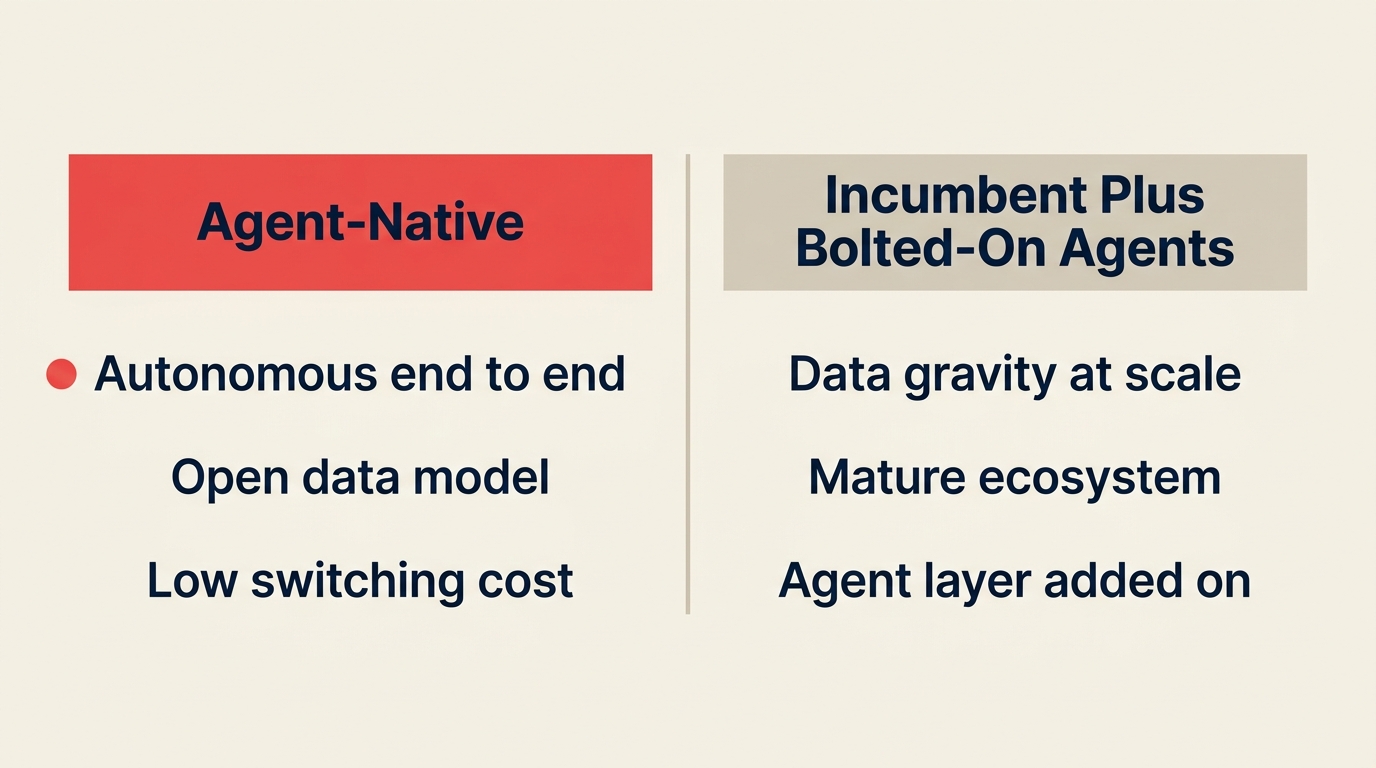
Before opening a comparison spreadsheet, run three questions. They won't give you a single right answer, but they will tell you which category of platform fits your stage.
Question 1: What does the agent automate end to end, without a human prompt?
Ask this for each platform on your list. Not "does it have AI features" but "what does the agent do on its own, start to finish, on a Tuesday when nobody is in the office?" Lead research, enrichment, follow-up sequencing, deal hygiene, inbound routing: which of those are fully autonomous and which still require a human to click a button? Score the platforms on agent autonomy, not on feature count.
Question 2: How open is the data model?
Your GTM motion will change. The agents you need at seed are not the agents you need post-Series B when you have an enterprise segment, a partner channel, and a customer success handoff. An agent-native platform with a flexible object model (custom objects, programmable workflows, open API) lets you rewire agent behavior as the motion evolves. A closed model locks you into the vendor's assumptions about how your pipeline should work.
Question 3: What is the realistic switching cost at your next funding milestone?
Switching a CRM at Series A when you have 3,000 contacts and 60 open deals is annoying. Switching at Series B when you have a 20-person sales team, 40,000 contacts, and a custom integration with your data warehouse is a multi-quarter project. Map the switching cost at the stage where you expect to revisit the decision, not at the stage you're at now.
This framework does not favor upstarts by default. A well-funded Series B company with a complex enterprise motion and a large contact database may find that Salesforce's data gravity, agent maturity, and ecosystem are the right fit, even if the platform started as a bolt-on story. The relevant comparison is not "which CRM has the coolest AI" but "which CRM's agent architecture matches how we plan to run GTM at the next stage of the business."
For context on how sales pipeline decisions interact with platform choice, the sales pipeline architecture guide is worth reviewing alongside any CRM evaluation.
How to Choose in 2026: Three Founder Actions
1. Run a live agent audit, not a demo. Ask each vendor to show you a recorded agent run on a real account, from raw signal to logged CRM action, with no human in the loop. If the demo is a slide deck about roadmap, that tells you where the agents actually are.
2. Talk to three companies one stage ahead of you on the same platform. Not the vendor's reference list (those are cherry-picked). Find founders on the same platform who are 12-18 months ahead in revenue and company size. Ask them what the agents do well, what they still have to do manually, and whether they'd make the same choice again.
3. Model the migration cost before you sign. Estimate what a platform switch would cost in eng hours, ops disruption, and lost pipeline context at your next funding round. If the answer is "six weeks of RevOps time and two eng sprints," factor that into the TCO of a cheaper or more agent-capable alternative today. Total cost of ownership (TCO) for a CRM includes the cost of the decision you'll regret in 24 months.
The SaaStr "follow the agents" lens is a useful filter, not a mandate. The ROX AI-layer vs replace CRM evaluation and the Apollo agentic GTM platform evaluation both cover adjacent bets founders are making right now.
FAQ
What is an agent-first CRM?
An agent-first CRM is a platform where AI agents handle GTM tasks autonomously, including lead research, enrichment, follow-up sequencing, and pipeline hygiene, without requiring a human prompt for each action. The agents are built into the core data model rather than added as an optional layer on top.
Should an early-stage startup use Salesforce or an agent-native upstart like Attio?
It depends on your GTM motion and how agent-intensive it is from day one. Salesforce carries more data gravity and ecosystem depth but started with agents as an add-on. Agent-native platforms like Attio are growing fast among AI-native founders who want agent autonomy at seed, but the switching cost at scale is a real consideration. Use the three-question framework above (agent autonomy, data model openness, switching cost at next milestone) to decide.
What is the "best CRM for AI-native startups 2026"?
There is no single answer, but the AI-native CRM vs Salesforce comparison is most useful when framed as a stage decision. Founders at seed or Series A with a high-velocity, agent-driven GTM motion are choosing agentic platforms like Attio. Founders at Series B and beyond with complex enterprise pipelines and existing data gravity are more likely to stay with or move to Salesforce Agentforce. The question is fit, not which platform has the better product marketing.
Related Reading
- ROX: AI Layer vs. Replace CRM Evaluation
- Salesforce Agentforce $1.2B ARR: What CROs Should Audit
- Apollo's Agentic GTM Platform Evaluation
Source: Which CRM Should You Use in 2026/2027? Follow the Agents, SaaStr