What is Gross Margin? Why Revenue Without Margin Is Just Vanity
Turn this article into takeaways for your work.


Each assistant summarizes the article only for you and suggests best practices for your work.
"We did $10 million in revenue!" the founder announced proudly.
"What's your gross margin?" I asked.
"Well... our direct costs were about $9.5 million..."
That's a 5% gross margin. Or as I call it, a nonprofit with ambition.
Gross Margin: The First Truth of Business
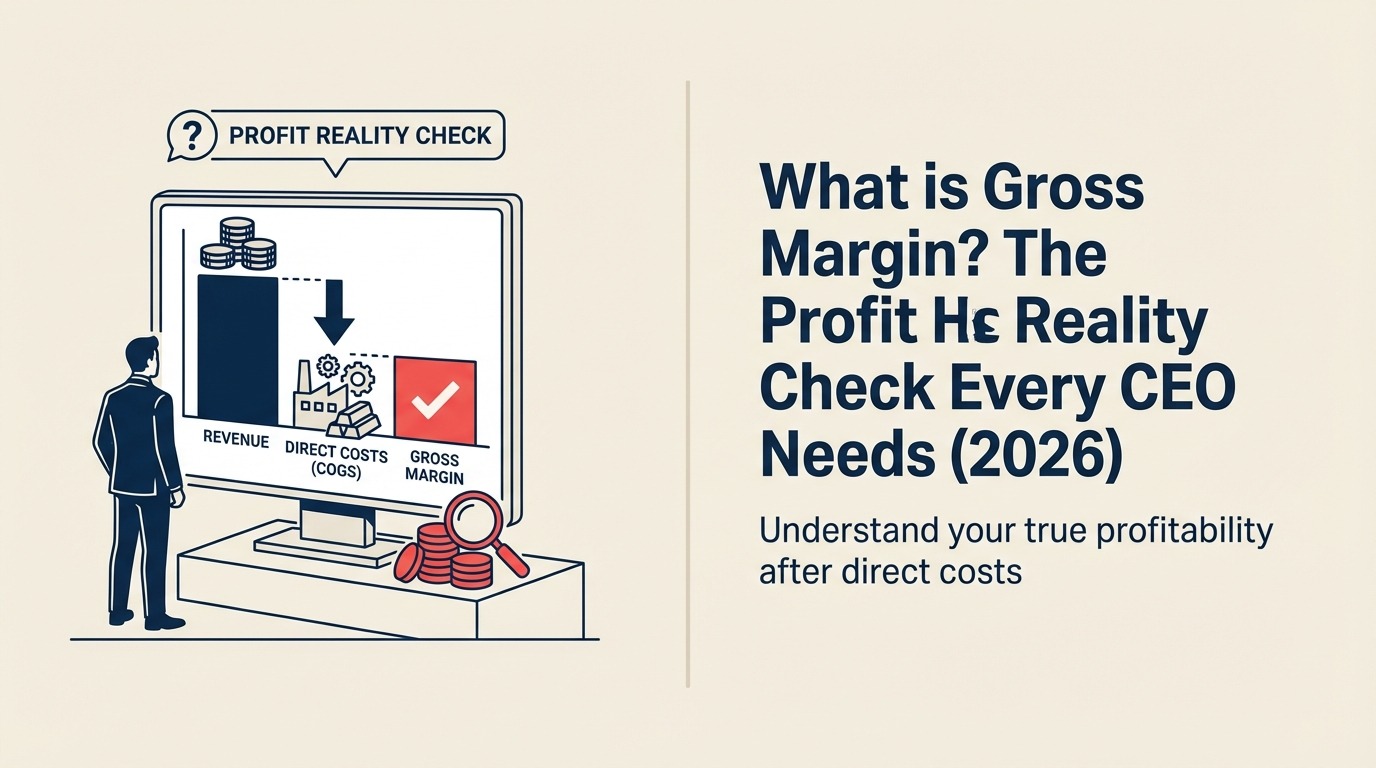
Gross Margin = (Revenue - Cost of Goods Sold) ÷ Revenue × 100
In plain English: How much money you keep from each sale after paying for what you sold.
- Revenue: $100
- Direct costs: $40
- Gross margin: 60%
- Meaning: You keep $60 to cover everything else
This is your business's first reality check. Because if your gross margin sucks, nothing else matters.
What Really Goes into COGS
Here's where most CEOs mess up, they don't include everything:
Manufacturing
- ✅ Raw materials
- ✅ Direct labor
- ✅ Factory overhead
- ❌ Sales commissions (that's operating)
- ❌ R&D (that's operating)
SaaS
- ✅ Hosting costs
- ✅ Third-party licenses
- ✅ Customer success (if dedicated)
- ❌ Sales team (operating)
- ❌ Product development (operating)
E-commerce
- ✅ Product cost
- ✅ Shipping to you
- ✅ Payment processing
- ❌ Marketing (operating)
- ❌ Warehouse rent (operating)
Services
- ✅ Direct labor on projects
- ✅ Contractor costs
- ✅ Project-specific tools
- ❌ Office rent (operating)
- ❌ Admin staff (operating)
Get this wrong, and you're lying to yourself about profitability.
Typical Gross Margin Ranges by Industry
Know where you stand. Treat these as rough rules of thumb, since margins swing widely by business model, accounting choices and company size:
Software/SaaS
- Excellent: 80-90%
- Good: 70-80%
- Concerning: Below 60%
- Fatal: Below 50%
E-commerce
- Luxury: 60-70%
- Standard retail: 40-50%
- Commodities: 20-30%
Manufacturing
- Specialized: 40-60%
- Standard: 25-40%
- Commodity: 15-25%
- Contract: 10-20%
Professional Services
- Consulting: 50-70%
- Agencies: 40-60%
- Implementation: 30-45%
- Staffing: 20-30%
Restaurants
- Fine dining: 60-70%
- Casual: 55-65%
- Fast food: 50-60%
- Delivery-heavy: 40-50%
The Gross Margin Reality Check
Three companies, all $1M revenue:
Company A: 80% margin = $800K to cover operations
Company B: 50% margin = $500K to cover operations
Company C: 20% margin = $200K to cover operations
Same revenue. Vastly different businesses. Company C needs 4x the revenue to match Company A's potential profit.
This is why VCs obsess over gross margin. It's your ceiling for everything else.
The Path to Margin Improvement
Four operating choices widen the margin left after direct costs, and each works through a different part of the business model.

1. Pricing Power (Fastest Impact)
5% price increase on 50% margin = 10% more gross profit per unit
Tactics that work:
- Value-based pricing
- Bundle to hide increases
- Annual increases (inflation + 2%)
- Premium tiers
Illustrative example: a SaaS company moves from $99/month to $119/month and loses 5% of customers. Revenue still rises about 14%, and because hosting and support costs barely change, nearly all of that lands in gross profit.
2. Cost Reduction (Biggest Impact)
10% COGS reduction on 50% margin = 5 percentage point improvement
Where to look:
- Supplier negotiation (annual)
- Volume discounts
- Alternative suppliers
- Process efficiency
- Waste reduction
Illustrative example: an e-commerce brand running a 60% margin cuts COGS by 15%, which adds 6 points of margin.
3. Mix Optimization (Strategic Impact)
Sell more high-margin products
The 80/20 rule applies:
- 20% of products drive 80% of margin
- Focus on winners
- Kill the losers
- Guide customers to better options
Example: a restaurant drops low-margin appetizers and promotes high-margin desserts, lifting its blended margin without raising a single price.
4. Operational Leverage (Scale Impact)
Fixed costs spread over more units
Works when:
- High fixed, low variable costs
- Capacity utilization below 80%
- Automation possible
Software is king here: Near-zero marginal cost means gross margin improves with scale.
Common Gross Margin Mistakes
Mistake 1: The Discount-Giant Trap
"Big discount retailers run on thin margins and they're huge!"
Yeah, and they spent decades building the scale, supplier leverage and cheap capital that make thin margins survivable. You don't have that yet. Low margins = no room for error.
Mistake 2: The Premium Delusion
"We're premium, so higher prices = higher margins"
Not if your COGS are premium too. Luxury handbags have great margins. Luxury cars? Not so much.
Mistake 3: The Scale Fantasy
"We'll make it up in volume"
If you lose money on each unit, selling more units loses more money. This isn't hard.
Mistake 4: The Hidden Cost Bomb
Forgetting returns, warranties, spoilage, theft. Real margin is often 5-10% lower than calculated.
Gross Margin's Ripple Effect
Your gross margin determines everything:
With 80% margins, you can:
- Spend heavily on R&D
- Build large sales teams
- Survive mistakes
- Fund growth internally
With 20% margins, you must:
- Run lean operations
- Focus on efficiency
- Minimize mistakes
- Need external funding
Low margins aren't bad if you know the game you're playing. But most don't.
The Margin Improvement Playbook
Month 1: Know Your Reality
- Calculate true gross margin
- Benchmark against industry
- Analyze by product/service
- Find the outliers
Month 2: Quick Wins
- Raise prices on inelastic products
- Negotiate with top 3 suppliers
- Kill lowest-margin offerings
- Fix obvious waste
Month 3: Systematic Improvement
- Implement value pricing
- Restructure supplier agreements
- Redesign high-volume products
- Automate repetitive processes
Month 4-6: Strategic Shifts
- Change business model if needed
- Enter higher-margin segments
- Build switching costs
- Create proprietary advantages
Technology for Margin Management
For Analysis
- ProfitWell Metrics (Paddle): SaaS revenue and churn metrics
- Fathom: Visual margin analysis
- Anaplan: Margin modeling
For Optimization
- Vendavo: Price optimization
- Coupa: Spend management
- NetSuite: Integrated margin tracking
For Monitoring
- Databox: Real-time dashboards
- Klipfolio: Custom margin KPIs
- Power BI: Deep analysis
Your Gross Margin Action Plan
This Week:
- Calculate exact gross margin
- List everything in COGS
- Compare to industry benchmarks
- Identify biggest cost drivers
This Month:
- Analyze margin by product/customer
- Test 5% price increase on one product
- Negotiate with largest supplier
- Kill lowest-margin offering
This Quarter:
- Implement margin-based pricing
- Restructure supplier relationships
- Optimize product mix
- Build margin dashboard
This Year:
- Achieve top-quartile margins
- Create sustainable advantages
- Build pricing power
- Fund growth from margins
The Bottom Line on Gross Margin
Gross margin is your business model's report card. It tells you:
- How efficient you are
- How much pricing power you have
- How sustainable your business is
- How fast you can grow
You can't cost-cut your way to greatness, but you can't grow your way out of bad margins either.
The magic happens when you combine healthy margins with strong growth. That's when businesses become empires.
Your move: Know your number. Improve it relentlessly. Because in business, margin is room to maneuver. And in 2026, you'll need all the room you can get.
Ready to go deeper? Master Unit Economics for granular profitability or explore pricing strategies to maximize margins.
Part of the Business Terms Collection.

Senior Operations & Growth Strategist
On this page
- Gross Margin: The First Truth of Business
- What Really Goes into COGS
- Typical Gross Margin Ranges by Industry
- The Gross Margin Reality Check
- The Path to Margin Improvement
- 1. Pricing Power (Fastest Impact)
- 2. Cost Reduction (Biggest Impact)
- 3. Mix Optimization (Strategic Impact)
- 4. Operational Leverage (Scale Impact)
- Common Gross Margin Mistakes
- Mistake 1: The Discount-Giant Trap
- Mistake 2: The Premium Delusion
- Mistake 3: The Scale Fantasy
- Mistake 4: The Hidden Cost Bomb
- Gross Margin's Ripple Effect
- The Margin Improvement Playbook
- Month 1: Know Your Reality
- Month 2: Quick Wins
- Month 3: Systematic Improvement
- Month 4-6: Strategic Shifts
- Technology for Margin Management
- For Analysis
- For Optimization
- For Monitoring
- Your Gross Margin Action Plan
- The Bottom Line on Gross Margin