What is Change Management? The Difference Between Transformation and Chaos
Turn this article into takeaways for your work.


Each assistant summarizes the article only for you and suggests best practices for your work.
Picture two companies rolling out the same ERP system. The first CEO announces "We're implementing a new ERP system" and leaves the rest to IT. Months later the budget has blown out, half the staff still work around the system, and a few key people have quit.
The second CEO starts with "We're evolving how we work," brings managers in early, and trains before go-live. A year later the system is simply how work gets done.
Same change. Different change management. Very different outcomes.
Change Management: The Human Side of Transformation
Change Management = The structured approach to transitioning individuals, teams, and organizations from current state to desired future state
It's not about the technical change. It's about:
- Hearts: Getting emotional buy-in
- Minds: Showing logical benefits
- Hands: Changing actual behaviors
Miss any one, and your transformation becomes expensive chaos.
What the Change Failure Numbers Actually Say
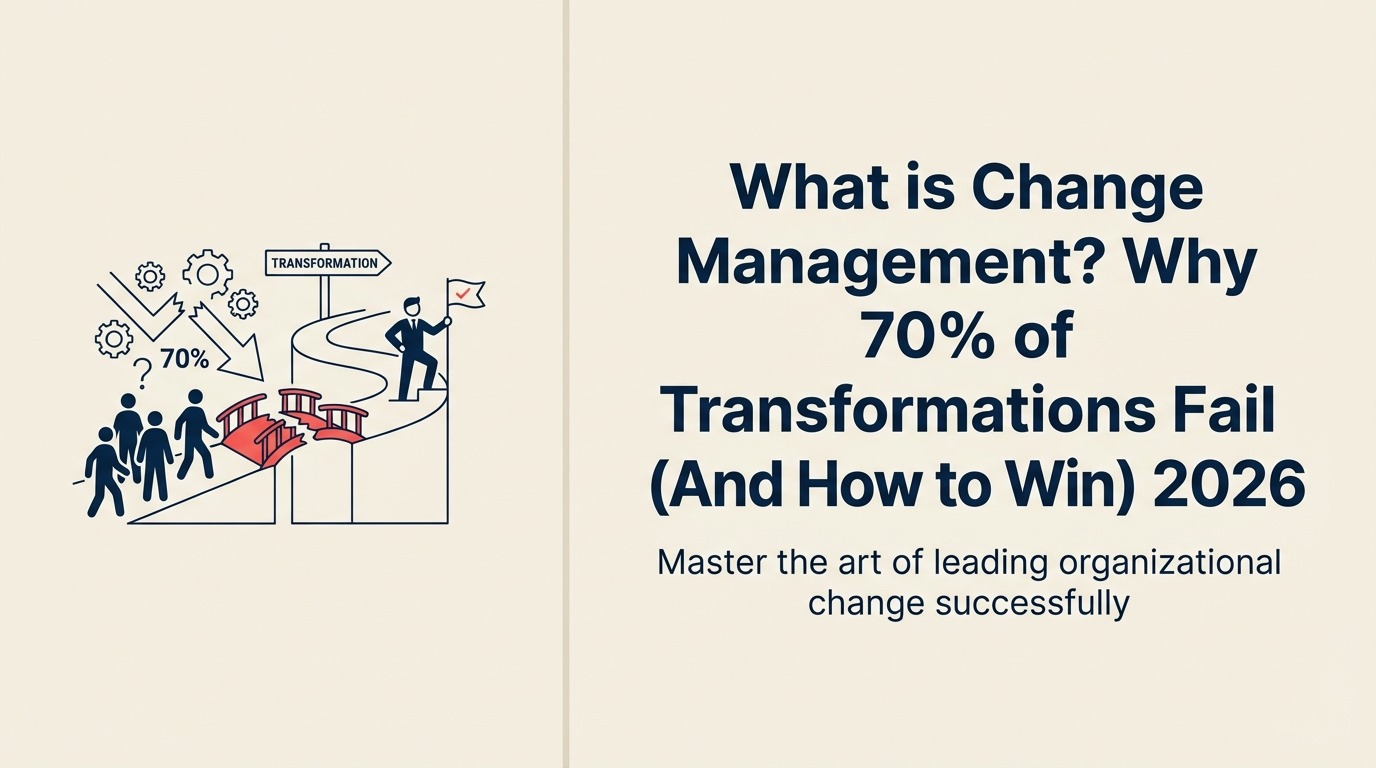
- "70% of change initiatives fail" is the most quoted number in the field, repeated by Kotter, McKinsey and many others. But a review in the Journal of Change Management traced its origins and found no valid, reliable empirical evidence behind the 70% figure. Treat it as a widely shared sense that change is hard, not a measured rate.
- What is measured is the gap that change management makes. In Prosci's practitioner research, projects with excellent change management met or exceeded objectives 88% of the time, versus 13% with poor change management, roughly seven times as likely.
But here's the thing: It's not the change that fails. It's the management of change.
The Psychology of Resistance
People don't resist change. They resist:
Loss
- Status ("I won't be the expert anymore")
- Control ("I can't influence this")
- Competence ("I don't know how")
- Connection ("My team will split up")
Uncertainty
- Future state unclear
- Personal impact unknown
- Success probability low
- Timeline unpredictable
Extra Work
- Learning curve
- Transition period chaos
- Maintaining old while building new
- No clear personal benefit
Understand this, and you can address real concerns, not surface objections.
The Classic Change Models
Kotter's 8-Step Process
- Create urgency - Why now?
- Build coalition - Who leads?
- Form vision - Where going?
- Communicate vision - Tell everyone
- Empower action - Remove barriers
- Create wins - Early success
- Consolidate - Don't declare victory
- Anchor - Make it stick
Best for: Large transformations
ADKAR Model
- Awareness - Why change?
- Desire - Want to change
- Knowledge - How to change
- Ability - Skills to change
- Reinforcement - Make it stick
Best for: Individual change focus
Bridges' Transition Model
- Ending - Let go of old
- Neutral Zone - Messy middle
- New Beginning - Fresh start
Best for: Understanding emotional journey
Lean Change Management
- Insights - Hypotheses about change
- Options - Experiments to try
- Experiments - Test and learn
- Review - Adapt based on feedback
Best for: Agile environments
The Change Curve: Emotional Journey
Everyone goes through this:
- Denial - "This won't happen"
- Resistance - "This is terrible"
- Exploration - "Maybe this could work"
- Commitment - "I'm in"
Your job: Help people move through faster.
Real Company Change Stories
Microsoft's Cultural Revolution
Change: Growth mindset culture Challenge: Decades of internal competition Approach:
- CEO modeled vulnerability
- Rewarded collaboration
- Killed stack ranking
- Celebrated learning from failure Result: Market cap from $300B to $2.5T
Netflix's DVD to Streaming
Change: Business model transformation Challenge: Cannibalize profitable DVD business Approach:
- Communicated streaming future early
- Kept DVD profitable during transition
- Invested heavily before revenue
- Let customers choose pace Result: Industry domination
Ford's Turnaround
Change: From near-bankruptcy to profit Challenge: Entrenched culture, bleeding cash Approach:
- Weekly transparency meetings
- Celebrated problems surfaced
- One team mentality
- Clear simple plan Result: Only US auto company to avoid bailout
The Modern Change Management Playbook
The modern playbook treats change as a four-phase adoption journey, with each phase preparing the conditions for the next.

Phase 1: Prepare (Months -3 to 0)
Build Foundation:
- Assess readiness
- Identify resistance
- Build coalition
- Create compelling story
- Design roadmap
Key Activities:
- Stakeholder analysis
- Impact assessment
- Communication plan
- Training design
- Success metrics
Phase 2: Launch (Months 0 to 3)
Create Movement:
- Announce with clarity
- Address concerns directly
- Start with willing
- Show early wins
- Maintain energy
Key Activities:
- Town halls
- Training sessions
- Pilot programs
- Feedback loops
- Quick wins
Phase 3: Sustain (Months 3 to 12)
Make It Stick:
- Reinforce behaviors
- Remove old systems
- Celebrate success
- Address backsliding
- Evolve based on learning
Key Activities:
- Progress tracking
- Resistance management
- Continuous communication
- Skills building
- Culture embedding
Phase 4: Institutionalize (Months 12+)
New Normal:
- Update job descriptions
- Align rewards
- Hire for new model
- Stop calling it "change"
- Prepare for next change
The Change Communication Formula
Message Architecture
Why (30%) + What (20%) + How (30%) + WIIFM (20%)

- Why: Burning platform or compelling vision
- What: Clear picture of future state
- How: Specific steps and timeline
- WIIFM: What's In It For Me
Communication Frequency
- Announce once: most people miss it or forget it
- Repeat it across meetings and channels: people start to hear it
- Keep repeating as the change lands: people start to believe it
- Reinforce it in daily routines: behavior changes
Channel Mix
- Face-to-face: the main channel, where questions get answered
- Digital: reinforcement between conversations
- Written: reference material people can come back to
Leaders routinely underestimate how much communication a change needs.
Building Your Change Coalition
The Essential Roles
- Sponsor - Senior leader with power
- Champion - Respected influencer
- Agent - Day-to-day driver
- Target - Those who must change
- Advocate - Early enthusiast
The Coalition Rules
- Enough visible supporters across the organization to reach a tipping point
- Include formal and informal leaders
- Mix of skeptics and believers
- All departments represented
- Meets weekly during change
Resistance Management Strategies
For Individual Resistance
- Listen first - Understand real concerns

- Acknowledge loss - Don't minimize
- Involve in solution - Give control back
- Provide support - Training, coaching
- Set boundaries - Change is not optional
For Group Resistance
- Identify leaders - Convert influencers
- Address publicly - Don't let it fester
- Show peer success - Social proof
- Create consequences - Both ways
- Split if needed - Isolate toxic resistance
For Organizational Resistance
- Change structure - Align to new model
- Update metrics - Measure new behaviors
- Revise rewards - Pay for change
- Replace if needed - New blood
- Overcommunicate - 10x more than comfortable
Change Management Tools
Assessment Tools
- Change Readiness Assessment
- Stakeholder Analysis Matrix
- Impact Assessment
- Force Field Analysis
- Culture Assessment
Planning Tools
- Change Roadmap
- Communication Calendar
- Training Matrix
- Resistance Management Plan
- Risk Register
Tracking Tools
- Adoption Metrics
- Pulse Surveys
- Feedback Loops
- Progress Dashboards
- Health Checks
The ROI of Change Management
With Excellent Change Management
- 88% meet or exceed objectives in Prosci's research
- About 7x more likely to succeed than projects with poor change management
- Higher employee engagement
- Faster adoption
With Poor Change Management
- 13% meet or exceed objectives
- Budgets and timelines slip as rework piles up
- Productivity dips while people work around the new system
- Key talent leaves
The math is clear: Change management isn't overhead, it's insurance.
Your Change Success Checklist
Before Launch
- Clear compelling vision
- Strong sponsor commitment
- Coalition built
- Resistance identified
- Communication plan ready
- Training designed
- Metrics defined
- Quick wins identified
During Change
- Regular communication
- Visible leadership
- Feedback loops active
- Resistance addressed
- Progress tracked
- Wins celebrated
- Course corrections made
- Energy maintained
After Change
- Behaviors reinforced
- Old ways removed
- Success measured
- Lessons captured
- Culture aligned
- Next change ready
Your 90-Day Change Plan
Days 1-30: Foundation
- Assess current state
- Build coalition
- Create vision
- Design approach
- Prepare organization
Days 31-60: Launch
- Communicate widely
- Start training
- Launch pilots
- Gather feedback
- Show quick wins
Days 61-90: Momentum
- Scale successful pilots
- Address resistance
- Refine approach
- Build capabilities
- Maintain energy
The Hard Truth About Change
Change management isn't about making people comfortable with change. It's about helping them move through discomfort productively.
Every transformation is actually two transformations:
- The technical change (systems, processes)
- The human change (behaviors, mindsets)
Guess which one is harder? Guess which one gets less attention?
The companies that thrive don't avoid change. They get good at it. And getting good at change means getting good at change management.
Because in the end, all business problems are people problems. And all transformations are human transformations.
Master the human side, and the technical side becomes easy.
Ignore the human side, and join the long list of transformations that stall.
Your choice.
Ready to lead successful transformations? Explore change leadership for building change leaders, or dive into how to change organizational culture for change that lasts.

Senior Operations & Growth Strategist
On this page
- Change Management: The Human Side of Transformation
- What the Change Failure Numbers Actually Say
- The Psychology of Resistance
- Loss
- Uncertainty
- Extra Work
- The Classic Change Models
- Kotter's 8-Step Process
- ADKAR Model
- Bridges' Transition Model
- Lean Change Management
- The Change Curve: Emotional Journey
- Real Company Change Stories
- Microsoft's Cultural Revolution
- Netflix's DVD to Streaming
- Ford's Turnaround
- The Modern Change Management Playbook
- Phase 1: Prepare (Months -3 to 0)
- Phase 2: Launch (Months 0 to 3)
- Phase 3: Sustain (Months 3 to 12)
- Phase 4: Institutionalize (Months 12+)
- The Change Communication Formula
- Message Architecture
- Communication Frequency
- Channel Mix
- Building Your Change Coalition
- The Essential Roles
- The Coalition Rules
- Resistance Management Strategies
- For Individual Resistance
- For Group Resistance
- For Organizational Resistance
- Change Management Tools
- Assessment Tools
- Planning Tools
- Tracking Tools
- The ROI of Change Management
- With Excellent Change Management
- With Poor Change Management
- Your Change Success Checklist
- Before Launch
- During Change
- After Change
- Your 90-Day Change Plan
- Days 1-30: Foundation
- Days 31-60: Launch
- Days 61-90: Momentum
- The Hard Truth About Change