What is Computer Vision? Giving Your Business Digital Eyes
Turn this article into takeaways for your work.


Each assistant summarizes the article only for you and suggests best practices for your work.
A quality inspector gets tired by the end of a shift. A computer vision system checks the last product on the line the same way it checked the first. This technology isn't just about cameras and sensors. It's about teaching machines to understand what they see and make intelligent decisions based on visual information.
Historical Background
Computer vision originated in the 1960s when researchers first attempted to mimic human visual perception. In July 1966, MIT's Seymour Papert wrote up The Summer Vision Project, a plan for summer workers to build a significant part of a visual system, from separating objects from background to naming them. That problem ended up occupying the field for decades.
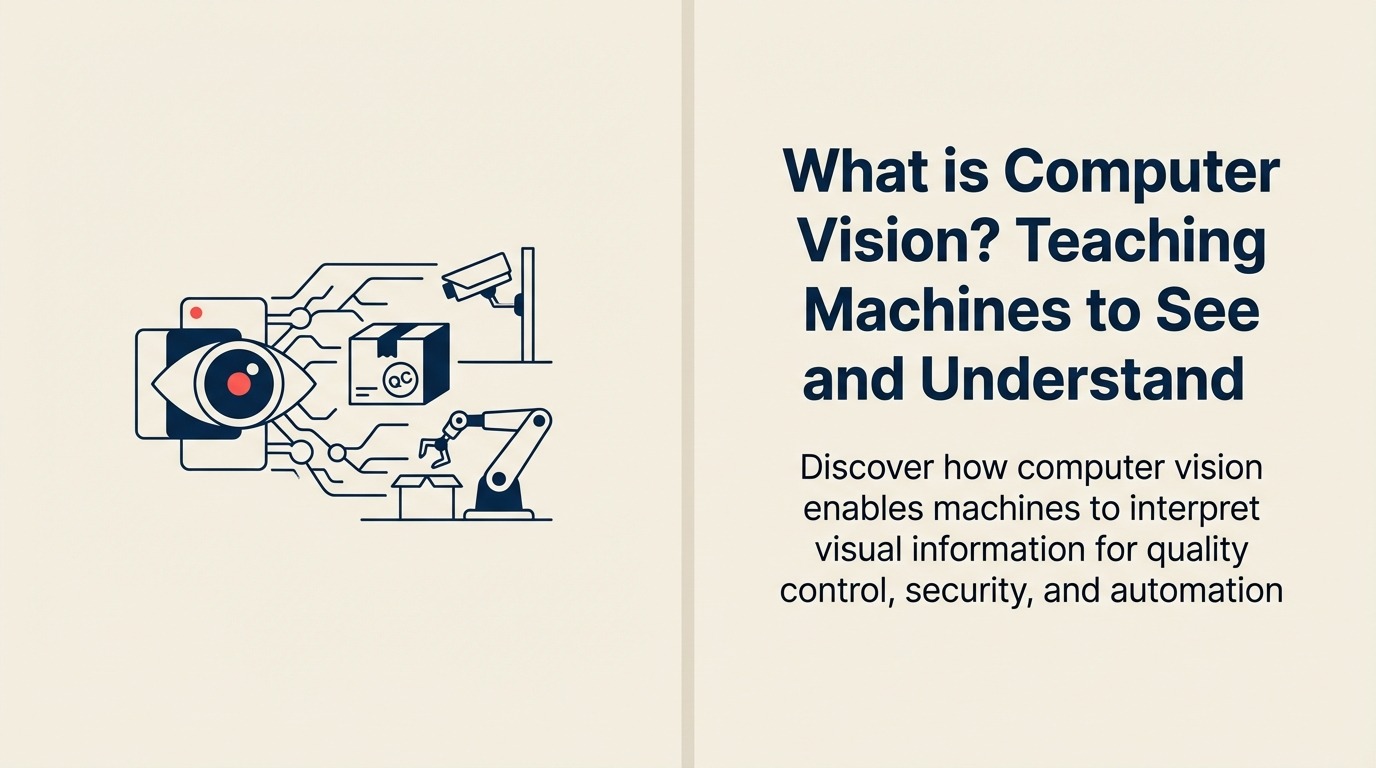
Put simply, computer vision is the field that helps computers draw a high-level understanding from digital images and video, so they can handle tasks that normally need human eyes.
The field evolved from simple edge detection in the 1970s to modern deep learning approaches that can outperform humans in specific visual tasks. The breakthrough came with convolutional neural networks in 2012, which revolutionized image recognition accuracy.
Business Applications Explained
For business leaders, computer vision means giving machines the ability to see, understand, and make decisions based on visual information, automating any task that requires human eyes and judgment.
Think of computer vision as hiring a visual expert who never blinks, can watch thousands of locations simultaneously, and improves their expertise with every image analyzed. It transforms cameras from passive recording devices into active business intelligence systems.
In practical terms, this means automated quality control that catches defects humans miss, security systems that recognize threats instantly, and retail analytics that understand customer behavior from video.
Critical Components
Computer vision consists of these essential elements:

• Image Acquisition: Cameras and sensors that capture visual data, from simple webcams to specialized industrial cameras, thermal sensors, or 3D scanners
• Pre-processing Engine: Systems that enhance and standardize images by adjusting lighting, removing noise, correcting distortions to ensure consistent analysis
• Feature Detection: Algorithms that identify important visual elements: edges, corners, textures, shapes, and colors that distinguish objects
• Pattern Recognition: Neural networks that match detected features to learned patterns, recognizing that specific shapes and colors represent a defective product. This capability also powers anomaly detection in quality control
• Decision Layer: Logic that translates visual understanding into business actions by triggering alerts, controlling machinery, or updating databases
The Vision Process
The computer vision process follows these steps:
Image Capture & Digitization: Cameras convert light into digital data as millions of pixels, each with color and brightness values, creating a numerical representation
Analysis & Feature Extraction: Algorithms scan pixel patterns to identify meaningful features by detecting edges where colors change, recognizing shapes, finding text or faces
Interpretation & Action: The system compares detected features against trained models to understand what it sees, then triggers appropriate responses
This transforms raw visual data into business intelligence: from "array of pixels" to "defective product on Line 3" to "stop conveyor and alert supervisor."
Four Main Categories
Computer vision generally falls into four main categories:

Type 1: Object Detection & Recognition Best for: Inventory management, security screening, product identification Key feature: Identifies and locates specific objects in images Example: Amazon Go stores tracking products customers select
Type 2: Image Classification Best for: Quality control, medical diagnosis, document processing Key feature: Categorizes entire images into predefined classes using supervised learning techniques Example: Sorting products as "pass" or "fail" on assembly lines
Type 3: Motion Analysis Best for: Security monitoring, traffic management, sports analytics Key feature: Tracks movement and analyzes behavior patterns, often combined with predictive analytics Example: Retail stores analyzing customer flow to optimize layouts
Type 4: 3D Reconstruction Best for: Manufacturing inspection, augmented reality, construction Key feature: Creates three-dimensional models from 2D images Example: Creating digital twins of physical products for analysis
Computer Vision at Work
Here's how businesses actually use computer vision:
Manufacturing Example: Automakers point cameras at painted car bodies on the line so a vision model can flag scratches, dust and uneven paint before a car moves to final assembly, instead of relying on a person to spot every flaw.
Retail Example: Cashierless stores such as Amazon Go use ceiling cameras to see which products a shopper takes off the shelf, so the bill is ready when the shopper walks out.
Healthcare Example: In a 2016 JAMA study, Google researchers trained a deep learning model to grade retinal photos for diabetic retinopathy. At one operating point it found 90.3% of referable cases on the EyePACS-1 test set with 98.1% specificity, which matters most in places with few eye specialists.
Further Learning
Ready to implement computer vision in your business?
- Understand the foundation with Artificial Intelligence
- Explore Deep Learning that powers modern vision systems
- Learn about Edge AI for real-time visual processing
- Discover how AI Automation can scale your visual inspection workflows
- Understand MLOps for deploying and managing vision models in production
External Resources
- OpenCV Documentation - Open-source computer vision library and tutorials
- Google AI Vision Research - Latest advances in computer vision
Frequently Asked Questions about Computer Vision
What is Computer Vision?
Computer Vision is the field of AI that enables machines to interpret and understand visual information from images and videos, making decisions based on what they "see."
What's the difference between Computer Vision and image processing?
Image processing manipulates images to enhance or extract information. Computer Vision goes further by understanding and interpreting visual content to make intelligent decisions, like identifying objects or detecting anomalies.
What are the four main types of Computer Vision?
Object Detection (finding and locating objects), Image Classification (categorizing entire images), Motion Analysis (tracking movement patterns), and 3D Reconstruction (creating 3D models from 2D images).
What components make up a Computer Vision system?
Five key components: image acquisition (cameras/sensors), pre-processing engine (image enhancement), feature detection (identifying visual elements), pattern recognition (matching to learned patterns), and decision layer (triggering actions).
Part of the AI Terms Collection.