日本語

PayPal's 4,760 Cuts Mark a New AI Layoff Category: Capex-Funded Restructuring

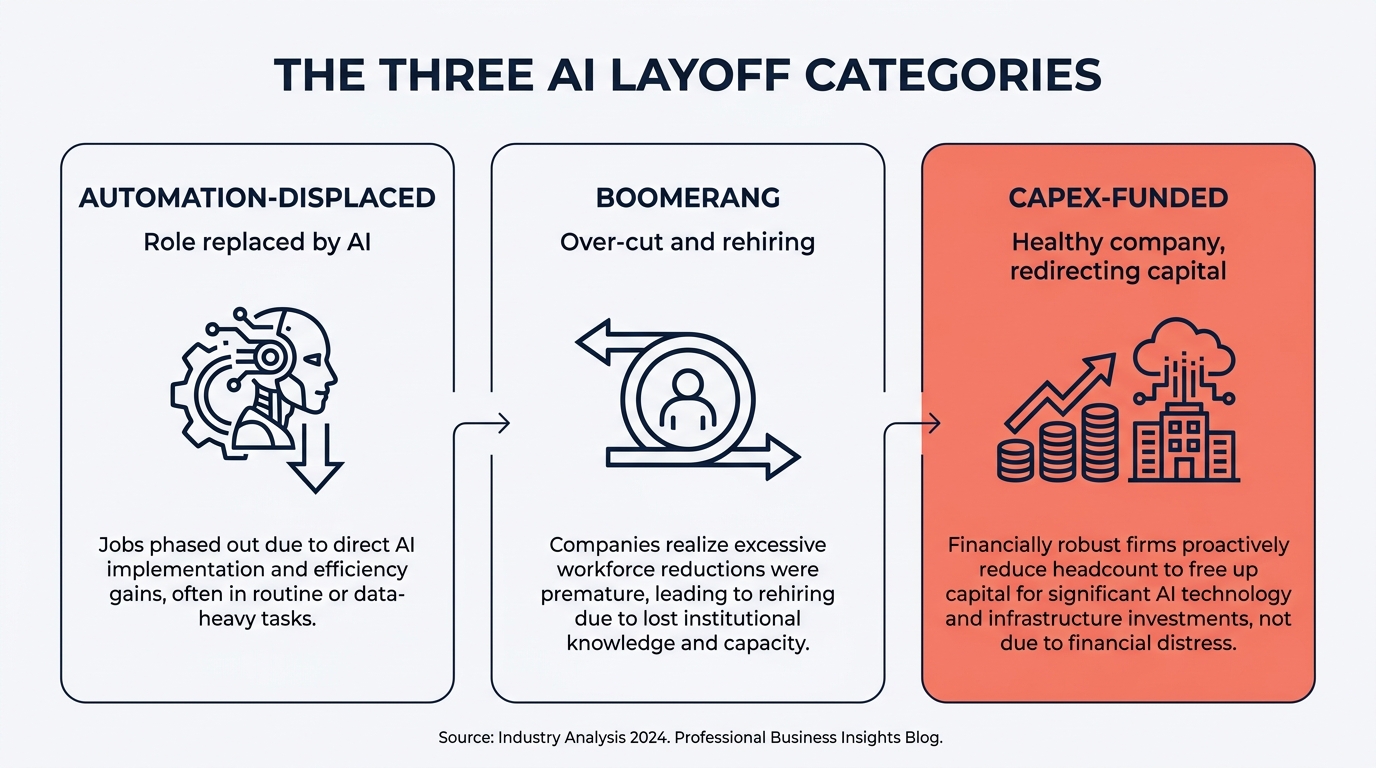
Three AI layoff categories: automation-displaced, boomerang, and capex-funded restructuring

PayPal just gave every Chief Human Resources Officer (CHRO) and CFO a new problem to name. It's not a traditional layoff. And if you handle it with a traditional playbook, you'll lose the people you can't afford to lose.

On May 5, 2026, PayPal filed an 8-K with the Securities and Exchange Commission announcing approximately 4,760 employee separations, representing roughly 20% of its global workforce, phased over two to three years. According to the PayPal SEC filing, the stated target is $1.5 billion in annual run-rate savings. The explicit rationale: transition to an AI-native operating model. This is the largest single AI-attributed restructuring announced in May 2026.

Quick Take: PayPal's cuts don't fit the old AI layoff template. The company isn't in distress and the roles aren't being automated away individually. The headcount is being sold to buy AI infrastructure. That's a new category, and it requires a new communication strategy.

What PayPal Actually Announced

New CEO Enrique Lores, who came from HP Inc. and officially took the reins on March 1, 2026, framed the restructuring as a deliberate capital reallocation. PayPal isn't cutting because revenue is declining. It's cutting because leadership has decided AI infrastructure is a better allocation of the same capital that was funding those 4,760 salaries.

That distinction matters because it changes the message your surviving workforce receives. In a traditional downturn-driven layoff, employees understand the context: the company hit a rough patch. In a capex-funded restructuring, the context is different: the company is profitable, and it chose to redirect spending away from people toward machines. Survivors do that math. And if your communications don't address it directly, they'll draw their own conclusions.

Key Facts

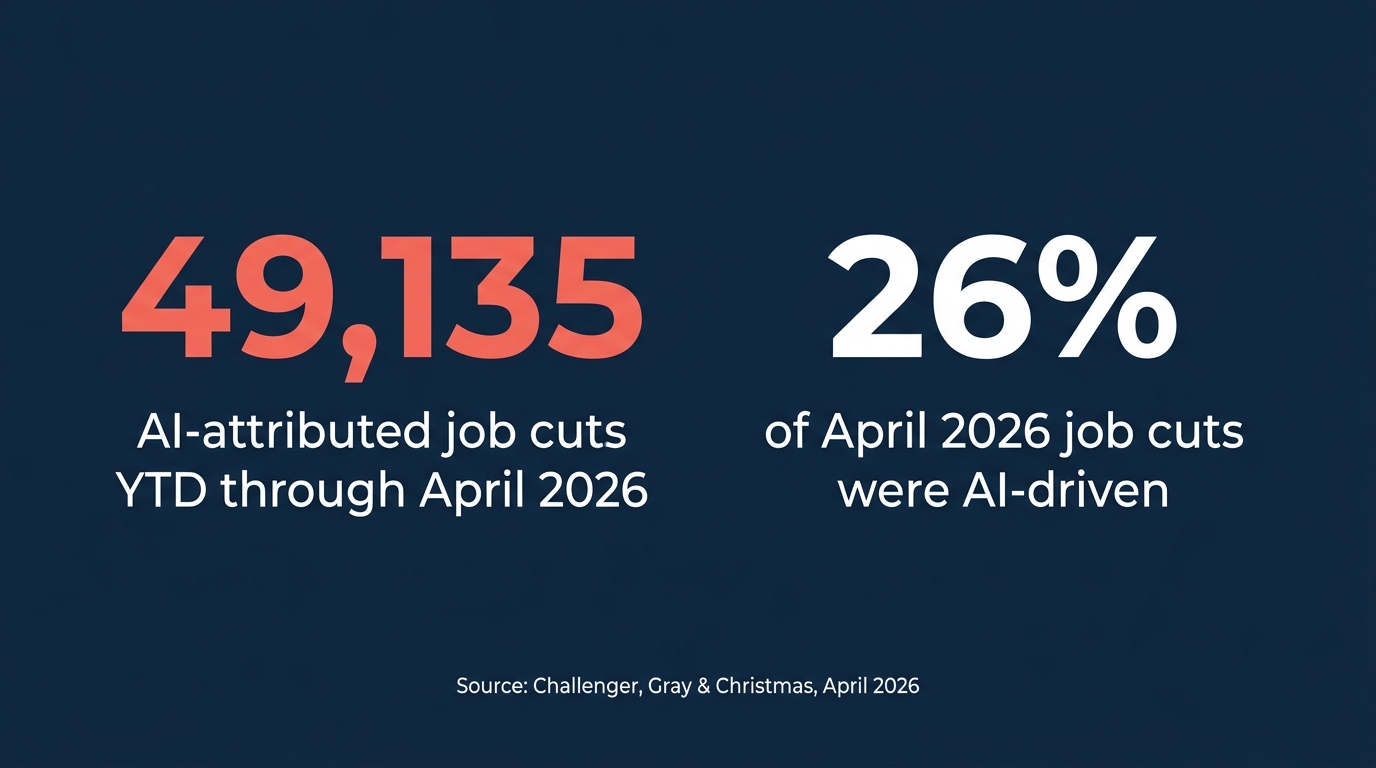
  • 49,135 jobs were attributed to AI as the cause of cuts year-to-date through April 2026, per Challenger, Gray & Christmas
  • 26% of all April 2026 job cuts were classified as AI-driven (CBS News, citing Challenger data)
  • 33% of companies that conducted AI-attributed layoffs reported losing critical skills and expertise afterward (Yale Insights / Gartner study, May 2026)

The broader backdrop reinforces how significant this moment is. CBS News reporting on the Challenger, Gray & Christmas April 2026 data showed AI was the leading stated reason for layoffs in both March and April 2026. Total tech sector layoffs reached approximately 142,000 through late May, with Meta, Amazon, Oracle, PayPal, and Coinbase among the major names. Per TechTimes, the common thread in 2026 is not financial distress but capital reallocation: a combined roughly $700 billion in AI infrastructure commitments that profitable companies are partially funding by reducing headcount.

The Three AI Layoff Categories CHROs Should Distinguish

Not all AI layoffs are the same. Treating them the same way is what leads to botched survivor communication and preventable attrition. There are now three distinct categories, each with its own communication logic and its own risk profile.

Category 1: Automation-Displaced

This is the category everyone was expecting. A role that used to require a human is now handled well enough by AI that the position is genuinely eliminated. Think: certain data entry roles, some first-level support functions, specific content moderation workflows.

The communication rule for this category: be specific about what changed and offer a visible skills path. Vague "AI is transforming our business" language doesn't hold up when an employee can see that their colleague's function was literally handed to a model. What works is naming the function, acknowledging the change, and making the redeployment program concrete enough that survivors believe it's real.

The retention risk: institutional knowledge walks out with the people who held those roles. How AI is changing your retention problem (not just your hiring problem) is particularly sharp in automation-displaced restructurings, where the loss often extends beyond the role itself.

Category 2: Boomerang

The company over-cut in a previous cycle, usually the 2022-2023 tech pullback, and is now rehiring the same functions at a higher market rate. This is more common than most HR leaders acknowledge publicly.

The communication rule here is the hardest: admit the misjudgment. Employees who lived through both the cut and the rebuild already know what happened. A communication that frames the rehiring as "growth" rather than correction will be read as spin, and it will damage credibility for everything that follows.

The retention risk: the workforce that stayed through both phases has a long memory. They watched colleagues get let go and watched the same roles refill. They'll apply that skepticism to everything leadership says next.

Category 3: Capex-Funded

This is the PayPal category. The company is financially healthy. The roles being eliminated aren't being automated away, at least not yet. But leadership has decided the capital tied up in those salaries produces a better return if redirected toward AI infrastructure, platforms, or models.

The communication rule here is explicit P&L transparency. You have to say, directly, that the company is making a capital allocation decision: investing in AI infrastructure in exchange for reduced headcount costs. If you don't say it, your surviving employees will say it for you, and their version won't be charitable.

The retention risk is uniquely sharp in this category. Survivors aren't worried about whether AI will replace their specific role today. They're worried about the signal: leadership would rather buy AI than invest in us. That's the implicit message of a capex-funded restructuring, and it will drive voluntary exits among your most capable people if left unaddressed.

For a framework on how the executive decision framework for AI workforce strategy applies across all three categories, the key principle is the same: survivors need to understand which category they're in before they can evaluate their own situation.

Why Capex-Funded Layoffs Need a Different Survivor Playbook

The standard survivor-communications playbook, acknowledge the cut, explain the reason in general terms, hold an all-hands, wait for things to settle, was designed for distress-driven restructuring. It doesn't map well to capex-funded restructuring, for one specific reason: it doesn't address the P&L tradeoff directly.

When a company cuts to fund AI infrastructure investment, the surviving workforce is effectively being asked to accept a lower headcount on the team in exchange for a future competitive advantage they may not yet be able to see. That's a harder sell than "we had to cut costs to survive." And it requires your communications to do something most HR teams are not set up to do: explain the financial logic clearly enough that employees can evaluate it themselves.

This is where financial literacy as an employee competency becomes a live issue rather than a development program abstraction. Your HR business partners need to be able to walk a manager through the basics of an AI capex commitment: what it is, why the board approved it, what the expected return looks like, and how that connects to the restructuring decision. Most HR business partners in 2026 don't have that fluency yet. The gap shows up in town halls when a manager gets a question about AI infrastructure spending and has to deflect.

The 33% skills-loss figure from Yale Insights and Gartner (May 2026) is the number that should be in front of every executive leadership team before a capex-funded restructuring is announced. Companies that did AI layoffs and lost the knowledge they needed for the AI transition are now trying to recover from both problems at once. The ones that avoided that outcome used AI as a tool to amplify people rather than as a replacement mechanism, even during restructuring.

The Retention Risk Hidden in the Profit and Loss Statement

AI was the leading reason for layoffs in March and April 2026, totaling 49,135 cuts year to date

The retention math in a capex-funded restructuring is worse than it looks in the initial headcount reduction.

Start with the voluntary attrition you don't see on the day of the announcement. High performers, especially those with AI skills, don't leave on announcement day. They update their mental model of job security, update their LinkedIn profiles quietly, and start having conversations. They leave in weeks four through ten, after the initial shock has faded but before your retention risk dashboard picks up the signal.

The hidden cost of delaying AI upskilling analysis shows that the talent most difficult to replace after an AI restructuring is the talent with the intersection of domain knowledge and emerging AI fluency. Those people can find work quickly. And they're often the ones who decided to stay through the initial cut, not because they couldn't leave, but because they hadn't decided yet.

The second layer of risk is manager attrition. When a capex-funded restructuring reduces team size without reducing workload, managers absorb the slack. The ones who were already stretched will make the calculation quickly: they're doing more work for the same pay while the company redirects savings into infrastructure. Manager attrition at the six-to-twelve month mark after a capex-funded cut is a known pattern that isn't adequately budgeted for in most restructuring models.

For CHROs who want to make this case to a CFO, the board-level communication framework for AI workforce investment provides the structure: frame the retention risk as a financial liability with a probability and a cost, not as a culture concern. The dollar figure attached to replacing a manager with 18 months of institutional knowledge in a post-restructuring environment is large enough to warrant explicit risk modeling in the restructuring business case.

What to Do This Week

The PayPal announcement is a forcing function. Whether or not your organization is in the middle of a restructuring, this is the week to categorize your AI workforce strategy and build the communication infrastructure before you need it.

Step 1: Categorize your current or planned restructuring.

Go back to the three categories. Is your organization in an automation-displaced situation, where specific roles are being genuinely replaced by AI functions? A boomerang situation, where prior cuts went too deep and you're correcting? Or a capex-funded situation, where headcount is being reduced to fund AI infrastructure spending? Each requires a different communication architecture. Using the wrong template produces the wrong results.

Step 2: Run a retention-risk audit.

Identify the 30 people your organization can least afford to lose in the next 12 months, specifically the people who hold the intersection of institutional knowledge and AI fluency, or who are acquiring AI fluency faster than their peers. These are the people most likely to leave in a capex-funded restructuring because they have the most options. Build a simple risk matrix: flight risk score, replacement difficulty score, knowledge concentration score. That audit tells you where to direct retention investment before the exits start.

Step 3: Brief your HR business partners on the P&L logic.

Before any town hall or manager cascade, your HR business partners need to be able to answer three financial questions: Why was this specific capital reallocation approved? What does the AI infrastructure investment actually produce? When would we expect to see the return? If your HRBPs can't answer those questions clearly, your managers can't, and your employees will fill the gap with their own interpretation.

Step 4: Draft the survivor communication template.

The capex-funded survivor message has four required components. Name the financial tradeoff directly: we are reducing headcount to fund [specific AI investment], not because of revenue pressure. Explain what the AI investment is expected to produce. State what is not changing for the people who remained. And give a specific commitment about how the company plans to invest in the people who stayed, whether that's AI upskilling, expanded scope, or something else concrete. Vague reassurances don't hold.

This is a different kind of restructuring. The people who survive it will be the foundation of the AI-native organization leadership is trying to build. How you communicate the tradeoff in the first 30 days will determine whether they're still there to build it.


FAQ

What is a capex-funded AI layoff?

A capex-funded AI layoff is a workforce reduction where a financially healthy company cuts headcount specifically to reallocate capital toward AI infrastructure spending, such as GPU clusters, AI platform licenses, or model development. It's distinct from an automation-displaced layoff (where AI directly performs a former human role) and from a restructuring driven by revenue decline. PayPal's May 2026 announcement, targeting $1.5 billion in annual savings to fund an AI-native operating model, is the clearest large-cap example of this category in 2026.

How should CHROs communicate AI-driven restructuring differently than traditional layoffs?

The key difference is P&L transparency. Traditional downturn-driven layoffs can be explained by market conditions that employees understand intuitively. Capex-funded AI restructurings require explicitly naming the capital allocation decision: headcount was reduced to fund AI infrastructure. If leadership doesn't name that tradeoff directly, surviving employees will name it themselves, usually less charitably. CHROs should also address the skills preservation risk directly, citing the data point that 33% of AI layoffs resulted in lost institutional knowledge, and explain the specific investments being made to retain and develop the people who stayed.

Are tech layoffs in 2026 actually driven by AI?

According to Challenger, Gray & Christmas, AI was the leading stated reason for U.S. job cuts in both March and April 2026, with AI-attributed cuts reaching 49,135 through April. But the category is broader than AI replacing individual roles. The 2026 pattern of workforce restructuring shows that a significant portion of AI-attributed cuts in 2026 are capex-funded, meaning profitable companies are reducing headcount to fund large AI infrastructure commitments, not because AI has automated the specific roles being eliminated.