日本語

Public vs Private vs Gated Roadmap: Choosing the Right Transparency Model

Public vs Private vs Gated Roadmap

Consider two SaaS companies competing in the same category. One posts their full roadmap publicly on a Canny board: features in development, items being considered, things they've decided not to build. Any prospect, customer, or competitor can see it. Their CS team rarely fields "when is X coming?" questions because the answer is publicly visible.

The other company shares nothing until it ships. Features appear in release notes. CS teams give verbal summaries in QBRs under NDA. Competitive intelligence stays in-house. Their CS team fields "when is X coming?" questions on every renewal call and improvises answers that sometimes hold and sometimes don't.

Neither strategy is wrong. Both have won mid-market SaaS companies significant market share. But both have costs that land squarely on CS, and those costs are predictable in advance if you know what to look for.

This is a structural decision. Once you commit to a roadmap model, you've set expectations across your customer base, your CS team's communication habits, and your competitive positioning. Changing models mid-stream is expensive. More on that later.

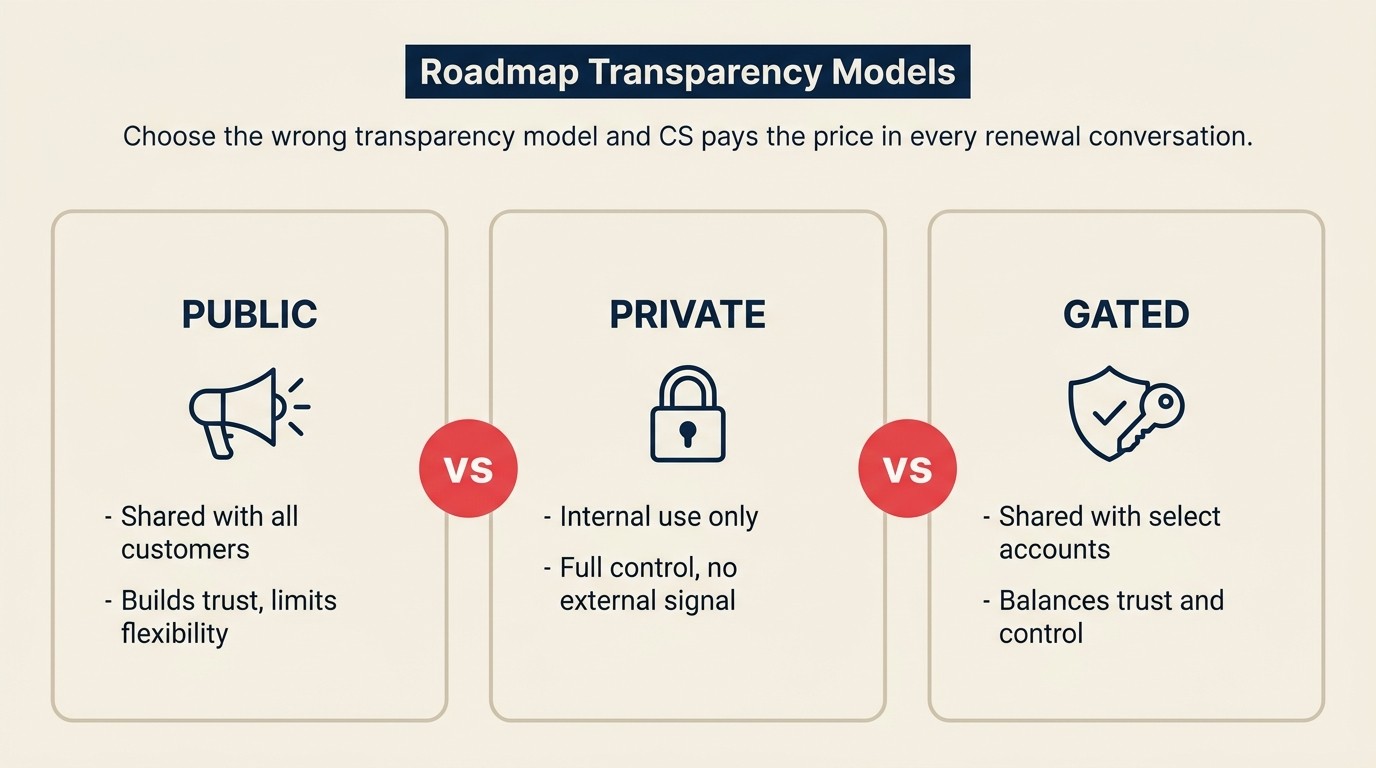
The Three Models Defined

Public roadmap: Fully visible to anyone (customers, prospects, competitors). Hosted on a roadmap tool like Canny, ProductBoard's public view, or a simple Trello board. Items typically fall into status categories: under consideration, planned, in development, shipped. Any visitor can see the full picture.

Private roadmap: Internal only. CSMs have access. Customers don't. Customers receive verbal summaries, presentation slides in QBRs, or NDA-protected previews for strategic accounts. What gets shared is controlled entirely by CS and Product, conversation by conversation.

Gated roadmap: Segmented access. Certain customer tiers (high-ARR accounts, CAB members, early access program participants) see more than general customers. The general customer base may see a high-level version (themes or categories) while strategic accounts see specific features and timelines. Hybrid variations are common: public "what's shipped," gated "what's coming."

Most companies don't make this choice deliberately. They drift into a model based on what their first PM or marketing leader did, and then discover its costs years later when CS starts improvising. The cost of CS-product misalignment puts numbers on exactly that outcome. Improvised roadmap communication is one of its most consistent contributors.

The Full Comparison

Dimension Public Private Gated
Competitive exposure High (competitors see everything) Low Medium (exposed only to select customers)
CSM improvisation risk Low (customers self-serve) High (no customer-facing reference) Medium (depends on access tier design)
Customer trust impact High for PLG; mixed for enterprise High for enterprise with NDA; low without High for customers with access; neutral for others
Operational overhead Low maintenance; high deprecation risk High (every customer conversation) Medium (managing access tiers)
Best-fit company profile PLG, developer tools, transparent-brand SaaS Enterprise-focused, competitive market, relationship-led sales Mid-market with a defined high-ARR tier
When customers churn over roadmap When promised items are removed When customers assume nothing is happening When gated customers feel less valued than before access

Key Facts: Roadmap Transparency and Business Outcomes

  • 78% of enterprise buyers say they prefer not to see a public roadmap from their primary SaaS vendor. They'd rather have a confidential NDA briefing, according to Forrester's B2B Tech Buying research.
  • CSMs at companies with no formal roadmap communication model spend an average of 4.2 hours per week improvising roadmap answers versus 1.8 hours at companies with a structured model, per TSIA's CS Benchmark data.
  • Organizations that changed roadmap models without a deliberate customer communication plan experienced an average 9-point NPS drop in the quarter of the transition, based on ProductBoard's customer research.

The Case for a Public Roadmap

Public roadmaps work best when transparency is already part of the brand and when the customer profile is a technical buyer who wants to evaluate the product's direction before committing.

The CS benefit is real: when customers can see the roadmap, the volume and intensity of "when is X coming?" questions drops significantly. Customers who are frustrated that a feature isn't built yet can see that it's under consideration, vote on it, and monitor progress, all without requiring a CSM to manage their expectations manually.

Public roadmaps also create community leverage. Customers who are active on a public roadmap tool become invested in the product direction. They add context to feature requests. They upvote items and add their own use cases. That feedback is richer than what CS can synthesize from call notes. Gartner's churn prevention research notes that customers who feel actively involved in a vendor's product direction are significantly less likely to evaluate alternatives, which is an argument for making roadmap engagement a deliberate retention mechanism rather than an accidental one. The VOC pipeline from CS to Product captures the same class of directional signal from customers who never touch your public tool.

But the risks are structural. Competitive exposure is real, not just to direct competitors, but to prospects who might see a feature you're building and wait for it rather than signing up now. The harder risk is the timeline problem: once you've publicly listed a feature as "planned," customers plan around it. When you deprioritize it, you've disappointed a public list of stakeholders, not just one customer on a call.

Public roadmaps require a disciplined process for removing or reclassifying items. That process is harder than it sounds, and most teams underestimate the customer communication required when something moves from "planned" to "under consideration."

The Case for a Private Roadmap

Private roadmaps are the default for enterprise-focused products in competitive categories. The logic is straightforward: if your competitive advantage depends on what you're building before anyone else builds it, publishing that publicly eliminates the advantage.

The enterprise sales motion also favors a private approach. Enterprise buyers are often won on relationships, trust in the vendor's judgment, and confidence in the product direction, not on a public roadmap they can read before signing. An NDA-protected preview for a strategic account creates a sense of exclusive partnership that a public board can't replicate. Forrester's B2B buyer trust research identifies consistency and dependability as the top trust dimensions for enterprise buyers, both of which a structured private briefing cadence is better positioned to deliver than a public board.

But private roadmaps put enormous pressure on CS. When customers can't see any documentation of what's coming, every "when is X coming?" question requires a CSM to give an answer that's accurate, on-brand, and not in violation of what Product has approved for external communication. Without a formal framework for what CSMs can say, the answer defaults to improvisation.

This is where the private model fails most mid-market companies: they assume that keeping the roadmap private is a competitive decision, and they don't build the corresponding CS communication infrastructure. The result is a CS team that's simultaneously telling customers too little (under-communicating) and too much (overpromising), depending on the individual CSM.

The Case for a Gated Roadmap

Gated access is the model that scales most effectively for mid-market SaaS companies with a defined high-ARR tier and a formal customer advisory board or early access program.

The strategic logic is: your most important customers get more visibility, which creates a meaningful relationship benefit that reinforces the value of staying in the top tier. General customers get themes or categories. Strategic accounts get specifics. The differentiation is deliberate.

For CS, gated roadmaps create a clear protocol: what you can share depends on the customer's access tier. A standard account gets the approved external summary. A CAB member gets a detailed preview. A customer in the early access program gets feature-level visibility under NDA. CSMs always know which tier applies and what's authorized for that tier. The early access tier management playbook details how to design and operate those tiers without creating expectation gaps between access levels.

The operational overhead is real but manageable. Someone has to own the access list, keep it current, and make sure the gated view is updated before customers with access look at it. Typically this sits with PMM or the CS operations function. It's not complicated work, but it requires someone to own it explicitly. It won't happen by accident.

The CS Impact of Each Model

This is the conversation that often doesn't happen. Product makes the roadmap model decision. CS learns about it when customers start asking questions. By then, the costs are already embedded.

In a public roadmap model: CS spends less time fielding roadmap questions, but more time managing expectations when items are removed or reprioritized. The customer service effort shifts from proactive communication to reactive damage control when the public roadmap changes.

In a private roadmap model: CS spends more time on roadmap conversations than in any other model. Every customer question requires a live answer. Without a tier framework for what CSMs can say, this becomes the highest improvisation risk in the company. Teams using the four-tier language framework manage this well; teams without it don't.

In a gated roadmap model: CS has the clearest operating protocol, because the access tier determines the conversation. But CS leaders need to actively manage which accounts are in which tier. Stale access lists create situations where a customer expects CAB-level visibility that they're no longer authorized to have.

The model with the most pressure on CS to improvise, by a significant margin, is private with no communication framework. If your company runs a private roadmap, the handling "when is X coming?" playbook is not optional. It's the operational requirement that makes the model viable.

How to Choose

Work through these questions before committing to a model. CS and Product should answer them together, not separately. How customers currently realize value from the product (their active use patterns) directly informs which model fits. The value realization milestones framework is a useful input here: accounts that haven't hit their core value milestones are more sensitive to roadmap uncertainty than those who have, which affects how much visibility you want to give them by default.

  1. How sensitive is your roadmap competitively? If you're building functionality that competitors would copy immediately if they saw it, public is off the table.

  2. What's your primary growth motion: PLG or SLG? PLG products that rely on self-serve discovery benefit from public roadmaps. Sales-led enterprise products typically don't. McKinsey's research on winning B2B tech customers finds that transparency about product direction is rated more important by technical buyers than by business buyers, which maps directly to the PLG vs. SLG split.

  3. How sophisticated are your customers? Technical buyers who want to evaluate product direction before signing favor public access. Business buyers who make renewal decisions based on relationship and value realized are better served by a private model with personal briefings.

  4. What's your CS team's capacity for manual roadmap communication? A private model requires significant CS time per account. If your CS team is at capacity, that time has to come from somewhere.

  5. Do you have a defined high-ARR tier with enough operational infrastructure to manage gated access? If yes, gated is worth evaluating. If no, it will become an unmaintained access list within two quarters.

  6. How frequently does your roadmap change? Highly dynamic roadmaps are harder to make public. The maintenance and communication burden of public deprioritizations is high.

  7. What are your top customers asking for? If your highest-ARR accounts are consistently asking for more roadmap visibility, a gated or private model with a formal NDA briefing cadence may be the right answer.

Operationalizing the Chosen Model

Whoever makes the model decision needs to also decide who owns it operationally.

Public model: PMM or Product owns the roadmap tool and its updates. CS is responsible for flagging when a public item is generating expectation gaps in customer conversations. The escalation path for removing public items, including customer communication, should be defined before the first item is removed.

Private model: Product owns the internal roadmap. PMM produces the external communication package each quarter. CS gets a pre-QBR briefing on what's approved for external sharing, using the tier language framework. A named PM per product area is the CS escalation point for "can I share X?" questions.

Gated model: PMM or CS operations owns the access list. Product produces a gated view (usually a separate Notion page, ProductBoard view, or document) that's updated at the start of each quarter. CS leaders are responsible for matching access tiers to accounts before QBR season.

The Transition Problem

If you currently have no model, customers have filled the vacuum with their own assumptions about what's coming and when. Transitioning to any deliberate model requires customer communication. Don't just launch a new approach without addressing what customers already believe.

A no-model environment typically means individual CSMs have been telling different customers different things. Before choosing a model, audit what's actually been said: review call recordings, check CRM notes, ask CSMs what they've been communicating. You may discover that some accounts have Tier 1 expectations for features that are actually Tier 3. This is also where capturing feedback systematically from CSM notes to backlog pays off: teams with structured note-taking can audit what was said far more accurately than those relying on memory.

The transition playbook:

  1. Audit current informal commitments across the customer base
  2. Choose the model with Product and CS together
  3. Communicate the change to customers with honesty: "We're formalizing how we share roadmap information, and we want to make sure your expectations are accurate"
  4. Reset any commitment that can't be honored, using the tier language framework, before the model launches

The customer communication required in step 4 is the hardest part. But addressing it proactively is less expensive than letting inflated expectations persist into the next renewal cycle.

The Three Roadmap Models: What They Actually Cost CS

The most useful way to compare the three models is by their CS cost, not their marketing appeal. Every roadmap model shifts work and risk somewhere. The public model shifts effort toward deprecation communication. The private model shifts it toward improvisation risk. The gated model shifts it toward access-list maintenance. The question isn't which model has no cost (none of them do). It's which cost your CS team is better positioned to carry.

Rework Analysis: The private roadmap is the default for most mid-market SaaS companies that never made a deliberate choice. It's inherited from an early-stage habit of not publishing anything externally. The problem is that "private" without a communication framework is not a roadmap model. It's an absence of one. CS teams operating under a private roadmap with no approved language spend, on average, 4.2 hours per week improvising roadmap answers (TSIA benchmark data). That's roughly one full day per CSM per month spent on a problem that a tier framework and a quarterly briefing would eliminate. The decision to go private is defensible. The decision to go private without building the corresponding CS communication infrastructure is what creates the improvisation pattern that makes "when is X coming?" the most dreaded question in a CSM's call rotation.

Frequently Asked Questions

What is the difference between a public, private, and gated roadmap?

A public roadmap is fully visible to anyone (customers, prospects, and competitors), typically hosted on a tool like Canny or ProductBoard. A private roadmap is internal only; customers receive verbal summaries in QBRs or NDA-protected previews on request. A gated roadmap segments access by customer tier: high-ARR accounts or CAB members see more detail than the general customer base. Most companies reach a model by drift, not decision. The practical difference between the models is where the communication burden falls: public roadmaps front-load deprecation risk; private roadmaps front-load CSM improvisation risk; gated roadmaps front-load access-tier management.

Which roadmap model is best for mid-market SaaS companies?

Gated roadmaps are the most effective model for mid-market SaaS companies that have a defined high-ARR customer tier and a formal advisory program. They give CS a clear operating protocol (access tier determines what you can share) while preserving competitive confidentiality for the general customer base. Public roadmaps work best for PLG products and developer tools where transparency is part of the brand. Private roadmaps work best for enterprise-focused products in competitive markets where roadmap confidentiality is a genuine advantage, provided the company builds the corresponding CS communication infrastructure.

How does the roadmap model affect CSM workload?

CSMs at companies without a formal roadmap communication model spend an average of 4.2 hours per week improvising roadmap answers, compared to 1.8 hours at companies with a structured model, per TSIA's CS Benchmark data. The private model creates the highest improvisation risk because customers can't self-serve answers. The public model reduces the volume of roadmap questions but creates more reactive communication work when items are deprioritized or removed. The gated model, when well-maintained, gives CSMs the clearest operating protocol and produces the most consistent customer conversations.

What happens when a company changes roadmap models?

Organizations that changed roadmap models without a deliberate customer communication plan experienced an average 9-point NPS drop in the quarter of the transition, based on ProductBoard's customer research. The transition problem is that customers have already formed expectations based on the previous model. Moving from no model to any deliberate model requires auditing what informal commitments CSMs have already made, resetting any commitment that can't be honored using honest tier language, and communicating the change proactively before customers discover it from a changed experience.

Should enterprise buyers see a public or private roadmap?

Enterprise buyers strongly prefer private roadmaps with personal briefings. Forrester's B2B Tech Buying research finds that 78% of enterprise buyers prefer a confidential NDA briefing over a public roadmap. The public roadmap creates a perception problem for enterprise relationships: if any prospect can see the same roadmap the enterprise account sees, the visibility carries no relationship value. The NDA briefing signals that the enterprise relationship entitles them to information the market doesn't have, which reinforces the partnership dynamic that enterprise renewal decisions are built on.

Who owns the roadmap model decision?

The roadmap model decision should be made jointly by the Head of Product and VP CS, not by Product alone. Product typically makes it alone because it feels like a product strategy choice. But the model has direct CS consequences: it determines how CSMs communicate roadmap information on every call, every QBR, and every renewal conversation. CS leaders who inherit a roadmap model they had no input on are managing downstream communication risk they weren't consulted about. The operational question (who maintains the model, who updates it, who communicates when items move) should be answered at the same time the model is chosen.

The Adjacent Decision: Release Notes and In-App Communication

Your roadmap model connects directly to how you communicate after features ship. Public roadmap companies typically have strong release note cultures: features ship publicly, are announced publicly, and the roadmap item closes publicly. Private roadmap companies often have the opposite problem: features ship with minimal external communication because there was never a public expectation to meet.

The customer-facing changes and release notes ownership question is the downstream consequence of this decision. When you're choosing your roadmap model, also decide who owns the communication when something ships, and how that connects to the visibility customers were given before it shipped.

Learn More