Annual Recurring Revenue (ARR): Fórmula e Exemplos
Turn this article into takeaways for your work.


Each assistant summarizes the article only for you and suggests best practices for your work.
O annual recurring revenue é o número que os investidores pedem primeiro, e é a métrica em torno da qual todo o planejamento do seu pipeline SaaS deve estar ancorado. O ARR diz quanto de receita previsível, baseada em assinatura, sua empresa gerará em um ano, sem o ruído de receitas pontuais.
O que é annual recurring revenue (ARR)?
Annual recurring revenue é o valor anual normalizado de todos os contratos de assinatura ativos. Ele captura apenas as cobranças recorrentes: a receita com a qual sua empresa pode contar na renovação, expressa em base anual.
Não é a receita total. Não inclui taxas de implantação, serviços profissionais pontuais nem cobranças variáveis por uso. O ARR é o núcleo estável e contratual.
Dados-chave: annual recurring revenue
- O crescimento mediano de empresas B2B SaaS privadas desacelerou para 22%, abaixo da mediana populacional de 25% em 2024, segundo a pesquisa de 2026 da SaaS Capital com mais de 1.000 empresas B2B SaaS privadas
- Empresas SaaS são tipicamente avaliadas entre 1x e 12x o ARR, com empresas de alto crescimento (acima de 50%) frequentemente ultrapassando 8x (Wall Street Prep, 2025)
- O net revenue retention (NRR) mediano é de 103% para empresas B2B SaaS bootstrapped entre US$ 3 milhões e US$ 20 milhões de ARR, com gross revenue retention mediano de 91%, segundo a SaaS Capital, 2026. Acima de 100%, a empresa faz o ARR crescer apenas com a base existente
A fórmula do ARR
A forma mais simples:
ARR = Número de clientes x Valor médio anual do contrato (ACV)
Ou, se você estiver partindo do MRR:
ARR = MRR x 12
Exemplo prático
Suponha que você tenha 80 clientes. Quarenta pagam R$ 6.000 por ano, trinta pagam R$ 12.000 por ano e dez pagam R$ 30.000 por ano.
- 40 x R$ 6.000 = R$ 240.000
- 30 x R$ 12.000 = R$ 360.000
- 10 x R$ 30.000 = R$ 300.000
- ARR Total = R$ 900.000
Contratos plurianuais. Se um cliente assina um contrato de 3 anos no valor total de R$ 90.000, você contabiliza R$ 30.000 no ARR, não R$ 90.000. O valor é normalizado para o montante anual. O caixa pode ser recebido antecipadamente (afetando o fluxo de caixa), mas o ARR reflete apenas a parcela recorrente anual.
Assinantes mensais. Multiplique a mensalidade por 12. Um cliente que paga R$ 500/mês contribui com R$ 6.000 para o ARR.
ARR vs MRR
Ambos medem a receita recorrente de assinaturas, mas servem a propósitos distintos.
| Dimensão | ARR | MRR |
|---|---|---|
| Período | Ano completo | Mês único |
| Melhor para | Contratos anuais, relatórios para board, captação de recursos | Produtos mensais, SaaS de ciclo curto |
| Relação entre fórmulas | ARR = MRR x 12 | MRR = ARR / 12 |
| Volatilidade | Menor (suavização anual) | Maior (sinal mês a mês) |
| Quem usa mais | Enterprise SaaS, investidores, CFOs | Times de crescimento, produto, consumer SaaS |
Se seus contratos são principalmente anuais ou plurianuais, o ARR é a métrica principal certa. Se você vende assinaturas mensais com upgrades e churns frequentes, o MRR oferece um ciclo de feedback mais preciso. A maioria das empresas B2B acompanha os dois.
O que conta (e o que não conta) no ARR
É fácil errar o ARR se você incluir receitas que não são verdadeiramente recorrentes.
Incluir no ARR:
- Mensalidades fixas de assinatura (mensais ou anuais, normalizadas para base anual)
- Licenças por assento com compromisso contratual
- Taxas recorrentes de plataforma com condições de renovação definidas
- Renovações automáticas a um preço estabelecido
Excluir do ARR:
- Taxas pontuais de implementação ou onboarding
- Serviços profissionais e contratos de consultoria
- Treinamentos ou workshops não recorrentes
- Cobranças variáveis por uso além de um nível contratado (a menos que representem um mínimo contratado previsível)
- Taxas de setup
O teste é simples: essa receita será renovada no próximo ano sob os mesmos termos contratuais? Se sim, ela pertence ao ARR. Se depende de um escopo de trabalho separado ou de um evento variável, não inclua.
Componentes: ARR novo, de expansão, de contração e perdido por churn
O ARR não é um número monolítico. Ele é composto por quatro partes em movimento, e entender cada uma delas revela de onde o crescimento realmente vem.
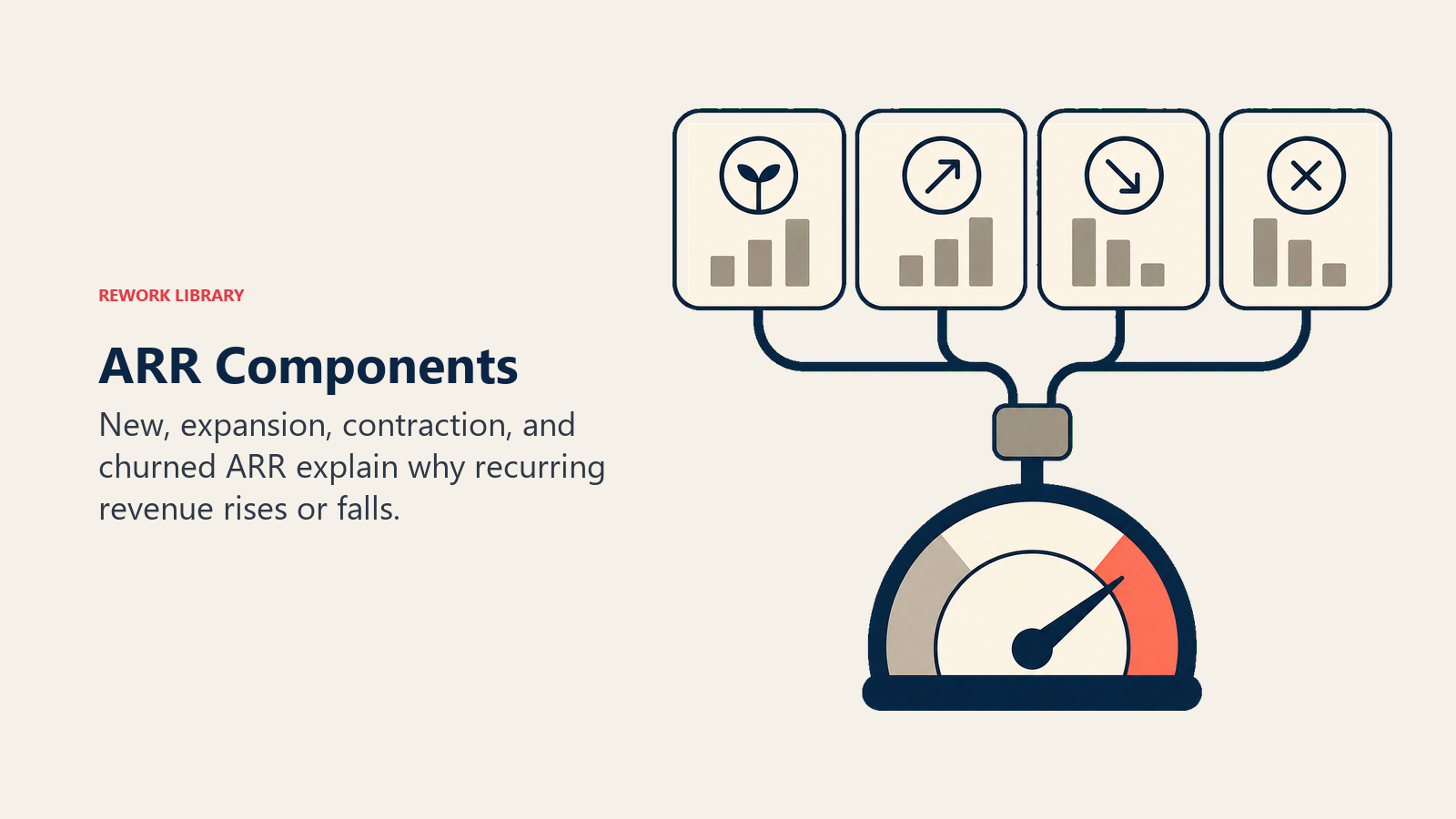
ARR novo é a receita de clientes que assinam pela primeira vez. É o resultado do seu pipeline de vendas e o driver de crescimento mais evidente.
ARR de expansão vem de clientes existentes que compram mais: upgrades, assentos adicionais, planos superiores ou novos módulos de produto. Costuma ser o ARR mais barato de gerar, pois o relacionamento já existe.
ARR de contração é a receita perdida de clientes que fazem downgrade em vez de cancelar. Um cliente que migra de um plano de R$ 24.000 para R$ 12.000 reduz o ARR em R$ 12.000. É um sinal de alerta que vale monitorar separadamente do churn.
ARR perdido por churn é a receita de clientes que cancelam completamente.
A interação desses quatro componentes determina o net revenue retention (NRR): a razão entre o ARR final da base de clientes existente e o ARR inicial. Um NRR acima de 100% significa que os clientes existentes expandem mais rápido do que fazem churn, ou seja, seu ARR cresce mesmo que você não feche nenhum negócio novo. A mediana de NRR fica em 103% para empresas B2B SaaS bootstrapped na faixa de US$ 3 milhões a US$ 20 milhões de ARR, segundo os benchmarks de 2026 da SaaS Capital.
Entender a composição importa também para decisões de pipeline. Se o ARR de expansão é forte, vale investir mais em customer success e em movimentos de upsell. Se o ARR novo é o único driver de crescimento, um trimestre ruim pode travar tudo. Veja visão geral das métricas de pipeline para ver como esses componentes se conectam à saúde geral do pipeline.
Por que o ARR importa
Investidores o usam como principal insumo de avaliação. Os múltiplos de ARR, a razão entre o valor da empresa e o ARR, são a linguagem padrão de captação de recursos no ecossistema SaaS. Quando um VC diz "estamos olhando para 8x receita", ele quer dizer 8x ARR.

Ele torna as previsões mais confiáveis. Como o ARR exclui receitas pontuais, oferece uma base limpa para a previsibilidade de receita. Você sabe o patamar mínimo de onde parte antes de acrescentar novas vendas.
Ele alinha toda a empresa. Vendas, finanças e customer success podem todos conectar seu trabalho a um único número. Vendas fecha ARR novo. CS defende e expande o ARR existente. Finanças reporta as variações líquidas do ARR para o board.
Ele sinaliza problemas cedo. Um ARR estagnado ou em queda detecta problemas antes que eles apareçam no caixa. Se contração e churn estão consumindo o ARR novo mais rápido do que o pipeline consegue repor, essa lacuna aparece no movimento do ARR antes de impactar o fluxo de caixa.
Ele orienta decisões sobre custo de aquisição. Conhecer o ARR por cliente permite calcular o payback do custo de aquisição de clientes e a proporção LTV:CAC que investidores e operadores acompanham. Sem números de ARR confiáveis, esses cálculos perdem o sentido.
Como calcular e crescer o ARR
Passo 1: Levante seus contratos ativos
Exporte todas as assinaturas ativas com data de início, data de término e valor total do contrato. Contratos plurianuais devem ser divididos pelo número de anos para obter o valor anual.
Passo 2: Categorize cada linha de receita
Classifique cada linha como assinatura (incluir) ou pontual (excluir). Se um contrato mistura as duas, separe a parcela recorrente. Seja consistente: sua definição de ARR precisa se manter de trimestre em trimestre para que as comparações façam sentido.
Passo 3: Segmente por componente
Organize seu ARR em grupos: novo, expansão, contração e churn. Calcule o ARR inicial mais o ARR novo e de expansão, menos contração e churn, para obter o ARR final. Calcule o NRR para avaliar a saúde da retenção.
Passo 4: Construa os alavancadores de crescimento
O ARR cresce por quatro caminhos:
- Fechar mais negócios novos (volume de vendas e melhoria do win rate)
- Aumentar o valor médio do contrato (precificação, empacotamento, otimização do tamanho do negócio)
- Reduzir o churn (qualidade do onboarding, stickiness do produto, investimento em customer success)
- Impulsionar a expansão (movimentos de upsell, upgrades acionados por uso, playbooks de expansão)
A maioria das empresas concentra quase toda a atenção no ARR novo e subestima a expansão. Mas se o seu NRR é de 90%, você perde 10% da sua base a cada ano antes de enviar uma única proposta nova. Corrigir a retenção tem um efeito composto que novos clientes não conseguem replicar.
Conecte suas metas de ARR aos seus métodos de previsão de vendas para saber se o pipeline consegue, de forma realista, entregar o ARR novo que seu plano de crescimento exige.
Exemplos de ARR
Estágio inicial: B2B SaaS com seed
Uma startup tem 25 clientes em planos anuais com média de R$ 8.400/ano.
- ARR = 25 x R$ 8.400 = R$ 210.000
ARR novo de negócios fechados no trimestre: R$ 42.000. Um cliente fez downgrade de R$ 8.400 para R$ 4.200 (contração: -R$ 4.200). Sem churns. Variação líquida do ARR: +R$ 37.800. ARR final: R$ 247.800.
Estágio de crescimento: mistura de contratos anuais e mensais
| Segmento | Clientes | Valor anual por cliente | ARR do segmento |
|---|---|---|---|
| Plano mensal (R$ 299/mês) | 60 | R$ 3.588 | R$ 215.280 |
| Plano anual (R$ 3.600/ano) | 45 | R$ 3.600 | R$ 162.000 |
| Enterprise anual (R$ 24.000/ano) | 12 | R$ 24.000 | R$ 288.000 |
| Total | 117 | R$ 665.280 |
NRR do trimestre: negócios de expansão adicionaram R$ 48.000, um churn removeu R$ 24.000 e dois downgrades removeram R$ 7.200. NRR = (R$ 665.280 + R$ 48.000 - R$ 24.000 - R$ 7.200) / R$ 665.280 = 103%.
Estágio de escala: mix concentrado em enterprise
Uma empresa com R$ 10 milhões de ARR tem 80% da receita em contratos enterprise anuais e 20% em mensalidades SMB. Os contratos enterprise têm ACV médio de R$ 125.000. A base SMB gira em torno de R$ 1.800/ano por cliente.
Se o segmento enterprise tem 60 clientes: 60 x R$ 125.000 = R$ 7,5 milhões de ARR de enterprise. Os R$ 2,5 milhões restantes vêm da base SMB mensal (cerca de 1.389 clientes SMB a R$ 1.800/ano).
Entender essa divisão é essencial para o planejamento do pipeline: negócios enterprise são menos numerosos, mas maiores, então uma renovação perdida move significativamente o ARR. Por isso, empresas com foco em enterprise constroem processos de inspeção de negócios e monitoram a precisão das previsões com rigor.
Leitura relacionada

Head of Enterprise Solutions
On this page
- O que é annual recurring revenue (ARR)?
- A fórmula do ARR
- Exemplo prático
- ARR vs MRR
- O que conta (e o que não conta) no ARR
- Componentes: ARR novo, de expansão, de contração e perdido por churn
- Por que o ARR importa
- Como calcular e crescer o ARR
- Passo 1: Levante seus contratos ativos
- Passo 2: Categorize cada linha de receita
- Passo 3: Segmente por componente
- Passo 4: Construa os alavancadores de crescimento
- Exemplos de ARR
- Estágio inicial: B2B SaaS com seed
- Estágio de crescimento: mistura de contratos anuais e mensais
- Estágio de escala: mix concentrado em enterprise
- Leitura relacionada