More in
AI at Work News
OpenAI Opened ChatGPT Advertising to Small Businesses at Any Budget
Jun 6, 2026
AI Is Everywhere at Work. Only 1 in 10 Say It Transformed the Job
Jun 6, 2026
Vibe Coding's $10.5B Moment: AI Now Starts Most New Software Builds
Jun 6, 2026
AI Agents Now Have More System Access Than Your Employees. Few Are Secured
Jun 5, 2026
Should You Build Your AI or Buy It? Watch What the Giants Bought.
Jun 5, 2026
Uber Caps Employee AI Spending at $1,500 Per Seat After a Budget Blowout
Jun 5, 2026
Trump's AI Executive Order Is Deregulatory. Your Compliance Risk Didn't Move
Jun 4, 2026
AI Pushed 220 Unicorns Below $1B. Pre-ChatGPT Companies Face a Reckoning
Jun 4, 2026
Token Prices Fell 67% This Year. Your AI Bill Is Going Up Anyway
Jun 3, 2026
Small Businesses Using AI Report Higher Revenue and Shorter Workdays
Jun 3, 2026
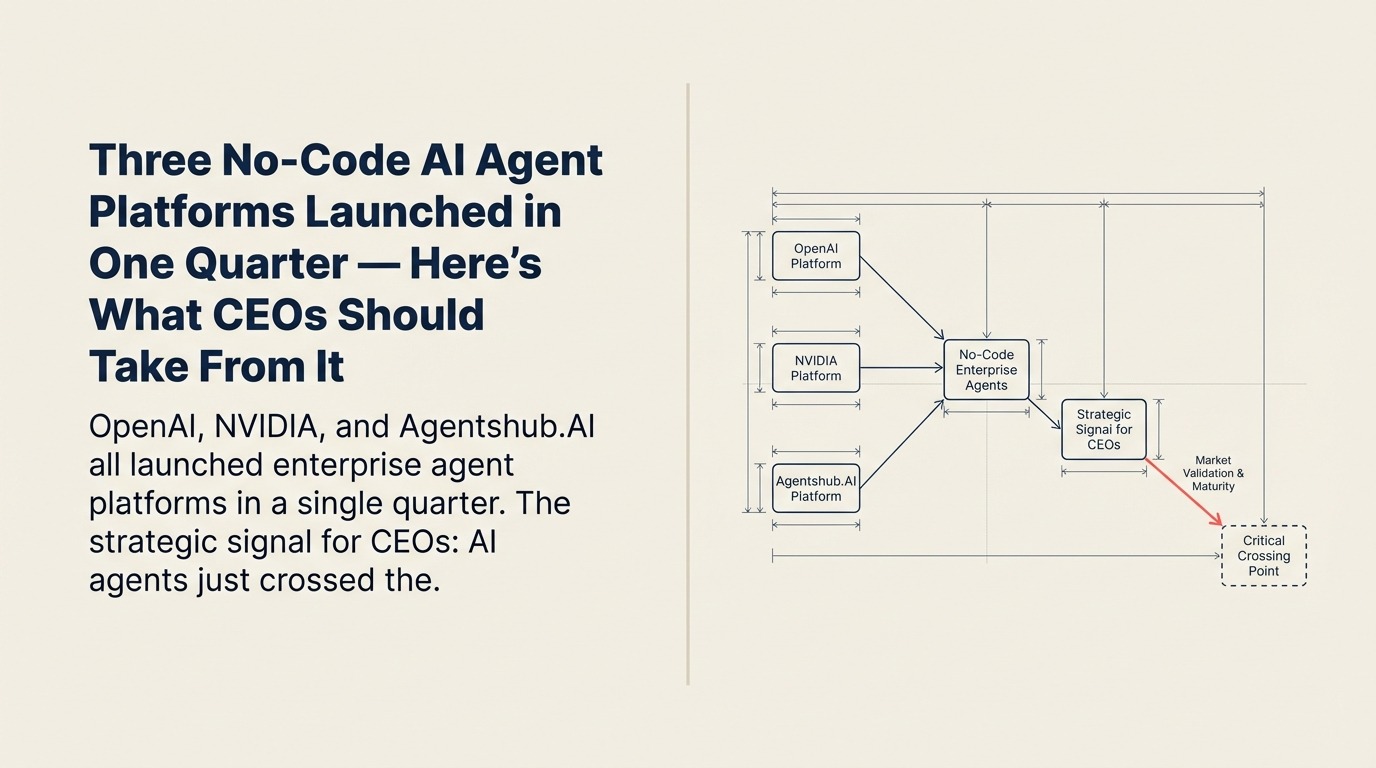
Three No-Code AI Agent Platforms Launched in One Quarter: Here's What CEOs Should Take From It
Turn this article into takeaways for your work.


Each assistant summarizes the article only for you and suggests best practices for your work.
The timing isn't coincidental. In a single quarter, three significant enterprise agent platforms launched within weeks of each other. And while each is aimed at a different buyer, together they signal something CEOs can't afford to read as isolated tech news.
Here's the sequence: OpenAI launched its enterprise agent platform (branded "Frontier") in February 2026, described by TechCrunch as infrastructure for companies to build and manage their own AI agents. NVIDIA followed in March at GTC with its Open Agent Development Platform (fully open source, backed by 17 named enterprise partners including SAP, Salesforce, Adobe, and Cisco). Then on April 6, according to Yahoo Finance, Agentshub.AI launched a no-code drag-and-drop agent builder aimed at business teams, not developers, with more than 1,000 integrations and templates covering Sales, Marketing, Customer Success, RevOps, and HR.
Three launches. One quarter. Dramatically different cost and complexity profiles. The same underlying message.
The SaaS Parallel CEOs Should Already Recognize
If you were running a company between 2008 and 2012, you watched the enterprise software market go through exactly this pattern. Custom-built systems were the status quo. Then Salesforce, Workday, and Zendesk made it possible to buy what you'd previously had to build. The question shifted from "how do we build CRM?" to "which CRM do we buy, and for which teams do we still build something custom?"

The AI agent market is at that inflection right now.
Eighteen months ago, building an enterprise AI agent meant significant engineering investment, model fine-tuning, and custom integration work. That was the "build" phase. What we're watching now (three platforms in one quarter, with increasingly accessible tooling) is the "off-the-shelf" phase beginning. The options are no longer binary (build or wait). They're now a spectrum:
- Build on infrastructure (OpenAI Frontier, NVIDIA's open platform): maximum flexibility, engineering investment required, you own the stack
- No-code custom (Agentshub.AI): business teams can build workflows without engineers, less flexibility at the edges
- Buy a pre-built agent (Salesforce Agentforce, HubSpot Breeze): lowest time-to-value, vendor-constrained
That spectrum exists now. It didn't clearly exist 12 months ago. And it changes the decision framework for every line item where your company is currently "waiting for AI to mature."
The governance side of this equation matters just as much as the tools. You can read the governance gap in more detail in the AI governance and enterprise readiness piece published earlier this week.
What Each Platform Actually Signals
OpenAI Frontier signals that the world's most-watched AI company is positioning enterprise infrastructure, not just model access, as its core commercial bet. Building on Frontier means betting that OpenAI's underlying models stay competitive and that you want to own the agent logic layer yourself. For companies with engineering depth and specific workflow requirements that pre-built tools don't cover, this is a real option. But it's an infrastructure play, not a turnkey solution.
NVIDIA's Open Agent Development Platform is the most interesting strategic signal of the three for enterprise buyers. It's fully open source, backed by major SaaS partners, and designed for hybrid routing: using frontier models for orchestration and lighter open models for task execution. NVIDIA claims 50%+ query cost reduction while maintaining accuracy. The open-source foundation eliminates vendor lock-in concerns. The 17 named enterprise partners (including companies already embedded in your tech stack like Salesforce and Atlassian) suggest this isn't a research project. It's infrastructure that major vendors are already building on.
Agentshub.AI is the clearest signal that the no-code agent wave is real. A drag-and-drop builder with 1,000+ integrations, targeting business teams directly, means the friction for standing up basic agentic workflows is dropping toward near-zero. The risk isn't that this doesn't work. It's that it works well enough that every team in your company starts building agents independently, without any coordination, governance, or coherent data strategy.
The CEO Decision Framework
None of this requires a decision this week. But it does require a frame. Here's how to think about it:

1. Where is your current "build or wait" list? Most companies have a mental inventory of AI use cases they've been deferring because the tooling wasn't ready, the cost was too high, or the engineering lift was too large. That list deserves a fresh review. Several items on it probably have off-the-shelf paths now that didn't exist six months ago.
2. What's your AI infrastructure bet? You're not choosing a tool. You're placing a bet on which infrastructure layer becomes your operating model. OpenAI, NVIDIA's open stack, and the major CRM vendors (Salesforce, HubSpot) are all trying to become that layer. Which one aligns with where your organization's data and workflows actually live?
3. Who governs agent creation in your company? This is the question most CEOs won't think about until something goes wrong. If Agentshub.AI or a similar no-code tool means that any manager can build an agent that talks to customer data, updates CRM records, or sends messages on behalf of your brand, what's your governance model? This needs an answer before the tools are deployed, not after. See the RevOps governance checklist for AI agents for the operational detail.
4. What's your make-or-buy line? The companies that got the most out of the SaaS wave weren't those that built everything or bought everything. They drew a clear line: buy everything that's core but not differentiating, build only where competitive differentiation lives. The same line applies to AI agents. Define yours explicitly before your teams make 12 independent decisions that collectively don't add up to a strategy.
The Budget Question You Should Be Asking
Here's the concrete test: look at your 2026 AI budget line. How much is allocated to model API costs and AI infrastructure versus pre-built tool subscriptions? If you haven't revisited that split since Q3 2025, you're pricing AI agents based on a market that no longer exists.
NVIDIA's platform claims significant cost reduction on query routing. No-code tools like Agentshub change the labor cost model for building automations. OpenAI Frontier changes the build-vs-buy calculus for custom agents. These aren't marginal shifts. They're the kind of changes that justify a mid-year budget review, not a wait-for-next-planning-cycle one.
For companies thinking through the broader AI workplace transformation and what it means for team structure, the agent platform wave adds another dimension to that conversation.
What to Do This Week
The arrival of accessible no-code agent platforms doesn't require a sprint. But it does warrant a structured conversation at the executive level before your teams start making independent decisions.

This week:
- Ask your CTO or Head of Engineering: which of the three new platforms (OpenAI Frontier, NVIDIA's open stack, Agentshub.AI) is closest to what we'd realistically build on, and what would a 90-day pilot look like?
- Pull your current "waiting for AI to mature" list and identify two or three items that now have off-the-shelf paths. Assign owners to evaluate them.
- Ask your head of RevOps or operations: are any business teams already using no-code automation tools (Zapier, Make, n8n) for revenue workflows? If yes, the agent wave is already arriving through that door.
- Put the buy-vs-build question explicitly on your next leadership agenda. Frame it as: "We need to define our make-or-buy line for AI agents before individual teams make that decision for us."
The inflection happened. The market moved from "build or wait" to "build, buy, or no-code." The companies that recognize that transition and make deliberate decisions will be better positioned than those that let the vendor ecosystem make the decision for them.
Learn More
- Agentshub.AI Just Made Enterprise AI Agents No-Code: CRO's 30-day pilot evaluation framework for the no-code agent platform
- AI Governance Policy for Departments: defining the make-or-buy line before teams build agents independently
- 86% of CEOs Are Increasing AI Budgets: why governance has to keep pace with the agent deployment wave
- AI Workforce Transformation in Professional Services: how leading firms are structuring the human-agent divide
Primary source: Yahoo Finance, April 6, 2026, Agentshub.AI launch. Additional context: NVIDIA Newsroom, March 16, 2026 and TechCrunch, February 5, 2026.