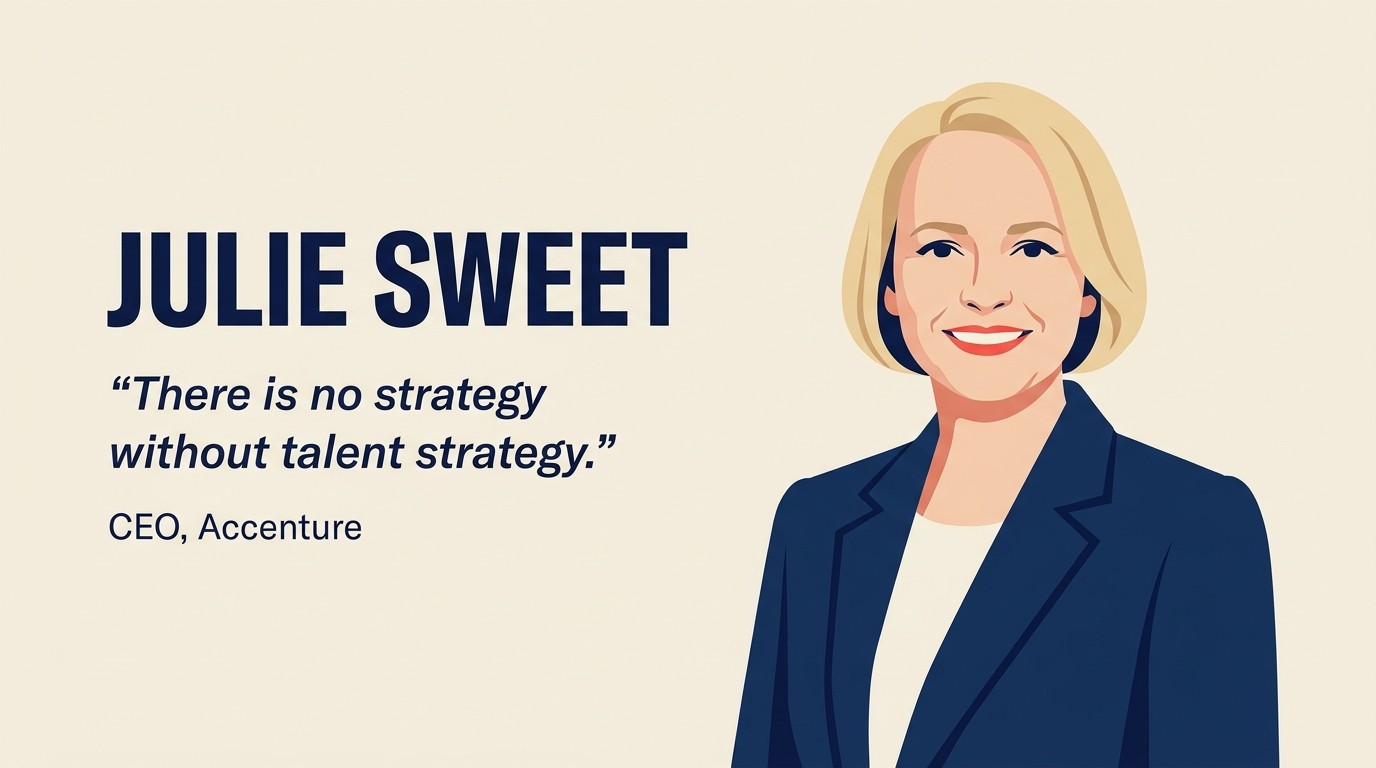
Julie Sweet Leadership Style: Scale, Reinvention, and Leading 750,000 People Through the AI Era
Turn this article into takeaways for your work.


Each assistant summarizes the article only for you and suggests best practices for your work.
Key Facts: Julie Sweet
- Born: 1967 (Tustin, California)
- Education: Claremont McKenna College (BA), Columbia Law School (JD)
- Pre-Accenture: Partner at Cravath, Swaine & Moore (1999-2010), corporate M&A practice
- Joined Accenture: 2010 as General Counsel, Secretary, and Chief Compliance Officer
- North America CEO: 2015-2019 (grew region to fastest-growing Accenture geography)
- Global CEO: September 2019-present
- Chairman: Added title in September 2021
- Revenue scaled: $43.2B (FY2019) → $64.9B (FY2024) under her tenure
- Workforce: ~492,000 → 750,000+ employees across 120+ countries
- Signature bet: $3 billion AI investment announced March 2023, first major professional services firm to commit at that scale
- Recognition: Fortune Most Powerful Women in Business (annual), Time 100 Most Influential
Julie Sweet spent ten years at Cravath, Swaine & Moore, one of the most selective law firms in the United States, where partnership is a genuine rarity. She made partner. Then in 2010, she left to join Accenture as General Counsel. Most BigLaw partners don't make that move. It's a significant pay cut on paper, a status step down in legal circles, and an entry into a functional role rather than a leadership one.
She became North America CEO in 2015, running Accenture's largest business unit. In September 2019, she became global CEO, inheriting a company with $43.2 billion in revenue and 492,000 employees. By fiscal year 2024, Accenture reached $64.9 billion in revenue and approximately 750,000+ employees across 120+ countries.
She repositioned Accenture around AI transformation before the 2023 generative AI wave made that an obvious move. She announced a $3 billion AI investment in March 2023 and trained Accenture's entire workforce on generative AI, the first professional services firm to do so at scale. Fortune named her to its Most Powerful Women in Business list every year of her tenure, placing her alongside Indra Nooyi and Sheryl Sandberg as one of the most studied female CEOs of her generation in terms of how scale, culture, and values interact at the top of a large organization.
But the more interesting question is how you actually run a company of 750,000 people without losing the thread. As the CEO of a services giant navigating a technology inflection, Sweet's position invites direct comparison with Ginni Rometty, both ran large professional services organizations through an AI transition, though Sweet moved earlier and faster in committing capital to the bet.
Leadership Style Breakdown
| Style | Weight | How it showed up |
|---|---|---|
| Operational Scaler | 60% | Sweet's leadership is fundamentally about execution at scale. Accenture under her tenure grew its headcount by roughly 260,000 people while maintaining revenue per employee and client relationship quality. She ran 40+ acquisitions per year to build cloud, AI, and digital capabilities, a pace that required disciplined integration processes and a clear acquisition thesis. The scale decisions, hiring, integrating, organizing, are her primary domain. |
| Strategic Repositioner | 40% | The AI pivot wasn't reactive. Sweet had been publicly talking about technology transformation as Accenture's core positioning since her North America CEO days. When generative AI emerged in 2022-2023, Accenture's positioning as a transformation partner, not just a staffing or outsourcing business, was already established. She moved the $3 billion AI investment announcement in March 2023, before most professional services competitors had articulated a coherent AI strategy. |
The 60/40 split matters because Sweet's execution credibility is what gives her repositioning claims market weight. A lot of consulting firms have announced AI strategies. Accenture's announcement landed differently because Sweet had already demonstrated she could execute at scale: 40+ acquisitions per year, 260,000 employees added, $21 billion revenue growth over five years. The strategic claim was backed by operational proof.
Key Leadership Traits
| Trait | Rating | What it means in practice |
|---|---|---|
| Domain-switching credibility (law to operations to strategy to CEO) | Very High | Sweet's career path (BigLaw partner, GC, regional CEO, global CEO) is unusual in that each transition required demonstrating competence in a domain where her previous credentials gave her no automatic standing. Her GC years gave her risk and governance credibility. Her North America CEO years gave her P&L credibility. The accumulation of domain-switching without losing credibility at each stage is a specific skill that most executives who stay within one functional track don't develop. |
| Anticipatory positioning (AI pivot before competitors moved) | High | The $3 billion AI investment was announced before most of Accenture's direct competitors had made a comparable commitment. The Accenture Technology Vision, an annual report on emerging technology trends, had been signaling AI as a transformation lever for several years before generative AI became mainstream news. Sweet's willingness to commit capital to a thesis before it was consensus is a real leadership quality. The risk is that early commitments can be wrong. The AI bet, so far, has not been. |
| Client-centricity at scale | High | Accenture's business model depends on long-term relationships with large enterprise clients. The average Accenture engagement doesn't last months. It lasts years. Sweet's North America years were built on maintaining and growing those relationships, and her global CEO role has required ensuring that relationship quality holds across 120+ countries and dozens of industry verticals. The risk this creates is that client dependency and vendor dependency can look similar from the outside. |
| Execution discipline across 750,000 employees | Strong | The organizational discipline required to run an acquisition program at 40+ deals per year while maintaining cultural coherence is genuinely difficult. Accenture's ability to absorb acquired companies, many of them technology boutiques or digital agencies with distinct cultures, without losing the value that made them worth acquiring requires both integration processes and cultural judgment. Sweet has been clear that she doesn't try to homogenize acquisitions immediately; she builds toward integration over time. |
The Sweet Transformation Model: An AI-First Services Doctrine
The Sweet Transformation Model
The Sweet Transformation Model is a leadership doctrine where a services CEO commits capital to a technology platform shift before market consensus forms, then trains the entire workforce on the new capability while running disciplined acquisitions to backfill skill gaps. It treats AI as an operating layer the firm sells, builds, and uses internally, not a marketing posture, and pairs strategic positioning with simultaneous operational execution rather than sequential rollouts.

The 3 Decisions That Defined Sweet
1. Moving from BigLaw to Accenture GC in 2010
This is the foundational decision, and it's worth understanding on its own terms rather than as a footnote to the CEO role.
Cravath, Swaine & Moore partnership is a specific kind of credential. Cravath is known for its lockstep compensation model, its unusually selective partnership track, and its work on the most complex M&A and securities litigation in the United States. Sweet had been there since 1992. She made partner. Leaving at that point was giving up something real.
The GC role at Accenture was, by legal market standards, a lateral move that many Cravath partners wouldn't take, stepping into corporate rather than BigLaw. But it was also an entry into a company with $21 billion in revenue at the time, operating in virtually every major industry across 120+ countries. The scope of organizational exposure was larger than any law firm role would have provided.
What she gained: understanding of how a global professional services company is actually run, from inside the leadership team rather than as external counsel. How contracts get structured, how client relationships are managed, how workforce decisions are made, how regulatory issues are navigated across multiple jurisdictions simultaneously. Five years as GC before moving to a P&L role gave her an operational foundation that most lawyers who become executives lack.
For executives considering functional transitions: Sweet's GC-to-CEO path illustrates a specific principle. The general counsel role in a large company isn't a support function. It's a front-row seat to every significant decision the company makes: M&A, regulatory, employment, governance. Executives who use functional roles as learning positions rather than career destinations accumulate cross-functional credibility faster than those who stay in the same functional track.
2. Repositioning Accenture as an AI-Led Transformation Company (2022-2023)
In March 2023, Accenture announced a $3 billion investment in AI, one of the largest single AI commitments by a professional services firm at the time. Reuters and Fortune both covered the announcement as a signal of where enterprise AI spending was heading, see the Accenture Wikipedia article for the firm's full history and revenue scale context. This included creating an AI Center of Excellence, building AI-specific practices across all industry verticals, signing major partnerships with Google, Microsoft, and AWS for AI infrastructure, and training all of Accenture's employees on generative AI capabilities.
The announcement came roughly four months after ChatGPT's public launch. But the positioning wasn't reactive to ChatGPT. Accenture's Technology Vision reports had been emphasizing AI as a transformation lever for several years. Sweet had been talking publicly about "responsible AI" and enterprise AI readiness in 2021 and 2022. The $3 billion commitment was the capital commitment that matched the strategic narrative she'd been building.
The execution has been real. Accenture's AI revenue grew faster than overall company revenue in fiscal 2023 and 2024. The firm signed AI transformation engagements with clients across financial services, healthcare, and manufacturing that were publicly disclosed as significant. The "LearnVantage" platform for AI training was deployed to the entire workforce, which at 750,000 people is its own feat of operational logistics.
For leaders making technology platform bets: Sweet's AI repositioning shows what it looks like to make a large bet before consensus, back it with capital rather than just rhetoric, and execute the operational components (training, partnerships, acquisitions) in parallel. The strategic claim and the operational execution were simultaneous, not sequential.
3. Maintaining Workforce Scale While Competitors Contracted
In 2022-2023, most large technology and professional services companies ran significant layoffs. Microsoft laid off 10,000 people in January 2023. Google, Meta, Amazon, and Salesforce all ran large reductions. McKinsey, Boston Consulting Group, and Deloitte cut headcount.

Accenture did run a reduction in 2023, approximately 19,000 positions or about 2.5% of the workforce, but it continued hiring in AI, cloud, and digital capabilities at a pace that made the net headcount change modest. The decision to maintain workforce scale while competitors contracted was a bet that talent density compounds: that having the people with AI and cloud skills in-house during a market transition creates advantages that are hard to replicate quickly on the other side of a downturn.
This is a version of a bet some technology companies have made historically, holding talent through cycles rather than running hire-fire loops. It's expensive in the short term. It creates real organizational density and capability depth if the bet is right. The risk is that you're carrying labor costs through a soft revenue period and the rebound doesn't materialize fast enough.
For executives running professional services businesses or talent-intensive organizations: the workforce scale decision is one of the hardest you'll make during a market correction. Accenture's 2023 path, targeted reduction in declining areas and continued hiring in growing ones, is a more surgical model than a broad headcount freeze or a large cut. It requires knowing specifically where the business is growing and being disciplined enough to not let the overall reduction become a blunt instrument that cuts the capabilities you need next.
What Sweet Would Do in Your Role
If you're a CEO positioning your company for a technology platform shift, Sweet's AI pivot has a direct model. She committed capital, $3 billion, before the market consensus formed. That's the difference between a strategic pivot and a strategic announcement. If your company's positioning claims aren't backed by budget allocation, hiring plans, and partnership commitments, they're not positioning. They're marketing. Ask: what dollar commitment would make your AI or technology transformation claim credible? Then make it.
If you're a COO or operations leader managing at scale, Sweet's acquisition integration model is worth examining. Accenture runs 40+ acquisitions per year and has to integrate each one without destroying what made the acquisition valuable, usually a specific technical capability, cultural identity, or client relationship. That requires an integration playbook that is both rigorous (the acquired company needs to connect to Accenture's systems, governance, and client base) and patient (the culture and talent can't be absorbed too fast). Ask your team: what's our explicit integration philosophy for the things we acquire? And does that philosophy match our actual integration behavior?
If you're a product or technology leader, the Accenture Technology Vision approach has a lesson about thought leadership as market positioning. Sweet used Accenture's annual technology forecast as a strategic communication tool; it positioned the firm as a guide to the same technology shifts it was selling implementation services for. If your company has genuine knowledge about where your industry is going, publishing that knowledge publicly often builds more client trust than proprietary confidentiality does. The credibility from being right publicly is worth more than the competitive protection of keeping the insight private.
If you're in sales or client relationship management, Sweet's North America CEO record is a useful template. Accenture North America became the fastest-growing Accenture region under her leadership, growing from roughly $15 billion in revenue. That growth came from a combination of new client acquisition and expansion of existing accounts. The expansion model, growing revenue with existing clients by adding new service lines as client trust deepens, is more capital-efficient than new client acquisition. Ask yourself: where are your existing clients underserving their own needs in areas you could provide? That's your expansion pipeline.
How Rework Supports the Sweet Transformation Model
Sweet's playbook pairs services-led AI transformation with the operational discipline to track every engagement, every acquired team, and every client expansion thread without losing visibility. That dual demand, strategic positioning plus execution rigor, is exactly what consulting firms, agencies, and services businesses struggle with when they try to copy the Accenture model at smaller scale.
Rework gives services firms a single workspace where the AI transformation pipeline, the client engagement portfolio, and the cross-team collaboration all sit together. The CRM and Sales Ops module (from $12/user/mo) tracks expansion revenue inside existing accounts, the pattern Sweet used to grow Accenture North America. Work Ops (from $6/user/mo) handles delivery execution across distributed consultants, so partners see capacity, utilization, and engagement health in one view. Firms going through their own AI pivot use Rework to keep transformation announcements honest, capital commitments, training rollout, and client wins tracked against the strategic narrative, not just slide decks.
Notable Quotes and Lessons Beyond the Boardroom
Sweet has spoken consistently about what she calls "rotating to the new." It's an operational framing, not a brand tagline. The idea is that organizations that are growing have to constantly move resources, people, capital, leadership attention, from areas that are stable or declining toward areas that are growing. The hard part isn't identifying where to grow. It's being willing to reduce investment in things that are currently producing revenue in order to build the things that will produce it in three years.
"Leaders have to be the chief rotation officer," she's said in interviews. That framing is deliberately anti-nostalgic. You're not preserving what the company has been. You're actively moving it toward what it needs to become.
On scale governance, she's been direct about what 750,000 employees requires: "You can't know everything. You have to build systems, cultures, and leaders who make good decisions when you're not in the room." That's a constraint-based approach to leadership at extreme scale: you're not trying to make every decision, you're trying to build the conditions under which good decisions get made. That framing applies to any organization with meaningful geographic or functional dispersion.
Where This Style Breaks
Sweet's Accenture is large enough that "transformation" can become a product category rather than a delivered outcome. Critics of large consulting engagements, and there are many legitimate ones, point out that Accenture's transformation work sometimes creates dependency rather than capability transfer. Clients run long-term Accenture engagements and emerge without the internal capability to maintain what was built. That's a real structural critique of the consulting model, not just Accenture.
At 750,000 employees, culture messaging inevitably becomes abstract. Tim Cook faces a structurally similar challenge at Apple, translating a CEO's cultural conviction through a global organization where most employees never interact with the person setting the tone, though Apple's product-centricity gives it different internal coherence mechanisms than a services firm. The values and principles that Sweet articulates in her public communications are genuine, but they have to travel through 120+ country offices, dozens of industry practices, and hundreds of client-facing teams. The gap between what the CEO says about culture and what a junior consultant experiences on a difficult client engagement is wider than at a 5,000-person company. That gap is a permanent feature of extreme scale, and it's worth being honest about.
The AI repositioning is directionally right, but the consulting industry's AI value model is still being tested. Clients who are building internal AI capabilities may find they need less Accenture over time, not more. The bet that AI complexity creates demand for transformation guidance rather than reducing it is plausible, but it's a bet, and the outcome is still being written.
Frequently Asked Questions about Julie Sweet's Leadership
Who is Julie Sweet?
Julie Sweet (born 1967) is the Chair and CEO of Accenture, the world's largest professional services firm. She joined Accenture in 2010 as General Counsel after a decade as a partner at Cravath, Swaine & Moore, became North America CEO in 2015, global CEO in September 2019, and added the Chair title in September 2021. Under her leadership, Accenture grew from $43.2B to $64.9B in revenue and from roughly 492,000 to 750,000+ employees.
How has Sweet transformed Accenture?
Sweet repositioned Accenture from a broad outsourcing and consulting firm into an AI-led transformation partner. She ran 40+ acquisitions per year to build cloud, AI, and digital capabilities, grew revenue by roughly $21 billion over five years, and added approximately 260,000 employees while maintaining revenue per employee. She also moved the firm's strategic narrative from "digital transformation" to "AI-led reinvention" before competitors made the same shift.
What is Accenture's AI strategy under Sweet?
In March 2023, Sweet announced a $3 billion AI investment, one of the largest single AI commitments by a professional services firm at the time. The strategy includes an AI Center of Excellence, AI practices across every industry vertical, deep partnerships with Google, Microsoft, and AWS, and the LearnVantage platform that trained Accenture's full 750,000-person workforce on generative AI, making it the first major professional services firm to do so at scale.
What is Sweet's legal background?
Sweet earned her JD from Columbia Law School and joined Cravath, Swaine & Moore in 1992, making partner in the firm's notoriously selective lockstep partnership in 1999. She practiced corporate M&A and securities law for a decade as partner before leaving for Accenture in 2010. The Cravath background gave her unusual depth in governance, regulatory, and contract structure, uncommon credentials for a CEO of a 750,000-person services firm.
What is Sweet's approach to talent?
Sweet treats talent density as a compounding advantage. While most large tech and professional services firms ran significant layoffs in 2022-2023, Accenture made a targeted 19,000-position reduction (~2.5%) while continuing to hire aggressively in AI, cloud, and digital, a surgical approach rather than a broad cut. She has also made workforce-wide AI training non-negotiable, betting that an AI-fluent 750,000-person workforce is harder to replicate than any single technology investment.
What can CEOs learn from Julie Sweet?
Three lessons stand out. First, back strategic claims with capital, Accenture's AI positioning was credible because the $3 billion commitment matched the rhetoric. Second, run anticipatory positioning rather than reactive positioning, commit to a thesis before consensus forms. Third, treat acquisition integration as a long game, not a 90-day playbook; Accenture absorbs 40+ acquisitions per year by being patient about cultural integration while being rigorous about systems, governance, and client connection.
Learn More
- Satya Nadella Leadership Style: How Growth Mindset and Empathy Transformed Microsoft
- Indra Nooyi Leadership Style: How PepsiCo's CEO Built a Purpose-Driven Strategy at Fortune 50 Scale
- Christine Lagarde Leadership Style: Institutional Credibility and Leading Through Systemic Crisis
- Ginni Rometty Leadership Style: Transformation Under Pressure and the Limits of Reinventing Slowly
- Jacinda Ardern Leadership Style: Empathetic Governance and What "Kindness" Actually Costs
Co-Founder, Rework.com
On this page
- Leadership Style Breakdown
- Key Leadership Traits
- The Sweet Transformation Model: An AI-First Services Doctrine
- The Sweet Transformation Model
- The 3 Decisions That Defined Sweet
- 1. Moving from BigLaw to Accenture GC in 2010
- 2. Repositioning Accenture as an AI-Led Transformation Company (2022-2023)
- 3. Maintaining Workforce Scale While Competitors Contracted
- What Sweet Would Do in Your Role
- How Rework Supports the Sweet Transformation Model
- Notable Quotes and Lessons Beyond the Boardroom
- Where This Style Breaks
- Learn More