Prioritizing Customer Feedback: How CS and Product Decide What Gets Acted On
Turn this article into takeaways for your work.


Each assistant summarizes the article only for you and suggests best practices for your work.
The prioritization fight between CS and Product is one of the most reliably recurring conflicts in a mid-market SaaS company. CS brings a list of things customers are asking for. Product brings a roadmap built around strategic bets and engineering capacity. The two don't overlap much. And neither side has a framework the other one trusts. It's one of the warning signs of CS-product misalignment that shows up earliest and degrades the VoC pipeline fastest.
So prioritization becomes a negotiation, not a decision. CS escalates the loudest accounts. Product pushes back with "roadmap fit." Both sides leave the meeting feeling unheard. Gartner's research on product decisions shows that growth-stage companies differentiate themselves by using direct customer feedback and market data as top prioritization inputs, not internal politics or executive instinct. Customers who deserve to see their feedback acted on don't hear back. Customers who complain loudly win changes that don't reflect the actual revenue distribution.
The problem isn't the conflict. It's the absence of a joint framework. CS and Product are making the same prioritization decision from different inputs and different success metrics. A shared model, one that both functions can see the logic of even if they weight it differently, replaces the negotiation with a process.
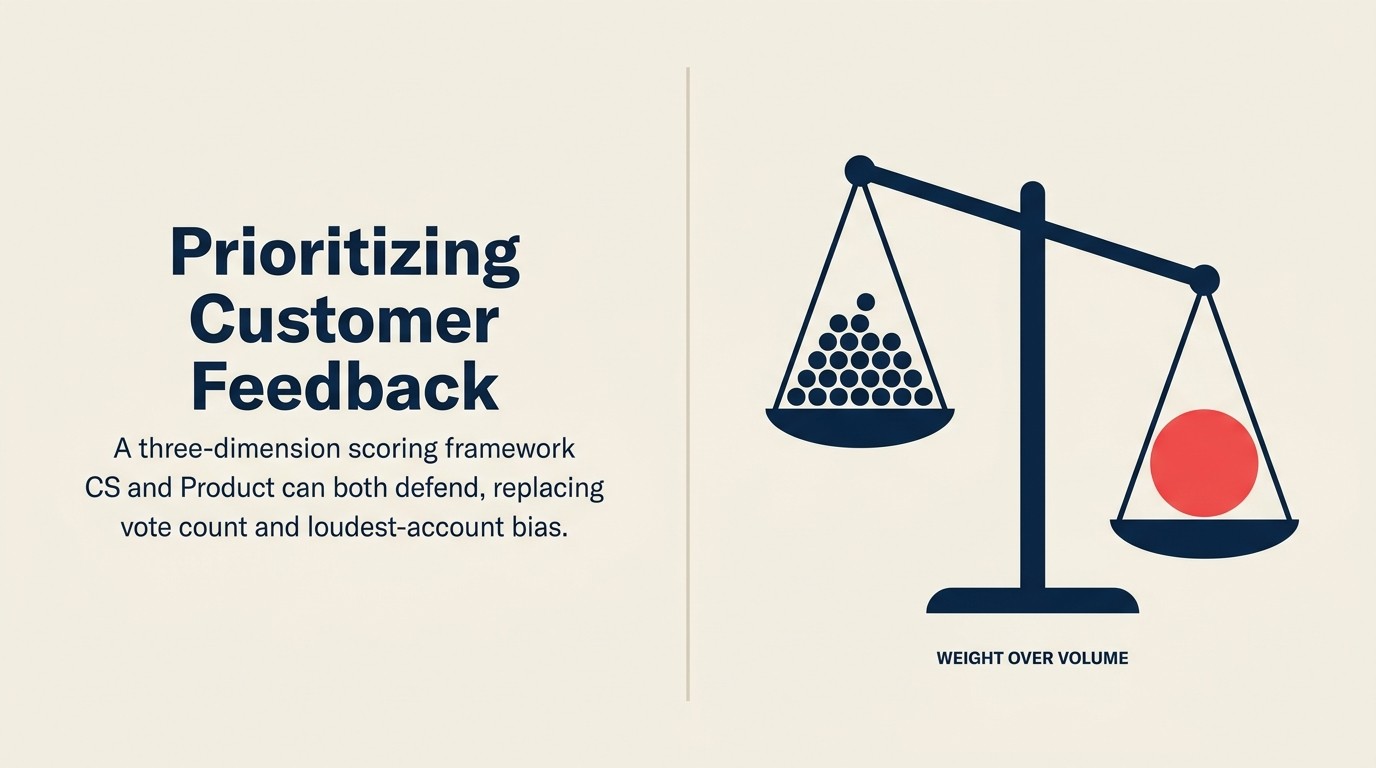
The 3-Dimension Scoring Model scores each feedback theme across three dimensions (revenue weight, customer breadth, and strategic alignment) that CS and Product each contribute to, and neither can fill in alone. The joint scoring session, not individual advocacy, produces the prioritized shortlist.
Why the Default Models Fail
Key Facts: Feedback Prioritization in Practice
- Only 31% of product teams use a formal scoring model for customer feedback prioritization; the majority rely on PM judgment or volume-based ranking, per Productboard's annual product management survey.
- Features prioritized using ARR-weighted models see 28% higher enterprise retention in the 12 months post-launch compared to features prioritized by vote count, per Gainsight research on CS-informed product decisions.
- Teams with a formal joint prioritization ritual report 40% less internal conflict over roadmap decisions and higher CSM trust in the product feedback process, per TSIA's CS-product alignment benchmarking study.
Before building a better model, it's worth being specific about what's wrong with the ones most teams use.
Vote count. Productboard, UserVoice, and similar tools default to ranking by vote or request count. One enterprise account renewing for $800K counts the same as one SMB trial account on a $6K plan. Standard product frameworks like RICE scoring and the MoSCoW method were designed to move beyond raw vote counts, but even these frameworks don't account for revenue concentration when applied without ARR weighting. The model systematically deprioritizes enterprise accounts, who tend to complain formally less often (they call their CSM, not the feedback portal) while over-indexing on SMB accounts that submit tickets and click upvote buttons. The result: you build for the squeaky wheel segment, not the revenue segment.
Loudest customer. CS advocates hardest for the accounts applying the most pressure. That pressure is usually inversely correlated with revenue maturity: struggling accounts escalate, healthy expanding accounts don't. Building roadmap decisions around the most vocal advocacy systematically misaligns investment toward retention emergencies rather than expansion opportunities.
PM gut instinct. Not wrong. Experienced PMs have calibrated instincts. But opaque gut instinct is defensible internally and invisible to CS. When CS can't see the logic behind a prioritization decision, they can't trust it. And when CS doesn't trust the process, they stop contributing to it. The VoC pipeline degrades because CSMs stop logging signals that "never go anywhere."
CS escalation wins. This creates the worst incentive structure: CSMs learn that formal feedback submission doesn't work, but escalation does. So they stop submitting structured feedback and start escalating informally. Product starts receiving one-off requests without context, without revenue weight, without aggregation. And the escalation threshold for CS drops over time. Every significant customer request becomes an "emergency." The shared scoring model is what breaks this cycle.
A Shared Prioritization Model: Three Dimensions
Quotable Nugget: Only 31% of product teams use a formal scoring model for customer feedback prioritization; the majority rely on PM judgment or volume-based ranking, per Productboard's annual product management survey. The remaining 69% are making roadmap decisions without a methodology both CS and Product can audit.
The three dimensions cover what CS knows, what Product knows, and what RevOps can contribute. No single function can score all three dimensions alone.

Dimension 1: Revenue weight. How much ARR is tied to this request, adjusted for renewal proximity and stated churn or expansion signal. This is the CS and RevOps contribution. PMs don't have clean access to ARR data, renewal timing, or CSM-assessed churn risk. CS does.
Dimension 2: Customer breadth. How many accounts are requesting this, weighted by customer tier. This combines CS pipeline data with the raw count. Breadth matters separately from revenue weight because ten mid-market accounts requesting the same thing is a different signal from one enterprise account requesting it, even if the ARR weights are similar.
Dimension 3: Strategic alignment. How closely does this request fit the current product direction? This is the Product contribution. CS can't assess strategic fit without roadmap context, and PMs shouldn't be expected to assign revenue weight without CS data.
Each dimension gets a score from 1 to 5. The composite score surfaces the items that are strong across all three, and reveals the tradeoff cases: high revenue weight but low strategic fit, or high breadth but low ARR.
Dimension 1: Applying Revenue Weight
Revenue weight answers: if we don't build this, how much ARR is at risk? And if we do build it, how much expansion does it unlock?

ARR at risk = contract value x renewal proximity factor x churn signal strength.
Renewal proximity factor: renewing in less than 90 days = 1.5x; renewing in 90-180 days = 1.0x; renewing beyond 180 days = 0.5x. A $200K account renewing in 60 days carries a higher urgency weight than the same ARR account renewing in 14 months, even if the underlying churn risk is similar.
Churn signal strength: CSM-flagged explicit churn risk tied to this request = 1.0; CSM-inferred risk based on account health trends = 0.5; no expressed churn signal = 0.1.
ARR expansion potential = unrealized expansion headroom x stated dependency score. An account at $80K ARR with 40 untapped seats, where the CSM reports this feature is the stated blocker for expansion, carries significant weight beyond the base ARR at risk.
The ARR-weighted feedback quantification article covers the full formula with a worked three-account example including concrete dollar amounts. Cross-referencing those weights with customer health monitoring data gives CS Ops a cleaner read on which signals represent genuine retention risk versus tactical noise.
Revenue weight score (1-5): assign based on total weighted ARR. Define thresholds appropriate to your ARR distribution. A team where enterprise accounts average $500K needs different breakpoints than one where the average deal is $30K.
Dimension 2: Applying Customer Breadth
Breadth answers: is this request concentrated in a few accounts, or is it distributed across the customer base?

Tier-weighted account count: count accounts by tier and apply weights. Enterprise accounts = 3x; Mid-Market = 2x; SMB = 1x. This adjusts for the systematic underreporting at the enterprise tier while preventing SMB volume from dominating.
Breadth score (1-5): based on weighted account count. For most mid-market teams, a weighted count of 10+ warrants a 5; fewer than 3 warrants a 1 or 2.
When breadth overrides revenue weight: if weighted account count is very high but ARR weight is low (many SMB accounts, no enterprise), the decision depends on strategic intent. If SMB is a growth segment, breadth matters. If the business is moving upmarket, breadth at the SMB tier shouldn't override low ARR weight.
One threshold rule worth making explicit: if a request appears in more than 30% of a customer tier, treat it as a baseline expectation rather than a feature request. At that point, not building it is a retention risk across the segment, not just for individual accounts.
Dimension 3: Applying Strategic Alignment
Strategic alignment answers: does this request fit where the product is going?
This is the dimension CS can least assess independently, and the one PMs sometimes use as a black box. The fix is making alignment criteria explicit before the scoring session, not during it.
Before the joint prioritization ritual, the Head of Product shares the current roadmap themes, the three to five strategic bets for the next two to three quarters. CS Ops maps each feedback theme to the roadmap themes and assigns a preliminary alignment score. PMs adjust if the mapping is off.
Strategic alignment score (1-5): direct fit with a current roadmap theme = 4-5; adjacent to a roadmap theme = 2-3; no apparent connection = 1.
The ICP filter: feedback from accounts that are outside your ICP gets tracked but excluded from the scoring model. Building for non-ICP customers pulls the roadmap toward segments you're not trying to serve. CS Ops flags non-ICP accounts at categorization time so they don't inflate the revenue weight or breadth scores.
When CS can challenge a "low strategic alignment" ruling: if a feedback theme is receiving a consistent score of 1 from Product across multiple quarters, and the accounts requesting it are high-ARR and high-fit, that's a signal worth surfacing explicitly. Either the roadmap theme definition needs updating, or there's a genuine tension between strategic direction and retention risk that leadership needs to address.
The Scoring Matrix in Practice
Three feedback items, scored across all three dimensions:

| Feedback theme | Revenue weight (1-5) | Customer breadth (1-5) | Strategic alignment (1-5) | Composite |
|---|---|---|---|---|
| Regional filtering in reports | 5 | 4 | 3 | 12 |
| Native HubSpot integration | 3 | 2 | 5 | 10 |
| Bulk user import via CSV | 2 | 5 | 2 | 9 |
Regional filtering scores highest despite lower strategic alignment because the revenue weight (several accounts renewing soon with churn signals tied to this gap) and breadth (appears across enterprise and mid-market tiers) together outweigh the strategic fit score.
Native HubSpot integration scores second: high strategic alignment (it's directly in a roadmap theme around integrations) but lower breadth and revenue weight than regional filtering.
Bulk user import scores third: high breadth (many SMB accounts requesting it) but low revenue weight and low strategic alignment. It might move to a later planning cycle rather than the current one.
How to handle ties: ties in composite score go to revenue weight as the tiebreaker. The model is designed to protect retention risk above other considerations. If two items are tied and one carries meaningfully higher ARR at risk, it takes priority.
When to override the model: the model is a decision input, not a decision rule. HBR's research on collecting honest customer feedback reinforces why the model needs to stay a decision input, not a decision rule. Customers give different answers depending on how you ask and who's in the room. Three override conditions warrant explicit documentation:
- Referenceable logo risk: a lighthouse customer account, regardless of ARR weight, threatens to churn and take their public reference with them. This is a strategic override.
- Compliance or regulatory requirement: a legal mandate isn't a feature request; it's a table-stakes threshold. Override the model and document the reason.
- Competitive emergency: a competitor ships a feature that directly creates churn risk across a segment. Revenue weight alone won't capture the urgency.
Document every override with a reason. Overrides that become routine are a signal that the model needs recalibration, not that exceptions are valid.
The Joint Prioritization Ritual
The scoring model only produces decisions if it's used in a structured session with the right people.

Who is in the room: the PM lead (or relevant PM for the feedback cluster), the VP CS, and the CS Ops data owner. RevOps joins quarterly to provide ICP and ARR data inputs. Keeping the group small prevents the session from becoming a committee decision. The quarterly customer feedback review article has a full agenda template and pre-read structure for this session.
Cadence: quarterly batch session (60-75 minutes) for standard prioritization; monthly 30-minute triage for items flagged as urgent (churn risk + renewal within 90 days). Urgent items don't wait for the quarterly session.
What CS Ops brings: the scored matrix with verbatims attached to each theme, the account list for each theme (names, ARR, renewal dates, churn signals), and any explicit customer statements about the impact of the gap.
What Product brings: the current roadmap themes, engineering capacity context, and the strategic alignment scores for each theme.
Output: a prioritized shortlist of three to five items, each with a named PM owner and a committed decision status (build in next quarter / defer to Q+2 / decline with rationale). Items that don't make the shortlist receive a formal status, not a "we'll revisit" non-answer.
Communicating Decisions Back to CS
This is the step most teams skip, and it's the reason the feedback loop collapses over time.
When a theme is prioritized, CS needs language to use with customers: "We've heard from several accounts that regional filtering is a significant gap. This is now on the roadmap for Q3, and we'll let you know when it's in beta." Specific, honest, no overpromise.
When a theme is deferred: "We've logged this for the next planning cycle. Right now, [other priority] is ahead of it based on the customer impact we're seeing across the base." CS can relay this to the customer without making it feel like a rejection. How CS communicates roadmap without overpromising gives CSMs the exact language scaffolding for each decision type.
When a theme is declined: "After review, this isn't something we're going to build in the near term. Here's the workaround that most customers are using, and here's why we made that call." The rationale doesn't have to be detailed. Customers respect "we decided to focus elsewhere" more than silence.
PMs should give CS the language, not leave CSMs to invent it. A one-paragraph decision memo per theme (what was decided, why, and what CS should say to affected customers) takes fifteen minutes per item and dramatically reduces the informal promises CSMs make to manage customer frustration.
Rework Analysis: The 3-Dimension Scoring Model works because it forces CS and Product to contribute their respective data before the prioritization session begins. In practice, the most common breakdown is Dimension 3 (strategic alignment) being scored in the room rather than before it, which lets PMs use alignment as a black box to override high-revenue signals without accountability. Teams that fix this by publishing roadmap themes in writing before the quarterly session see the conflict rate drop significantly. Rework's shared workspace model is specifically designed to make this pre-session context-sharing a default, not an exception.
When the Framework Breaks
Three edge cases the model doesn't handle cleanly:
Referenceable logo risk. An account worth $300K ARR but carrying exceptional public reference value (speaking slots, case studies, co-marketing) threatens to churn over a product gap. The ARR weight might not capture the full strategic cost of losing the reference. CS needs a clear escalation path for these situations that bypasses the standard model.
Compliance-driven requests. A customer requirement driven by GDPR, HIPAA, SOC 2, or similar regulatory frameworks isn't a feature request. It's a table-stakes threshold. These should be tracked separately from the VoC pipeline and escalated directly to the CPO.
Competitive emergency. A competitor ships a feature that's now appearing in CS conversations across multiple high-ARR accounts simultaneously. The quarterly cadence is too slow. Build an emergency triage protocol with a named channel, a 24-hour response commitment from the PM lead, and a fast-track scoring session for competitive emergency submissions. Usage tracking analytics can help CS quantify the urgency: if affected accounts are also showing declining feature engagement, the competitive risk is compounding.
Learn More

Senior Operations & Growth Strategist
On this page
- Why the Default Models Fail
- A Shared Prioritization Model: Three Dimensions
- Dimension 1: Applying Revenue Weight
- Dimension 2: Applying Customer Breadth
- Dimension 3: Applying Strategic Alignment
- The Scoring Matrix in Practice
- The Joint Prioritization Ritual
- Communicating Decisions Back to CS
- When the Framework Breaks
- Learn More